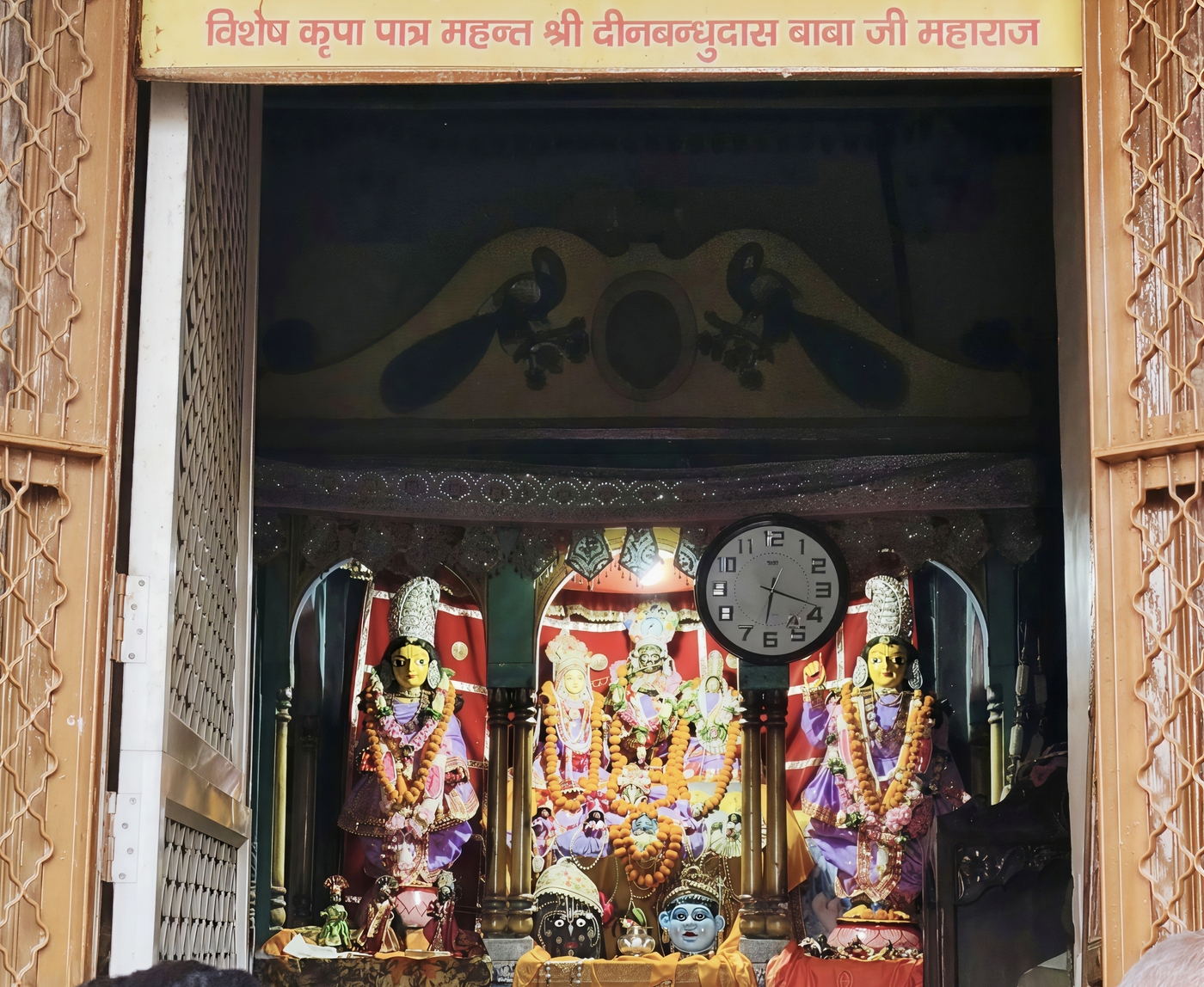
After forty-three years of hard, village-to-village wandering, old age finally caught up with Sanatana Gosvami. He handed over the daily service of his beloved Madana-mohana to his disciple Krishna Dasa Brahmachari. Then he moved to spend his final years in bhajana on the banks of the Manasi-Ganga at Govardhana, near the shrine of Chakaleshvara Mahadeva. Even there, well past sixty years of age, he kept to the discipline that had marked his whole life in Vrindavana. Every day he walked around Govardhana Hill, and he kept a vow of offering 1,008 obeisances each day, both to the Hill itself and to any Vaishnava he happened to meet along the way. The tradition places in this final period the story of Madana-mohana appearing to excuse him from the daily parikrama because of his age, and of Sanatana's quiet refusal. That story is told in Arrival in Vrindavana and Madana-mohana. It is the last recorded exchange between the Deity he had discovered and the devotee who had served Him for decades.
An Ocean of Love and Mercy #
The Bhakti-ratnakara sums up how Sanatana was remembered by those who actually lived alongside him in these years. Its words are given here almost exactly: "Mahaprabhu often said that Sanatana Gosvami was His favorite devotee. As an ocean of love and mercy, Sanatana excelled all other devotees in his compassion toward the suffering souls." Readers may give such glowing traditional praise more or less weight. But the more concrete details kept alongside it give a consistent picture. Villagers brought him their disputes over crops and their family quarrels. In return they received both practical guidance and instruction in devotional life. This shows a man whose learning and former experience in government were, in the end, placed entirely at the service of ordinary people. He did not keep them for the learned upper class he had grown up among.
Disappearance and Samadhi #
Sanatana Gosvami is traditionally said to have disappeared from this world in 1558, at Vrindavana. His samadhi stands to this day directly behind the Radha-Madana-mohana temple, where he had established the Deity's worship decades earlier. So at the end he remained close, even in body, to the Deity whose service had been the center of his whole life in Vraja. In Gaudiya Vaishnava theology, he is remembered as the eternal associate Labanga-manjari (or, in some accounts, Rati-manjari), who serves Srimati Vishakha-sakhi within Radha and Krishna's own eternal pastimes. This is understood to be his confidential identity, hidden behind his outward life as a renounced scholar who searched out Vraja's holy places.
What He Left Behind #
Sanatana's importance to the tradition that followed him can perhaps be seen most clearly in how his own brother regarded him. By Srila Prabhupada's account, Srila Rupa Gosvami accepted Sanatana as his spiritual master. Rupa was his own younger brother, and by any ordinary measure his equal in scholarship. Rupa opened his own Bhakti-rasamrita-sindhu with an offering of respect to Sanatana as his spiritual master. Elsewhere Srila Prabhupada calls Sanatana "the ideal spiritual master, for he delivers one the shelter of the lotus feet of Madana-mohana," and these words give Sanatana a special place in the Gaudiya guru-parampara's own understanding. In that understanding, he is the doorway through which a sincere seeker first comes into a right relationship with Krishna. He is the sambandha-acharya. In this reading, without him the later stages of devotional life have no firm ground to stand on.
His nephew Srila Jiva Gosvami arrived in Vrindavana as a young scholar after the death of his own father, Anupama, in Bengal. Jiva studied directly under both Sanatana and Rupa. He carried their shared work of writing and teaching further, and made it fuller and more orderly than ever. In his own writings he openly built on the groundwork Sanatana had already laid in the Brihad-bhagavatamrita and the Dasama-tippani. Sanatana laid the foundation in conduct and scripture. Rupa laid it in the theory of rasa and in poetry. Jiva brought the whole philosophy together. In this way, within the span of one generation, the three Goswamis of this single Bengali family gave Gaudiya Vaishnavism nearly all of its scriptural and doctrinal structure. They built it quite literally from nothing but what Sri Chaitanya Mahaprabhu had asked of them, and what each of them was willing to give up in order to carry it out.
Five centuries later, that inheritance still continues. In the tradition's own understanding, every pilgrim who visits the Radha-Madana-mohana temple, with Sanatana's samadhi behind it, is visiting a special place. Here the eldest of the Six Goswamis chose a beggar's bati bread over a minister's table. Here a Deity discovered by a man who had escaped from Hussain Shah's court became one of the most beloved Deities of Vrindavana. In the end, his life made a small circle. It began with a young scholar's dream of the Bhagavatam, told in Birth and Early Life in Bengal. It ended with an old man's samadhi beside the Deity of the same Krishna who, the tradition says, had come to him in that dream. In between, he spent almost his whole life patiently guiding others toward the same shelter, just as he himself had once been guided.
