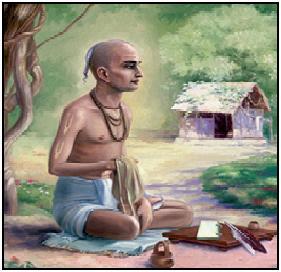
Sri Chaitanya-charitamrita names Sanatana Gosvami as the author of four major works, and each of them met a different need:
- Hari-bhakti-vilasa
- Brihad-bhagavatamrita
- Dasama-tippani
- Dasama-carita
Sri Chaitanya Mahaprabhu had asked him to help build the small Gaudiya Vaishnava community, which was still taking shape.
Hari-bhakti-vilasa: A Code of Vaishnava Conduct #
Among Sanatana's four instructions from Sri Chaitanya Mahaprabhu was a direct order to "compile a book establishing the proper behavior for devotees of Krishna in order to create the foundations of a Vaishnava society." At Varanasi, Sanatana asked for guidance on how to begin, and the Lord gave him a detailed outline: "Because you asked Me for a synopsis, please hear these few indications. In the beginning describe how one must take shelter of a bona fide spiritual master," and the outline went on from there. It covered initiation, morning duties, and Deity worship with five, sixteen or fifty prescribed ingredients. It also covered how to behave when approaching a temple, the observance of Ekadashi and festival days such as Janmashtami and Rama-navami, and the general conduct expected of a Vaishnava toward guru, scripture and fellow devotees alike. Sanatana carried out this work together with Gopala Bhatta Gosvami. The Hari-bhakti-vilasa that came from it became, and still is, the basic handbook of worship and conduct for the entire Gaudiya Vaishnava community. Later teachers such as Raghunatha Bhatta Gosvami, and generations after them, have taken the details of daily sadhana from it. Sanatana also wrote his own commentary on the work, to guide later readers through its detailed rules of worship.
Brihad-bhagavatamrita: A Journey Through the Hierarchy of Devotion #
The Hari-bhakti-vilasa deals with practice. The Brihad-bhagavatamrita deals with doctrine, and it is told in the form of a story. It is roughly 2,500 verses long and divided into two parts. The work follows a Brahmana character named Gopa-kumara on a journey. First he travels through the various planetary systems and forms of liberation found within the material and spiritual worlds. Then he enters the eternal realm of Krishna Himself. Through this story Sanatana sets out, in careful order, the ranking of Krishna's devotees: who is more advanced than whom, and why, and what qualities mark each stage of advancement in bhakti. Sanatana also wrote his own commentary on the work, called the Dig-darshini ("Compass," or "Pointer of Direction"). Without it, many of the book's more tightly packed theological arguments are difficult for a modern reader to follow.
Brihad-vaishnava-toshani: Opening the Tenth Canto #
Sanatana's third major work, also known as the Dasama-tippani, is a long commentary on the Tenth Canto of Srimad-Bhagavatam. This canto describes Krishna's own birth, childhood and youthful pastimes in Vrindavana. So for the Gaudiya tradition it is theologically the single most important part of the entire Bhagavata Purana. Later commentators, including Srila Jiva Gosvami, built directly on Sanatana's explanations here. The work is one of the tradition's earliest full efforts to bring out the devotional meaning of Krishna's pastimes, centred on rasa, and not to read the same verses only as a story or as philosophy.
Krishna-lila-stava: Praise in Verse #
Sanatana's fourth recorded work, Krishna-lila-stava, is a devotional poem of 432 verses. It retells Krishna's pastimes as told in the Bhagavata Purana, from the opening of the Tenth Canto to the killing of Kamsa. In this way it is a companion in poetry to the same part of scripture that his prose commentary, the Brihad-vaishnava-toshani, explains. In this same work Sanatana speaks to the Bhagavata itself directly. Later Gaudiya writers have quoted these lines because they show his personal relationship with the scripture he spent so much of his life explaining: "O holy Bhagavata, you are my only company, my only friend, and my guru. You are my greatest treasure and my personal saviour. You are the emblem of my highest fortune and the very form of ecstasy. I offer my obeisances unto you."
A Legacy Carried Forward #
Within a single generation of Sri Chaitanya Mahaprabhu's own life, these four works gave the Gaudiya Vaishnava community two things. They gave it a working code of conduct, and serious Sanskrit theology to stand beside it. These were exactly the two things Sri Chaitanya Mahaprabhu had specifically instructed Sanatana to produce. Sanatana and Rupa first gathered and organized writings like these, and their nephew Jiva Gosvami carried the work onward. On the strength of this material, Krishnadasa Kaviraja Gosvami was later able to compose Sri Chaitanya-charitamrita itself. For its account of these same events, he drew again and again on the Goswamis' own writings and on Raghunatha Dasa Gosvami's personal memories of them. So the circle of debt is complete. The Lord instructed Sanatana. Sanatana wrote down the tradition's law and doctrine. Then a later Goswami used those same writings to record Sanatana's own life for those who came after. This is part of what the tradition means when it calls Sanatana's decades in Vrindavana foundational.
