The Sanoriya Vipra
The Mathura Brahmana Who Guided Chaitanya Mahaprabhu
The complete life, on one page: The main biography and every pastime page, in order, in one place
Introduction
Scriptural evidence for the introduction (1)
kṛṣṇadāsa, sanoḍiyā-vipra — dunhe patha jāne, gaṅgā-tīra-pathe cale, mane baḍa sukhe
Word for word
kṛṣṇadāsa: Rajaputa Krishnadasa; sanoḍiyā-vipra: the Sanodiya brahmana; dunhe: both of them; patha jāne: knew the path; gaṅgā-tīra-pathe: along the bank of the Ganges; cale: walked; mane baḍa sukhe: with great happiness of mind.
Both Rajaputa Krishnadasa and the Sanodiya brahmana knew the path along the Ganges bank very well.
Establishes the Sanoriya brahmana's practical role as a guide once Chaitanya Mahaprabhu left Vrindavana for the Ganges-bank road to Prayaga.
Chapter 1
The Meeting at Adi Keshava Temple
A brahmana's ecstatic dance in Mathura reveals an unexpected bond with Chaitanya Mahaprabhu's own guru.
Arrival at Vishrama Ghat #
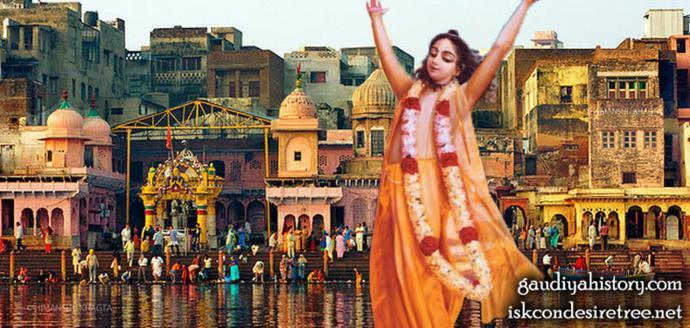
When Sri Chaitanya Mahaprabhu entered Mathura, He went first to Vishrama Ghat on the Yamuna and bathed there. From the ghat He went to see Krishna's birthplace and the Deity known as Keshavaji, or Adi Keshava. Standing before the Deity, Mahaprabhu began to chant and dance, overwhelmed with ecstatic love, and the sound He raised drew a crowd. People who had never seen anything like it stood watching, amazed.
One brahmana in that crowd did more than watch. He fell at Mahaprabhu's feet and then rose and began dancing beside Him. The two danced together, embracing, calling out the names Hari and Krishna, until the whole temple courtyard was in an uproar of chanting. The priest serving Lord Keshava came out and garlanded Mahaprabhu. Onlookers told each other that no ordinary person could inspire love like this - that Mahaprabhu must be Krishna Himself, come to deliver Mathura.
A Private Question #
After the dancing settled, Mahaprabhu took the brahmana aside to a quiet spot. The brahmana was an elderly, sincere and spiritually advanced man, and Mahaprabhu asked him directly where this transcendental ecstasy for Krishna had come from. The brahmana's answer was simple. Years earlier, His Holiness Srila Madhavendra Puri had come touring through Mathura. He had visited this brahmana's own home, taken him as a disciple, and even accepted a meal cooked by his hand. The brahmana said that Madhavendra Puri had later installed the Gopala Deity, the same Deity still being served at Govardhana Hill.
The moment he heard Madhavendra Puri's name, Mahaprabhu immediately fell at the brahmana's feet. Startled, even frightened, the brahmana fell back at Mahaprabhu's feet in turn, protesting that this was not right - Mahaprabhu was a sannyasi, and he only an ordinary brahmana. The brahmana guessed, correctly, that such extraordinary love for Krishna in this stranger could only mean some connection to Madhavendra Puri himself.
"You Are My Guru" #
Mahaprabhu's reply is one of the clearest statements anywhere in the Chaitanya-charitamrita on how one should regard the godbrothers of one's spiritual master. He told the brahmana plainly: "You are on the platform of My spiritual master, and I am your disciple. Since you are My spiritual master, it is not befitting that you offer Me obeisances." Ishvara Puri, Mahaprabhu's own diksha-guru, and this brahmana were godbrothers, both disciples of Madhavendra Puri. In Mahaprabhu's own understanding, this meant that the village brahmana stood in the position of a guru to Him.
Balabhadra Bhattacharya, who had been traveling with Mahaprabhu, explained the relationship in full, and the brahmana - pleased beyond measure - began to dance again. He took Mahaprabhu home and, entirely on his own initiative, began serving Him however he could.
Cooking Despite Caste, and a Verse from the Gita #
When the brahmana asked Balabhadra Bhattacharya to cook Mahaprabhu's lunch, Mahaprabhu stopped him with a smile: "Madhavendra Puri has already taken lunch at your place. Therefore you may cook and give Me the food. That is My instruction." He then quoted a verse everyone would have recognized, from the Bhagavad-gita: whatever a great man does, other men follow; whatever standard he sets, the world takes up.
The text is honest about how serious this was. This brahmana belonged to the Sanodiya community, priests who traditionally served goldsmiths and jewelers. As a rule, a sannyasi did not accept food cooked in a Sanodiya home. Madhavendra Puri had broken that rule once, because he looked at the man's Vaishnava character and not at his caste. Now Mahaprabhu broke it again, on purpose, to make the same point very clear. The episode shows plainly that real bhakti is higher than birth.
Word spread through Mathura fast. Hundreds of thousands are said to have come to see Mahaprabhu after this, so many that He had to come outside the brahmana's house simply to be seen. What began as one man's private ecstasy at a temple had turned, within days, into a citywide event - and had bound this otherwise unknown brahmana permanently into Mahaprabhu's story. What happened once the crowds grew too large to manage is told on Persuading the Lord to Leave Vrindavana.
Scriptural evidence for this chapter (4)
vipra kahe, — 'śrīpāda śrī-mādhavendra-purī / bhramite bhramite āilā mathurā-nagarī' / kṛpā kari' teṅho mora nilaye āilā / more śiṣya kari' mora hāte 'bhikṣā' kailā
Word for word
vipra kahe: the brahmana said; śrīpāda śrī-mādhavendra-purī: His Holiness Sri Madhavendra Puri; bhramite bhramite āilā mathurā-nagarī: came touring to the city of Mathura; kṛpā kari': by his causeless mercy; teṅho mora nilaye āilā: he came to my home; more śiṣya kari': accepting me as his disciple; mora hāte bhikṣā kailā: took a meal from my own hand.
The brahmana replied, "His Holiness Srila Madhavendra Puri came to the city of Mathura while he was on tour. While at Mathura, Sripada Madhavendra Puri visited my house and accepted me as a disciple. He even took lunch at my home."
The brahmana's own account of how he became Madhavendra Puri's disciple, the fact that makes him significant to Chaitanya Mahaprabhu at all.
prabhu kahe, — "tumi 'guru', āmi 'śiṣya'-prāya / 'guru' hañā 'śiṣye' namaskāra nā yuyaya"
Word for word
prabhu kahe: Sri Chaitanya Mahaprabhu said; tumi guru: you are My spiritual master; āmi śiṣya-prāya: I am like your disciple; guru hañā: being the spiritual master; śiṣye namaskāra nā yuyaya: it is not befitting to offer obeisances to the disciple.
Sri Chaitanya Mahaprabhu said, "You are on the platform of My spiritual master, and I am your disciple. Since you are My spiritual master, it is not befitting that you offer Me obeisances."
Mahaprabhu's direct statement of the guru-tattva principle that a spiritual master's godbrother is to be honored as a guru, applied here to a village brahmana of low social rank.
yad yad ācarati śreṣṭhas tat tad evetaro janaḥ / sa yat pramāṇaṁ kurute lokas tad anuvartate
Word for word
yat yat ācarati śreṣṭhaḥ: whatever the best man does; tat tat eva itaraḥ janaḥ: that very thing lesser men do; saḥ yat pramāṇaṁ kurute: whatever standard he sets by exemplary acts; lokaḥ tat anuvartate: the world follows.
"Whatever action a great man performs, common men follow. And whatever standards he sets by exemplary acts, all the world pursues."
From the purport: Purport excerpt: "This is a quotation from the Bhagavad-gita (3.21)."
Quoted by Chaitanya Mahaprabhu to justify accepting cooked food from the Sanodiya brahmana despite the caste restriction, since Madhavendra Puri had already set the precedent.
yadyapi 'sanoḍiyā' haya seita brāhmaṇa / sanoḍiyā-ghare sannyāsī nā kare bhojana / tathāpi purī dekhi' tāṅra 'vaiṣṇava'-ācāra / 'śiṣya' kari' tāṅra bhikṣā kaila aṅgīkāra
Word for word
yadyapi sanoḍiyā haya seita brāhmaṇa: although that brahmana belonged to the Sanodiya community; sanoḍiyā-ghare sannyāsī nā kare bhojana: a sannyasi does not accept food in the house of a Sanodiya; tathāpi purī dekhi' tāṅra vaiṣṇava-ācāra: still, Madhavendra Puri, seeing his Vaishnava behavior; śiṣya kari' tāṅra bhikṣā kaila aṅgīkāra: accepted him as a disciple and accepted food from him.
The brahmana belonged to the Sanodiya brahmana community, and a sannyasi does not accept food from such a brahmana. Although the brahmana belonged to the Sanodiya community, Srila Madhavendra Puri had seen that he behaved like a Vaishnava and had therefore accepted him as his disciple.
States plainly, in the text's own words, the caste restriction this brahmana's community carried and how Madhavendra Puri had already set it aside for him on the basis of Vaishnava character.
Chapter 2
Persuading the Lord to Leave Vrindavana
When the crowds become too great, the Sanoriya brahmana proposes the road that will take Chaitanya Mahaprabhu toward Prayaga.
A Devotee Overwhelmed #
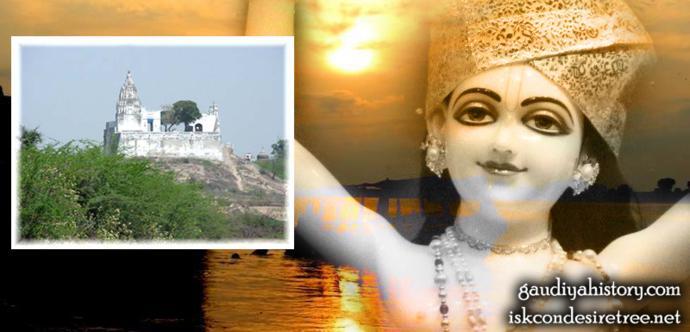
After the scene at Adi Keshava Temple, Mahaprabhu's presence in the Mathura-Vrindavana region drew larger and larger crowds. Balabhadra Bhattacharya, who had accompanied Mahaprabhu from Jagannatha Puri and managed the practical side of the journey, began to feel the strain. People came from early morning onward asking for the Lord's darshan, and Balabhadra could no longer keep up. Mahaprabhu Himself, meanwhile, was so continuously absorbed in ecstatic love that ordinary travel had become genuinely difficult.
Balabhadra concluded that it would be better for everyone if Mahaprabhu left the region. But he did not simply announce this to the Lord - he first discussed the problem with the Sanoriya brahmana, the same man who had welcomed Mahaprabhu into his home after the temple. It was a natural thing to do: the brahmana knew the country, and Mahaprabhu had already shown him extraordinary respect.
The Sanoriya Brahmana's Proposal #
The brahmana's suggestion was specific and practical. "Let us take Him to Prayaga," he said, "and go along the banks of the Ganges. It will be very pleasurable to go that way." He went further, naming an actual itinerary: travel first to the holy place of Soro-kshetra, bathe in the Ganges there, and continue from there toward Prayaga. The timing mattered too. It was the start of the month of Magha. If they left soon, they would reach Prayaga in time for the Makara-sankranti bathing festival, when entering the Ganges is considered especially auspicious.
He then told Balabhadra plainly how to handle Mahaprabhu Himself: submit the proposal gently, speak of the pleasure of the Ganges-bank road, and let the Lord decide. Balabhadra did exactly this, telling Mahaprabhu that the constant crowds had become impossible to manage and proposing the journey toward Prayaga during Makara-sankranti.
The Lord Agrees #
Mahaprabhu, the text says plainly, had no personal desire to leave Vrindavana - He was speaking only to satisfy His devotee's anxiety. He told Balabhadra: "You have brought Me here to show Me Vrindavana. I am very much indebted to you, and I shall not be able to repay this debt. Whatever you desire, I must do. Wherever you take Me, I shall go."
The next morning, after bathing, Mahaprabhu set out. Balabhadra first took Him toward Mahavana (Gokula), putting Him aboard a boat to cross the river. From there, the Sanoriya brahmana and the Rajaputa Krishnadasa led the way, because they were the ones who actually knew the Ganges-bank path. Krishnadasa was a second companion, and he too was fearless and knowledgeable. The four of them walked together: Mahaprabhu, Balabhadra Bhattacharya, Krishnadasa, and the Sanoriya brahmana.
Not long after, on this same road, Mahaprabhu's ecstasy would put all four of their lives in danger. This same brahmana would be the first to speak up and save them. That crisis, and its remarkable outcome, is told on The Pathan Soldiers on the Road.
Why the Route Mattered #
The route the brahmana chose was not a shortcut picked at random. Makara-sankranti is the day on which, by the calendar, the sun enters Capricorn. In this tradition it has long been treated as one of the most auspicious bathing days of the year, and Prayaga's Magha-mela draws pilgrims to the Ganges especially around this day. A brahmana of Mathura would have known the calendar and the pilgrim roads well enough to plan around both, and that is what he did. He planned a bath at Soro-kshetra on the way, and he timed the journey so that Mahaprabhu would reach the meeting place of the Ganges and Yamuna at the most sacred bathing time of the year. It is a small, practical detail. But it is one more sign of how directly this otherwise unknown brahmana shaped the Lord's movements during these months.
Scriptural evidence for this chapter (1)
vipra kahe, — prayāge prabhu lañā yāi / gaṅgā-tīra-pathe yāi, tabe sukha pāi / 'soro-kṣetre, āge yāñā kari' gaṅgā-snāna / sei pathe prabhu lañā kariye payāna'
Word for word
vipra kahe: the brahmana said; prayāge prabhu lañā yāi: let us take the Lord to Prayaga; gaṅgā-tīra-pathe yāi: let us go by the path along the Ganges bank; tabe sukha pāi: then we shall get pleasure; soro-kṣetre āge yāñā: going first to Soro-kshetra; kari' gaṅgā-snāna: after bathing in the Ganges; sei pathe prabhu lañā kariye payāna: let us take the Lord along that path.
The brahmana said, "Let us take Him to Prayaga and go along the banks of the Ganges. It will be very pleasurable to go that way. After going to the holy place named Soro-kshetra and bathing in the Ganges, let us take Him that way and go."
The Sanoriya brahmana's own proposal of the route and itinerary that took Chaitanya Mahaprabhu out of Vrindavana toward Prayaga.
Chapter 3
The Pathan Soldiers on the Road
A fearless speech before Pathan cavalry saves Chaitanya Mahaprabhu's companions from execution.
Fallen Unconscious Beneath a Tree #
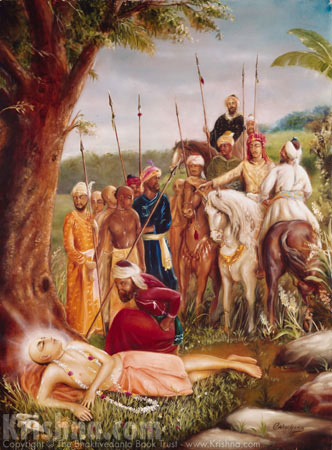
As the four travelers made their way along the Ganges bank - Mahaprabhu, Balabhadra Bhattacharya, the Rajaputa Krishnadasa, and the Sanoriya brahmana - they stopped to rest under a tree near grazing cows. Mahaprabhu was already fatigued and deeply absorbed. Then a cowherd boy nearby blew on his flute, and the sound struck Mahaprabhu with such force of ecstatic love that He fell to the ground unconscious, foaming at the mouth, His breathing stopped.
While He lay there, ten Pathan cavalry soldiers rode up and dismounted. Seeing a sannyasi senseless on the ground, they jumped to an ugly conclusion: this holy man, they reasoned, must have been carrying gold, and these four men around Him must have poisoned Him with dhuturā to rob him. Without waiting to find out otherwise, the soldiers seized all four companions, intending to kill them.
Two Frightened, Two Fearless #
Of the four, two - almost certainly Balabhadra Bhattacharya and one other Bengali in the party - began to tremble openly in fear. The other two did not. Krishnadasa, of the Rajaputa warrior community, was fearless by nature. So, the text says just as plainly, was the Sanoriya brahmana - and he spoke first, and spoke boldly.
He told the soldiers directly that they were under the authority of their own king, and that the matter should be taken to their commander. Then he identified himself: "This sannyasi is my spiritual master, and I am from Mathura. I am a brahmana, and I know many people who are in the service of the Muslim king." He proposed a plan that any reasonable captor could accept: tie them up, wait, and let the sannyasi Himself explain when He woke. The soldiers accused the group of coming from different, suspicious places (one from the west, one from Mathura, two trembling Bengalis). This time Krishnadasa answered, with a bold bluff of his own. He claimed that he could call on two hundred Turkish soldiers and a hundred cannons. The brahmana stayed calm and Krishnadasa showed courage, so the Pathan soldiers hesitated.
Mahaprabhu Wakes, and a Sufi Is Converted #
At that moment Mahaprabhu regained consciousness, chanting "Hari! Hari!" loudly and dancing in open ecstasy. The sight and sound apparently struck the soldiers "as if their hearts were struck by thunderbolts," and, seized by fear, they released all four men at once.
What followed turned an armed standoff into something else entirely. The soldiers came before Mahaprabhu themselves, worshiping His feet and accusing the four companions of drugging and robbing Him. Mahaprabhu corrected them simply: "These are not rogues. They are My associates... Due to epilepsy, I sometimes fall unconscious. Out of their mercy, these four men maintain Me." One of the Muslim soldiers present, a Sufi practitioner, was moved by Mahaprabhu and tried to defend an impersonal reading of God from the Quran. Mahaprabhu refuted him point by point, arguing that the Quran itself ultimately establishes a personal, transcendental God, until the man could no longer speak. He fell at Mahaprabhu's feet, chanting Krishna's name, and asked to be taught the goal of life. Mahaprabhu initiated him on the spot, renaming him Ramadasa.
A second Pathan present, a young man who turned out to be the son of the local king, also fell at Mahaprabhu's feet - his name was Vijuli Khan (also written Bijali Khan). Mahaprabhu placed His foot on his head in blessing. All the Pathan soldiers there became mendicants, and in time came to be celebrated as the Pathana Vaishnavas, touring the country and singing Mahaprabhu's glories. Vijuli Khan himself, the text says, became a greatly advanced devotee, honored at every place of pilgrimage he visited.
From there Mahaprabhu continued toward Soro-kshetra and Prayaga. The Sanoriya brahmana and Krishnadasa were still with Him. At Soro-kshetra the Lord asked them to return home, but they begged to go with Him as far as Prayaga, and He agreed. That final part of the journey is told on Onward to Prayaga.
Scriptural evidence for this chapter (3)
Quoted in the text above:
- Madhya 18.169 Chaitanya-charitamrita
Further verses:
kṛṣṇadāsa — rājaputa, nirbhaya se baḍa / sei vipra — nirbhaya, se — mukhe baḍa daḍa
Word for word
kṛṣṇadāsa rājaputa: Krishnadasa, of the Rajaputa race; nirbhaya se baḍa: he was very fearless; sei vipra: that brahmana (the Sanodiya); nirbhaya: also fearless; se mukhe baḍa daḍa: he was very bold in speech.
The devotee Krishnadasa, who belonged to the Rajaputa race, was very fearless. The Sanodiya brahmana was also fearless, and he spoke very bravely.
The text's direct character note on the brahmana at the moment of greatest danger, just before he speaks to the Pathan soldiers.
'rāmadāsa' bali' prabhu tāṅra kaila nāma / āra eka pāṭhāna, tāṅra nāma — 'vijulī-khāṅna'
Word for word
rāmadāsa bali': of the name Ramadasa; prabhu tāṅra kaila nāma: the Lord gave him this name; āra eka pāṭhāna: another Pathan; tāṅra nāma vijulī-khāṅna: his name was Vijuli Khan.
In this way Sri Chaitanya Mahaprabhu directly initiated the saintly Muslim by advising him to chant the holy name of Krishna. The Muslim's name was changed to Ramadasa. Another Pathan Muslim present there was named Vijuli Khan.
Names the two Pathan soldiers converted in this episode. This Ramadasa is a different person from Ramadasa Vipra, an unrelated devotee already recorded elsewhere.
Chapter 4
Onward to Prayaga
At Soro-kshetra, the brahmana and Krishnadasa refuse to turn back - and then the record falls silent.
A Bath at Soro-kshetra #
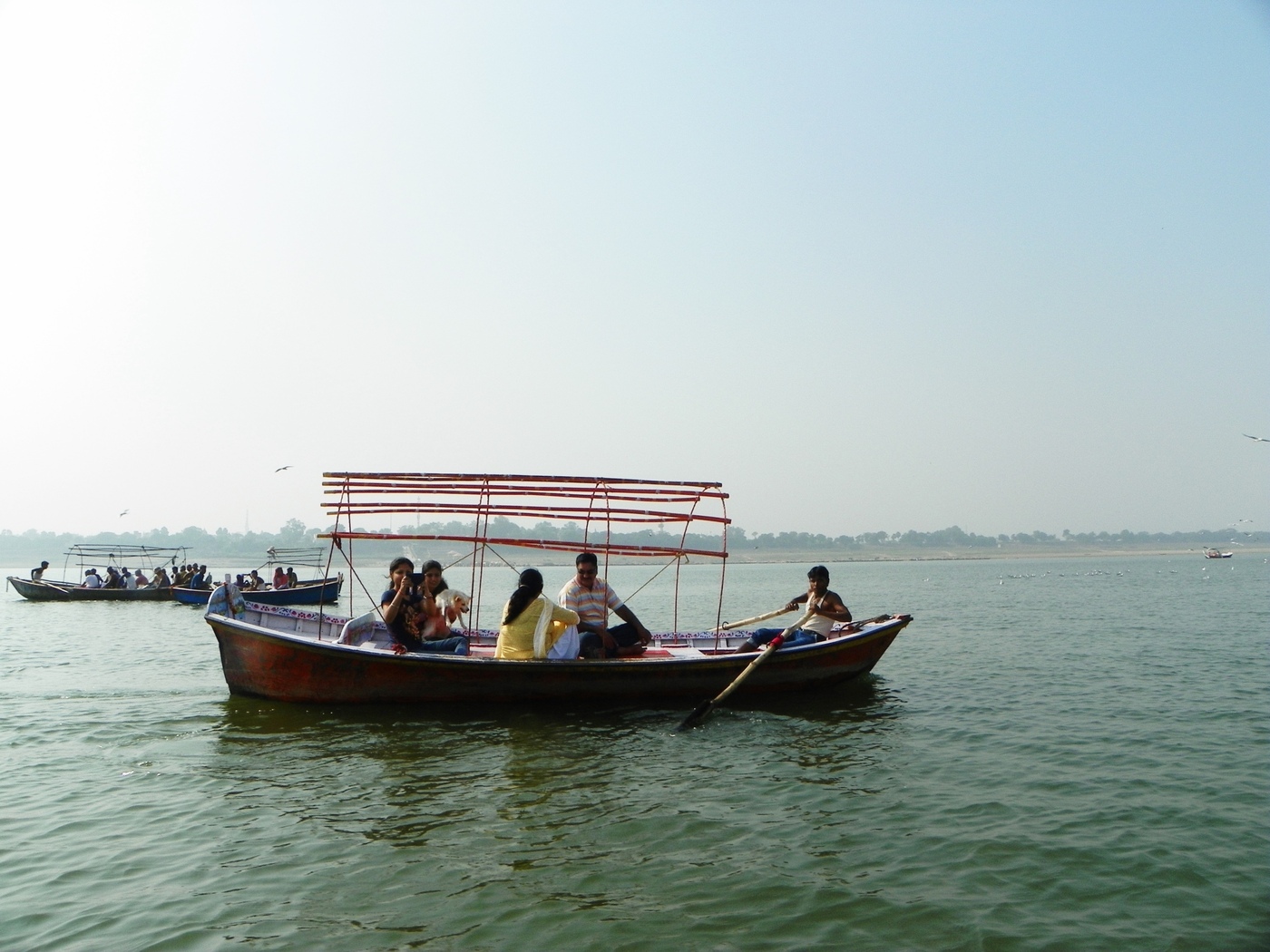
After the encounter with the Pathan soldiers on the road out of Vrindavana, Mahaprabhu continued west and south along the route the Sanoriya brahmana had proposed. He is said to have brought good fortune to the yavanas and mlecchas of that region as He passed. The Pathan soldiers converted on the road are one clear example. When He reached the holy place of Soro-kshetra, He bathed in the Ganges there, just as the brahmana had planned back in Vrindavana. Then He started along the riverbank road toward Prayaga.
"Where Shall We Again Get Your Feet?" #
It was at Soro-kshetra that Mahaprabhu tried to send His two Vrindavana guides home. He asked the Sanoriya brahmana and the Rajaputa Krishnadasa to return, their work of guiding Him apparently done. Both refused - with folded hands, the text says, they pleaded to continue. "Let us go to Prayaga with You," they said. "If we do not go, when shall we again get the association of Your lotus feet?" They gave Mahaprabhu a practical reason too: this was Muslim-ruled country, disturbances could arise anywhere, and Balabhadra Bhattacharya, learned scholar though he was, did not speak the local language. Mahaprabhu smiled and let them stay.
The Last Mention #
As far as the surviving text goes, this is the last time the Chaitanya-charitamrita gives either the Sanoriya brahmana or Krishnadasa a personal moment. The text says that wherever Mahaprabhu went from there, whoever saw Him became a Vaishnava, and whoever met that Vaishnava became one in turn. In this way town after town turned to devotion, just as Mahaprabhu had earlier transformed South India. He finally reached Prayaga and spent ten days bathing at the meeting place of the Yamuna and Ganges during the Makara-sankranti festival, known there as the Magha-mela.
Krishnadasa Kaviraja Goswami ends his account of the Vrindavana tour by admitting that it was too great for him to describe fully. He writes that even Lord Shesha, with His thousands of hoods, could not reach the end of Mahaprabhu's activities there, and that he had only sketched the general direction. Shortly after, at Prayaga, Mahaprabhu's circle famously grows to include Srila Rupa Gosvami. At that point the story moves on. Neither the Sanoriya brahmana nor Krishnadasa the Rajaputa appears again in the text.
Nothing more is recorded about what became of the brahmana. We do not know whether he returned to his home and family in Mathura, whether he continued in devotional life, or how his days ended. Even his personal name was never given, so it is lost for good. What remains is what Krishnadasa Kaviraja Goswami chose to preserve in two chapters. This unnamed brahmana came from a community that society ranked low. Yet Chaitanya Mahaprabhu addressed him as a guru. He fed the Lord, though social custom forbade it. He guided the Lord past danger. Then, just where the story turns to someone else, he vanished from history.
This is not unique to him. The Chaitanya-charitamrita and Chaitanya-bhagavata both name dozens of devotees this briefly: a house, a single service, a line of dialogue, and nothing more. But the Sanoriya brahmana is different. In that short space, Krishnadasa Kaviraja Goswami still gives him great importance. He was a godbrother of the Lord's guru. He planned the Lord's route. And he was the one calm voice standing between four travelers and a company of soldiers ready to kill them. For a biography, the record he leaves behind is very short. But short does not mean unimportant.
Scriptural evidence for this chapter (1)
sei vipre, kṛṣṇadāse, prabhu vidāya dilā / yoḍa-hāte dui-jana kahite lāgilā / prayāga-paryanta duṅhe tomā-saṅge yāba / tomāra caraṇa-saṅga punaḥ kāhāṅ pāba?
Word for word
sei vipre kṛṣṇadāse: to the Sanodiya brahmana and Krishnadasa; prabhu vidāya dilā: the Lord asked them to return; yoḍa-hāte dui-jana kahite lāgilā: the two of them, with folded hands, began to say; prayāga-paryanta duṅhe tomā-saṅge yāba: we two will go with You up to Prayaga; tomāra caraṇa-saṅga punaḥ kāhāṅ pāba: where will we again get the association of Your feet.
At Soro-kshetra, the Lord requested the Sanodiya brahmana and Rajaputa Krishnadasa to return home, but with folded hands they began to speak: "Let us go to Prayaga with You. If we do not go, when shall we again get the association of Your lotus feet?"
The brahmana's last recorded words in the Chaitanya-charitamrita; after this the narrative does not mention him again.
Closing
Who Was the Sanoriya Vipra #
The Sanoriya Vipra (also written Sanodiya Vipra) was a brahmana of Mathura who appears in Sri Chaitanya Mahaprabhu's life at one of its most vivid stretches: the Lord's tour of Vrindavana and His journey onward toward Prayaga. Krishnadasa Kaviraja Goswami gives him real space in the Chaitanya-charitamrita, across chapters seventeen and eighteen of the Madhya-lila, yet never once gives his personal name. "Sanoriya" or "Sanodiya" is not a name at all - it names the priestly community he belonged to, brahmanas who traditionally served goldsmith and jeweler families. He is called simply vipra, brahmana, again and again. What the text does preserve, in detail, is his character: fearless, resourceful, practical, and deeply attached to Mahaprabhu once he understood who stood before him.
| Detail | Description |
|---|---|
| Community | Sanodiya brahmana (priests to goldsmith and jeweler families) |
| Home | Mathura |
| Guru | Srila Madhavendra Puri |
| Met Chaitanya Mahaprabhu | At the Adi Keshava temple, Mathura, during the Lord's Vrindavana tour |
| Primary source | Chaitanya-charitamrita, Madhya-lila, chapters 17 and 18 |
| Personal name | Not recorded |
- Sri Chaitanya-caritamrta, Madhya-lila 17.156-190 (Bhaktivedanta VedaBase)
- Sri Chaitanya-caritamrta, Madhya-lila 18.130-225 (Bhaktivedanta VedaBase)
- Sanoriya Vipra - Gaudiya History, ISKCON Desire Tree
- Bijali Khan - Gaudiya History, ISKCON Desire Tree
- Sanoriya Vipra - Shyam Das Baba (excerpted from Sri Chaitanya: His Life & Associates by Srila Bhakti Ballabh Tirtha Maharaj)
