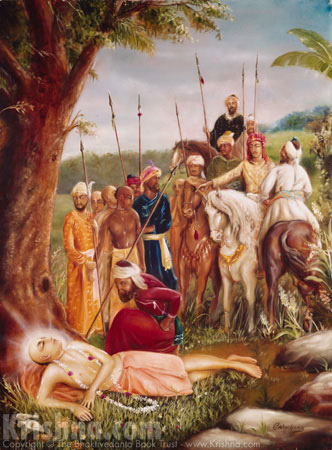
Bijali Khan
The Young Pathan Prince Who Received the Lord's Foot Upon His Head
Also known as Vijuli Khan, Vijulikhan, Bijuli Khan
“Krishna!”
Bijali Khan's cry as he fell at Sri Chaitanya Mahaprabhu's feet, moments before the Lord placed His own foot on his head in blessing (Chaitanya-charitamrita, Madhya-lila 18.209)
Bijali Khan was a young Pathan noble, the son of a local Muslim ruler. Krishnadasa Kaviraja Goswami records his name as Vijuli Khan. Bijali Khan's armed escort met Sri Chaitanya Mahaprabhu along the banks of the Ganges, as the Lord was making His way back from Vrindavana toward Prayaga. What began as a case of mistaken robbery ended with Bijali Khan himself falling at the Lord's feet. Afterward, in the words of Krishnadasa Kaviraja Goswami's Chaitanya-charitamrita, he became a mahā-bhāgavata whose fame was known at every place of pilgrimage. He should not be confused with two other Bengali devotees who also carry the title Khan. Satyaraja Khan was a Hindu Kayastha householder of Kulina-grama, whose family received the court title generations before Mahaprabhu's birth. Ser Khan was a Pathan official of a later generation, converted by Shyamananda Pandit in Orissa. Bijali Khan's own story belongs to neither family and neither period. It is a single, specific meeting on the road. It took place decades before Ser Khan's conversion, and in a completely different part of the country from Satyaraja Khan's ancestral village.
| Detail | Description |
|---|---|
| Name in Chaitanya-charitamrita | Vijuli Khan (popularly written Bijali Khan) |
| Background | Pathan; son of a local Muslim ruler (rājāra kumāra) |
| Setting | Along the Ganges bank, on Mahaprabhu's return route from Vrindavana toward Prayaga |
| Companion in the group | Ramadasa, an elder Sufi practitioner among the same cavalry troop, initiated moments earlier |
| Textual source | Sri Chaitanya-charitamrita, Madhya-lila 18.163-212 |
| Approximate period | During Mahaprabhu's return journey from Vrindavana toward Prayaga, some years after His sannyasa (early sixteenth century) |
| Legacy | Remembered among the Pathan Vaishnavas, Muslim converts who toured India singing Mahaprabhu's glories |
A Meeting Along The Ganges Bank #
After touring Vrindavana and the holy places around it, Mahaprabhu prepared to leave for Prayaga. He did so on the advice of Balabhadra Bhattacharya and a Sanodiya brahmana of Mathura known as the Sanoriya Vipra, who knew the path along the Ganges bank well. Accompanied only by these two and the Rajaputa devotee Krishnadasa, Mahaprabhu crossed the river by boat and set out walking along the Ganges. Tired from walking, He sat beneath a tree near a herd of grazing cows. A cowherd boy's flute struck Him with such ecstatic love that He fell unconscious. His breath stopped, and foam came from His mouth. Just at this moment, ten Pathan cavalry soldiers rode up. Among them, still very young, rode the son of their local ruler: Bijali Khan. The soldiers arrested Mahaprabhu's four companions on suspicion of poisoning and robbing a wealthy sannyasi, and they were then fearlessly talked out of it. All of this is told in full on The Pathan Soldiers on the Road. That chapter properly belongs to the Sanoriya Vipra and Krishnadasa, the two men who stayed calm and saved four lives. Bijali Khan's own part in the story begins only after Mahaprabhu regained consciousness and the soldiers, awestruck, released their prisoners.
The Young Pathan Prince #
Chaitanya-charitamrita is exact about who Bijali Khan was in that troop of ten. He was very young, and he was the son of the king. This means some local Muslim ruler, whose territory the text never names. The other Pathans present were his own servants. They were headed by a serious older man dressed in black, whom people already regarded as a saintly Sufi practitioner. That elder Sufi was the one who stepped forward first, moved by what he had seen. He tried to defend from the Koran the idea that God is impersonal, without form or personality. Bijali Khan, still a young man among his own servants, watched this exchange. He did not lead it.
Ramadasa's Surrender, And Then His Own #
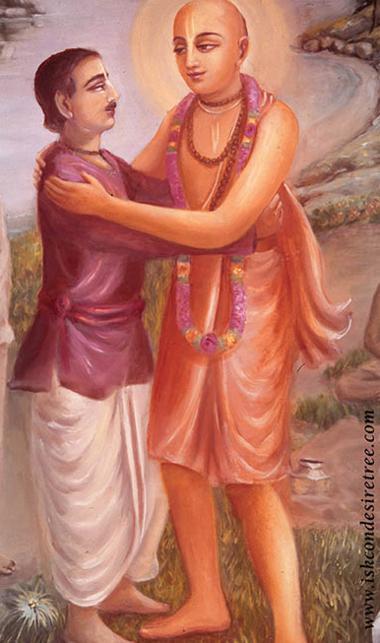
Mahaprabhu defeated the Sufi's arguments point by point. He showed that the Koran itself, when read to its conclusion, establishes a personal, transcendental Godhead who is reached only through loving devotion. The Sufi could not answer. He fell at Mahaprabhu's feet, his tongue already turning to the Hare Krishna mahā-mantra, and asked to be taught life's real goal. Mahaprabhu initiated him then and there, renaming him Ramadasa. The text then gives one short verse: crying out 'Krishna!', he fell at Mahaprabhu's feet, and Mahaprabhu placed His own foot on his head. That falling devotee was Bijali Khan himself, the young man who had ridden in ready to kill four strangers only a short while before.
The Pathan Vaishnavas #
Mahaprabhu then told all the Pathans present to chant Krishna's name, and, the text says, they were overwhelmed by ecstatic love as they did. When the Lord finally departed, every one of those ten soldiers had become a vairāgī, one who has renounced the world. In time they came to be celebrated across Bengal and beyond as the Pathan Vaishnavas. They toured the country singing Mahaprabhu's glories. They were Muslim-born men who had become wandering devotees. Their lives were a living argument against the idea that birth or background could ever keep someone from bhakti. At the end of the episode, the text singles out Bijali Khan himself by name from all of them. It says that he became a mahā-bhāgavata, a greatly advanced devotee, honored at every tirtha he visited. After this, Mahaprabhu, the Sanoriya Vipra and Krishnadasa moved on toward Soro-kshetra and Prayaga. These last steps of that same afternoon's journey are told at Onward to Prayaga.
A Life Told In A Few Verses #
Outside these fifty verses of Madhya-lila eighteen, nothing about Bijali Khan survives. There is no birth year and no name for the kingdom his father ruled. There is no account of where his later life as a Pathan Vaishnava actually took him. And there are no words of his own beyond the single cry of "Krishna!" that the text records. Even the spelling of his name changes between sources. Krishnadasa Kaviraja Goswami himself writes Vijuli Khan. Later devotional retellings made the form Bijali Khan popular, and he is generally remembered by this name today. Both names refer to the same young man in the same encounter. An entirely unrelated "Bijli Khan Pathan" also appears in the devotional folklore of the separate Kabir tradition, centered on Maghar near Gorakhpur. He is a different figure from a different lineage, and shares only the name. What Chaitanya-charitamrita preserves of the actual Vijuli Khan is small, but it is exact: a place, a family detail, a cry, and a blessing.
Scriptural evidence
‘রামদাস’ বলি’ প্রভু তাঁর কৈল নাম । আর এক পাঠান, তাঁর নাম — ‘বিজুলী-খাঁন’ ॥
'rāmadāsa' bali' prabhu tāṅra kaila nāma
āra eka pāṭhāna, tāṅra nāma — 'vijulī-khāṅna'
Word for word
rāmadāsa bali': of the name Rāmadāsa; prabhu: Sri Chaitanya Mahaprabhu; tāṅra: his; kaila: made; nāma: name; āra eka pāṭhāna: another Muslim; tāṅra nāma: his name; vijulī-khāṅna: Vijuli Khan.
In this way Sri Chaitanya Mahaprabhu directly initiated the saintly Muslim by advising him to chant the holy name of Krishna. The Muslim's name was changed to Ramadasa. Another Pathan Muslim present there was named Vijuli Khan.
This is the verse where Vijuli Khan (Bijali Khan) is first named in the text, immediately after his companion's own initiation as Ramadasa.
অল্প বয়স তাঁর, রাজার কুমার । ‘রামদাস’ আদি পাঠান — চাকর তাঁহার ॥
alpa vayasa tāṅra, rājāra kumāra
'rāmadāsa' ādi pāṭhāna — cākara tāṅhāra
Word for word
alpa vayasa tāṅra: his age is very young; rājāra kumāra: son of the king; rāmadāsa: Ramadasa; ādi: heading the list; pāṭhāna: the Muslims; cākara tāṅhāra: servants of him.
Vijuli Khan was very young, and he was the son of the king. All the other Muslims, or Pathanas, headed by Ramadasa, were his servants.
The only textual detail on Bijali Khan's family background: he was young, and his father was a local ruler, unnamed in the text.
‘কৃষ্ণ’ বলি’ পড়ে সেই মহাপ্রভুর পায় । প্রভু শ্রীচরণ দিল তাঁহার মাথায় ॥
'kṛṣṇa' bali' paḍe sei mahāprabhura pāya
prabhu śrī-caraṇa dila tāṅhāra māthāya
Word for word
kṛṣṇa bali': chanting the holy name of Krishna; paḍe: falls down; sei: that Vijuli Khan; mahāprabhura pāya: at the lotus feet of Sri Chaitanya Mahaprabhu; prabhu: Sri Chaitanya Mahaprabhu; śrī-caraṇa dila: placed His foot; tāṅhāra māthāya: on his head.
Vijuli Khan also fell down at the lotus feet of Sri Chaitanya Mahaprabhu, and the Lord placed His foot on his head.
The central verse of Bijali Khan's own story: his own words are reduced to a single cry of the holy name, met with the Lord's own foot placed on his head as blessing.
সেই বিজুলী-খাঁন হৈল ‘মহাভাগবত’ । সর্বতীর্থে হৈল তাঁর পরম-মহত্ত্ব ॥
sei vijulī-khāṅna haila 'mahā-bhāgavata'
sarva-tīrthe haila tāṅra parama-mahattva
Word for word
sei: that; vijulī-khāṅna: Vijuli Khan; haila: became; mahā-bhāgavata: most advanced devotee; sarva-tīrthe: in all places of pilgrimage; haila: became; tāṅra: his; parama: great; mahattva: importance.
Vijuli Khan became a greatly advanced devotee, and his importance was celebrated at every holy place of pilgrimage.
The text's closing word on Bijali Khan, the only line describing what became of him after this single episode.
তাঁ-সবারে কৃপা করি' প্রভু ত' চলিলা ।
সেইত পাঠান সব 'বৈরাগী' হইলা ॥
tāṅ-sabāre kṛpā kari' prabhu ta' calilā
seita pāṭhāna saba 'vairāgī' ha-ilā
Word for word
tāṅ-sabāre: to all of them; kṛpā kari': bestowing mercy; prabhu: Sri Chaitanya Mahaprabhu; ta': indeed; calilā: departed; seita: they; pāṭhāna: the Muslims of the Pathana community; saba: all; vairāgī ha-ilā: became mendicants.
After bestowing His mercy upon them in this way, Sri Chaitanya Mahaprabhu left. All those Pathan Muslims then became mendicants.
The verse recording the mass conversion: all ten Pathan soldiers, not only Bijali Khan and the elder Sufi individually, became vairagis once Mahaprabhu departed.
Frequently asked
When was Bijali Khan born?
Bijali Khan appeared Not recorded in Not recorded.
When and where did Bijali Khan disappear?
Bijali Khan disappeared Not recorded at Not recorded.
What are the main pastimes of Bijali Khan?
The pastimes covered here include: The Debate the Young Pathan Watched.