The Sanoriya Vipra
The Mathura Brahmana Who Guided Chaitanya Mahaprabhu
Also known as Sanodiya Brahmana, Sanoriya Brahmin, the Vipra of Mathura
“This sannyasi is my spiritual master, and I am from Mathura. I am a brahmana, and I know many people who are in the service of the Muslim king.”
Speaking without fear to the Pathan cavalry who had seized Chaitanya Mahaprabhu's companions - Chaitanya-charitamrita, Madhya-lila 18.169
Who Was the Sanoriya Vipra #
The Sanoriya Vipra (also written Sanodiya Vipra) was a brahmana of Mathura who appears in Sri Chaitanya Mahaprabhu's life at one of its most vivid stretches: the Lord's tour of Vrindavana and His journey onward toward Prayaga. Krishnadasa Kaviraja Goswami gives him real space in the Chaitanya-charitamrita, across chapters seventeen and eighteen of the Madhya-lila, yet never once gives his personal name. "Sanoriya" or "Sanodiya" is not a name at all - it names the priestly community he belonged to, brahmanas who traditionally served goldsmith and jeweler families. He is called simply vipra, brahmana, again and again. What the text does preserve, in detail, is his character: fearless, resourceful, practical, and deeply attached to Mahaprabhu once he understood who stood before him.
| Detail | Description |
|---|---|
| Community | Sanodiya brahmana (priests to goldsmith and jeweler families) |
| Home | Mathura |
| Guru | Srila Madhavendra Puri |
| Met Chaitanya Mahaprabhu | At the Adi Keshava temple, Mathura, during the Lord's Vrindavana tour |
| Primary source | Chaitanya-charitamrita, Madhya-lila, chapters 17 and 18 |
| Personal name | Not recorded |
Meeting Madhavendra Puri at Mathura #
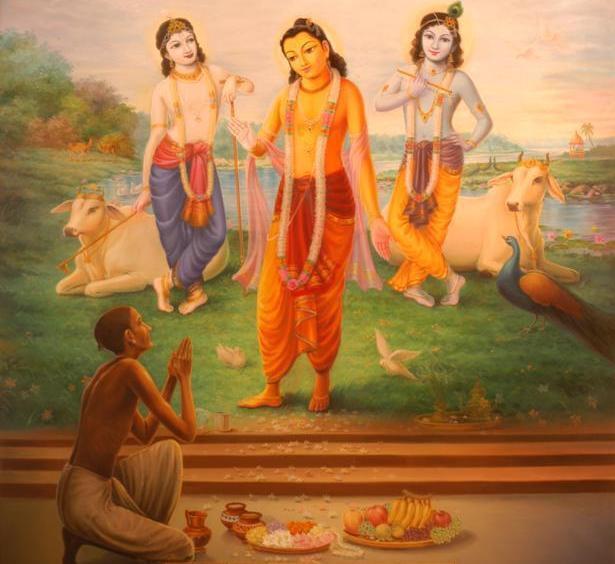
Years before Mahaprabhu ever reached Mathura, Madhavendra Puri had passed through the city on tour. He stopped at this brahmana's home, accepted him as a disciple, and even took bhiksha - a cooked meal - from his hand. That meal mattered more than it might seem. Madhavendra Puri was the one who later discovered and installed the Gopala Deity at Govardhana, the same Deity still worshiped there. The brahmana's whole later importance rests on this one encounter, simple as it otherwise was. His link to Madhavendra Puri, and nothing else, is the reason he is written about at all.
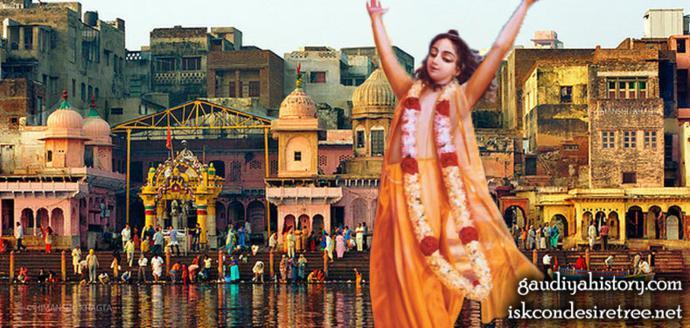
When Chaitanya Mahaprabhu entered Mathura, bathed at Vishrama Ghat, and stood before the Deity Keshavaji dancing in ecstatic love, this brahmana was among the crowd. He fell at the Lord's feet and began dancing with Him. Read the full story on The Meeting at Adi Keshava Temple.
A Guru's Godbrother, Honored Above Caste #
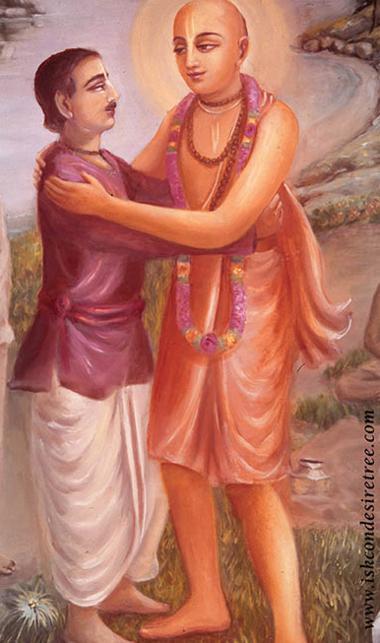
Mahaprabhu drew the brahmana aside and asked the source of his ecstatic love. When He heard Madhavendra Puri's name, He immediately fell at the man's feet. Sannyasis do not normally even eat from this brahmana's community. So a sannyasi bowing to him was startling, so startling that the brahmana himself protested. Mahaprabhu's answer became one of the clearest statements in the Chaitanya-charitamrita of how siksha and diksha relationships work: a spiritual master's godbrother stands on the guru's own platform, whatever his social station. Mahaprabhu then insisted on taking food cooked by the brahmana's own hand, quoting a verse of the Bhagavad-gita on how a great person's conduct becomes the standard others follow. The full episode, including the caste tension the text itself acknowledges, is told on The Meeting at Adi Keshava Temple.
Guiding Chaitanya Mahaprabhu Out of Vrindavana #
As Mahaprabhu's fame in Vrindavana grew, the crowds became unmanageable. Balabhadra Bhattacharya, the Lord's traveling companion since Puri, grew anxious for His safety and wanted Him to leave. The Sanoriya brahmana was the one who proposed the actual route. They would go down along the Ganges and bathe at the holy place of Soro-kshetra, timing the journey to reach Prayaga for the Makara-sankranti bathing festival. Both the brahmana and a second companion, the Rajaputa Krishnadasa, knew that road well and offered to guide Him along it. That decision, and the walk it set in motion, is told on Persuading the Lord to Leave Vrindavana.
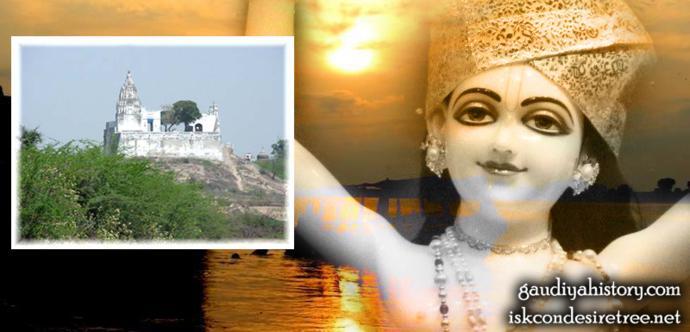
Facing the Pathan Cavalry #
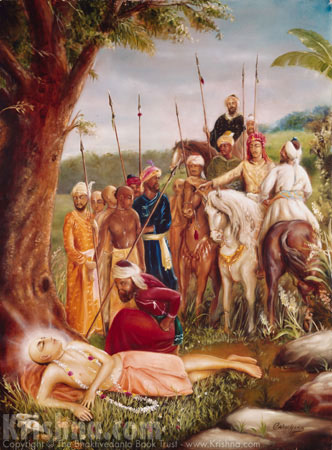
On that road, Mahaprabhu once fell unconscious in ecstasy after hearing a cowherd boy's flute. A troop of Pathan cavalry, finding a sannyasi senseless on the ground, assumed His four companions had drugged and robbed Him, and seized all four to kill them. While two of the party trembled in fear, the Sanoriya brahmana and Krishnadasa stood their ground. The brahmana spoke first, and spoke without flinching, buying time until Mahaprabhu revived. What followed - His theological exchange with a Sufi soldier in the troop, and the soldier's initiation as a Vaishnava - is one of the more remarkable episodes in the entire Chaitanya-charitamrita. Read it on The Pathan Soldiers on the Road.
Vanishing From the Record #
At Soro-kshetra, Mahaprabhu tried to send the brahmana and Krishnadasa home. Both refused, insisting on seeing Him safely to Prayaga first. That is the last clearly personal moment either man gets in the text. Once the party reaches Prayaga - where Mahaprabhu's circle soon widens to include Srila Rupa Gosvami - Krishnadasa Kaviraja Goswami's narrative moves on, and the Sanoriya brahmana is not mentioned again. No record survives of what became of him afterward, of whether he returned to Mathura, or even of what his own name was. Details of his final days are told, so far as the text allows, on Onward to Prayaga.
Unlike many other associates of that period, he has no recorded previous identity in Krishna-lila in the Gaura-ganoddesha-dipika. This is all the record honestly tells us. Krishnadasa Kaviraja Goswami gave this devotee two full chapters, so he clearly mattered. Yet he is remembered entirely by the name of his community, not by his own.
Scriptural evidence
kṛṣṇadāsa, sanoḍiyā-vipra — dunhe patha jāne, gaṅgā-tīra-pathe cale, mane baḍa sukhe
Word for word
kṛṣṇadāsa: Rajaputa Krishnadasa; sanoḍiyā-vipra: the Sanodiya brahmana; dunhe: both of them; patha jāne: knew the path; gaṅgā-tīra-pathe: along the bank of the Ganges; cale: walked; mane baḍa sukhe: with great happiness of mind.
Both Rajaputa Krishnadasa and the Sanodiya brahmana knew the path along the Ganges bank very well.
Establishes the Sanoriya brahmana's practical role as a guide once Chaitanya Mahaprabhu left Vrindavana for the Ganges-bank road to Prayaga.
- Sri Chaitanya-caritamrta, Madhya-lila 17.156-190 (Bhaktivedanta VedaBase)
- Sri Chaitanya-caritamrta, Madhya-lila 18.130-225 (Bhaktivedanta VedaBase)
- Sanoriya Vipra - Gaudiya History, ISKCON Desire Tree
- Bijali Khan - Gaudiya History, ISKCON Desire Tree
- Sanoriya Vipra - Shyam Das Baba (excerpted from Sri Chaitanya: His Life & Associates by Srila Bhakti Ballabh Tirtha Maharaj)
Frequently asked
When was The Sanoriya Vipra born?
The Sanoriya Vipra appeared Unknown in Mathura, Uttar Pradesh (probable).
Who was the guru of The Sanoriya Vipra?
The spiritual master of The Sanoriya Vipra was Srila Madhavendra Puri.
When and where did The Sanoriya Vipra disappear?
The Sanoriya Vipra disappeared Unknown at Unknown.
What are the main pastimes of The Sanoriya Vipra?
The pastimes covered here include: The Meeting at Adi Keshava Temple, Persuading the Lord to Leave Vrindavana, The Pathan Soldiers on the Road, Onward to Prayaga.