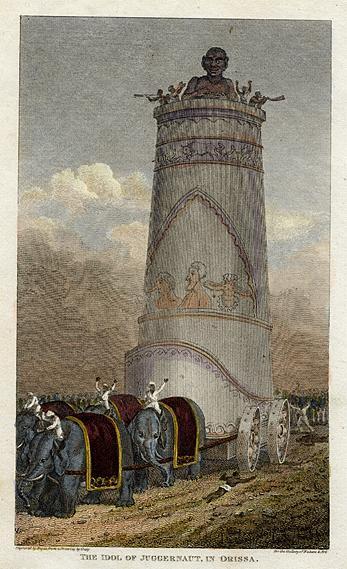
Not every devotee at Puri received a personal assignment from Sri Chaitanya Mahaprabhu. Satyaraja Khan's family did. Chaitanya-charitamrita records that Ramananda Vasu and Satyaraja Khan were present from Kulina-grama, and that "Sri Caitanya Mahaprabhu, with great respect, gave them the following orders": to become the worshipers of the ropes used to pull Lord Jagannatha's chariot, and to bring silken rope from their own village every single year for the festival. It was not a ceremonial gesture. Making silk rope was apparently a real trade of Kulina-grama's residents. Mahaprabhu turned that ordinary village craft into an annual act of Deity service. In this way He tied His two Bengali householder-devotees permanently to Nandighosa and to the largest festival held in Puri. Nandighosa is the great chariot that carries Lord Jagannatha through the streets of Puri every year at Ratha-yatra.
Sold To The Descendants Of Gunaraja Khan #
The depth of Mahaprabhu's feeling for this family shows in the same conversation. He first spoke to the Kulina-grama devotees about Gunaraja Khan's Sri Krishna-vijaya. This is a Bengali retelling of Krishna's pastimes from the Tenth and Eleventh Cantos of Srimad-Bhagavatam, written so plainly that even ordinary readers with little education could follow it. Mahaprabhu told them that it contained a line revealing its author's own ecstatic love for Krishna. Then He recited a verse about His own attachment to Krishna, the son of Nanda Maharaja. Speaking of Himself, He added one of the most quoted single lines connected with this family: "By this statement I am sold into the hands of the descendants of Gunaraja Khan." It is an extraordinary thing for the Lord to say about anyone, and even more so about a family remembered mainly for its silk-rope service. And Mahaprabhu did not stop there. He told them directly, "even a dog living in your village is very dear to Me. What, then, to speak of others?" He praised the father's book and then made this declaration about the son's household, one after the other in the same conversation. The two belong together as parts of one and the same affection. Kulina-grama's devotion was expressed quietly, through poetry, rope-making and yearly journeys. But it had reached Mahaprabhu completely.
An Ordinary Service, Repeated Every Year #
Mahaprabhu's words are dramatic. But this episode is worth telling on its own because the actual service was so ordinary. Rope for a chariot is not a scripture, a poem or a philosophical argument. It is simply rope. It was made by hand in a Bengali village and carried several hundred miles to Orissa, year after year, so that a wooden Deity's cart could be pulled through the streets of Puri. Sri Chaitanya Mahaprabhu's own attention to this detail is a small but clear example of an idea that this whole family's history returns to again and again. In Gaudiya Vaishnavism, a very plain, physical act of service, taken up without complaint and repeated faithfully, can be exactly as important as any achievement that looks more spiritual. Satyaraja Khan seems to have taken this lesson to heart, not only received it as an instruction. He then asked Mahaprabhu, in his own words, what a householder like himself should actually do with his life. That story is told at how to recognize a Vaishnava.
