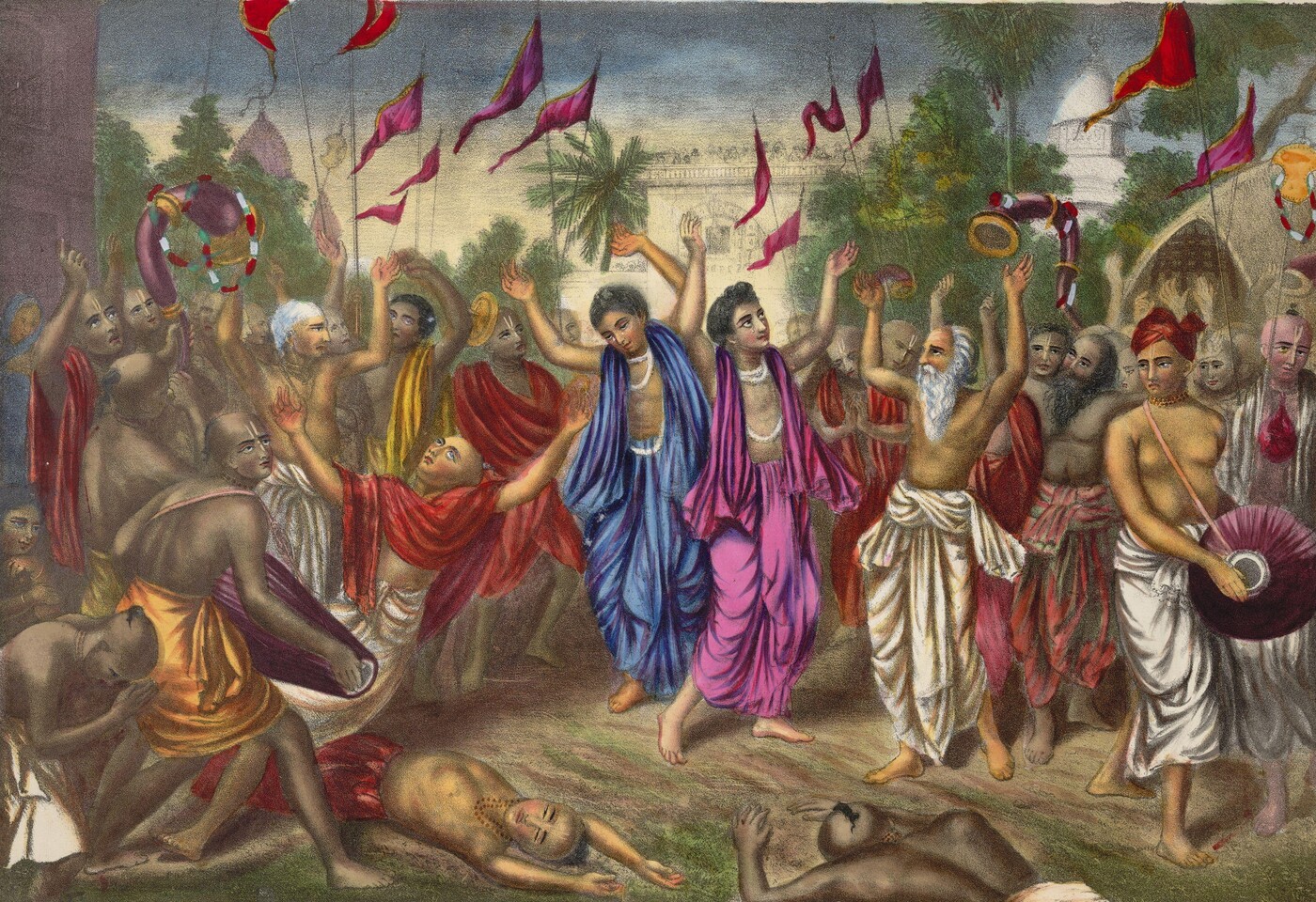
Kulina-grama sent more than devotees to Jagannatha Puri. It sent a whole sankirtana party, and Satyaraja Khan was one of the two men chosen to dance at its head. Sri Chaitanya-charitamrita records it plainly: "There was a sankirtana party from the village known as Kulina-grama, and Ramananda and Satyaraja were appointed the dancers in this group." It is a small detail, but an important one. Being named a dancer in a sankirtana party meant standing at the front of a group of singing devotees and setting the movements the rest would follow. And this was in the middle of one of the largest public festivals in India.
Seven Parties, One Devotee Among Them #
Years later, at another Ratha-yatra, Mahaprabhu organized His Puri devotees into seven separate sankirtana groups so that the chanting could fill the whole road to the Gundicha temple at once. Two of the Lord's own most intimate associates, Sri Advaita Acharya and Sri Nityananda Prabhu, led the first two parties as their principal dancers. Satyaraja Khan danced in one of the remaining five groups. He is named in the same verse along with Vakresvara Pandita, Acyutananda, Pandita Srivasa and Narahari dasa. This places him, even if only briefly, among devotees whose names are central to whole chapters of Gaudiya Vaishnava history. Mahaprabhu walked from party to party, watching the kirtana. Chaitanya-charitamrita says that each group of devotees felt certain the Lord was dancing in their own group alone. This detail tells us as much about the ecstasy of the occasion as about the seven separate dancers who were leading it.
Recognized Among The Pilgrims At Puri #
Satyaraja Khan was noticed by name at Puri on at least one more occasion. This was during the well-known Bera-kirtana pastime. King Prataparudra asked to be shown Mahaprabhu's devotees from a hidden place where he could watch. Gopinatha Acharya pointed each group out to him in turn: Raghava Pandita, Vasudeva Datta, the residents of Khanda headed by Mukunda dasa and Narahari, and many others by name. When he came to the Bengali pilgrims from Satyaraja's own village, Gopinatha Acharya said: "And here are all the residents of Kulina-grama, such as Satyaraja Khan and Ramananda. Indeed, all of them are present here." The moment is brief, but it confirms something the sankirtana-party verse only suggests. Hundreds of devotees gathered at Puri each year, yet Satyaraja Khan was well known enough to be named individually, not lost in an unnamed crowd of pilgrims. In return for that recognition, Mahaprabhu asked his family for a specific, hereditary service to the Deity of Jagannatha. That story is told at keeper of the silken ropes.
A Village Of High Birth, A Branch Of Its Own #
The name Kulina-grama itself means, roughly, "village of high-born families," and Krishnadasa Kaviraja Goswami's own arrangement of Mahaprabhu's associates treats it in just that way. He treats it as a community, not just a scattering of individuals. One verse of Adi-lila names Satyaraja together with Ramananda, Yadunatha, Purushottama, Shankara and Vidyananda as heading a branch of their own on the tree of Mahaprabhu's devotees. A following verse adds that the whole village, under Vaninatha Vasu, served Mahaprabhu as "their only life and wealth." Satyaraja was also a sankirtana dancer. Taken together with this, these details describe a specific, recognizable community of devotees, not an unnamed group of Bengali pilgrims. Six or more householders from one village are named. Krishnadasa Kaviraja places each one individually in his careful record of exactly who surrounded Sri Chaitanya Mahaprabhu.
A Gopi Of Vraja, Remembered By Name #
Gaudiya Vaishnava tradition goes a step further than Chaitanya-charitamrita itself in identifying who Satyaraja Khan really was. Shivananda Sena's own son, Kavi-karnapura, lists the eternal identities of Mahaprabhu's associates in his Gaura-ganoddesha-dipika. There he names Satyaraja Khan as Sukantha-devi, one of the two Gandharva dancers of Vraja in Krishna's original pastimes. He identifies Ramananda Vasu in turn as her companion Kalakantha-devi. We should be clear about what kind of source this is. Gaura-ganoddesha-dipika is an identification recorded by Kavi Karnapura in 1576, not a scene told in Chaitanya-charitamrita itself. But it is a real and specific claim, made by name. Its author's own father organized the very pilgrimages that brought Kulina-grama's devotees to Puri each year. So it is one more link between a fairly little-known householder and the wider, well-recorded circle of Sri Chaitanya Mahaprabhu's associates.
