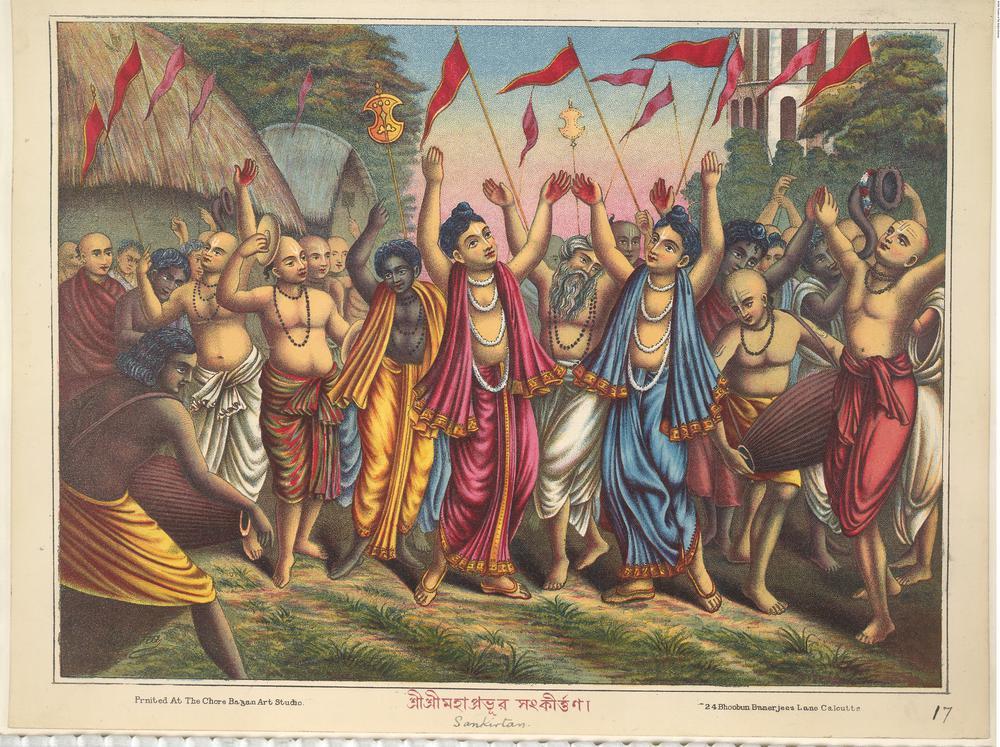
This entire exchange took place during Mahaprabhu's stay at the house of Sarvabhauma Bhattacharya in Puri, where several of His closest householder devotees came to Him with personal questions. Here, after his family had been given the service of the Ratha-yatra ropes, Satyaraja Khan asked Sri Chaitanya Mahaprabhu a much more personal question of his own. Chaitanya-charitamrita records his exact words: "My dear Lord, being a householder and a materialistic man, I do not know the process of advancing in spiritual life. I therefore submit myself unto Your lotus feet and request You to give me orders." These are very humble words for him to use about himself. Mahaprabhu had just declared in public that his family was so dear to Him that even a dog of their village was loved. Mahaprabhu's reply matched the humility of the question. Continue chanting the holy name of Krishna without stopping, He said, and serve Krishna's devotees whenever possible. Nothing more elaborate than that.
Satyaraja was satisfied but curious, and he asked a further question: how could he actually recognize a Vaishnava when he saw one? Mahaprabhu's answer became one of Chaitanya-charitamrita's most quoted teachings on the subject. Whoever chants the holy name of Krishna even once, He said, is worshipable and should be counted the topmost of human beings. Such chanting alone relieves a person of the reactions of a sinful life, with no need for elaborate rites of initiation beforehand: "one simply has to vibrate the holy name with his lips," Mahaprabhu said. Even a man of the lowest class can be delivered by it. He closed with a direct instruction: "One who is chanting the Hare Krishna mantra is understood to be a Vaishnava; therefore you should offer all respects to him." Satyaraja had just called himself materialistic and ignorant of spiritual advancement. For such a householder, it was a very generous and simple answer. It measured devotion by what one's tongue does, not by birth, learning or formal qualification. Srila Prabhupada, commenting on this exchange, connects it directly to how initiation is actually practiced. He explains that chanting the holy name does not itself wait for initiation or any first qualification. But a candidate for formal initiation is still expected first to show steadiness in chanting and in following the regulative principles.
This exchange was more than a single conversation, because it did not stay in the past. Chaitanya-charitamrita records that in a following year, one of the inhabitants of Kulina-grama again asked the very same question. He asked what his duty was and how a Vaishnava could be recognized. Mahaprabhu understood their sincerity and patiently taught them once more the differences between the grades of Vaishnava. This time He explained that a first-class Vaishnava is one whose very presence makes others chant the holy name. Such a Vaishnava is different in degree from a Vaishnava and a Vaishnavatara, who are also truly advancing but whose devotion does not yet spread to others so strongly. The text does not say by name whether it was Satyaraja Khan asking a second time or another villager. So we should not claim to know more than Chaitanya-charitamrita itself tells us here. But it is clear that, whoever exactly asked it, Kulina-grama's devotees did not treat this question as settled after one answer. They carried it back to Mahaprabhu year after year, on the same journeys that men like Shivananda Sena organized from Bengal to Puri, alongside the very ropes Satyaraja Khan's own family brought for the Lord's chariot.
Scriptural sources for this pastime
After this, Ramananda Vasu and Satyaraja Khan both submitted questions at the lotus feet of Sri Chaitanya Mahaprabhu.
Introduces the personal dialogue between Satyaraja Khan and Mahaprabhu on how a householder can advance in spiritual life.
grhastha visayi ami, ki mora sadhane
sri-mukhe ajna kara prabhu—nivedi carane
Word for word
grhastha: householder; visayi: materialistic man; ami: I; ki: what; mora sadhane: the process of my advancement in spiritual life; sri-mukhe: from Your own mouth; ajna kara: please order; prabhu: my Lord; nivedi carane: I submit unto Your lotus feet.
Satyaraja Khan said, "My dear Lord, being a householder and a materialistic man, I do not know the process of advancing in spiritual life. I therefore submit myself unto Your lotus feet and request You to give me orders."
Satyaraja Khan's own words, quoted directly as the page's pull-quote, a householder's humble, specific question about spiritual advancement.
Sri Chaitanya Mahaprabhu replied, "Without cessation continue chanting the holy name of Lord Krishna. Whenever possible, serve Him and His devotees, the Vaishnavas."
The core of Mahaprabhu's teaching on how to recognize a Vaishnava: by the chanting itself, not by external qualification.
diksa-puraścarya-vidhi apeksa na kare
jihva-sparse a-candala sabare uddhare
Word for word
diksa: initiation; puraścarya: activities before initiation; vidhi: regulative principles; apeksa: reliance on; na: not; kare: does; jihva: the tongue; sparse: by touching; a-candala: even the lowest of men, the candala; sabare: everyone; uddhare: delivers.
"One does not have to undergo initiation or execute the activities required before initiation. One simply has to vibrate the holy name with his lips. Thus even a man in the lowest class [candala] can be delivered.
From the purport: Purport excerpt: "Due to the necessity of these activities, we do not immediately initiate disciples in the International Society for Krishna Consciousness. For six months, a candidate for initiation must first attend arati and classes in the sastras, practice the regulative principles and associate with other devotees."
Prabhupada's own purport here directly connects this teaching to ISKCON's initiation practice, making this verse especially relevant for a devotee readership.
"ataeva yanra mukhe eka krsna-nama
sei ta' vaisnava, kariha tanhara sammana"
Word for word
ataeva: therefore; yanra mukhe: in whose mouth; eka: one; krsna-nama: the holy name of Krishna; sei ta' vaisnava: he is a Vaishnava; kariha: offer; tanhara: to him; sammana: respect.
Sri Chaitanya Mahaprabhu then finally advised, "One who is chanting the Hare Krishna mantra is understood to be a Vaishnava; therefore you should offer all respects to him."
Mahaprabhu's closing instruction to Satyaraja Khan in this dialogue, summarizing how to recognize and treat a Vaishnava.
The following year, the inhabitants of Kulina-grama again asked the Lord the same question. Hearing this question, Sri Chaitanya Mahaprabhu again taught them about the different types of Vaishnavas.
Shows this was a recurring exchange in subsequent years, though Chaitanya-charitamrita does not specify by name whether Satyaraja Khan himself asked again.
Sri Chaitanya Mahaprabhu said, "A first-class Vaishnava is he whose very presence makes others chant the holy name of Krishna."
The three-tier distinction (Vaishnava, Vaishnavatara, Vaishnavatama) Mahaprabhu taught when the same question about recognizing a Vaishnava was asked again in a later year.
Our editorial team comprises trained devotees and researchers of the Hare Krishna Movement, Kota, who follow this same disciplic tradition in daily practice. Every biography is carefully researched, fact-checked against Vedic scriptures, and cites its sources.
Reviewed by
Temple & Scriptural Research Team
Each biography undergoes a detailed review by our senior devotees and scriptural researchers to verify factual accuracy and ensure alignment with Vaishnava philosophy and Srila Prabhupada's teachings.