Every year, Sri Chaitanya Mahaprabhu sent Jagadananda Pandita to Navadvipa to bring cloth and prasadam to His mother, Sachi Mata. On one such trip, Jagadananda returned to Puri carrying something unplanned: a sonnet written by Advaita Acharya. When Mahaprabhu read it, His separation from Krishna became so overwhelming that the devotees around Him grew genuinely afraid He would not survive it. At night, alone with His grief, He would rub His face against the walls of His room until it bled.
An Idea Born of Fear #
Svarupa Damodara Goswami, the Lord's closest confidential secretary at Puri, spent a day thinking over the problem before he arrived at a plan. He and the other devotees would ask Shankara Pandita to sleep in the same room as the Lord at night. Shankara was Damodara Pandita's younger brother, and they already knew him as a devotee of unguarded, unalloyed love. Sri Chaitanya-charitamrita records that the devotees had to beg Mahaprabhu directly for permission. This suggests that the Lord did not simply agree at once. To let anyone see Him in that condition, night after night, was itself a kind of surrender.
The Lord's Feet Upon Shankara's Body #
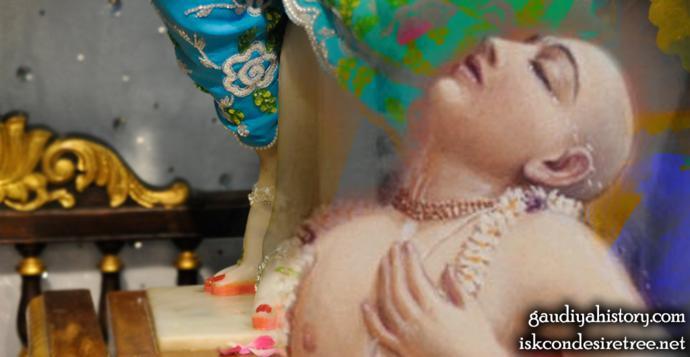
Once permission was given, Shankara Pandita lay down at Mahaprabhu's feet, and the Lord rested His legs across Shankara's own body as He tried to sleep. Krishnadasa Kaviraja Goswami marks the moment with the title that has stayed with Shankara ever since. He became celebrated as prabhu-padopadhana, "the pillow of Sri Chaitanya Mahaprabhu," and the text also compares him directly to Vidura from Srimad-Bhagavatam. Vidura was the devotee-uncle who was so humble in Krishna's presence that Krishna's own feet found rest against him. Through the night Shankara would massage the Lord's legs. Sometimes he drifted into sleep himself. Each time he woke, he sat back up and started the massage again. He did not fight his sleep. He simply repeated this again and again, and in this way stayed alert until morning.
One detail in particular has stayed with Gaudiya Vaishnava readers for five centuries. Once, Shankara lay asleep without any covering over himself. Then Mahaprabhu Himself got up and wrapped His own quilt around him. It was not a servant, and not another devotee, who did this. The arrangement worked exactly as Svarupa Damodara had hoped. The text plainly says that Mahaprabhu was afraid of waking Shankara. So He could no longer slip out of the room at night or injure His face against the walls. Just one trusted person sleeping beside Him did what no argument or pleading from the other devotees had been able to do.
Remembered in Verse #
Sri Chaitanya-charitamrita notes that this exact pastime was later described in verse by Raghunatha Dasa Goswami in his devotional poem Gauranga-stava-kalpavriksha. One verse from that poem is quoted in the same chapter of Chaitanya-charitamrita. It gives some idea of the condition in which Shankara Pandita served: "Because of separation from His many friends in Vrindavana, who were like His own life, Sri Chaitanya Mahaprabhu spoke like a madman. His intelligence was transformed. Day and night He rubbed His moonlike face against the walls, and blood flowed from the injuries." This was the condition the Lord was in, night after night. Against it, Shankara Pandita offered his quiet, repeated service: falling asleep, waking, massaging the Lord's legs, falling asleep again. This service offered whatever calm the Lord's body could still receive.
As on The Love Called Pure and Unalloyed, no purport by Srila Prabhupada is attached to these particular verses, and no surviving source gives an exact date for how long this nightly arrangement continued. But Sri Chaitanya-charitamrita does make the service itself clear. It was patient and uncomplaining. It was also physically close in a way that was given to almost no one else in the Lord's circle at Puri.
