Sri Shankara Pandita
The Devotee Whose Body Became the Lord's Own Pillow
The complete life, on one page: The main biography and every pastime page, in order, in one place
Introduction
Sri Shankara Pandita was one of the closest personal attendants of Sri Chaitanya Mahaprabhu during the Lord's years at Jagannatha Puri. He was so close that the Lord rested against Shankara's own body through the night, when Mahaprabhu's ecstatic love for Krishna grew violent enough to injure Him. Sri Chaitanya-charitamrita names him the eleventh branch of the great tree of Mahaprabhu's associates, and the younger brother of Damodara Pandita. It also gives him a title that no other devotee in the text shares: prabhu-padopadhana, "the resting place for the Lord's feet." His name is easy to confuse with two very different figures, so that point is explained first.
| Detail | Description |
|---|---|
| Era | Contemporary of Chaitanya Mahaprabhu, early sixteenth century |
| Documented as | Eleventh branch of the Chaitanya tree (Chaitanya-charitamrita, Adi-lila 10.33) |
| Elder brother | Damodara Pandita, the tenth branch |
| Best known as | Prabhu-padopadhana, "the Lord's foot-pillow," for his nightly service at Jagannatha Puri |
| Role among devotees | Personal night attendant to Mahaprabhu during His most intense years of ecstasy at Puri |
| Identity | The gopi Shri Bhadra, on whose chest Krishna slept in Vrindavana (Gaura-ganoddesha-dipika 157) |
| Birth and disappearance | Not recorded |
Scriptural evidence for the introduction (2)
The eleventh branch, the younger brother of Damodara Pandita, was known as Sankara Pandita. He was celebrated as the shoes of the Lord.
The founding reference for Shankara Pandita's place among Mahaprabhu's associates: his family relation to Damodara Pandita and his earliest epithet, "the shoes of the Lord."
यस्या वक्षसि सुष्वाप कृष्णो वृन्दावने पुरा ।
सा श्रीभद्राद्य गौराङ्ग प्रियः शङ्करपण्डितः ॥
yasyā vakṣasi suṣvāpa kṛṣṇo vṛndāvane purā
sā śrī-bhadrādya gaurāṅga priyaḥ śaṅkara-paṇḍitaḥ
During Lord Krsna's Vrndavana pastimes He would sometimes sleep peacefully on the chest of Sribhadra-gopi. This same Sribhadra-gopi later appeared as Sankara Pandita, who was very dear to Lord Caitanya Mahaprabhu.
Kavi Karnapura's identification of Shankara Pandita as the gopi Shri Bhadra, on whose chest Krishna slept in Vrindavana; it matches his later service as the Lord's 'pillow' at Puri. Sanskrit: diacritic edition of the Gaura-ganoddesha-dipika; English translation as published at bvmlu.org.
Chapter 1
The Love Called Pure and Unalloyed
How Sri Chaitanya Mahaprabhu placed Shankara Pandita in his elder brother's care, and why.
Every year, the devotees of Bengal traveled together to Jagannatha Puri to see Sri Chaitanya Mahaprabhu. The chapters that describe the Lord's reunion with them are some of the most loving in Sri Chaitanya-charitamrita. Krishnadasa Kaviraja Goswami places this particular meeting in the period he calls the beda-kirtana pastimes. He describes how nearly two hundred devotees arrived at Lake Narendra on the outskirts of Puri. By order of King Prataparudra, they were given lodging and prasadam. Then they were brought before the Lord one group at a time. Mahaprabhu did not simply bless the crowd in general terms. He went down the line and spoke to individuals by name, and what He said to each person was different, personal, and often surprising.
A King Watching From Hiding #
Before Mahaprabhu ever spoke to the new arrivals directly, King Prataparudra himself came to watch the procession. He stood where the devotees would not notice a king among them. Gopinatha Acharya stood beside him, pointing out face after face: Advaita Acharya first, then Srivasa Pandita, Vakresvara Pandita, and a long list of names that plainly included Shankara Pandita himself. It is a small detail, but an important one. This happens before any of the exchanges that follow, and Shankara is seen only from a distance. Yet he was already so well known in Mahaprabhu's circle that a king's attendant could name him without hesitation.
A Roll Call With a Difference #
Vasudeva Datta insisted that his younger companion Mukunda was spiritually senior to him, and Mahaprabhu did not correct him. To Srivasa Thakura and his brothers He said He felt purchased by their devotion; Srivasa replied that it was they who had been purchased by the Lord's mercy. To Shivananda Sena He said, simply, that His affection for him had been great from the very beginning. Those words dropped Shivananda to the ground in ecstasy. Each exchange in this chapter works the same way. Mahaprabhu names a quality in a devotee that no outsider would have guessed, and the devotee's own reply reveals just as much in return.
Two Brothers, Two Kinds of Love #
When Shankara Pandita came before Him, the Lord turned first to Damodara Pandita, Shankara's elder brother, and stated the difference clearly: "My affection for you is on the platform of awe and reverence," He told Damodara. "Therefore keep your younger brother Sankara with you, because he is connected to Me by pure, unalloyed love." It is a striking thing for the Lord to say about two brothers standing side by side. One loved Him with the formal respect due to God. The other loved Him without that distance at all. And it was this second, more open kind of love that needed a guardian.
Damodara Pandita's reply is remembered as a small classic example of Vaishnava humility: "Sankara is my younger brother, but from today he becomes my elder brother because of Your special mercy upon him." In one sentence, Damodara set aside the natural family order and put a spiritual order in its place. The brother who received Mahaprabhu's own unguarded love now stood above his elder in devotion, whatever their birth order says. Damodara Pandita accepted this duty without complaint. From that meeting on, he treated his own younger brother with the respect due to an elder.
Why the Distinction Mattered #
Sri Chaitanya-charitamrita does not directly say why Shankara's love needed guarding, instead of simply being praised. But the position of this scene in the story answers the question. This same Shankara Pandita would later be trusted with the single most intimate service any of Mahaprabhu's associates performed. He lay at the Lord's own feet through the night at Puri, to keep Him from injuring Himself in ecstasy. That episode is told in full on Prabhu-Padopadhana, the Lord's Own Pillow. A love without awe also has no instinct to hold back. In His final years, the Lord's condition left no room for a servant who held back. Damodara's reverence made him the right person to manage Shankara's household affairs and conduct. Shankara did not have that same reverence, and this is what let him come close enough, later, to serve the Lord in the way no one else could.
No purport by Srila Prabhupada is attached to these particular verses, and no surviving source dates the episode more precisely than "one of the Bengali devotees' yearly visits" during the Puri years. What survives is the exchange itself: three short lines of dialogue that Gaudiya Vaishnavas still quote to describe the difference between reverential and unalloyed devotion.
Scriptural evidence for this chapter (1)
After seeing Sankara, Lord Sri Caitanya Mahaprabhu told Damodara, "My affection for you is on the platform of awe and reverence. Therefore keep your younger brother Sankara with you because he is connected to Me by pure unalloyed love." Damodara Pandita replied, "Sankara is my younger brother, but from today he becomes my elder brother because of Your special mercy upon him."
The direct source for the central exchange of this pastime page: Mahaprabhu's own distinction between reverential and unalloyed love, spoken about Shankara Pandita.
Chapter 2
Prabhu-Padopadhana, the Lord's Own Pillow
The nights Shankara Pandita's own body cushioned Sri Chaitanya Mahaprabhu against His own ecstasy.
Every year, Sri Chaitanya Mahaprabhu sent Jagadananda Pandita to Navadvipa to bring cloth and prasadam to His mother, Sachi Mata. On one such trip, Jagadananda returned to Puri carrying something unplanned: a sonnet written by Advaita Acharya. When Mahaprabhu read it, His separation from Krishna became so overwhelming that the devotees around Him grew genuinely afraid He would not survive it. At night, alone with His grief, He would rub His face against the walls of His room until it bled.
An Idea Born of Fear #
Svarupa Damodara Goswami, the Lord's closest confidential secretary at Puri, spent a day thinking over the problem before he arrived at a plan. He and the other devotees would ask Shankara Pandita to sleep in the same room as the Lord at night. Shankara was Damodara Pandita's younger brother, and they already knew him as a devotee of unguarded, unalloyed love. Sri Chaitanya-charitamrita records that the devotees had to beg Mahaprabhu directly for permission. This suggests that the Lord did not simply agree at once. To let anyone see Him in that condition, night after night, was itself a kind of surrender.
The Lord's Feet Upon Shankara's Body #
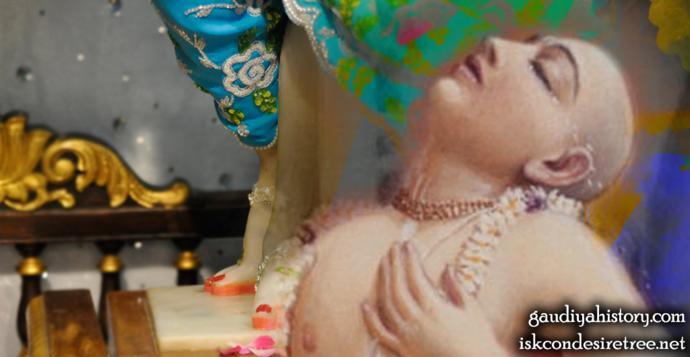
Once permission was given, Shankara Pandita lay down at Mahaprabhu's feet, and the Lord rested His legs across Shankara's own body as He tried to sleep. Krishnadasa Kaviraja Goswami marks the moment with the title that has stayed with Shankara ever since. He became celebrated as prabhu-padopadhana, "the pillow of Sri Chaitanya Mahaprabhu," and the text also compares him directly to Vidura from Srimad-Bhagavatam. Vidura was the devotee-uncle who was so humble in Krishna's presence that Krishna's own feet found rest against him. Through the night Shankara would massage the Lord's legs. Sometimes he drifted into sleep himself. Each time he woke, he sat back up and started the massage again. He did not fight his sleep. He simply repeated this again and again, and in this way stayed alert until morning.
One detail in particular has stayed with Gaudiya Vaishnava readers for five centuries. Once, Shankara lay asleep without any covering over himself. Then Mahaprabhu Himself got up and wrapped His own quilt around him. It was not a servant, and not another devotee, who did this. The arrangement worked exactly as Svarupa Damodara had hoped. The text plainly says that Mahaprabhu was afraid of waking Shankara. So He could no longer slip out of the room at night or injure His face against the walls. Just one trusted person sleeping beside Him did what no argument or pleading from the other devotees had been able to do.
Remembered in Verse #
Sri Chaitanya-charitamrita notes that this exact pastime was later described in verse by Raghunatha Dasa Goswami in his devotional poem Gauranga-stava-kalpavriksha. One verse from that poem is quoted in the same chapter of Chaitanya-charitamrita. It gives some idea of the condition in which Shankara Pandita served: "Because of separation from His many friends in Vrindavana, who were like His own life, Sri Chaitanya Mahaprabhu spoke like a madman. His intelligence was transformed. Day and night He rubbed His moonlike face against the walls, and blood flowed from the injuries." This was the condition the Lord was in, night after night. Against it, Shankara Pandita offered his quiet, repeated service: falling asleep, waking, massaging the Lord's legs, falling asleep again. This service offered whatever calm the Lord's body could still receive.
As on The Love Called Pure and Unalloyed, no purport by Srila Prabhupada is attached to these particular verses, and no surviving source gives an exact date for how long this nightly arrangement continued. But Sri Chaitanya-charitamrita does make the service itself clear. It was patient and uncomplaining. It was also physically close in a way that was given to almost no one else in the Lord's circle at Puri.
Scriptural evidence for this chapter (3)
Thus Sankara Pandita lay at the feet of Sri Caitanya Mahaprabhu, and the Lord placed His legs upon Sankara's body. Sankara became celebrated by the name Prabhu-padopadhana ["the pillow of Sri Caitanya Mahaprabhu"]. He was like Vidura, as Sukadeva Gosvami previously described him.
Source of the pastime's central image and Shankara Pandita's lasting epithet, including the direct comparison to Vidura from Srimad-Bhagavatam.
He would lie asleep without a covering on his body, and Sri Caitanya Mahaprabhu would get up and wrap him with His own quilt. Sankara Pandita would always fall asleep, but he would quickly awaken, sit up and again begin massaging the legs of Sri Caitanya Mahaprabhu. In this way he would stay awake the entire night. Out of fear of Sankara, Sri Caitanya Mahaprabhu could neither leave His room nor rub His lotuslike face against the walls.
Source for the quilt detail and for the plan's stated purpose: Shankara's presence kept Mahaprabhu from leaving the room or injuring Himself at night.
This pastime of Sri Caitanya Mahaprabhu's has been described very nicely by Raghunatha dasa Gosvami in his book known as Gauranga-stava-kalpavriksha. "Because of separation from His many friends in Vrindavana, who were like His own life, Sri Caitanya Mahaprabhu spoke like a madman. His intelligence was transformed. Day and night He rubbed His moonlike face against the walls, and blood flowed from the injuries."
Krishnadasa Kaviraja's own citation of Raghunatha Dasa Goswami's independent poetic record of this same pastime, quoted to show the intensity of the condition Shankara Pandita's service was meant to ease.
Closing
Not to Be Confused With Two Other Shankaras #
Adi Shankaracharya, the eighth-century philosopher who founded Advaita Vedanta, is an entirely different person from an entirely different tradition centuries earlier. The shared name is coincidence, nothing more. A second Shankara is closer to Shankara Pandita's own world, and easier to mix up: Shankararanya. This was the sannyasa name taken by Vishvarupa, the elder brother of Sri Chaitanya Mahaprabhu. Vishvarupa left home for the renounced order in his youth and passed away at Pandarapura. Sri Ranga Puri brought this news to Mahaprabhu (Chaitanya-charitamrita, Adi-lila 9.300 and Madhya-lila 9.299). Shankararanya belonged to the Panca-dravida sannyasa order. He has no recorded family or service connection at all to Shankara Pandita. Krishnadasa Kaviraja Goswami keeps the two figures completely separate in his text, and never uses one name in place of the other. None of the three Shankaras has his own Wikipedia article. So a reader who goes only by the name has nothing else to tell them apart, and that is why this difference matters so much.
The Eleventh Branch of the Chaitanya Tree #
In the tenth chapter of Chaitanya-charitamrita's Adi-lila, Krishnadasa Kaviraja Goswami names, branch by branch, the devotees who gathered around Mahaprabhu in Nadia and at Jagannatha Puri. Directly after describing Damodara Pandita as the tenth branch, he adds a single verse for the eleventh: "the younger brother of Damodara Pandita, was known as Sankara Pandita. He was celebrated as the shoes of the Lord" (Adi 10.33). That one line already sums up his whole reputation. From the very first time the text mentions him, he is known for being physically close to the Lord and for humble service. He is not known for learning, speaking skill or renunciation.
The tradition goes further still. Gaura-ganoddesha-dipika is Kavi Karnapura's traditional key that links Mahaprabhu's associates to figures from Krishna's earlier pastimes in Vraja. It identifies Shankara Pandita as the former Shri Bhadra-gopi. She was the gopi on whose chest Krishna would sometimes rest while sleeping in Vrindavana (verse 157). The parallel is exact and easy to remember. The same soul who once cushioned Krishna's sleep in Vraja later cushioned Chaitanya Mahaprabhu's restless nights at Puri.
Kavi Karnapura's verse reads:
yasyā vakṣasi suṣvāpa kṛṣṇo vṛndāvane purā
sā śrī-bhadrādya gaurāṅga priyaḥ śaṅkara-paṇḍitaḥ
"During Lord Krsna's Vrndavana pastimes He would sometimes sleep peacefully on the chest of Sribhadra-gopi. This same Sribhadra-gopi later appeared as Sankara Pandita, who was very dear to Lord Caitanya Mahaprabhu." (Gaura-ganoddesha-dipika 157)
What the Record Does Not Say #
No surviving source gives a year of birth or disappearance for Shankara Pandita. No source names any independent literary work by him, or any place connected with him beyond Jagannatha Puri itself. He does not appear to have been the subject of any dedicated lecture or class by Srila Prabhupada. Everything we know about him comes from a handful of verses in Sri Chaitanya-charitamrita and the single identifying verse of Gaura-ganoddesha-dipika. That is not much, compared with some of Mahaprabhu's better-known associates. But it is consistent. Every detail comes from one of those verses, not from guesswork.
- Shankara Pandita (Gaudiya History biography)
- Shankararanya (Gaudiya History biography, consulted for disambiguation)
- Sri Gaura-ganoddesha-dipika (Gaudiya History)
- Sri Chaitanya-charitamrita, Adi-lila, Chapter 10 (the branches of the Chaitanya tree)
- Sri Chaitanya-charitamrita, Madhya-lila, Chapter 11 ("The Beda-kirtana Pastimes of Sri Caitanya Mahaprabhu")
- Sri Chaitanya-charitamrita, Antya-lila, Chapter 19 ("The Inconceivable Behavior of Lord Sri Caitanya Mahaprabhu")
