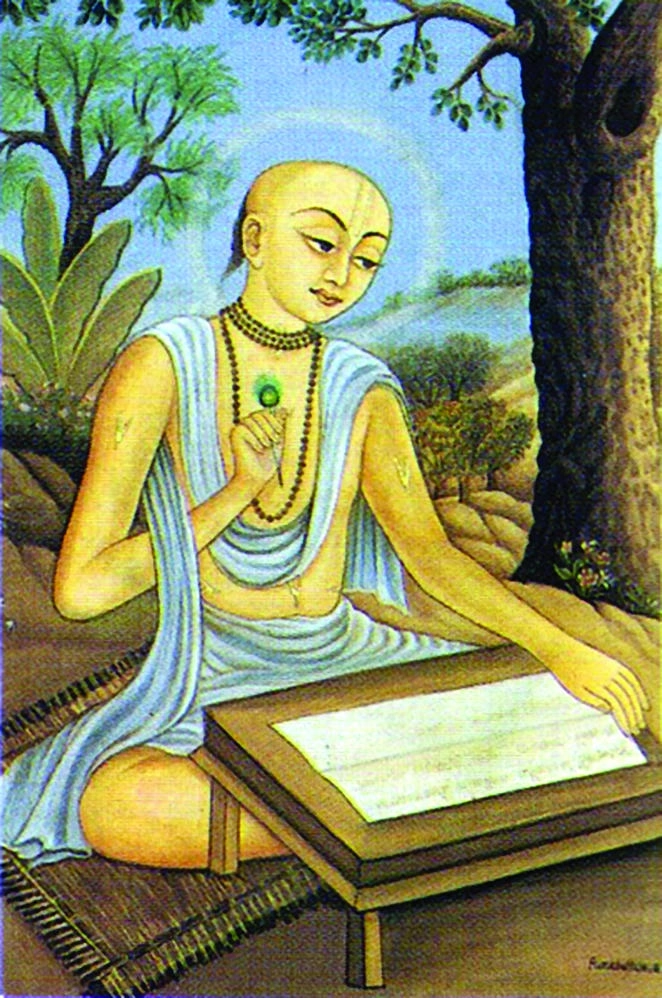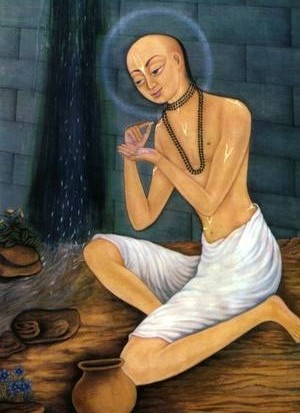
Srila Raghunatha Dasa Goswami
Foremost in Renunciation Among the Six Goswamis of Vrindavana
Also known as Raghunatha dasa Gosvami, Raghunath Das Goswami, Svarupera Raghu (the Raghu of Svarupa Damodara)
“O mind, I grasp your feet and beg you with sweet words: please cast away all hypocrisy and develop intense, unprecedented love for my spiritual master, Vrajabhumi, the people of Vraja, the Vaishnavas, the brahmanas, the holy name, and the transcendental shelter that is the fresh young couple of Vraja, Radha and Krishna.”
Sri Manah-siksa ("Instructions to the Mind"), Text 1 - the opening verse of his best-known devotional poem.
dāsa-śrī-raghunāthasya pūrvākhyā rasa-mañjarī
amuṁ kecit prabhāṣante śrīmatīṁ rati-mañjarīm
bhānumaty-ākhyayā kecid āhus taṁ nāma-bhedataḥ
"Srila Raghunatha dasa Gosvami was the incarnation of Rasa-manjari. Some say that Raghunatha das Gosvami was the incarnation of Rati-manjari, and others say he was the incarnation of Bhanumati-devi." (Gaura-ganoddesha-dipika 186)
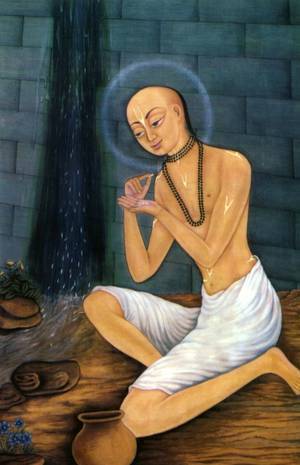
Srila Raghunatha Dasa Goswami is remembered among the Six Goswamis of Vrindavana as the perfect example of renunciation taken as far as it can go. He was born into more wealth than most people of his time would see in several lifetimes. Yet he walked away from all of it to beg his food at a temple gate. In his final decades he lived on a few mouthfuls of buttermilk a day beside a small lake in Vraja. Sri Chaitanya Mahaprabhu placed him in the personal care of His secretary Svarupa Damodara Gosvami at Jagannatha Puri. There, and later at Vrindavana under Rupa Gosvami and Sanatana Gosvami, Raghunatha Dasa became the standard by which every Gaudiya Vaishnava understands what surrender means. This was Srila Prabhupada's own view, and he expressed it many times.
| Detail | Description |
|---|---|
| Full name | Raghunatha Dasa Goswami |
| Born | c. 1494 (sources vary), Saptagrama area, Hooghly district, Bengal |
| Family | Only son of the landholder Govardhana Majumadara; nephew of Hiranya Dasa |
| Identity | In Krishna-lila: Rasa-manjari; some say Rati-manjari or Bhanumati (Gaura-ganoddesha-dipika 186; Chaitanya-charitamrita Adi 10.91 purport) |
| Diksha-guru | Yadunandana Acharya |
| Guided at Puri by | Sri Chaitanya Mahaprabhu and Svarupa Damodara Gosvami |
| Guided at Vrindavana by | Rupa Gosvami and Sanatana Gosvami |
| Chief works | Stavavali (including Manah-siksa and Vilapa-kusumanjali), Dana-keli-cintamani, Mukta-caritra |
| Disappeared | Traditionally dated 1586, Radha-kunda |
Birth into Wealth in Bengal #
Raghunatha Dasa was born the only son of Govardhana Majumadara, a landholder of the Saptagrama area of Hooghly district in Bengal. Govardhana and his brother Hiranya Dasa held the right to collect a share of the region's imperial tax revenue, and the family lived in great wealth. According to Srila Prabhupada's own description in a 1975 Vrindavana lecture, his father's income was twelve lakhs of rupees, an extraordinary sum for that time. As a boy Raghunatha received the association and blessing of Haridasa Thakura. From an early age his heart was already drawn toward Sri Chaitanya Mahaprabhu and Nityananda Prabhu. Outwardly, however, he continued to live in his father's prosperous household, and later married there.
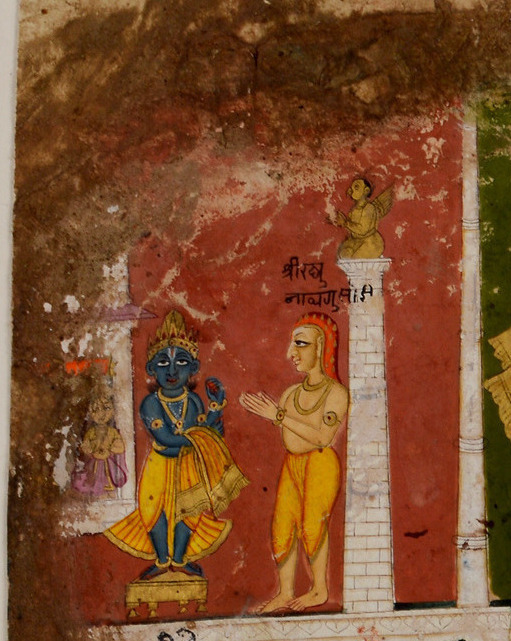
In Sri Chaitanya-charitamrita (Adi 10.91), Krishnadasa Kaviraja Goswami counts him among the branches of the Chaitanya tree:
mahāprabhura priya bhṛtya - raghunātha-dāsa
sarva tyaji’ kaila prabhura pada-tale vāsa
"Śrīla Raghunātha dāsa Gosvāmī, the forty-sixth branch of the tree, was one of the most dear servants of Lord Caitanya Mahāprabhu. He left all his material possessions to surrender completely unto the Lord and live at His lotus feet." (Chaitanya-charitamrita Adi 10.91)
In his purport Srila Prabhupada gives his eternal identity from the Gaura-ganoddesha-dipika: "In the Gaura-gaṇoddeśa-dīpikā (186) it is stated that Śrīla Raghunātha dāsa Gosvāmī was formerly the gopī named Rasa-mañjarī. Sometimes it is said that he was Rati-mañjarī."
The Long Escape to Puri #
Raghunatha's family could see that he was restless. They tried to hold him at home with marriage and responsibility, but he found no taste in either. Over several years he made repeated attempts to leave for Jagannatha Puri, but he was caught and brought home each time. He finally succeeded late one night, when his own family priest, Yadunandana Acharya, came to the house with a request, and Raghunatha used the chance to slip away. Before this, Raghunatha had gone to Panihati to meet Lord Nityananda Prabhu. Nityananda Prabhu publicly called him a thief for having stayed away so long, and gave him the memorable order that led to the famous chida-dadhi-mahotsava. This is the festival of chipped rice and yogurt that Gaudiya Vaishnavas still celebrate today. The fuller account of these years is told in The Struggle to Renounce the World.
Under the Care of Svarupa Damodara #
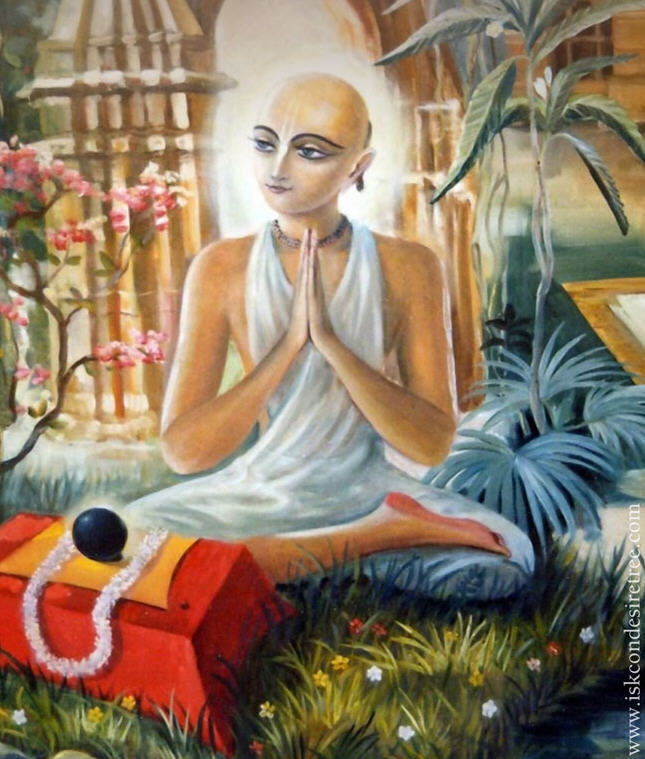
Raghunatha reached Jagannatha Puri after a twelve-day journey on foot, having eaten only three times along the way. Sri Chaitanya Mahaprabhu embraced him and entrusted him, by name, to His own secretary Svarupa Damodara Gosvami. From then on, Svarupa Damodara was known as the guardian of Raghunatha, who was called "Svarupera Raghu." Under this care Raghunatha's renunciation became famous. He stood at the Simha-dvara gate to beg alms. Later he gave up even that, because he judged it too uncertain a thing to depend on. For years he ate nothing but the spoiled temple rice that even the temple cows would not touch. Mahaprabhu personally gave him a Govardhana-sila and a garland of conchshells that He Himself had worn for three years. He also taught him directly the verse beginning trnad api sunicena. It says that one who considers himself lower than a blade of grass can chant the holy name without obstruction. These episodes are described fully in Service Under Svarupa Damodara at Puri.
To Vrindavana After the Lord's Disappearance #
Raghunatha Dasa remained at Puri roughly sixteen years in all. He served Svarupa Damodara Gosvami through the time of Sri Chaitanya Mahaprabhu's own disappearance and for some years after. When Svarupa Damodara himself left this world, Raghunatha could no longer bear to stay. He made his way to Vrindavana, where Rupa Gosvami and Sanatana Gosvami received him and drew him back from the edge of despair. There he became a living link between the Lord's pastimes at Puri and the Vaishnava community of Vrindavana. Krishnadasa Kaviraja Goswami accepted Raghunatha as his diksha-guru. Krishnadasa Kaviraja received the details that fill the Antya-lila of Sri Chaitanya-charitamrita from Raghunatha more than from anyone else.
Bhajana at Radha-kunda #
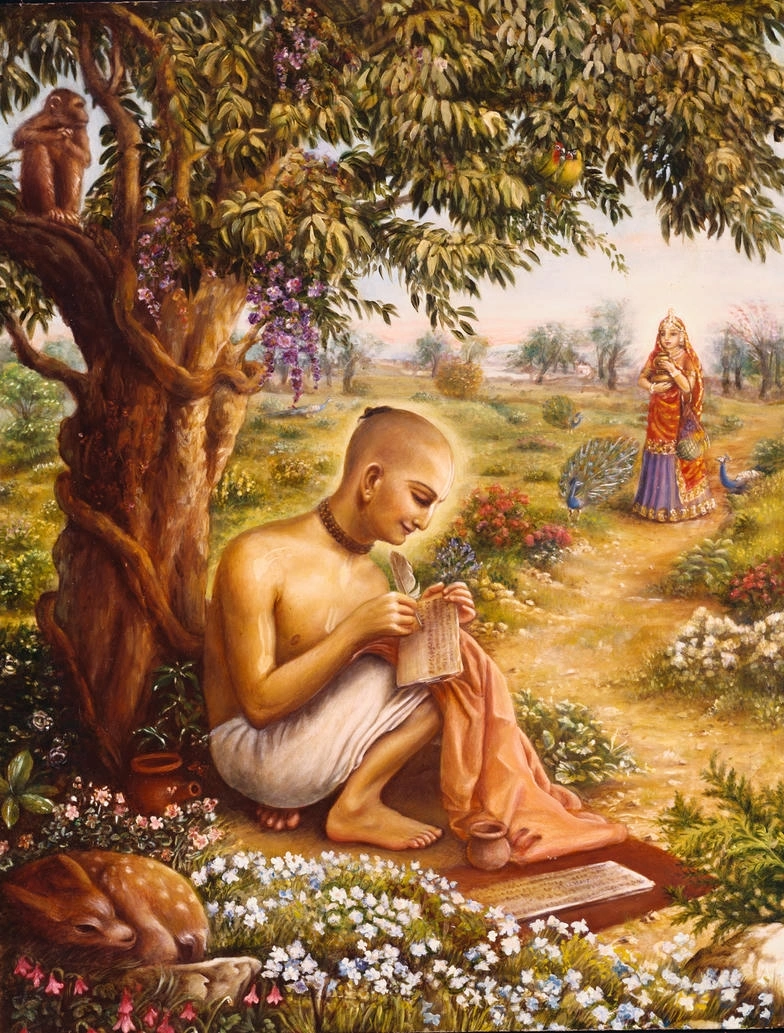
Raghunatha Dasa did not stay on near Rupa Gosvami and Sanatana Gosvami at the center of Vrindavana town. Instead he settled beside Radha-kunda for the rest of his life, some four decades. He kept a discipline of chanting, bathing and obeisances that left barely ninety minutes a day for eating or sleep. As his grief for his departed associates grew deeper each year, he ate less and less. In his final years he had almost completely given up eating and drinking. In this same period he wrote these works:
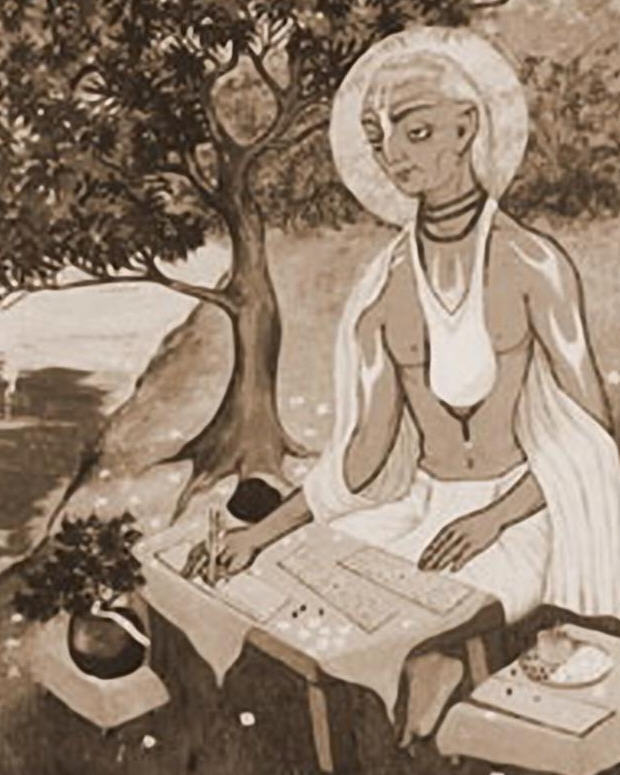
- Stavavali: the poems gathered under this title, including the celebrated Manah-siksa and the tearful Vilapa-kusumanjali
- Dana-keli-cintamani: a drama
- Mukta-caritra: a shorter composition
His bhajana and his writings are described more fully in Bhajana at Radha-kunda and in Literary Works and the Stavavali.
Disappearance and Place in the Parampara #
Raghunatha Dasa Goswami is traditionally said to have left this world in 1586, on Shukla Dvadasi of the month of Ashvina. His samadhi still stands on the bank of Radha-kunda, and pilgrims visit it to this day. Srila Prabhupada returned to his example again and again to show what vairagya, renunciation, really means and what it really costs. Raghunatha was a rich man's son who was offered every comfort, yet he chose a leaf-cup of buttermilk instead. In the closing words of the Antya-lila of Sri Chaitanya-charitamrita, its author Krishnadasa Kaviraja Goswami names Raghunatha Dasa Goswami as his spiritual master. In this way Raghunatha's legacy passed directly into the book that has shaped Gaudiya Vaishnavism ever since.
Songs in the Vaishnava Song Book #
The Vaishnava Song Book carries 2 songs attributed to Srila Raghunatha Dasa Goswami. See the full author page here.
Scriptural evidence
Quoted in the text above:
- Verse 186 Gaura-ganoddesha-dipika
- Adi 10.91 Sri Chaitanya-charitamrita quoted above ↑
What Srila Prabhupada said
"There are two Raghus: one Raghunatha dasa Gosvami and one Raghunatha Bhatta Gosvami... According to whole Vedic system, there are four castes: brahmana, ksatriyas, vaisyas and sudras. So this Raghunatha dasa Gosvami belong to the... Of course, a Vaisnava is never sudra, but in social standard they belonged to the ksatriya or sudra. Therefore he is named as dasa Gosvami, Raghunatha dasa Gosvami."
Six Gosvamis Lecture, Sri Sri Sad-gosvamy-astaka: Lecture, 1968-11-18, Los Angeles
- Sri Chaitanya-charitamrita, Antya-lila, Chapter 6 (Bhaktivedanta VedaBase)
- Sri Chaitanya-charitamrita, Antya-lila 20.96-98 (Bhaktivedanta VedaBase)
- Raghunatha Dasa Goswami - Gaudiya History
- Raghunatha Dasa Goswami - Vrindavan Chandrodaya Mandir
- Srila Prabhupada lecture, Srimad-Bhagavatam 6.2.14, Vrindavana, September 17 1975
- Srila Prabhupada lecture, Bhagavad-gita 4.22, Bombay, April 11 1974
- Sri Manah-siksa - Sri Narasingha Chaitanya Ashram
Disciples
Frequently asked
When was Srila Raghunatha Dasa Goswami born?
Srila Raghunatha Dasa Goswami appeared c. 1494 (sources vary) in Saptagrama area, Hooghly district, Bengal (some secondary sources specify the village of Krishnapura).
Who was the guru of Srila Raghunatha Dasa Goswami?
The spiritual master of Srila Raghunatha Dasa Goswami was Sri Yadunandana Acharya.
When and where did Srila Raghunatha Dasa Goswami disappear?
Srila Raghunatha Dasa Goswami disappeared Traditionally 1586, Shukla Dvadasi of Ashvina (some sources place it a few years earlier) at Radha-kunda, Vrindavana.
What are the main pastimes of Srila Raghunatha Dasa Goswami?
The pastimes covered here include: Birth in a Wealthy Bengali Family, The Struggle to Renounce the World, Service Under Svarupa Damodara at Puri, Arrival in Vrindavana, Bhajana at Radha-kunda, Literary Works and the Stavavali, Disappearance and Legacy.