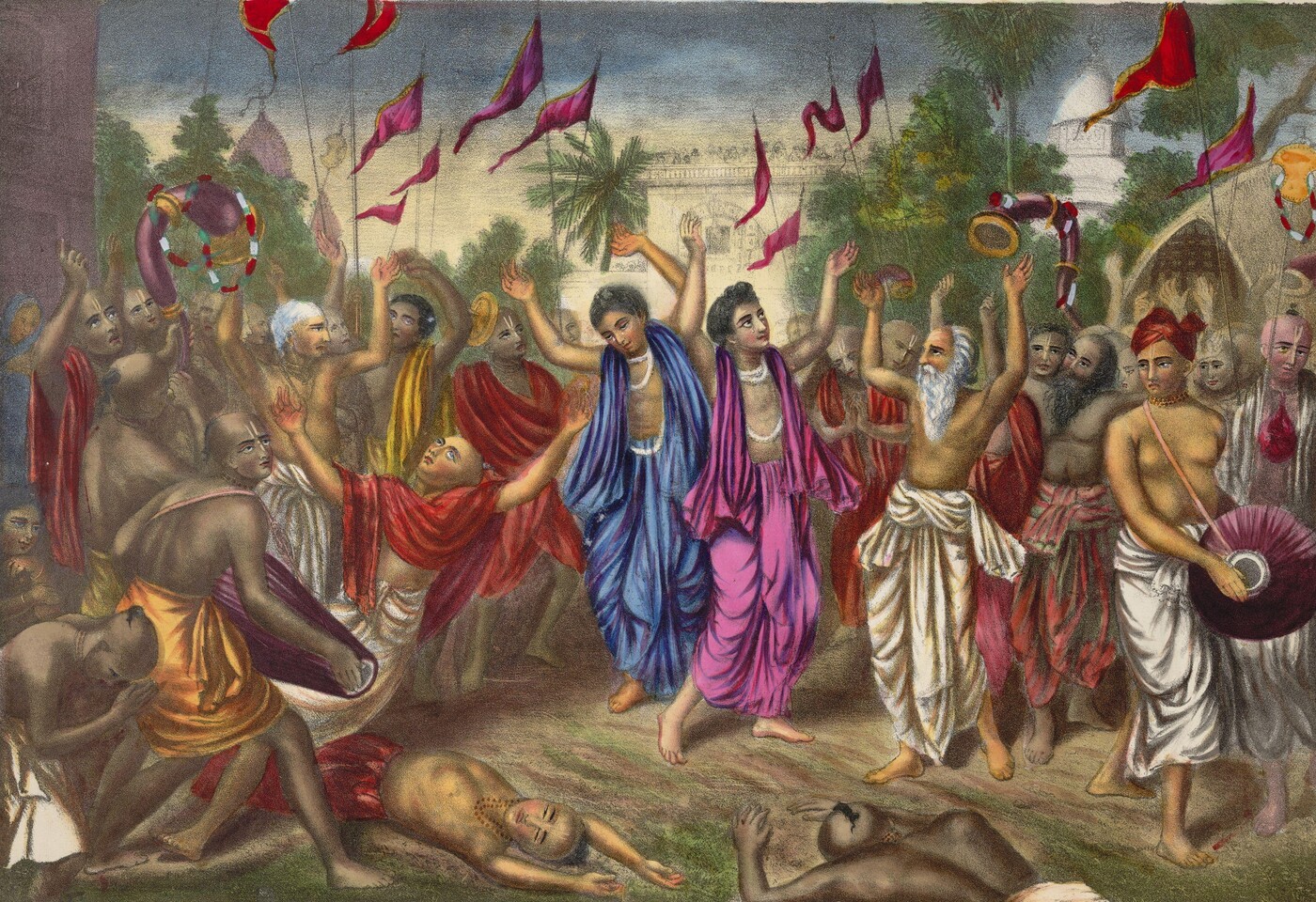
Long before Shrikanta became known for a single moment of injured pride on the road to Jagannatha Puri, he was simply one face among the two or three hundred devotees who made the annual walk from Bengal to see Sri Chaitanya Mahaprabhu at Ratha-yatra. Two facts about those years survive in Sri Chaitanya-charitamrita: whose household he belonged to, and what he did once he arrived.
A Sub-Branch Of Shivananda's Household #
Sri Chaitanya-charitamrita's tenth chapter of Adi-lila is built around an extended image: the Lord's movement as a great tree, with named branches and sub-branches carrying its fruit outward. Shrikanta appears there as one twig of that tree, tied directly to his uncle: "Shrivallabha Sena and Shrikanta Sena were also subbranches of Shivananda Sena, for they were not only his nephews but also unalloyed devotees of Sri Chaitanya Mahaprabhu" (Adi 10.63). Srila Shivananda Sena was the householder responsible for leading Bengal's devotees to Puri every year: arranging lodging, paying tolls and ferrymen, and keeping two hundred or more pilgrims fed and moving. Shrikanta and his cousin Shrivallabha grew up inside that same circle of organized service, which is likely why both boys are named together wherever either one appears.
Krishnadasa Kaviraja Goswami did not name so many minor figures in this chapter just for decoration. His choice reflects something the tradition takes seriously. The tradition holds that devotion is not measured by fame. It also holds that a householder devotee's nephew belongs in the same record as a renowned Goswami, provided his devotion is genuine. Kavi Karnapura's Gaura-ganoddesha-dipika is a separate work that lists the Krishna-lila identity behind each of these associates. It adds one more detail about Shrikanta's place in this list. It names him as the Vraja-gopi Katyayani-devi, appearing in this lifetime inside Shivananda Sena's own family.
A Responsive Singer In Mukunda's Party #
The one concrete role Shrikanta is given in the text comes from the Ratha-yatra festival itself. At the festival, the assembled devotees were organized into several kirtan parties for the procession before Lord Jagannatha's chariot. Sri Chaitanya-charitamrita records: "Another two persons, Shrikanta and Vallabha Sena, joined as responsive singers. In this group, the senior Haridasa Thakura was the dancer" (Madhya 13.41). Srila Prabhupada's purport gives the full list of this party's members. Srila Mukunda Datta led it as chief singer. Vasudeva, Gopinatha, Murari, Shrikanta and Vallabha Sena were the responsive singers who answered his lines back. The senior Haridasa Thakura, one of the most exalted devotees present at any Ratha-yatra, danced in front of them all.
Kirtan at this level of the festival was carefully planned. Each party had its own singer, its own responders, and its own dancer. These places were not given casually. They put junior devotees like Shrikanta directly inside the same performing group as some of the movement's most senior figures. Haridasa Thakura danced in this party, and its chief singer was the accomplished Mukunda Datta. So to be a "responsive singer" here, answering back the melody, was itself a mark of trust. Young voices were given a place in the Lord's own sankirtana, instead of being left to watch from the edge of the crowd.
What The Kirtan Years Do Not Tell Us #
Nothing in the text says how many years in a row Shrikanta sang in this party, how old he was when it began, or what became of his singing after the events described in The Boy Who Left The Party took place. In general, Sri Chaitanya-charitamrita is not interested in biography for its own sake. It will name a devotee's role in a single festival and then let decades pass in silence. This is because its purpose is to record devotion wherever it appears, not to trace a life from beginning to end. The two verses about Shrikanta's kirtan years are exactly that kind of record. They are exact about the one thing that mattered (his place in the party, and whose party it was). But they are silent about everything else a modern reader might want to know.
Together, the two verses do give a steady, settled picture of Shrikanta before the episode on the Puri road. He was a nephew inside a well-run household. He was given a genuine role in the festival's kirtan. He stood near some of Sri Chaitanya Mahaprabhu's most trusted associates. All this was years before anything happened that made Krishnadasa Kaviraja Goswami pause to record his name a third time. This settled picture helps us read what comes next. Shrikanta was a boy secure enough in his place among the devotees to feel that something had gone wrong when his uncle was struck, and to say so aloud.
