Sri Shubhananda Dvija
The Singer Who Drank Mahaprabhu's Foam
The complete life, on one page: The main biography and every pastime page, in order, in one place
Introduction
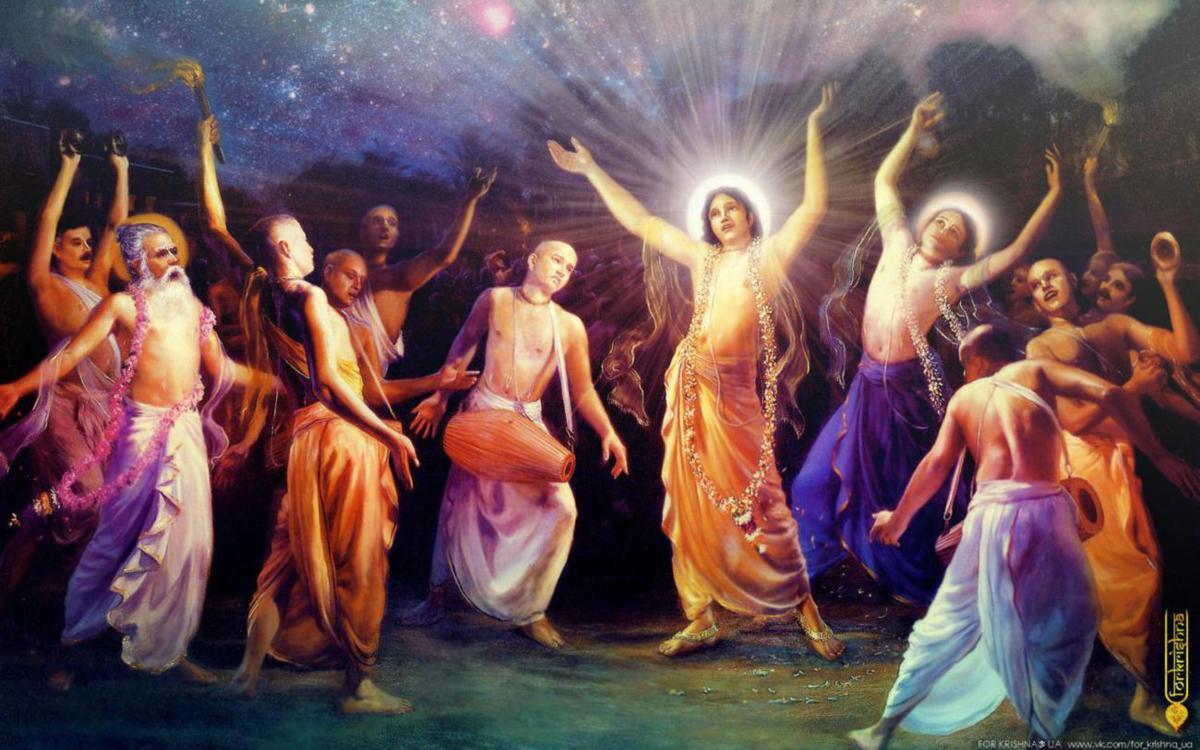
Shubhananda Dvija (also spelled Subhananda) appears in the lists of devotees in Sri Chaitanya-charitamrita as one of the many brahmanas and singers who gathered around Sri Chaitanya Mahaprabhu in the early sixteenth century. Compared with the devotees whose full life stories the tradition tells, he is a minor figure. No separate life story of his survives, and no scholarly study is written about him alone. But the little that is recorded is clear and vivid. He is named as one of the singers in Srivasa Thakura's own kirtana group at the yearly Ratha-yatra festival in Jagannatha Puri. There he is also given credit for a single, striking act that Krishnadasa Kaviraja Goswami thought worth a verse of its own.
| Detail | Description |
|---|---|
| Named in | Chaitanya-charitamrita (Adi-lila 10.110; Madhya-lila 13.39, 13.110), Gaura-ganoddesha-dipika (verses 194-207) |
| Title | Dvija, "twice-born," marking him as a brahmana by birth |
| Documented role | Kirtana singer in Srivasa Thakura's group at the Ratha-yatra |
| Identity | Malati, a maidservant of Srimati Radharani (Gaura-ganoddesha-dipika 194-199; Chaitanya-charitamrita Adi 10.110 purport) |
| Associated place | Jagannatha Puri, Odisha |
| Birth / disappearance | Not recorded |
Scriptural evidence for the introduction (2)
śrīnātha miśra, śubhānanda, śrīrāma, īśāna
śrīnidhi, śrīgopīkānta, miśra bhagavān
Word for word
śrīnātha miśra: Śrīnātha Miśra; śubhānanda: Śubhānanda; śrīrāma: Śrīrāma; īśāna: Īśāna; śrīnidhi: Śrīnidhi; śrī-gopīkānta: Śrī Gopīkānta; miśra bhagavān: Miśra Bhagavān.
The fifty-fifth branch was Śrīnātha Miśra, the fifty-sixth was Śubhānanda, the fifty-seventh was Śrīrāma, the fifty-eighth was Īśāna, the fifty-ninth was Śrīnidhi, the sixtieth was Śrī Gopīkānta, and the sixty-first was Miśra Bhagavān.
From the purport: Śubhānanda, who formerly lived in Vṛndāvana as Mālatī, was one of the kīrtana performers who danced in front of the Ratha-yātrā car during the Jagannātha festival.
Names Shubhananda as the fifty-sixth branch of the Chaitanya tree in Krishnadasa Kaviraja Goswami's own list, and Srila Prabhupada's purport independently confirms his identity in Krishna-lila as Malati.
मलती चन्द्रलतिका मञ्जुमेधा वराङ्गदा ।
रत्नावली च कमला गुणचूडा सुकेशिनी ॥
कर्पूरमञ्जरी श्याममञ्जरी श्वेतमञ्जरी ।
विलासमञ्जरी कामलेखा च मौनमञ्जरी ॥
गन्धोन्मादा रसोन्मादा चन्द्रिका कलभाषिणी ।
गोपाली हरिणी काली कलाक्षी नित्यमञ्जरी ॥
कलकण्ठी कुराङ्गाक्षी चन्द्रिका चन्द्रशेखरा ।
या याः स्वयोग्यसेवायां नियुक्ताः सन्ति राधया ॥
गौरेण तत्प्रियैः सार्धं धृतपुरुषविग्रहः ।
खेलन्ति स्म स्वभावानुसारात्ताः क्रमशो यथा ॥
शुभानन्दो द्विजो ब्रह्मचारी श्रीधर नामकः ।
परमानन्दगुप्तो यत्कृता कृष्णस्तवावली ॥
malatī candralatikā mañjumedhā varāṅgadā
ratnāvalī ca kamalā guṇacūḍā sukeśinī
karpūra-mañjarī śyāma-mañjarī śveta-mañjarī
vilāsa-mañjarī kāmalekhā ca mauna-mañjarī
gandhonmādā rasonmādā candrikā kalabhāṣiṇī
gopālī hariṇī kālī kalākṣī nitya-mañjarī
kalakaṇṭhī kurāṅgākṣī candrikā candraśekharā
yā yāḥ sva-yogya-sevāyāṁ niyuktāḥ santi rādhayā
gaureṇa tat-priyaiḥ sārdhaṁ dhṛta-puruṣa-vigrahaḥ
khelanti sma svabhāvānusārāt tāḥ kramaśo yathā
śubhānando dvijo brahmacārī śrīdhara nāmakaḥ
paramānanda-gupto yat kṛtā kṛṣṇa-stavāvalī
Malati, Candralatika, Manjumedha, ... were among the maidservants of Srimati Radharani. Assuming male forms they appeared among Lord Caitanya's associates, and each displayed his particular kind of ecstatic love for the Lord. These gopis became Subhananda Dvija, Sridhara Brahmacari, ... respectively.
Kavi Karnapura lists Radharani's maidservants (194-197), says they took male forms in Gaura-lila in the same order (198), and begins the list of devotees with Shubhananda Dvija (199); so Malati, first of the maidservants, is Shubhananda. Srila Prabhupada confirms 'Śubhānanda, who formerly lived in Vṛndāvana as Mālatī' in his purport to Chaitanya-charitamrita Adi 10.110. Sanskrit: diacritic edition of the Gaura-ganoddesha-dipika; English translation as published at bvmlu.org.
Chapter 1
The Foam of Mahaprabhu's Dance
How one singer in Srivasa Thakura's kirtana group came to drink what fell from the Lord's own mouth during the Ratha-yatra.
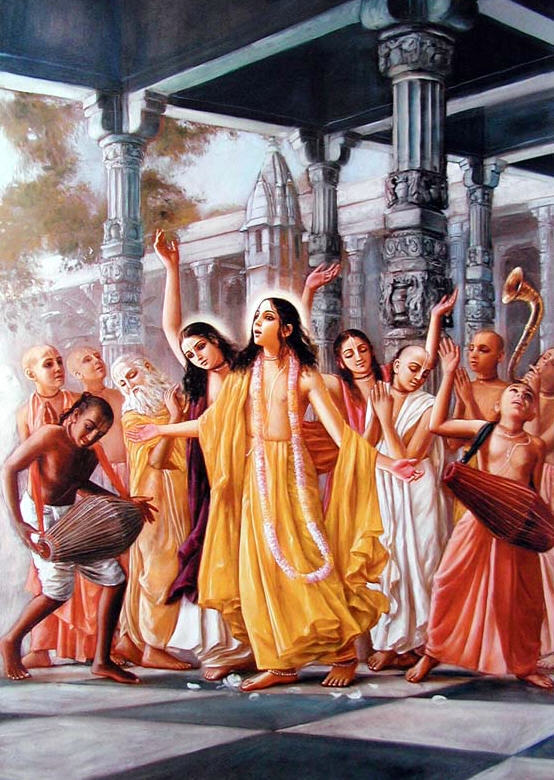
Every year at Jagannatha Puri, Lord Jagannatha's chariot began its slow journey down the broad sandy road toward the Gundicha temple. It was pulled by the temple servants called gaudas, while King Prataparudra himself swept the road ahead with a golden-handled broom. Sri Chaitanya Mahaprabhu came every year to dance in front of that chariot. Krishnadasa Kaviraja Goswami describes this dancing in one particular year in the thirteenth chapter of Chaitanya-charitamrita's Madhya-lila. In that description, Shubhananda Dvija appears briefly as part of an actual scene, not just as a name in a list.
Seven Groups for One Dance #
Mahaprabhu did not dance alone. According to the chapter's own summary, he divided his assembled sankirtana party into seven separate groups, with two mridanga drums in each. So fourteen mridangas sounded together along the road. For the first group, he appointed Damodara Svarupa as chief singer and gave Advaita Acharya the position of dancer. He then organized a second group and made Srivasa Thakura its chief singer (Madhya 13.38). The text goes on to name the men who sang the response to Srivasa Thakura's lead: "Gangadasa, Haridasa, Sriman, Shubhananda and Sri Rama Pandita," while Nityananda Prabhu himself was appointed to dance in that same group (Madhya 13.39). This is the only scene in all the accepted Gaudiya texts that names Shubhananda among other devotees while he is doing something. He is singing in Srivasa Thakura's own party, with Nityananda Prabhu dancing in front of him.
Mahaprabhu moved between all seven groups as they sang. The tradition holds that he was mystically present in each of them at once, so every group felt sure he was dancing with them alone. As the chariot moved on, the groups in the end came together into one huge, loud kirtana, with the Lord dancing in the middle of it all. Somewhere within that great sound of drums and voices, the moment involving Shubhananda took place.
The Foam That Fell From His Mouth #
Dancing before Jagannatha's cart, Mahaprabhu passed into a state of ecstasy so overwhelming that foam appeared at the corner of his mouth. This is one of the known bodily signs of transcendental bhava, and Chaitanya-charitamrita records it again and again through his life. Krishnadasa Kaviraja Goswami gives what happened next in a single couplet: "That foam, taking it, Shubhananda drank. A relisher of the mellow of Krishna-prema, he was very fortunate" (sei phena lañā śubhānanda kaila pāna / kṛṣṇa-prema-rasika teṅho mahā-bhāgyavān, Madhya 13.110).
The two words Krishnadasa Kaviraja chooses to describe him deserve a closer look. Kṛṣṇa-prema-rasika means something more than simply "devoted". A rasika is someone with a trained and refined taste for a particular flavor. Here the flavor is prema, love of Krishna in its most intense, ecstatic form. Mahā-bhāgyavān, "very fortunate," is the author's own judgement on the act. He shows no disgust or surprise that a devotee drank another man's saliva. He shows the opposite, almost envy, that Shubhananda alone in the crowd was placed close enough, and was bold enough, to take that particular prasada. In the world Krishnadasa Kaviraja Goswami is describing, whatever falls from Mahaprabhu's own body in a state of divine ecstasy is not ordinary matter at all.
One Verse, Remembered #
Nothing else is recorded about how Shubhananda came to be standing close enough to Mahaprabhu to do this, what he felt in the moment, or what became of him afterward. He is not shown speaking, and no later chapter returns to him. What survives is this one couplet. There is also his place, earlier in the same chapter, as one of the five singers responding to Srivasa Thakura in that same festival's dancing. For a great many of the devotees who followed Chaitanya, this is all that the historical record usually keeps. There is no biography, only a single, clearly remembered act, written down because someone who was there thought it was worth remembering.
Scriptural evidence for this chapter (3)
Quoted in the text above:
- Madhya 13.110 Sri Chaitanya-charitamrita
Further verses:
advaitere nṛtya karibāre ājñā dila
śrīvāsa — pradhāna āra sampradāya kaila
Word for word
advaitere: unto Advaita Ācārya; nṛtya: dancing; karibāre: for performing; ājñā: order; dila: gave; śrīvāsa: Śrīvāsa Ṭhākura; pradhāna: chief; āra: another; sampradāya: group; kaila: formed.
Advaita Ācārya Prabhu was ordered to dance in the first group. The Lord then formed another group with Śrīvāsa Ṭhākura as the chief man.
From the purport: Purport excerpt: "In the first group, Dāmodara Svarūpa was appointed chief singer, and the responding singers were Dāmodara Paṇḍita, Nārāyaṇa, Govinda Datta, Rāghava Paṇḍita and Govindānanda. Śrī Advaita Ācārya was appointed as a dancer. The next group was formed, and the chief singer was Śrīvāsa Ṭhākura."
Confirms that Damodara Svarupa, not Srivasa Thakura, was chief singer of the first group in which Advaita Acharya danced, before the Lord formed the second group with Srivasa Thakura as its own chief singer, the group Shubhananda sang in.
gaṅgādāsa, haridāsa, śrīmān, śubhānanda
śrī-rāma paṇḍita, tāhāṅ nāce nityānanda
Word for word
gaṅgādāsa: Gaṅgādāsa; haridāsa: Haridāsa; śrīmān: Śrīmān; śubhānanda: Śubhānanda; śrī-rāma paṇḍita: Śrī Rāma Paṇḍita; tāhāṅ: there; nāce: dances; nityānanda: Lord Nityānanda.
The five singers who responded to the singing of Śrīvāsa Ṭhākura were Gaṅgādāsa, Haridāsa, Śrīmān, Śubhānanda and Śrī Rāma Paṇḍita. Śrī Nityānanda Prabhu was appointed as a dancer.
Places Shubhananda as one of the five responding singers in Srivasa Thakura's own kirtana group at the Ratha-yatra, with Nityananda Prabhu dancing in that same group.
Closing
Named as the Fifty-Sixth Branch #
Much of what we know about Mahaprabhu's less famous associates comes from a single, planned way of writing. In the tenth chapter of Adi-lila, Krishnadasa Kaviraja Goswami describes the whole society gathered around Chaitanya as a great tree. The most important devotees are its branches, and their own followers are smaller branches growing from them. It is a long chapter that goes through dozens of names, a few at a time, and Shubhananda's is one of them: "the fifty-fifth branch was Shrinatha Mishra, the fifty-sixth was Shubhananda, the fifty-seventh was Shrirama..." (Adi 10.110). Simply being named as a branch of the tree shows that a devotee had some standing. Krishnadasa Kaviraja was working from a list of devotees that already existed and was, it seems, well known. He did not invent it. But the verse tells us nothing more about Shubhananda than his place in the list. Further details about him come only from Srila Prabhupada's purport to the same verse, and from one other, separate book.
A Manjari Before Gaura-Lila #
Gaudiya Vaishnava tradition holds that many of Chaitanya's male associates had been manjaris in Krishna's own pastimes in Vrindavana. Manjaris are young maidservants of Srimati Radharani, and the tradition holds that they took male form to help Chaitanya's sankirtana mission in this age. This is set out in order in the Gaura-ganoddesha-dipika, a short work in verse by Kavi Karnapura, written in 1576. It lists Radharani's maidservants (Malati, Candralatika, Manjumedha and others) and states that, "assuming male forms," they appeared among Chaitanya's associates. It matches each gopi's name, in order, with the name of a devotee (verses 194-207). The first name on that list, Malati, matches the first name in the list of devotees: Subhananda Dvija. Srila Prabhupada's purport to Chaitanya-charitamrita Adi 10.110 separately confirms the same identity, in almost the same words. Shubhananda, he writes, "formerly lived in Vrindavana as Malati." So two sources, one from the sixteenth century and one from the twentieth, agree on this one point. But neither of them says anything more about what this identity meant for the way Shubhananda lived or served.
Kavi Karnapura's list of maidservants begins with Malati, and the matching list of devotees begins with Shubhananda:
malatī candralatikā mañjumedhā varāṅgadā
...
gaureṇa tat-priyaiḥ sārdhaṁ dhṛta-puruṣa-vigrahaḥ
khelanti sma svabhāvānusārāt tāḥ kramaśo yathā
śubhānando dvijo brahmacārī śrīdhara nāmakaḥ
"Malati, Candralatika, Manjumedha, ... were among the maidservants of Srimati Radharani. Assuming male forms they appeared among Lord Caitanya's associates, and each displayed his particular kind of ecstatic love for the Lord. These gopis became Subhananda Dvija, Sridhara Brahmacari, ... respectively." (Gaura-ganoddesha-dipika 194-199)
Singing in Srivasa Thakura's Group #
Only one scene shows Shubhananda taking part in events, not just named in a list. It is the Ratha-yatra festival at Jagannatha Puri, described at length in Chaitanya-charitamrita's Madhya-lila, chapter thirteen. Each year, as Lord Jagannatha's cart moved slowly toward the Gundicha temple, Mahaprabhu organized his sankirtana party into seven separate groups. Each group had two mridanga drums, so fourteen mridangas sounded at once along the road. For one of these groups, the Lord gave Advaita Acharya the position of dancer, with Damodara Svarupa as chief singer. He then formed another group and made Srivasa Thakura its chief singer (Madhya 13.38). The text names the singers who sang in response to Srivasa Thakura's lead: "Gangadasa, Haridasa, Sriman, Shubhananda and Sri Rama Pandita," and Nityananda Prabhu himself was appointed to dance in that same group (Madhya 13.39). This is the only place in the accepted Gaudiya texts where Shubhananda is shown doing something together with other named devotees, not simply listed. It places him in Srivasa Thakura's own kirtana party.
What the Record Leaves Unanswered #
Beyond these few references, almost nothing is recorded about Shubhananda Dvija as a person. There is no birth date or place, no account of when or how he came to Mahaprabhu, no death date, and no separate biography or scholarly study about him. He does not even have an entry on Wikipedia. One more claim needs care, and should not simply be repeated as fact. The ISKCON-affiliated biography website gaudiyahistory.iskcondesiretree.com states that Shubhananda was also present at the Kheturi festival organized decades later by Narottama Dasa Thakura. But it gives no verse or written source for this detail. Its other statements about him can all be traced to the Chaitanya-charitamrita passages above. If the claim is accurate, it would mean that Shubhananda lived to an old age after Mahaprabhu's own disappearance. But since no early source can be quoted for it, the claim is best treated as devotional tradition, not as established fact.
- Sri Chaitanya-charitamrita, Adi-lila 10.110 (vedabase.io)
- Sri Chaitanya-charitamrita, Madhya-lila 13.38-39 (vedabase.io)
- Sri Chaitanya-charitamrita, Madhya-lila 13.110 (vedabase.io)
- Sri Gaura-ganoddesha-dipika, verses 187-212 (English translation)
- Shubhananada Dvija — Gaudiya History (ISKCON Desire Tree)
