A Bag That Never Stayed Full #
Every morning in Navadwip, Shuklambara Brahmachari slung a cloth bag over his shoulder and walked from door to door asking for rice. It was not a large ambition. He kept just enough to offer and eat. The rest of his day went to chanting the names of Krishna, with tears running down his face as he walked the same lanes again and again. Neighbors who judged by appearance saw only a beggar. But Sri Chaitanya Mahaprabhu saw something else. Sri Chaitanya-charitamrita records the result in one short verse: the Lord would jokingly or seriously beg food from Shuklambara Brahmachari, or simply snatch it from him and eat it (Adi 10.38). That one line, in a long list of the Lord's associates, is all that Shuklambara Brahmachari is famous for. If we read it carefully, it also tells us that this happened more than once.
The Lord Could Not Wait #
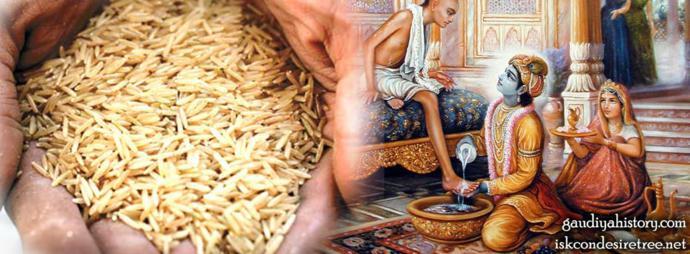
Chaitanya-charitamrita preserves at least one of those occasions in detail. Shuklambara Brahmachari lived by the Ganges in Navadwip. One day he came upon Sri Chaitanya Mahaprabhu dancing in ecstasy. At that moment no one was thinking about the rice in Shuklambara's begging bag. Mahaprabhu was so pleased with him that He reached into the bag Shuklambara carried, pulled out a fistful of raw, unhusked rice, and began eating it on the spot. No one present tried to stop Him, and He did not stop Himself. He went on until the entire supply was finished (Adi 17.20). This is a startling detail in the life story of a man who is otherwise little known. By Krishnadasa Kaviraja Goswami's own account, the Supreme Personality of Godhead could not wait for the rice to be cooked.
Birth After Birth Your Poor Servant #
Sri Chaitanya-bhagavata takes the same event further, with a speech that gives it its meaning. Vrindavana Dasa Thakura records that Mahaprabhu turned to Shuklambara Brahmachari and told him that birth after birth he had remained the Lord's poor servant, always offering everything and keeping nothing back for himself. The Lord also told him that if he did not give it willingly, the Lord would simply take it by force, exactly as He had done once before. The reference is to Krishna's own life. In Dwaraka, it is remembered, Krishna once snatched a hidden sack of chipped rice, and Rukmini Devi caught His hand and tried to stop Him (Chaitanya-bhagavata, Madhya-khanda, chapter 16). The comparison places Shuklambara Brahmachari inside a much older story. He is not a small side note in it. He is a second example of the very same mercy.
An Echo at Shrivasa's House #
The pastime did not happen on just one afternoon. Narahari Chakravarti's later chronicle Bhakti-ratnakara records another moment of the same kind, this time in the house of Srivasa Thakura. Mahaprabhu was absorbed in kirtana. As Shuklambara passed by, the Lord put His hand into Shuklambara's begging bag, drew out a handful of unwashed rice, and called him Sudama, the name of Krishna's own poor brahmana friend from Dwaraka. Shuklambara kept dancing through the kirtana with the bag still hanging from his shoulder. He was too moved to do anything else, while the devotees around him watched their own feelings rise to match his. The repetition matters. This was not a single playful act of the Lord. It was a known exchange between the two of them that happened again and again. Others saw it often enough for it to be written down twice, in two different books.
Rice Beside the Holy Name #
The Adi 17.20 episode is more than a charming little story because of what Krishnadasa Kaviraja Goswami places right beside it. Right after eating Shuklambara Brahmachari's raw rice, Mahaprabhu began a long and detailed explanation of the harer nama verse from the Brihan-naradiya Purana. This verse is celebrated across the Gaudiya tradition because it declares that chanting the holy name is the one sure way to cross the difficulties of the age. The verse says, "In this Age of Kali there is no other means, no other means, no other means for self-realization than chanting the holy name, chanting the holy name, chanting the holy name of Lord Hari" (Adi 17.21). Krishnadasa Kaviraja Goswami does not treat these as two unrelated events reported side by side. He places the explanation directly after the meal, in the same ecstatic mood. So a poor man's begged rice, eaten raw by the Lord, leads straight into one of the tradition's central teachings on the holy name. This link is easy to miss if the rice-snatching is read only as a curious story.
Not a Story About Wealth #
It would be easy to read all of this as a story about food. It is really a story about what the Lord notices. Shuklambara Brahmachari owned nothing worth mentioning. He had no scholarship to offer and no household to invite the Lord into. This is exactly the point that every source keeps returning to. His poverty was never a barrier to Mahaprabhu's affection. If anything, his poverty was the very thing the Lord approached with more eagerness, not less. The fuller story of their relationship at Shuklambara's home is told separately. It includes the night Mahaprabhu's own devotees gathered under Shuklambara's roof, and the cooked meal the Lord later called the finest of His life. See The Meal at Shuklambara's House for that account.
