Shuklambara Brahmachari
The Poor Brahmachari Whose Rice the Lord Could Not Resist
The complete life, on one page: The main biography and every pastime page, in order, in one place
Introduction
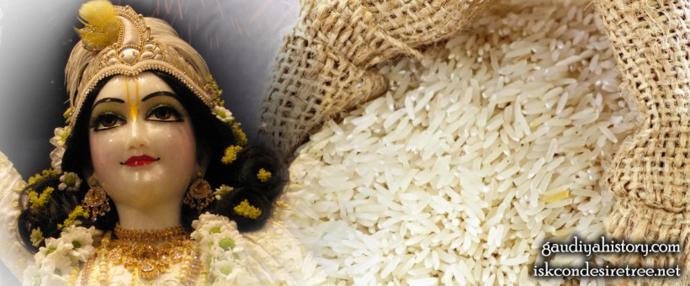
Shuklambara Brahmachari was a poor, unmarried brahmachari of Navadwip. He kept himself alive by begging rice from door to door. Today he is remembered for one thing above all: Sri Chaitanya Mahaprabhu loved to eat what he begged. In Sri Chaitanya-charitamrita, Krishnadasa Kaviraja Goswami counts him among the main branches of the Lord's devotee-tree. Sri Chaitanya-bhagavata records several separate occasions when Mahaprabhu came looking for his rice, snatched it straight from his bag, or asked him to cook a full meal. No known source tells us about his family, his age, or the year he was born or passed away. Only these few, clear glimpses of him survive. They show a devotee whose poverty the Lord treated as a kind of wealth.
| Detail | Description |
|---|---|
| Name | Shuklambara Brahmachari (also spelled Suklambara, Shuklambar) |
| Role | Poor mendicant brahmachari of Navadwip; an early, close companion of Sri Chaitanya Mahaprabhu |
| Home | Navadwip, on the bank of the Ganges |
| Livelihood | Begged rice door to door; offered it and ate what remained |
| Principal sources | Sri Chaitanya-charitamrita, Adi-lila 10.38 and 17.20; Sri Chaitanya-bhagavata |
| Identity | One of the yajna-patnis who fed Krishna; some say one of their brahmana husbands (Gaura-ganoddesha-dipika 191; Chaitanya-charitamrita Adi 10.38 purport) |
| Birth / disappearance | Not recorded in any known source |
Scriptural evidence for the introduction (2)
শুক্লাম্বর–ব্রহ্মচারী বড় ভাগ্যবান্ ।
যাঁর অন্ন মাগি’ কাড়ি’ খাইলা ভগবান্ ॥
śuklāmbara-brahmacārī baḍa bhāgyavān
yāṅra anna māgi' kāḍi' khāilā bhagavān
Word for word
śuklāmbara-brahmacārī: Śuklāmbara Brahmacārī; baḍa: very; bhāgyavān: fortunate; yāṅra: whose; anna: food; māgi': begging; kāḍi': snatching; khāilā: ate; bhagavān: the Supreme Personality of Godhead.
The sixteenth branch, Shuklambara Brahmachari, was very fortunate because Lord Chaitanya Mahaprabhu jokingly or seriously begged food from him or sometimes snatched it from him forcibly and ate it.
From the purport: It is stated that Śuklāmbara Brahmacārī, an inhabitant of Navadvīpa, was Lord Caitanya Mahāprabhu’s first companion in the saṅkīrtana movement. When Lord Caitanya returned from Gayā after initiation, He stayed with Śuklāmbara Brahmacārī because He wanted to hear from this devotee about the pastimes of Lord Kṛṣṇa. ... It is said that Śuklāmbara Brahmacārī was one of the wives of the yajñic brāhmaṇas during the time of Lord Kṛṣṇa’s pastimes in Vṛndāvana. Lord Kṛṣṇa begged food from the wives of the yajñic brāhmaṇas, and Lord Caitanya Mahāprabhu performed a similar pastime by begging rice from Śuklāmbara Brahmacārī.
The verse the main biography quotes as its pull-quote; the purport is the primary source for Shuklambara Brahmachari being counted among the Lord's earliest companions and for the Gaya-return visit described on the main page and in The Meal at Shuklambara's House.
शुक्लाम्बरो ब्रह्मचारी पुरासीद्यज्ञपत्निका ।
प्रार्थयित्वा यदन्नं श्रीगौराङ्गो भुक्तवान्प्रभुः ।
केचिदाहुर्ब्रह्मचारी याज्ञिकब्राह्मणः पुरा ॥१९१॥
śuklāmbaro brahmacārī purāsīd yajña-patnikā |
prārthayitvā yad-annaṁ śrī-gaurāṅgo bhuktavān prabhuḥ |
kecid āhur brahmacārī yājñika-brāhmaṇaḥ purā ||191||
Suklambara Brahmacari was the incarnation of one of the yajna-patnis who gave food in charity to Krsna and his friends. Lord Caitanya was accustomed to eating food He had begged from Suklambara Brahmacari. Some say that Suklambara Brahmacari was not one of the yajna-patnis, but one of their husbands, the yajnika-brahmanas.
Kavi Karnapura's identification of Shuklambara Brahmachari's earlier role in Krishna-lila, with the second reading he also records. Sanskrit: diacritic edition of the Gaura-ganoddesha-dipika; English translation as published at bvmlu.org.
Chapter 1
The Rice from the Begging Bag
Sri Chaitanya Mahaprabhu snatched raw rice from a poor brahmachari's begging bag and ate it on the spot, an act Chaitanya-charitamrita and Chaitanya-bhagavata both remember in detail.
A Bag That Never Stayed Full #
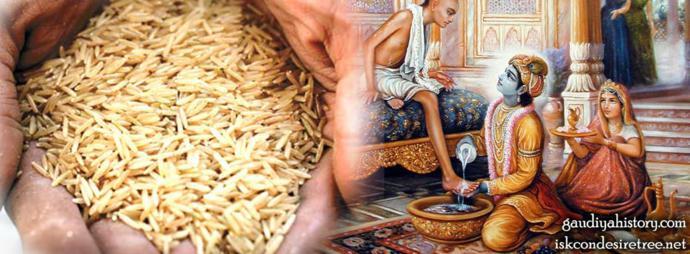
Every morning in Navadwip, Shuklambara Brahmachari slung a cloth bag over his shoulder and walked from door to door asking for rice. It was not a large ambition. He kept just enough to offer and eat. The rest of his day went to chanting the names of Krishna, with tears running down his face as he walked the same lanes again and again. Neighbors who judged by appearance saw only a beggar. But Sri Chaitanya Mahaprabhu saw something else. Sri Chaitanya-charitamrita records the result in one short verse: the Lord would jokingly or seriously beg food from Shuklambara Brahmachari, or simply snatch it from him and eat it (Adi 10.38). That one line, in a long list of the Lord's associates, is all that Shuklambara Brahmachari is famous for. If we read it carefully, it also tells us that this happened more than once.
The Lord Could Not Wait #
Chaitanya-charitamrita preserves at least one of those occasions in detail. Shuklambara Brahmachari lived by the Ganges in Navadwip. One day he came upon Sri Chaitanya Mahaprabhu dancing in ecstasy. At that moment no one was thinking about the rice in Shuklambara's begging bag. Mahaprabhu was so pleased with him that He reached into the bag Shuklambara carried, pulled out a fistful of raw, unhusked rice, and began eating it on the spot. No one present tried to stop Him, and He did not stop Himself. He went on until the entire supply was finished (Adi 17.20). This is a startling detail in the life story of a man who is otherwise little known. By Krishnadasa Kaviraja Goswami's own account, the Supreme Personality of Godhead could not wait for the rice to be cooked.
Birth After Birth Your Poor Servant #
Sri Chaitanya-bhagavata takes the same event further, with a speech that gives it its meaning. Vrindavana Dasa Thakura records that Mahaprabhu turned to Shuklambara Brahmachari and told him that birth after birth he had remained the Lord's poor servant, always offering everything and keeping nothing back for himself. The Lord also told him that if he did not give it willingly, the Lord would simply take it by force, exactly as He had done once before. The reference is to Krishna's own life. In Dwaraka, it is remembered, Krishna once snatched a hidden sack of chipped rice, and Rukmini Devi caught His hand and tried to stop Him (Chaitanya-bhagavata, Madhya-khanda, chapter 16). The comparison places Shuklambara Brahmachari inside a much older story. He is not a small side note in it. He is a second example of the very same mercy.
An Echo at Shrivasa's House #
The pastime did not happen on just one afternoon. Narahari Chakravarti's later chronicle Bhakti-ratnakara records another moment of the same kind, this time in the house of Srivasa Thakura. Mahaprabhu was absorbed in kirtana. As Shuklambara passed by, the Lord put His hand into Shuklambara's begging bag, drew out a handful of unwashed rice, and called him Sudama, the name of Krishna's own poor brahmana friend from Dwaraka. Shuklambara kept dancing through the kirtana with the bag still hanging from his shoulder. He was too moved to do anything else, while the devotees around him watched their own feelings rise to match his. The repetition matters. This was not a single playful act of the Lord. It was a known exchange between the two of them that happened again and again. Others saw it often enough for it to be written down twice, in two different books.
Rice Beside the Holy Name #
The Adi 17.20 episode is more than a charming little story because of what Krishnadasa Kaviraja Goswami places right beside it. Right after eating Shuklambara Brahmachari's raw rice, Mahaprabhu began a long and detailed explanation of the harer nama verse from the Brihan-naradiya Purana. This verse is celebrated across the Gaudiya tradition because it declares that chanting the holy name is the one sure way to cross the difficulties of the age. The verse says, "In this Age of Kali there is no other means, no other means, no other means for self-realization than chanting the holy name, chanting the holy name, chanting the holy name of Lord Hari" (Adi 17.21). Krishnadasa Kaviraja Goswami does not treat these as two unrelated events reported side by side. He places the explanation directly after the meal, in the same ecstatic mood. So a poor man's begged rice, eaten raw by the Lord, leads straight into one of the tradition's central teachings on the holy name. This link is easy to miss if the rice-snatching is read only as a curious story.
Not a Story About Wealth #
It would be easy to read all of this as a story about food. It is really a story about what the Lord notices. Shuklambara Brahmachari owned nothing worth mentioning. He had no scholarship to offer and no household to invite the Lord into. This is exactly the point that every source keeps returning to. His poverty was never a barrier to Mahaprabhu's affection. If anything, his poverty was the very thing the Lord approached with more eagerness, not less. The fuller story of their relationship at Shuklambara's home is told separately. It includes the night Mahaprabhu's own devotees gathered under Shuklambara's roof, and the cooked meal the Lord later called the finest of His life. See The Meal at Shuklambara's House for that account.
Scriptural evidence for this chapter (2)
Quoted in the text above:
- Adi 17.21 Sri Chaitanya-charitamrita
Further verses:
তবে শুক্লাম্বরের কৈল তণ্ডুল ভক্ষণ ।
‘হরের্নাম’ শ্লোকের কৈল অর্থ বিবরণ ॥
tabe śuklāmbarera kaila taṇḍula-bhakṣaṇa
'harer nāma' ślokera kaila artha vivaraṇa
Word for word
tabe: thereafter; śuklāmbarera: of Shuklambara Brahmacari; kaila: did; taṇḍula: raw rice; bhakṣaṇa: eating; harer nāma ślokera: of the verse celebrated as such; kaila: did; artha: of the meaning; vivaraṇa: explanation.
After this incident the Lord ate raw rice given by Shuklambara Brahmachari and explained very elaborately the import of the "harer nama" shloka mentioned in the Brihan-naradiya Purana.
From the purport: Purport excerpt: "When Shri Chaitanya Mahaprabhu was dancing in ecstasy, he approached the Lord with a begging bag containing rice. The Lord was so pleased with His devotee that He immediately snatched the bag and began to eat the raw rice. No one forbade Him, and thus He finished the entire supply of rice."
The central textual source for this pastime page: the raw-rice episode and its direct link to Mahaprabhu's discourse on the harer-nama verse, in Krishnadasa Kaviraja Goswami's own account.
Chapter 2
The Meal at Shuklambara's House
The night the Lord's closest devotees gathered under a beggar's roof, and the cooked meal He later called the most delicious of His entire life.
Home from Gaya #
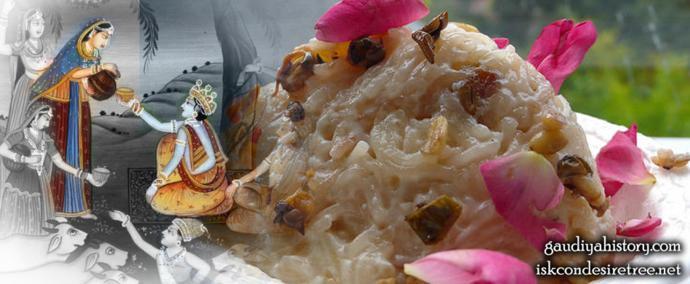
When Sri Chaitanya Mahaprabhu returned to Navadwip from Gaya after receiving initiation there, He did not go first to His own household. According to the purport tradition that goes with Chaitanya-charitamrita, He went to Shuklambara Brahmachari's home, because He wanted to hear from him about the pastimes of Lord Krishna (Adi 10.38). This is one of the more striking details in the whole account. Of everyone in Navadwip whom the newly initiated Lord might have gone to see, He chose the house of a man who owned nothing but a begging bag. Sri Chaitanya-bhagavata describes a fuller scene at that same house not long afterward. That scene, and the meal that followed it, are told below.
Gadadhara's Eavesdropping #
Shriman Pandit carried the news along the bank of the Ganges that the Lord would meet with His devotees that night at Shuklambara Brahmachari's house. When Gadadhara Pandit heard of it, he hurried there ahead of the others and hid himself inside. He hoped to overhear whatever Mahaprabhu might say about Krishna's pastimes without being noticed. He did not have to hide for long. One by one the Lord's intimate associates arrived. Among them were Sadashiva, Murari Gupta, Shriman Pandit, and Shuklambara Brahmachari himself, the host of the gathering. Then Vishvambhara, as Mahaprabhu was known before sannyasa, appeared among them (Chaitanya-bhagavata, Madhya-khanda, chapter 1). What followed was an ecstasy that few of those present could find words for. Srivasa Thakura and the others who witnessed it later said that the Lord's transformations that night were unlike anything they had seen. And Gadadhara Pandit's hiding place turned out to be the closest seat in the house.
The Sadashiva named here is Sadashiva Pandit. His own life story also records this night gathering, with Shuklambara, Shriman Pandit and Murari Gupta present.
A Meal He Was Afraid to Cook #
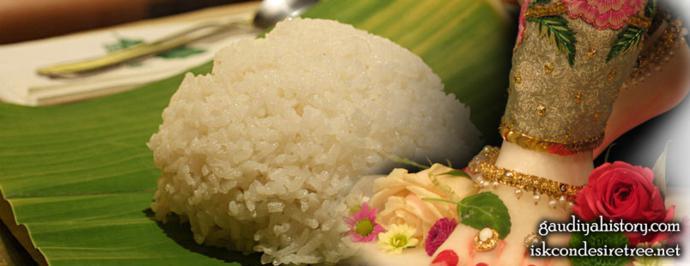
Some time after this, Mahaprabhu told Shuklambara Brahmachari that He wished to eat a full meal at his house. The announcement frightened him more than it pleased him. He begged rice for a living. What could he possibly set before the Lord that would be fit to serve? Mahaprabhu repeated that this was truly His wish. So Shuklambara went to the other devotees for advice. They told him that if he cooked the meal without touching the rice with his hands, this would solve the problem. On the appointed day he bathed, dressed, lit the stove, and set water to boil. Then, without letting his hands touch the grain, he poured the rice in along with a piece of plantain-tree pith. He chanted Krishna's names the entire time: Jaya Krishna Gopal, Govinda, Vanamali (Chaitanya-bhagavata, Madhya-khanda, chapter 26). Tradition holds that Lakshmi Devi herself blessed the pot with a glance as it cooked.
The Best Meal of His Life #
When Mahaprabhu arrived with His associates, He first offered the finished rice and vegetables to Vishnu with His own hand, as is proper before any meal is eaten. Then He sat down to eat the meal: a beggar's begged rice, boiled with nothing more than plantain pith. Chaitanya-bhagavata records what He said afterward, in words that have stayed with the story ever since: in His entire life, He said, He had never eaten anything so delicious (Madhya-khanda, chapter 26). The devotees who were there wept at what they were seeing. They did not weep over the food. They wept because the Lord's pleasure in it showed how much He valued a poor man's love.
Wealth the Rich Could Not Buy #
Chaitanya-bhagavata ends the episode by drawing its own moral, and we state it plainly here. No amount of wealth, high birth, or scholarship could have bought what Shuklambara Brahmachari received that day. This is because the Lord's mercy responds only to devotion, never to what a person owns. The Rice from the Begging Bag carries the same lesson. Mahaprabhu once snatched raw rice straight from Shuklambara's bag. Later He praised Shuklambara's cooked meal above every other meal of His life. In the end, these were the same offering, made by the same poor man, and accepted the same way both times. Nothing survives about Shuklambara Brahmachari's life before or after these episodes and the earlier gathering under his roof. The record keeps only the meals. The tradition judged that only the meals, or really the love inside them, were worth keeping.
Closing
A Beggar's Bag in Navadwip #
When Krishnadasa Kaviraja Goswami describes the associates of Sri Chaitanya Mahaprabhu as branches growing from a single tree, he names Shuklambara Brahmachari as the sixteenth branch. So a poor man stands in a list that also holds scholars, kings, and renunciate goswamis. The purport to that verse explains that Shuklambara Brahmachari lived in Navadwip. It also says, remarkably, that he was Mahaprabhu's first companion in the sankirtana movement itself. When the Lord returned to Navadwip from Gaya after receiving initiation there, He went and stayed at Shuklambara Brahmachari's home, because He wanted to hear from him about the pastimes of Lord Krishna. This detail alone shows the place this poor brahmachari held in Mahaprabhu's early life. The Lord chose him, ahead of wealthier or more learned devotees, as someone whose company He Himself sought out.
A Servant Since Krishna's Own Pastimes #
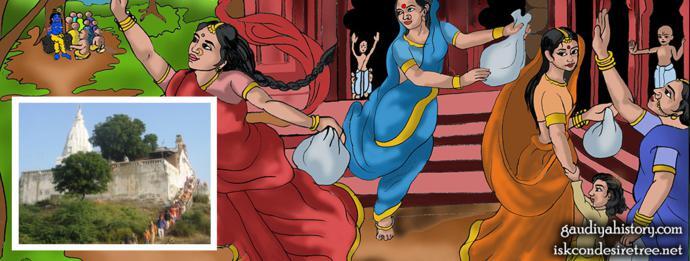
The Gaura-ganoddesha-dipika is a traditional Gaudiya text. It links each of Mahaprabhu's Navadwip associates with a figure from Krishna's own pastimes in Vraja. It identifies Shuklambara Brahmachari (verse 191) as formerly one of the yajna-patnis. These were the wives of the ritualist brahmanas who were performing a sacrifice. They secretly carried food out to Krishna and His cowherd friends in the forest, and they broke their husbands' rules to do so. The same verse notes that some record him instead as one of the yajnika brahmanas themselves, the husbands and not the wives. The tradition keeps both readings side by side and does not settle the question. Either way, this identity explains why Mahaprabhu's pastime with him takes the form it does. In Krishna-lila, Krishna begged food from the yajna-patnis. In Gaura-lila, Chaitanya Mahaprabhu begged, and sometimes simply took, food from Shuklambara Brahmachari. The two pastimes mirror each other by design.
Here are Kavi Karnapura's own words in the Gaura-ganoddesha-dipika (verse 191):
śuklāmbaro brahmacārī purāsīd yajña-patnikā
prārthayitvā yad-annaṁ śrī-gaurāṅgo bhuktavān prabhuḥ
kecid āhur brahmacārī yājñika-brāhmaṇaḥ purā
"Suklambara Brahmacari was the incarnation of one of the yajna-patnis who gave food in charity to Krsna and his friends. Lord Caitanya was accustomed to eating food He had begged from Suklambara Brahmacari. Some say that Suklambara Brahmacari was not one of the yajna-patnis, but one of their husbands, the yajnika-brahmanas." (Gaura-ganoddesha-dipika 191)
Srila Prabhupada gives the same identity in his purport to Chaitanya-charitamrita Adi 10.38: "It is said that Śuklāmbara Brahmacārī was one of the wives of the yajñic brāhmaṇas during the time of Lord Kṛṣṇa’s pastimes in Vṛndāvana. Lord Kṛṣṇa begged food from the wives of the yajñic brāhmaṇas, and Lord Caitanya Mahāprabhu performed a similar pastime by begging rice from Śuklāmbara Brahmacārī."
An Honest Gap in the Record #
Outside of these few, specific episodes, almost nothing is recorded about Shuklambara Brahmachari. No known source gives his birth year, his family, or any account of his life after these Navadwip pastimes. No samadhi site of his own, and no written work credited to him, has been found in any known source either. What remains is exactly what Krishnadasa Kaviraja Goswami and Vrindavana Dasa Thakura chose to preserve: a handful of meals, remembered because of who ate them.
- Sri Chaitanya-charitamrita, Adi-lila 10.38 (text, synonyms, translation, purport)
- Sri Chaitanya-charitamrita, Adi-lila 17.20 (text, synonyms, translation, purport)
- Shuklambara Brahmachari — biography and compiled Chaitanya-bhagavata / Gaura-ganoddesha-dipika references
- Shuklambara Brahmachari — biography (Gaura-ganoddesha-dipika and further Chaitanya-bhagavata references)
