Home from Gaya #
When Sri Chaitanya Mahaprabhu returned to Navadwip from Gaya after receiving initiation there, He did not go first to His own household. According to the purport tradition that goes with Chaitanya-charitamrita, He went to Shuklambara Brahmachari's home, because He wanted to hear from him about the pastimes of Lord Krishna (Adi 10.38). This is one of the more striking details in the whole account. Of everyone in Navadwip whom the newly initiated Lord might have gone to see, He chose the house of a man who owned nothing but a begging bag. Sri Chaitanya-bhagavata describes a fuller scene at that same house not long afterward. That scene, and the meal that followed it, are told below.
Gadadhara's Eavesdropping #
Shriman Pandit carried the news along the bank of the Ganges that the Lord would meet with His devotees that night at Shuklambara Brahmachari's house. When Gadadhara Pandit heard of it, he hurried there ahead of the others and hid himself inside. He hoped to overhear whatever Mahaprabhu might say about Krishna's pastimes without being noticed. He did not have to hide for long. One by one the Lord's intimate associates arrived. Among them were Sadashiva, Murari Gupta, Shriman Pandit, and Shuklambara Brahmachari himself, the host of the gathering. Then Vishvambhara, as Mahaprabhu was known before sannyasa, appeared among them (Chaitanya-bhagavata, Madhya-khanda, chapter 1). What followed was an ecstasy that few of those present could find words for. Srivasa Thakura and the others who witnessed it later said that the Lord's transformations that night were unlike anything they had seen. And Gadadhara Pandit's hiding place turned out to be the closest seat in the house.
The Sadashiva named here is Sadashiva Pandit. His own life story also records this night gathering, with Shuklambara, Shriman Pandit and Murari Gupta present.
A Meal He Was Afraid to Cook #
Some time after this, Mahaprabhu told Shuklambara Brahmachari that He wished to eat a full meal at his house. The announcement frightened him more than it pleased him. He begged rice for a living. What could he possibly set before the Lord that would be fit to serve? Mahaprabhu repeated that this was truly His wish. So Shuklambara went to the other devotees for advice. They told him that if he cooked the meal without touching the rice with his hands, this would solve the problem. On the appointed day he bathed, dressed, lit the stove, and set water to boil. Then, without letting his hands touch the grain, he poured the rice in along with a piece of plantain-tree pith. He chanted Krishna's names the entire time: Jaya Krishna Gopal, Govinda, Vanamali (Chaitanya-bhagavata, Madhya-khanda, chapter 26). Tradition holds that Lakshmi Devi herself blessed the pot with a glance as it cooked.
The Best Meal of His Life #
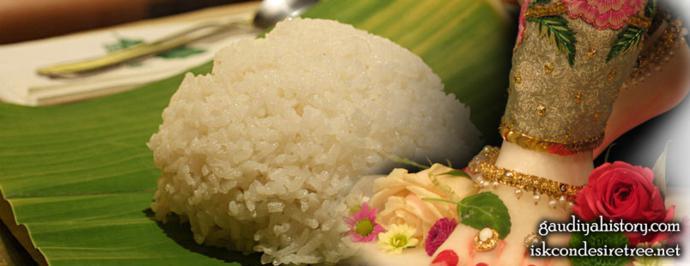
When Mahaprabhu arrived with His associates, He first offered the finished rice and vegetables to Vishnu with His own hand, as is proper before any meal is eaten. Then He sat down to eat the meal: a beggar's begged rice, boiled with nothing more than plantain pith. Chaitanya-bhagavata records what He said afterward, in words that have stayed with the story ever since: in His entire life, He said, He had never eaten anything so delicious (Madhya-khanda, chapter 26). The devotees who were there wept at what they were seeing. They did not weep over the food. They wept because the Lord's pleasure in it showed how much He valued a poor man's love.
Wealth the Rich Could Not Buy #
Chaitanya-bhagavata ends the episode by drawing its own moral, and we state it plainly here. No amount of wealth, high birth, or scholarship could have bought what Shuklambara Brahmachari received that day. This is because the Lord's mercy responds only to devotion, never to what a person owns. The Rice from the Begging Bag carries the same lesson. Mahaprabhu once snatched raw rice straight from Shuklambara's bag. Later He praised Shuklambara's cooked meal above every other meal of His life. In the end, these were the same offering, made by the same poor man, and accepted the same way both times. Nothing survives about Shuklambara Brahmachari's life before or after these episodes and the earlier gathering under his roof. The record keeps only the meals. The tradition judged that only the meals, or really the love inside them, were worth keeping.
