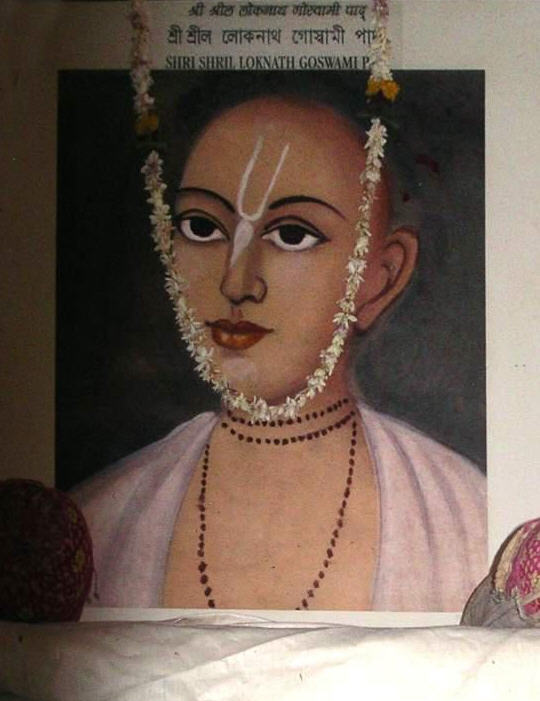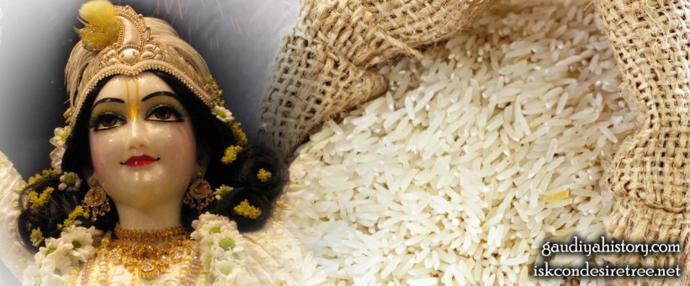
Shuklambara Brahmachari
The Poor Brahmachari Whose Rice the Lord Could Not Resist
Also known as Suklambara Brahmachari, Shuklambar Brahmachari, Suklambar Brahmacari
“The sixteenth branch, Shuklambara Brahmachari, was very fortunate because Lord Chaitanya Mahaprabhu jokingly or seriously begged food from him or sometimes snatched it from him forcibly and ate it.”
Sri Chaitanya-charitamrita, Adi-lila 10.38, Krishnadasa Kaviraja Goswami describing Shuklambara Brahmachari as the sixteenth branch of the Chaitanya tree
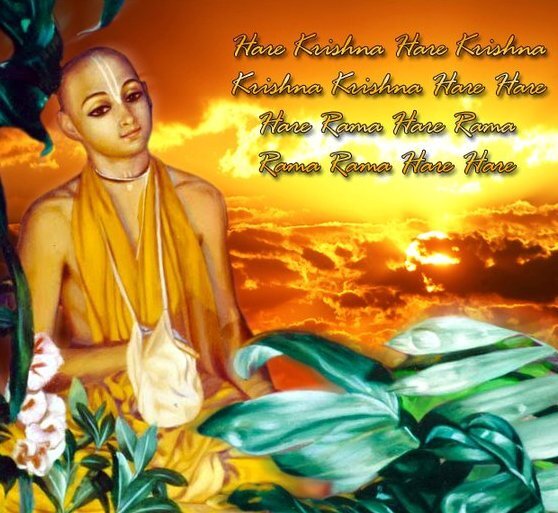
Shuklambara Brahmachari was a poor, unmarried brahmachari of Navadwip. He kept himself alive by begging rice from door to door. Today he is remembered for one thing above all: Sri Chaitanya Mahaprabhu loved to eat what he begged. In Sri Chaitanya-charitamrita, Krishnadasa Kaviraja Goswami counts him among the main branches of the Lord's devotee-tree. Sri Chaitanya-bhagavata records several separate occasions when Mahaprabhu came looking for his rice, snatched it straight from his bag, or asked him to cook a full meal. No known source tells us about his family, his age, or the year he was born or passed away. Only these few, clear glimpses of him survive. They show a devotee whose poverty the Lord treated as a kind of wealth.
| Detail | Description |
|---|---|
| Name | Shuklambara Brahmachari (also spelled Suklambara, Shuklambar) |
| Role | Poor mendicant brahmachari of Navadwip; an early, close companion of Sri Chaitanya Mahaprabhu |
| Home | Navadwip, on the bank of the Ganges |
| Livelihood | Begged rice door to door; offered it and ate what remained |
| Principal sources | Sri Chaitanya-charitamrita, Adi-lila 10.38 and 17.20; Sri Chaitanya-bhagavata |
| Identity | One of the yajna-patnis who fed Krishna; some say one of their brahmana husbands (Gaura-ganoddesha-dipika 191; Chaitanya-charitamrita Adi 10.38 purport) |
| Birth / disappearance | Not recorded in any known source |
A Beggar's Bag in Navadwip #
When Krishnadasa Kaviraja Goswami describes the associates of Sri Chaitanya Mahaprabhu as branches growing from a single tree, he names Shuklambara Brahmachari as the sixteenth branch. So a poor man stands in a list that also holds scholars, kings, and renunciate goswamis. The purport to that verse explains that Shuklambara Brahmachari lived in Navadwip. It also says, remarkably, that he was Mahaprabhu's first companion in the sankirtana movement itself. When the Lord returned to Navadwip from Gaya after receiving initiation there, He went and stayed at Shuklambara Brahmachari's home, because He wanted to hear from him about the pastimes of Lord Krishna. This detail alone shows the place this poor brahmachari held in Mahaprabhu's early life. The Lord chose him, ahead of wealthier or more learned devotees, as someone whose company He Himself sought out.
Not the Banana-Seller #
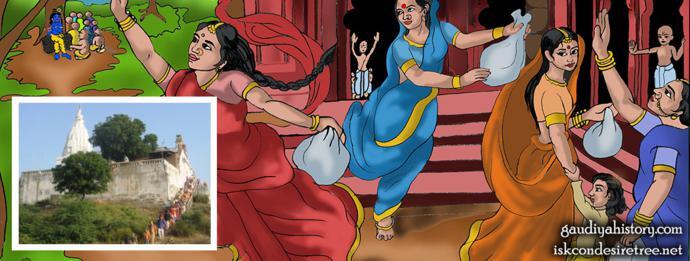
Some casual retellings of Mahaprabhu's Navadwip years describe a poor devotee whose humble offering of bananas the Lord accepted with special tenderness. When we check Chaitanya-charitamrita and Chaitanya-bhagavata, we find that this is not Shuklambara Brahmachari's story. His story, told again and again across several chapters, is about rice. It is rice begged from house to house, rice snatched raw from his bag, and rice cooked and praised as the most delicious meal of the Lord's life (see The Meal at Shuklambara's House). The banana story more likely belongs to Kholavecha Shridhara. He was the Navadwip seller of bananas and vegetables whose very name means "banana-seller" (kola), and Mahaprabhu often visited his shop too. The two are easy to mix up, because both were poor Navadwip devotees whose ordinary daily trade became the setting for the Lord's mercy. Only one detail in Shuklambara's own story is connected with bananas, and it is about cooking, not an offering. When he once prepared a meal for the Lord, he boiled the rice together with a piece of plantain-tree pith. This was an everyday ingredient, not a gift of fruit.
A Servant Since Krishna's Own Pastimes #
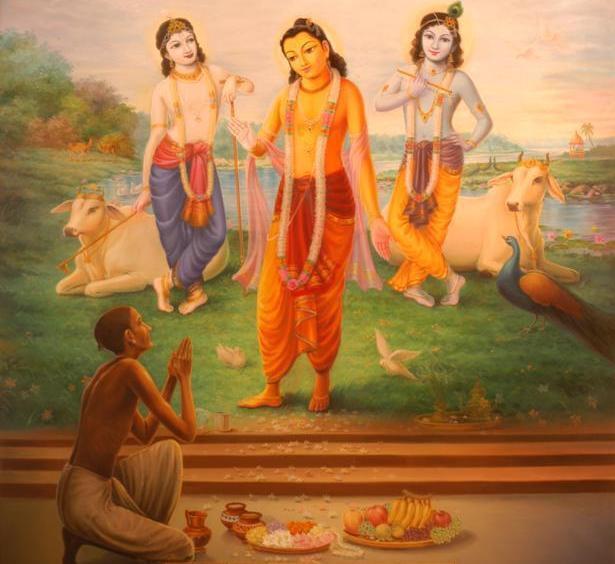
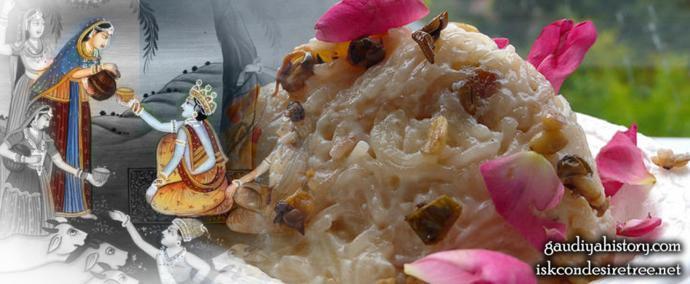
The Gaura-ganoddesha-dipika is a traditional Gaudiya text. It links each of Mahaprabhu's Navadwip associates with a figure from Krishna's own pastimes in Vraja. It identifies Shuklambara Brahmachari (verse 191) as formerly one of the yajna-patnis. These were the wives of the ritualist brahmanas who were performing a sacrifice. They secretly carried food out to Krishna and His cowherd friends in the forest, and they broke their husbands' rules to do so. The same verse notes that some record him instead as one of the yajnika brahmanas themselves, the husbands and not the wives. The tradition keeps both readings side by side and does not settle the question. Either way, this identity explains why Mahaprabhu's pastime with him takes the form it does. In Krishna-lila, Krishna begged food from the yajna-patnis. In Gaura-lila, Chaitanya Mahaprabhu begged, and sometimes simply took, food from Shuklambara Brahmachari. The two pastimes mirror each other by design.
Here are Kavi Karnapura's own words in the Gaura-ganoddesha-dipika (verse 191):
śuklāmbaro brahmacārī purāsīd yajña-patnikā
prārthayitvā yad-annaṁ śrī-gaurāṅgo bhuktavān prabhuḥ
kecid āhur brahmacārī yājñika-brāhmaṇaḥ purā
"Suklambara Brahmacari was the incarnation of one of the yajna-patnis who gave food in charity to Krsna and his friends. Lord Caitanya was accustomed to eating food He had begged from Suklambara Brahmacari. Some say that Suklambara Brahmacari was not one of the yajna-patnis, but one of their husbands, the yajnika-brahmanas." (Gaura-ganoddesha-dipika 191)
Srila Prabhupada gives the same identity in his purport to Chaitanya-charitamrita Adi 10.38: "It is said that Śuklāmbara Brahmacārī was one of the wives of the yajñic brāhmaṇas during the time of Lord Kṛṣṇa’s pastimes in Vṛndāvana. Lord Kṛṣṇa begged food from the wives of the yajñic brāhmaṇas, and Lord Caitanya Mahāprabhu performed a similar pastime by begging rice from Śuklāmbara Brahmacārī."
The Rice the Lord Could Not Resist #
Sri Chaitanya-charitamrita records the heart of this pastime in one often-quoted verse. The text says that Shuklambara Brahmachari was very fortunate, because the Lord would beg food from him, jokingly or seriously, and sometimes simply snatch it and eat it (Adi 10.38). A second verse, later in the same volume, links one such occasion with a much larger teaching. Mahaprabhu ate raw rice given by Shuklambara Brahmachari. Then, moved by that same ecstatic mood, He explained at length the meaning of the famous harer nama verse from the Brihan-naradiya Purana on chanting the holy name (Adi 17.20). In other words, a poor man's begged rice stands right beside one of the tradition's central teachings on the holy name. Read the fuller account in The Rice from the Begging Bag.
Two Remembered Meals #
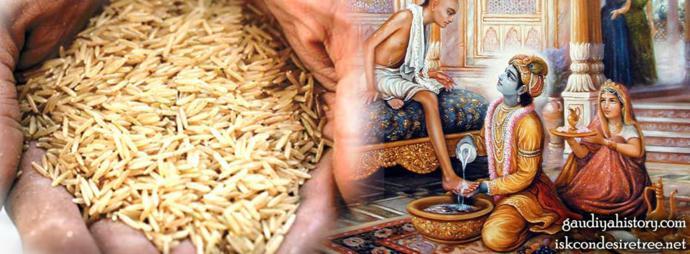
Beyond the single rice-snatching image, Chaitanya-bhagavata also records longer scenes. One is the night Mahaprabhu gathered His devotees at Shuklambara Brahmachari's own house after returning from Gaya. Gadadhara Pandit, Murari Gupta and Srivasa Thakura were among those present to witness His ecstasy. Another, separate episode is the day the Lord invited Himself to eat a full meal that Shuklambara had cooked with his own begged rice. This episode is covered in detail on The Meal at Shuklambara's House. Taken together, the episodes show the same thing. Shuklambara was too poor ever to be mistaken for a rich supporter, yet the Lord treated his rice as though it were the finest food in Navadwip.
An Honest Gap in the Record #
Outside of these few, specific episodes, almost nothing is recorded about Shuklambara Brahmachari. No known source gives his birth year, his family, or any account of his life after these Navadwip pastimes. No samadhi site of his own, and no written work credited to him, has been found in any known source either. What remains is exactly what Krishnadasa Kaviraja Goswami and Vrindavana Dasa Thakura chose to preserve: a handful of meals, remembered because of who ate them.
Scriptural evidence
Quoted in the text above:
- Verse 191 Gaura-ganoddesha-dipika
Further verses:
শুক্লাম্বর–ব্রহ্মচারী বড় ভাগ্যবান্ ।
যাঁর অন্ন মাগি’ কাড়ি’ খাইলা ভগবান্ ॥
śuklāmbara-brahmacārī baḍa bhāgyavān
yāṅra anna māgi' kāḍi' khāilā bhagavān
Word for word
śuklāmbara-brahmacārī: Śuklāmbara Brahmacārī; baḍa: very; bhāgyavān: fortunate; yāṅra: whose; anna: food; māgi': begging; kāḍi': snatching; khāilā: ate; bhagavān: the Supreme Personality of Godhead.
The sixteenth branch, Shuklambara Brahmachari, was very fortunate because Lord Chaitanya Mahaprabhu jokingly or seriously begged food from him or sometimes snatched it from him forcibly and ate it.
From the purport: It is stated that Śuklāmbara Brahmacārī, an inhabitant of Navadvīpa, was Lord Caitanya Mahāprabhu’s first companion in the saṅkīrtana movement. When Lord Caitanya returned from Gayā after initiation, He stayed with Śuklāmbara Brahmacārī because He wanted to hear from this devotee about the pastimes of Lord Kṛṣṇa. ... It is said that Śuklāmbara Brahmacārī was one of the wives of the yajñic brāhmaṇas during the time of Lord Kṛṣṇa’s pastimes in Vṛndāvana. Lord Kṛṣṇa begged food from the wives of the yajñic brāhmaṇas, and Lord Caitanya Mahāprabhu performed a similar pastime by begging rice from Śuklāmbara Brahmacārī.
The verse the main biography quotes as its pull-quote; the purport is the primary source for Shuklambara Brahmachari being counted among the Lord's earliest companions and for the Gaya-return visit described on the main page and in The Meal at Shuklambara's House.
- Sri Chaitanya-charitamrita, Adi-lila 10.38 (text, synonyms, translation, purport)
- Sri Chaitanya-charitamrita, Adi-lila 17.20 (text, synonyms, translation, purport)
- Shuklambara Brahmachari — biography and compiled Chaitanya-bhagavata / Gaura-ganoddesha-dipika references
- Shuklambara Brahmachari — biography (Gaura-ganoddesha-dipika and further Chaitanya-bhagavata references)
Frequently asked
When was Shuklambara Brahmachari born?
Shuklambara Brahmachari appeared Not recorded in Navadwip, Bengal (traditional home).
When and where did Shuklambara Brahmachari disappear?
Shuklambara Brahmachari disappeared Not recorded.
What are the main pastimes of Shuklambara Brahmachari?
The pastimes covered here include: The Rice from the Begging Bag, The Meal at Shuklambara's House.