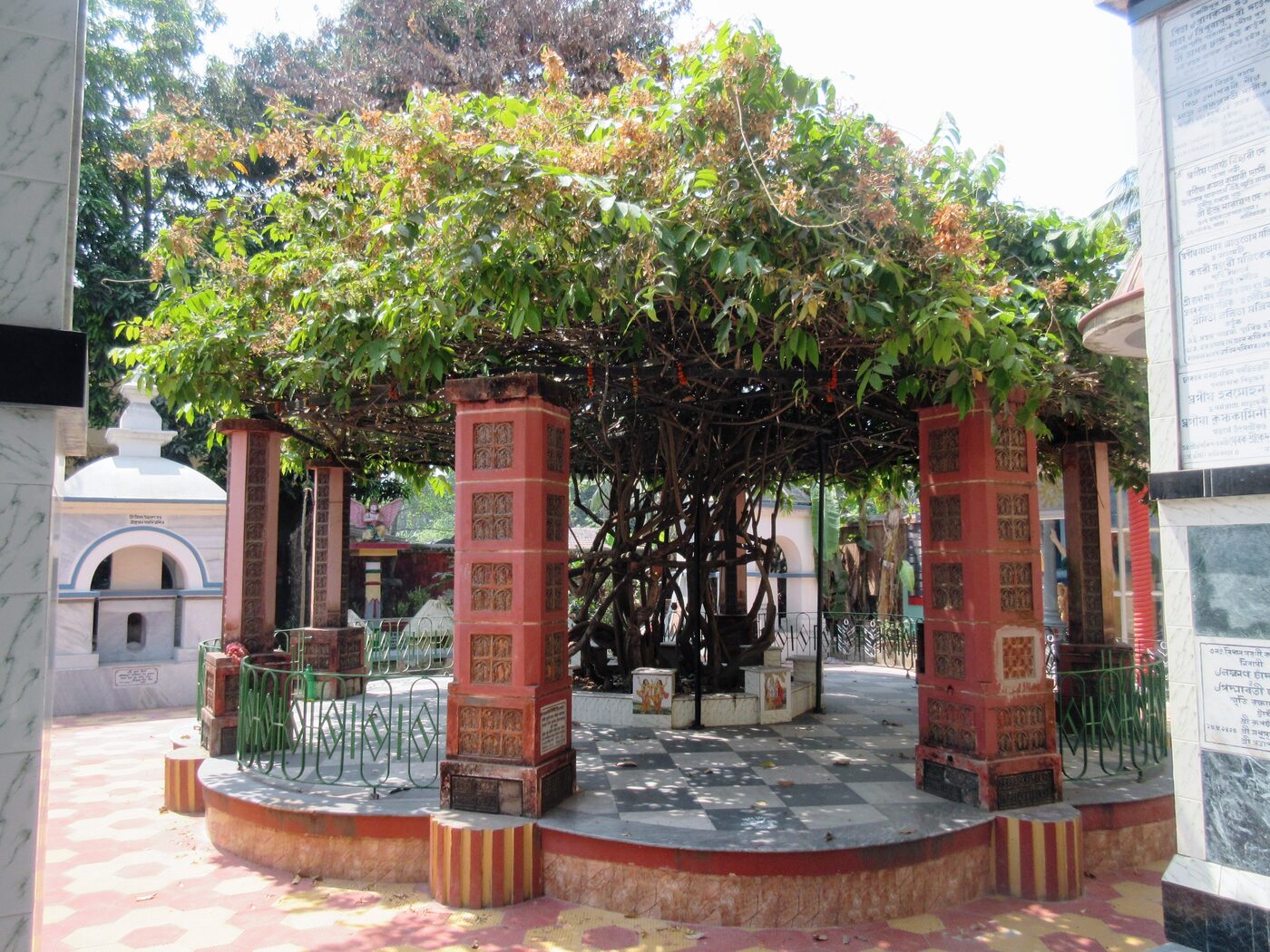
Uddharana Datta's own life had already shown an important principle. A devotee's caste does not make his service unacceptable, and food offered to the Lord with devotion is always pure, no matter who cooked it. Gaudiya Vaishnava tradition, recorded in Narahari Chakravarti's Bhakti-ratnakara, remembers a special test of this principle. The Bhakti-ratnakara itself could not be checked in English translation. So the story below is given as the well-known tradition it is, not quoted directly from the original text.
| Detail | Description |
|---|---|
| Setting | Uddharana Datta's house at Saptagrama, during Nityananda Prabhu's stay |
| Traditional source | Bhakti-ratnakara, by Narahari Chakravarti Thakura |
| Central object | A cooking implement that became a living Madhavi vine |
| Supporting evidence | Srila Prabhupada's own purport confirms a Madhavi-lata still grows in front of the temple hall at Saptagrama |
An Envious Brahmana's Objection #
According to the tradition, a brahmana who could not bear the popularity of Nityananda Prabhu's sankirtana came one day to Uddharana Datta's house. The brahmana hoped to embarrass Nityananda Prabhu in a debate about which is better, jnana (dry philosophical speculation) or bhakti (devotional service). Nityananda Prabhu let the debate go on instead of ending it quickly. When the hour for the midday meal arrived, He invited the brahmana to eat with the rest of the household. The brahmana agreed, bathed, and sat down to honor the prasadam. Then he learned that Uddharana Datta himself, a suvarna-vanik by caste, had cooked it. He rose to leave, insisting that a brahmana could not accept food prepared by someone of a lower caste.
The Lord's Answer #
Nityananda Prabhu answered him with the same argument that devotional literature makes elsewhere. Krishna's remnants are completely spiritual and always pure, whoever has cooked them. And a person's real qualification comes from character and devotion, not birth. The brahmana was partly satisfied and sat down again. But when he saw Uddharana Datta serving the food with his own hands, he could not set aside his objection, and he rose a second time. At that point, tradition says, Nityananda Prabhu took the cooking implement from Uddharana Datta's hand and planted it in the ground. In front of everyone present, it grew at once into a fragrant Madhavi vine.
The brahmana's pride broke completely. He fell to the ground calling out the holy names, smeared the sacred dust of the place over his own body, and begged forgiveness from both Nityananda Prabhu and Uddharana Datta, asking to be allowed to honor the very prasadam he had twice refused.
A Tree That Can Still Be Found #
A small detail in Srila Prabhupada's own purport to Sri Chaitanya-charitamrita makes this pastime more than a devotional story handed down with no link to facts that can be checked. Describing the temple at Saptagrama as it stood in the twentieth century, he notes that "in front of the temple there is now a big hall, and in front of the hall is a Madhavi-lata plant." Srila Prabhupada was not telling the miracle story when he wrote this. He was simply describing the temple grounds as he found them on his visits, as a child and again in 1967. He mentions this particular plant, and no other. And it is exactly the plant that, tradition says, grew from Nityananda Prabhu's own hand. This kind of quiet confirmation gives some real weight to a pastime that otherwise has no source to support it, even though no verified citation from the original-language text can be placed beside it.
The temple and its Deities, the Madhavi tree included, are described further on the page covering Uddharana Datta's disappearance and legacy.
