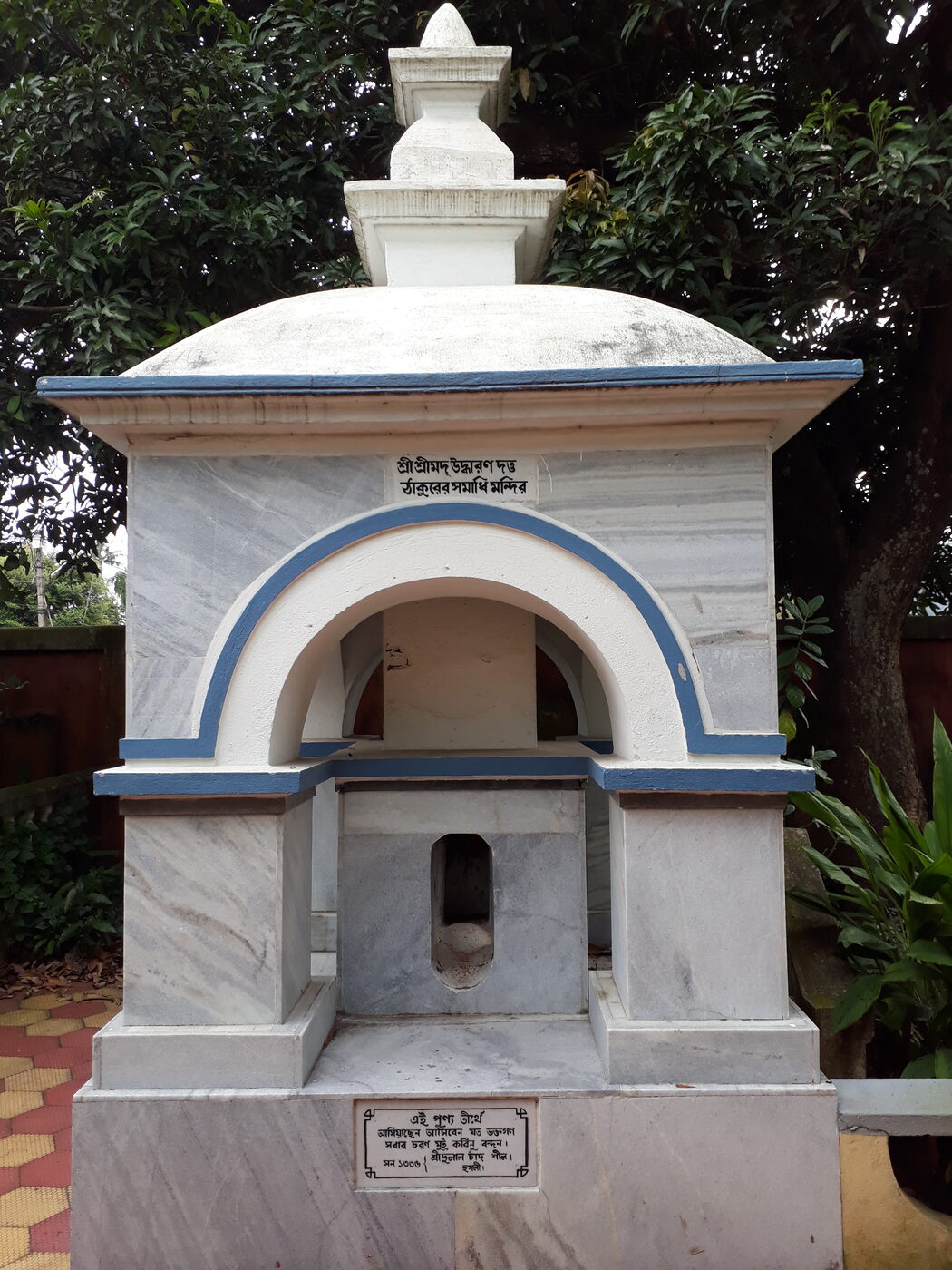
Srila Uddharana Datta Thakura was born around 1481 in Saptagrama, a river-port town on the Sarasvati river in the Hooghly district of Bengal. The town was near what later became the Trishabigha railway station. In his day Saptagrama was large enough to take in several neighboring villages under one name: Vasudevapura, Bansabediya, Krishnapura, Nityanandapura, Shivapura and Shankhanagara, together with Saptagrama itself. His father was Srikara Datta and his mother Bhadravati. Some later retellings of his life give his birth name as Divakara Datta. They say Nityananda Prabhu renamed him Uddharana at initiation. But Srila Prabhupada's purport to Sri Chaitanya-charitamrita simply calls him "previously known as Sri Uddharana Datta," without mentioning an earlier name. So the sources are not fully consistent on this point. We leave that gap as it is, instead of choosing one side.
| Detail | Description |
|---|---|
| Birth | c. 1481, Saptagrama, Hooghly district, Bengal |
| Parents | Srikara Datta (father), Bhadravati (mother) |
| Caste | Suvarna-vanik (gold merchant and banking community) |
| Occupation | Estate manager (diwan) for a zamindar at Naihati, near Katwa |
| Legacy place name | Uddharanapura, the estate town named after him |
Born Into the Suvarna-Vanik Community #
The suvarna-vaniks - the name simply joins suvarna, gold, and vanik, merchant - were Bengal's community of bankers and gold dealers. By the time Srila Prabhupada wrote about this family history in his purport to Chaitanya-charitamrita, suvarna-vanik families such as the Mulliks and Sils had built much of colonial Calcutta, and more than half the city's population traced itself to this single mercantile community. Srila Prabhupada added a personal note: his own paternal family came from this same district and belonged to the same community, which is part of why he remembered visiting Uddharana Datta Thakura's temple as a child.
An Old Wound and Its Healing #
The suvarna-vaniks had a grievance that began long before Uddharana Datta's birth. According to the account Srila Prabhupada gives from Bhaktisiddhanta Sarasvati Thakura's Anubhashya, King Ballala Sena had once borrowed heavily from a suvarna-vanik banker named Gauri Sena and spent the money extravagantly. When Gauri Sena finally refused to lend him more, Ballala Sena took revenge. He arranged a social plot that took away the caste position of the entire suvarna-vanik community. They were cast out from the ranks of brahmana, kshatriya and vaishya alike. Chaitanya-bhagavata records the reversal of this old injustice in a single line, quoted in Srila Prabhupada's own purport: yateka vanika-kula uddharana haite pavitra ha-ila dvidha nahika ihate - there is no doubt that the entire suvarna-vanik community was purified again through Nityananda Prabhu's grace. The verse plays on the very word uddharana, deliverance. This is almost certainly why devotees have remembered this one merchant of that community so strongly. His own name came to stand for what Nityananda Prabhu had done for all of them.
Manager of an Estate at Naihati #
As an adult, Uddharana Datta worked as the diwan, or estate manager, for a zamindar at Naihati, about a mile and a half north of Katwa. Ruins connected with that estate are still pointed out near the Dainhata railway station. The place from which he managed the estate's business is still called Uddharanapura in his honor. It is a rare case in the Gaudiya Vaishnava world of a whole town keeping a devotee's given name, not a title or a name of praise, five hundred years later.
As far as the available sources tell us, Uddharana Datta's life before he met Nityananda Prabhu was ordinary. He was a prosperous manager from a caste already marked by an old social injustice, and he went about the work of collecting revenue for another man's estate. What happened when Nityananda Prabhu came to Saptagrama, and stayed for months in his house, is the subject of the next page.
