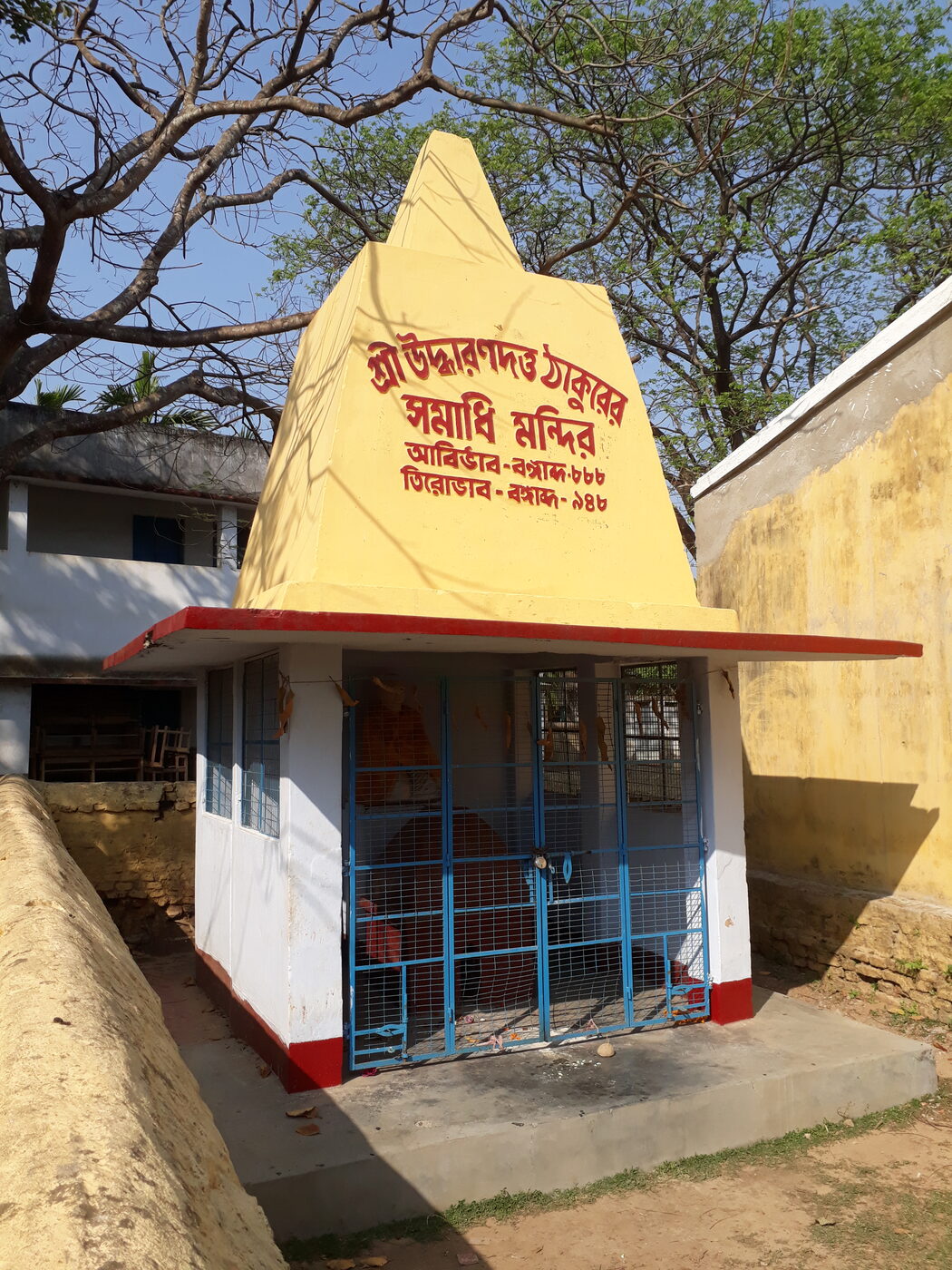
Srila Uddharana Datta Thakura disappeared on the Krishna Trayodashi, the thirteenth day of the dark fortnight, in the month of Pausha. The year is given as 1463 in the Shaka era. This is usually converted to 1541 in the Gregorian calendar, but one account that is often copied online gives 1552. Small differences like this often appear when dates are passed down through many retellings, so both years are given here instead of quietly choosing one.
Wikipedia's article on him also claims that he spent his last years at Puri and Vrindavana, that he disappeared near the Bamsi-vata in Vrindavana, and that his body was later divided between samadhis at Saptagrama and Uddharanpur. None of the available ISKCON-published sources confirm this. It should be read as a separate and less well-supported tradition, alongside the more consistent account centered on Bengal.
| Detail | Description |
|---|---|
| Disappearance | Krishna Trayodashi, month of Pausha, Shaka 1463 (c. 1541, sometimes given as 1552) |
| Visited afterward by | Jahnava Mata, who found he had already passed away |
| Son | Srinivasa Datta |
| Temple today | Saptagrama, with a six-armed Mahaprabhu Deity, Nityananda Prabhu, Gadadhara Pandit, Radha-Govinda and a shalagrama-shila |
| Notable visitor | Srila Prabhupada, as a child and again in 1967 |
Jahnava Mata's Visit #
After the disappearance of Sri Chaitanya Mahaprabhu, Jahnava Mata visited Saptagrama and came to Uddharana Datta Thakura's house. Jahnava Mata was Nityananda Prabhu's own consort, and in those years she carried much of the responsibility for holding the movement's second generation together. By that time, the sources agree, Uddharana Datta had already left this world. It is a small detail, but it shows something important. Even after his passing, Uddharana Datta's house remained a place the movement's leaders thought worth visiting.
The Deities and the Temple #
During his lifetime Uddharana Datta personally installed and worshiped a six-armed (sad-bhuja) Deity of Sri Chaitanya Mahaprabhu, with Nityananda Prabhu on the right and Gadadhara Pandit on the left. Along with these Deities were a Radha-Govinda murti and a shalagrama-shila. The temple is also linked to the story of the Madhavi tree. The Madhavi tree still grows in front of the temple hall. A wooden Deity of Uddharana Datta himself was installed by a family descendant, Jagamohana Datta, in the early twentieth century. It was later taken away by a man named Madana-mohana Datta, and it is now worshiped elsewhere along with a shalagrama-shila. In its place, a picture of Uddharana Datta is worshiped at the Saptagrama temple.
The temple's upkeep has had its own ups and downs. In the Bengali year 1283 (1876), a babaji named Nitai Dasa arranged a donation of twelve bighas of land for it. Management later declined, but was restored in 1899 through the efforts of Balarama Mullik of Hooghly, a subjudge, working with wealthy suvarna-vanik families - the same community Uddharana Datta himself had belonged to nearly four centuries earlier, still keeping up his temple.
Srila Prabhupada's Own Connection #
The most personal account of Uddharana Datta Thakura comes from Srila Prabhupada himself, writing in his purport to Sri Chaitanya-charitamrita. He recalls visiting this temple in his own childhood with his parents, because, he writes, "all the members of the suvarna-vanik community enthusiastically take interest in this temple of Uddharana Datta Thakura." Srila Prabhupada's own paternal family belonged to that community. Decades later, in 1967, the temple's executive committee invited him back. This was shortly after he had returned to India from establishing the Hare Krishna movement in America. He brought some of his first American students to see the temple. Few of Sri Chaitanya Mahaprabhu's associates are connected so directly and so personally with Srila Prabhupada's own family history.
What Endures #
Uddharana Datta Thakura had one son, Srinivasa Datta, and later generations of the family are said to have spread into Calcutta, Hooghly and other parts of Bengal. No song, poem or philosophical work by him is found in any known list of Gaudiya Vaishnava song-authors. His name does not appear in any of them. Instead, what remains is what the tradition remembered him for from the start: a house that became Nityananda Prabhu's own, a kitchen the Lord preferred, a temple that suvarna-vanik families have kept for nearly five centuries, and a town, Uddharanapura, that still carries his name.
