Srila Uddharana Datta Thakura
The Gold Merchant Who Cooked for Nityananda Prabhu
The complete life, on one page: The main biography and every pastime page, in order, in one place
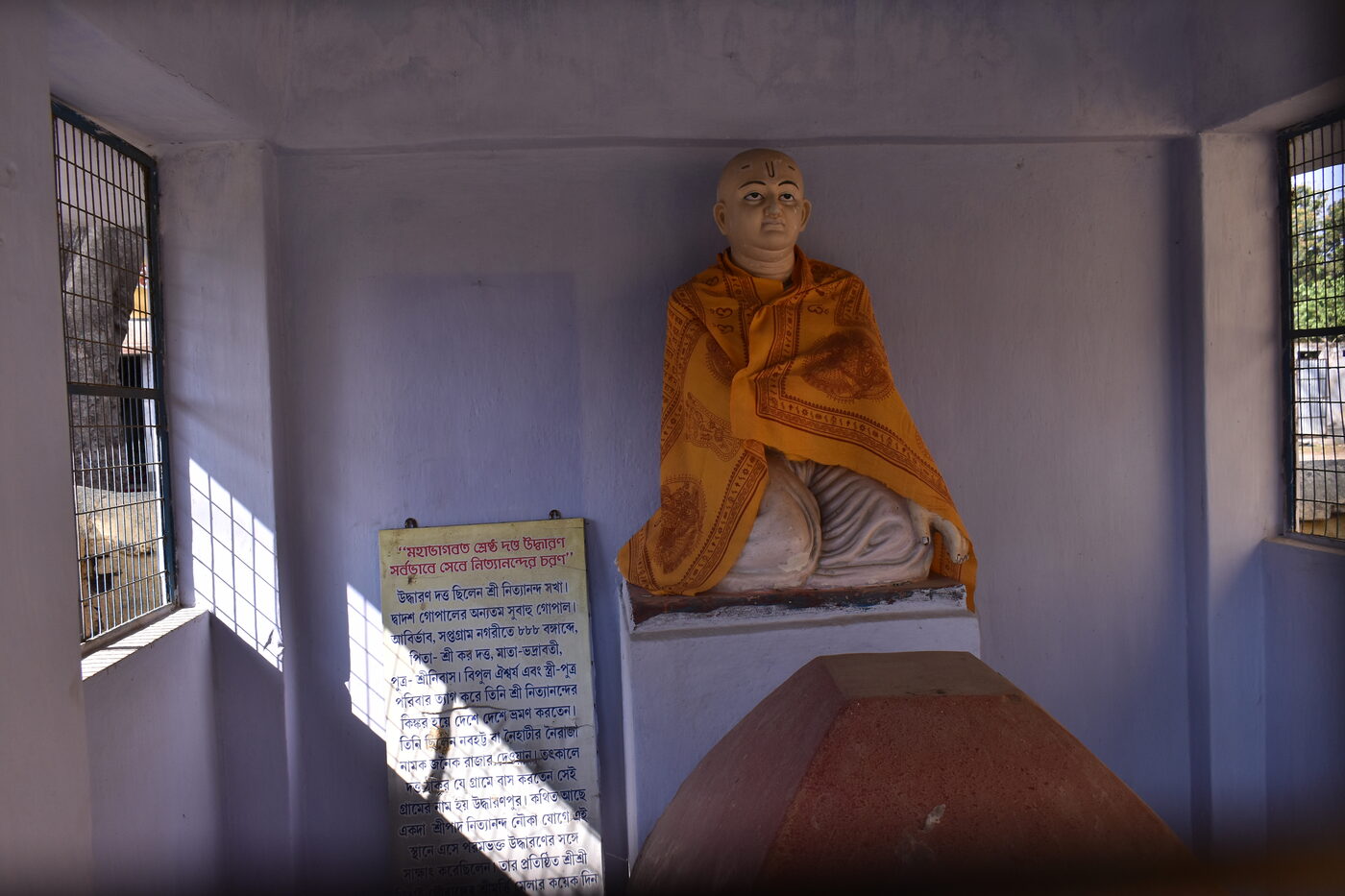
Introduction
Srila Uddharana Datta Thakura was a wealthy merchant of the suvarna-vanik, or gold-trading, caste of Bengal who became one of the closest personal associates of Nityananda Prabhu. Sri Chaitanya-charitamrita calls him "maha-bhagavata-shrestha," the best among great devotees, who worshiped Nityananda Prabhu's lotus feet in every possible way. He is remembered above all as the devotee in whose house Nityananda Prabhu lived for months, and whose cooking Nityananda Prabhu Himself preferred to eat.
| Detail | Description |
|---|---|
| Other names | Divakara Datta (name before his association with Nityananda Prabhu, per some accounts) |
| Birth | c. 1481, Saptagrama, Hooghly district, Bengal |
| Family | Father Srikara Datta, mother Bhadravati; son Srinivasa Datta |
| Caste / community | Suvarna-vanik (gold merchant and banking community) |
| Occupation | Estate manager (diwan) for a zamindar at Naihati, near Katwa |
| Identity | Subahu, Krishna's cowherd friend in Vraja; eleventh of the twelve gopalas (Gaura-ganoddesha-dipika 129; Chaitanya-charitamrita Adi 11.41) |
| Disappearance | Krishna Trayodashi, month of Pausha, Shaka 1463 |
Scriptural evidence for the introduction (2)
মহাভাগবত–শ্রেষ্ঠ দত্ত উদ্ধারণ ।
সর্বভাবে সেবে নিত্যানন্দের চরণ ॥ ৪১ ॥
maha-bhagavata-shrestha datta uddharana
sarva-bhave seve nityanandera carana
Word for word
maha-bhagavata: great devotee; shrestha: chief; datta: the surname Datta; uddharana: Uddharana; sarva-bhave: in all respects; seve: worships; nityanandera: of Lord Nityananda; carana: lotus feet.
Uddharana Datta Thakura, the eleventh among the twelve cowherd boys, was an exalted devotee of Lord Nityananda Prabhu. He worshiped the lotus feet of Lord Nityananda in all respects.
From the purport: Purport excerpt: "The Gaura-ganoddesa-dipika (129) states that Uddharana Datta Thakura was formerly the cowherd boy of Vrindavana named Subahu."
This is the single verse in Chaitanya-charitamrita that names Uddharana Datta directly and gives his identity in Krishna's Vraja-lila; Prabhupada's purport here is the fullest primary-source biography of him available.
सुबाहुर्यो व्रजे गोपो दत्त उद्धारणाख्यकः ।
महेश पण्डितः श्रीमन्महाबाहुर्व्रजे सखा ॥१२९॥
subāhur yo vraje gopo datta uddhāraṇākhyakaḥ |
maheśa paṇḍitaḥ śrīman mahābāhur vraje sakhā ||129||
The devotee who had been the cowherd boy Subahu in Vrajabhumi appeared in Lord Caitanya's pastimes as Uddharana Datta. Lord Krsna's cowherd friend Mahabahu appeared in Lord Caitanya's pastimes as Sriman Mahesa Pandita.
Kavi Karnapura's verse naming Uddharana Datta as Subahu, a cowherd boy of Vraja (the purport sentence confirming it is shown under Chaitanya-charitamrita Adi 11.41). Sanskrit: diacritic edition of the Gaura-ganoddesha-dipika; English translation as published at bvmlu.org.
Chapter 1
The Merchant of Saptagrama
A suvarna-vanik family, an old social wound, and the estate at Uddharanapura.
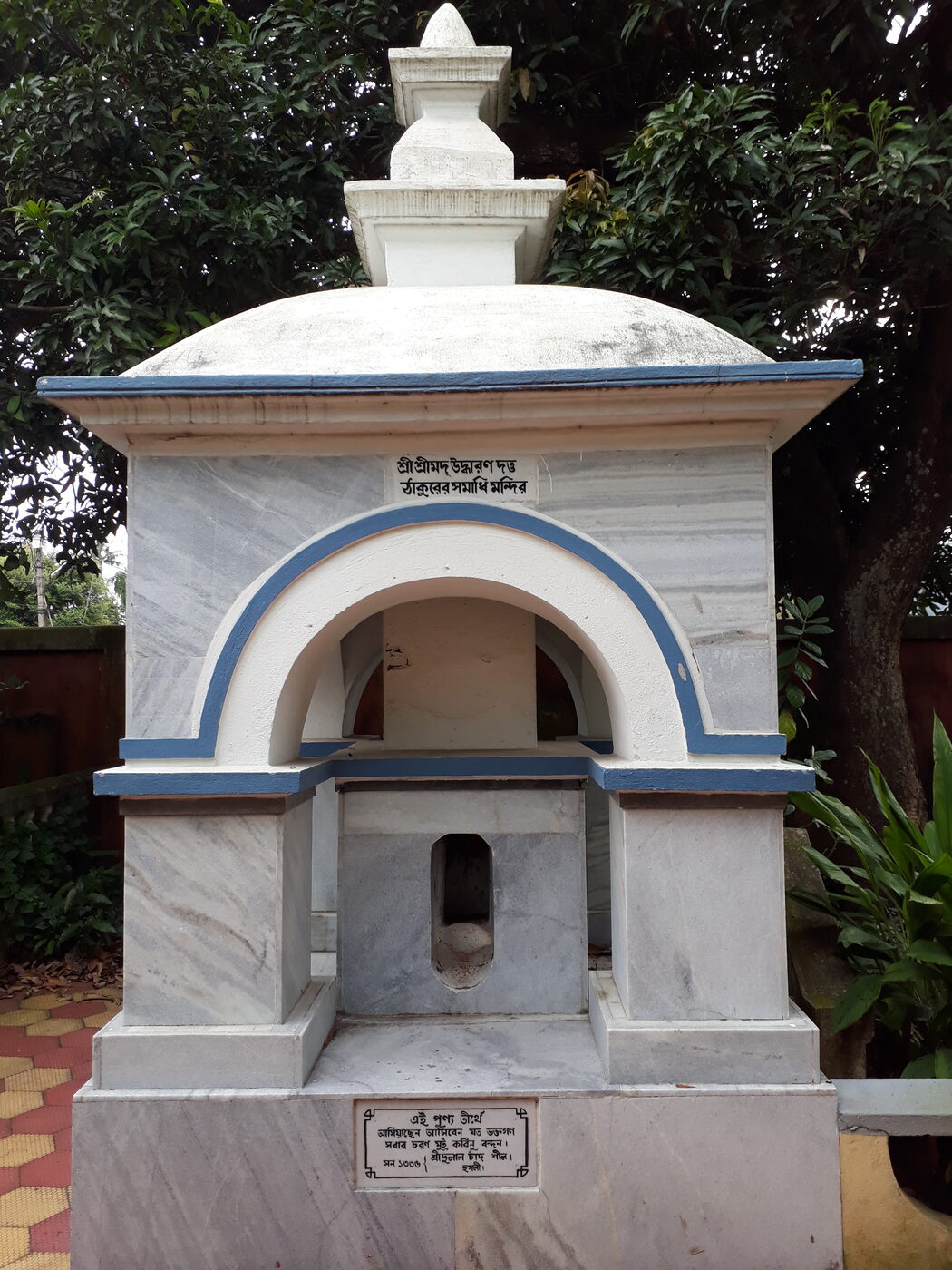
Srila Uddharana Datta Thakura was born around 1481 in Saptagrama, a river-port town on the Sarasvati river in the Hooghly district of Bengal. The town was near what later became the Trishabigha railway station. In his day Saptagrama was large enough to take in several neighboring villages under one name: Vasudevapura, Bansabediya, Krishnapura, Nityanandapura, Shivapura and Shankhanagara, together with Saptagrama itself. His father was Srikara Datta and his mother Bhadravati. Some later retellings of his life give his birth name as Divakara Datta. They say Nityananda Prabhu renamed him Uddharana at initiation. But Srila Prabhupada's purport to Sri Chaitanya-charitamrita simply calls him "previously known as Sri Uddharana Datta," without mentioning an earlier name. So the sources are not fully consistent on this point. We leave that gap as it is, instead of choosing one side.
| Detail | Description |
|---|---|
| Birth | c. 1481, Saptagrama, Hooghly district, Bengal |
| Parents | Srikara Datta (father), Bhadravati (mother) |
| Caste | Suvarna-vanik (gold merchant and banking community) |
| Occupation | Estate manager (diwan) for a zamindar at Naihati, near Katwa |
| Legacy place name | Uddharanapura, the estate town named after him |
Born Into the Suvarna-Vanik Community #
The suvarna-vaniks - the name simply joins suvarna, gold, and vanik, merchant - were Bengal's community of bankers and gold dealers. By the time Srila Prabhupada wrote about this family history in his purport to Chaitanya-charitamrita, suvarna-vanik families such as the Mulliks and Sils had built much of colonial Calcutta, and more than half the city's population traced itself to this single mercantile community. Srila Prabhupada added a personal note: his own paternal family came from this same district and belonged to the same community, which is part of why he remembered visiting Uddharana Datta Thakura's temple as a child.
An Old Wound and Its Healing #
The suvarna-vaniks had a grievance that began long before Uddharana Datta's birth. According to the account Srila Prabhupada gives from Bhaktisiddhanta Sarasvati Thakura's Anubhashya, King Ballala Sena had once borrowed heavily from a suvarna-vanik banker named Gauri Sena and spent the money extravagantly. When Gauri Sena finally refused to lend him more, Ballala Sena took revenge. He arranged a social plot that took away the caste position of the entire suvarna-vanik community. They were cast out from the ranks of brahmana, kshatriya and vaishya alike. Chaitanya-bhagavata records the reversal of this old injustice in a single line, quoted in Srila Prabhupada's own purport: yateka vanika-kula uddharana haite pavitra ha-ila dvidha nahika ihate - there is no doubt that the entire suvarna-vanik community was purified again through Nityananda Prabhu's grace. The verse plays on the very word uddharana, deliverance. This is almost certainly why devotees have remembered this one merchant of that community so strongly. His own name came to stand for what Nityananda Prabhu had done for all of them.
Manager of an Estate at Naihati #
As an adult, Uddharana Datta worked as the diwan, or estate manager, for a zamindar at Naihati, about a mile and a half north of Katwa. Ruins connected with that estate are still pointed out near the Dainhata railway station. The place from which he managed the estate's business is still called Uddharanapura in his honor. It is a rare case in the Gaudiya Vaishnava world of a whole town keeping a devotee's given name, not a title or a name of praise, five hundred years later.
As far as the available sources tell us, Uddharana Datta's life before he met Nityananda Prabhu was ordinary. He was a prosperous manager from a caste already marked by an old social injustice, and he went about the work of collecting revenue for another man's estate. What happened when Nityananda Prabhu came to Saptagrama, and stayed for months in his house, is the subject of the next page.
Scriptural evidence for this chapter (2)
Quoted in the text above:
- Antya-khanda, Chapter Five (quoted in the Bhaktivedanta purport to Sri Chaitanya-charitamrita, Adi 11.41) Chaitanya-bhagavata
Further verses:
This time Lord Caitanya stayed at the house of Candrashekhara, although he was regarded as a shudra or kayastha, for the Lord, as the Supreme Personality of Godhead, is completely independent.
From the purport: Purport excerpt: "Before the time of Caitanya Mahaprabhu, the suvarna-vanik class was condemned by Ballal Sena, who was then the King of Bengal, due to a personal grudge... Ballal Sena became angry and condemned the entire suvarna-vanik society as belonging to the sudra community."
This purport gives the fuller background on the Ballal Sena dispute that led to the suvarna-vanik community's social ostracism, the same history behind Uddharana Datta's own caste standing.
Chapter 2
Nityananda's Arrival in Saptagrama
Nityananda Prabhu makes Uddharana Datta's house His own, and eats what he cooks.
After spending some time at Khardaha, Nityananda Prabhu traveled with His associates to Saptagrama, on the banks of the Triveni. The Triveni is the meeting point of the Ganga, Yamuna and Sarasvati rivers. It was already famous in tradition as the place where the seven rishis once performed austerities to reach Govinda's feet. Vrindavana Dasa Thakura describes the scene in Chaitanya-bhagavata. Nityananda Prabhu bathed there in great happiness with all His devotees. Uddharana Datta kept a temple of the Lord on that very riverbank. He came forward and offered his mind, body and words to Nityananda Prabhu's feet, free of any pretense.
| Detail | Description |
|---|---|
| Place | Saptagrama, at the Triveni confluence |
| Length of stay | Nityananda Prabhu remained in Uddharana Datta's house for an extended period |
| Key detail | Nityananda Prabhu ate food cooked by Uddharana Datta's own hand |
| Wider effect | Chaitanya-bhagavata says the whole suvarna-vanik community of Saptagrama took shelter of Nityananda Prabhu |
A Household Made the Lord's Own #
Chaitanya-bhagavata calls Uddharana Datta an extremely elevated and generous Vaishnava who, in effect, had from birth the right to worship Nityananda Prabhu. Once Nityananda Prabhu arrived, He made Uddharana Datta's house His base for what several accounts describe as months at a time. Nityananda Prabhu wandered door to door through Saptagrama chanting the holy names. Each evening He returned to the same house, where Uddharana Datta had already given his whole life to serving Him. Sri Chaitanya-charitamrita sums up the relationship in one line: Uddharana Datta "worshiped the lotus feet of Lord Nityananda in all respects" (sarva-bhave). His worship was complete, not occasional or partial.
The Lord's Preferred Cook #
Every source repeats one detail: Nityananda Prabhu ate food that Uddharana Datta himself had cooked. In sixteenth-century Bengal, strict caste rules decided who could cook for whom, so this was an important point. A well-known Vaishnava saying puts the principle plainly - bhaktera dravya prabhu kari kari khaya, abhaktera dravya-pane ulati na caya: the Lord eagerly takes what His devotee offers, and pays no attention to what a non-devotee offers, however rich. Nityananda Prabhu clearly preferred Uddharana Datta's kitchen, and this was itself a public statement that a suvarna-vanik's devotion counted for more than a brahmana's birth. The tradition returns to this claim directly in the story of the Madhavi tree. There, an orthodox brahmana's discomfort at this very fact leads to one of Nityananda Prabhu's most remembered miracles.
Standing Beside Nityananda Prabhu for His Own Marriage #
A short time later, the closeness built during this stay was tested and confirmed in the most personal way possible. Sri Chaitanya Mahaprabhu asked Nityananda Prabhu to set aside the wandering life of an avadhuta and marry, so that Bengal's householders would have someone they could actually imitate. It was Uddharana Datta Thakura who then went with Nityananda Prabhu to Suryadasa Sarakhela's house at Saligrama to ask for the hand of his daughter Vasudha. Nityananda Prabhu's own biography tells the dramatic story that followed in full: the refusal, Vasudha's collapse, and how Nityananda Prabhu restored her to life on condition that the marriage would go ahead. That page also notes that the episode is found only in the later Bengali devotional biographies (the Bhakti-ratnakara and Premavilasa), not in Krishnadasa Kaviraja Goswami's own Chaitanya-charitamrita. For Uddharana Datta's own story, what matters is simpler. Of everyone in Nityananda Prabhu's circle, he was the one chosen to stand beside Him for it.
Sri Chaitanya-charitamrita also places Uddharana Datta at Nityananda Prabhu's side at Panihati. He was seated among the Lord's associates on a raised platform, on the day Raghunatha Dasa Goswami came to meet Nityananda Prabhu there before his final flight from home. It is only a brief mention. His is one name among many that, the verse says, nobody could count. But it shows that Uddharana Datta's place at Nityananda Prabhu's side was not limited to Saptagrama. He was at Nityananda Prabhu's side wherever the mission went.
Scriptural evidence for this chapter (1)
উদ্ধারণ দত্ত আদি যত নিজগণ ।
উপরে বসিলা সব, কে করে গণন ? ॥ ৬৩ ॥
uddharana datta adi yata nija-gana
upare vasila saba, ke kare ganana?
Word for word
uddharana datta: Uddharana Datta; adi: and similar, other persons; yata nija-gana: all personal associates; upare: above; vasila: sat down; saba: all; ke: who; kare ganana: can count.
Similarly, Uddharana Datta Thakura and many other personal associates of the Lord sat on the raised platform with Nityananda Prabhu. No one could count them all.
This verse places Uddharana Datta at Panihati, years after the Saptagrama period, on the day Raghunatha Dasa Goswami came to meet Nityananda Prabhu - proof his place at Nityananda Prabhu's side lasted his whole life.
Chapter 3
The Miracle of the Madhavi Tree
A proud brahmana, a plate of prasadam, and a tree that still grows at Saptagrama.
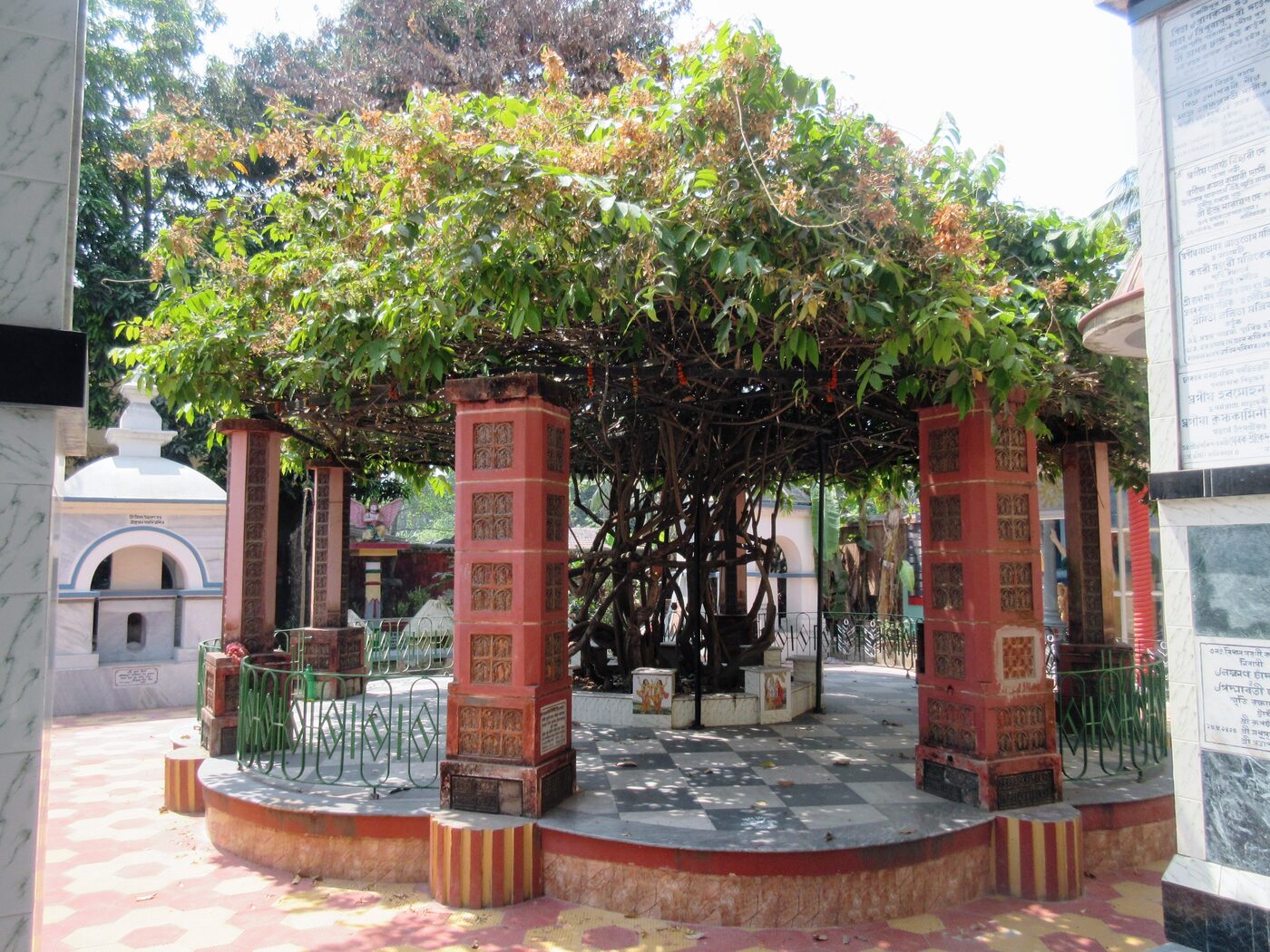
Uddharana Datta's own life had already shown an important principle. A devotee's caste does not make his service unacceptable, and food offered to the Lord with devotion is always pure, no matter who cooked it. Gaudiya Vaishnava tradition, recorded in Narahari Chakravarti's Bhakti-ratnakara, remembers a special test of this principle. The Bhakti-ratnakara itself could not be checked in English translation. So the story below is given as the well-known tradition it is, not quoted directly from the original text.
| Detail | Description |
|---|---|
| Setting | Uddharana Datta's house at Saptagrama, during Nityananda Prabhu's stay |
| Traditional source | Bhakti-ratnakara, by Narahari Chakravarti Thakura |
| Central object | A cooking implement that became a living Madhavi vine |
| Supporting evidence | Srila Prabhupada's own purport confirms a Madhavi-lata still grows in front of the temple hall at Saptagrama |
An Envious Brahmana's Objection #
According to the tradition, a brahmana who could not bear the popularity of Nityananda Prabhu's sankirtana came one day to Uddharana Datta's house. The brahmana hoped to embarrass Nityananda Prabhu in a debate about which is better, jnana (dry philosophical speculation) or bhakti (devotional service). Nityananda Prabhu let the debate go on instead of ending it quickly. When the hour for the midday meal arrived, He invited the brahmana to eat with the rest of the household. The brahmana agreed, bathed, and sat down to honor the prasadam. Then he learned that Uddharana Datta himself, a suvarna-vanik by caste, had cooked it. He rose to leave, insisting that a brahmana could not accept food prepared by someone of a lower caste.
The Lord's Answer #
Nityananda Prabhu answered him with the same argument that devotional literature makes elsewhere. Krishna's remnants are completely spiritual and always pure, whoever has cooked them. And a person's real qualification comes from character and devotion, not birth. The brahmana was partly satisfied and sat down again. But when he saw Uddharana Datta serving the food with his own hands, he could not set aside his objection, and he rose a second time. At that point, tradition says, Nityananda Prabhu took the cooking implement from Uddharana Datta's hand and planted it in the ground. In front of everyone present, it grew at once into a fragrant Madhavi vine.
The brahmana's pride broke completely. He fell to the ground calling out the holy names, smeared the sacred dust of the place over his own body, and begged forgiveness from both Nityananda Prabhu and Uddharana Datta, asking to be allowed to honor the very prasadam he had twice refused.
A Tree That Can Still Be Found #
A small detail in Srila Prabhupada's own purport to Sri Chaitanya-charitamrita makes this pastime more than a devotional story handed down with no link to facts that can be checked. Describing the temple at Saptagrama as it stood in the twentieth century, he notes that "in front of the temple there is now a big hall, and in front of the hall is a Madhavi-lata plant." Srila Prabhupada was not telling the miracle story when he wrote this. He was simply describing the temple grounds as he found them on his visits, as a child and again in 1967. He mentions this particular plant, and no other. And it is exactly the plant that, tradition says, grew from Nityananda Prabhu's own hand. This kind of quiet confirmation gives some real weight to a pastime that otherwise has no source to support it, even though no verified citation from the original-language text can be placed beside it.
The temple and its Deities, the Madhavi tree included, are described further on the page covering Uddharana Datta's disappearance and legacy.
Scriptural evidence for this chapter (1)
কিবা বিপ্র, কিবা ন্যাসী, শূদ্র কেনে নয় ।
যেই কৃষ্ণতত্ত্ববেত্তা, সেই ‘গুরু’ হয় ॥ ১২৮ ॥
kibā vipra, kibā nyāsī, śūdra kene naya
yei kṛṣṇa-tattva-vettā, sei 'guru' haya
Word for word
kibā: whether; vipra: a brahmana; kibā: whether; nyāsī: a sannyasi; śūdra: a shudra; kene: why; naya: not; yei: anyone who; kṛṣṇa-tattva-vettā: a knower of the science of Krishna; sei: that person; guru: the spiritual master; haya: is.
Whether one is a brahmana, a sannyasi, or a shudra, whatever he is, he can become a spiritual master if he knows the science of Krishna.
The same principle behind Nityananda Prabhu's acceptance of Uddharana Datta's cooking: real qualification comes from knowledge and devotion, not birth. Sri Chaitanya Mahaprabhu states this directly to Ramananda Raya.
Chapter 4
Disappearance and the Uddharanpur Legacy
Jahnava Mata's visit, a temple cared for over nearly five centuries, and Srila Prabhupada's own family tie.
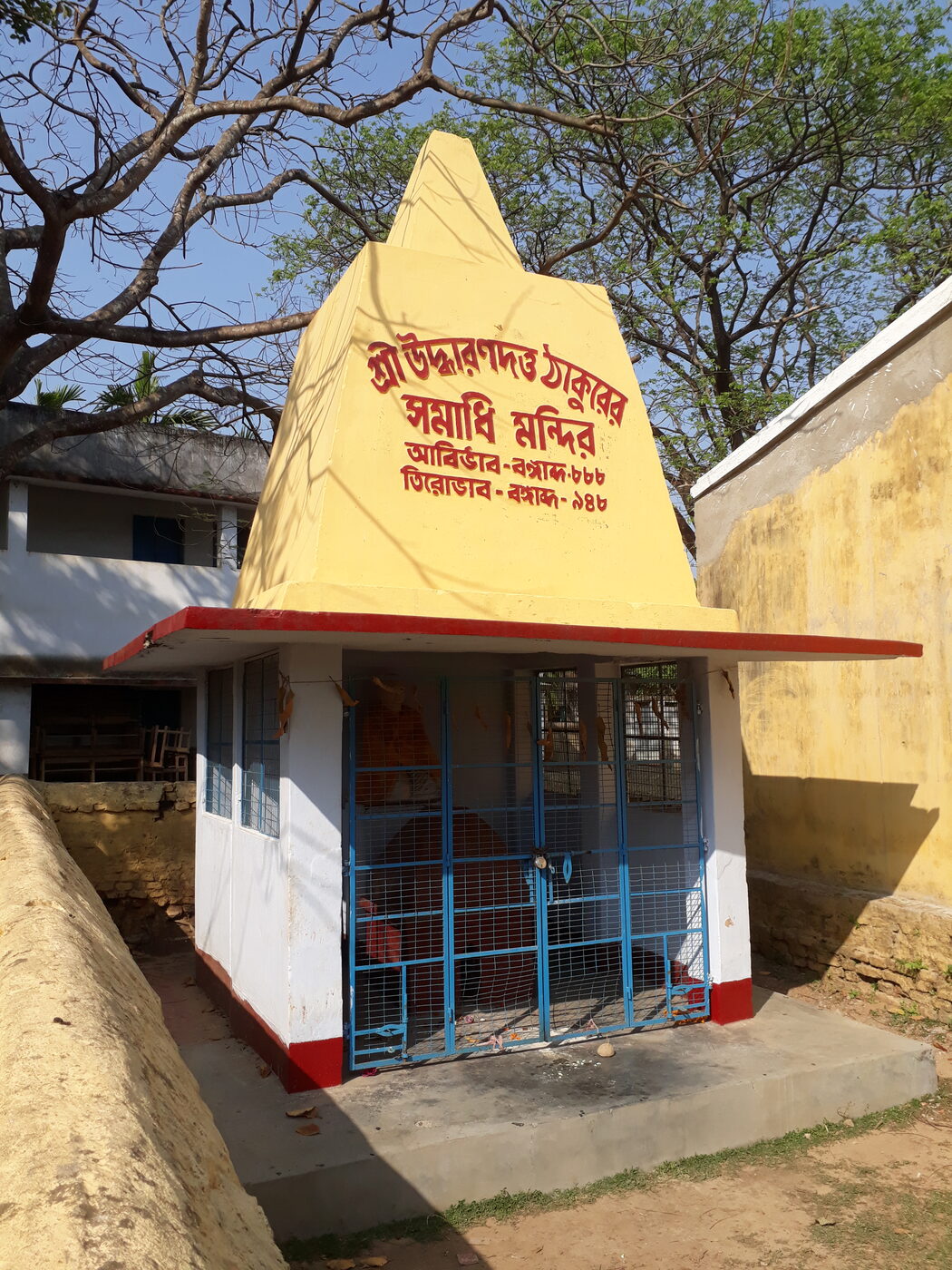
Srila Uddharana Datta Thakura disappeared on the Krishna Trayodashi, the thirteenth day of the dark fortnight, in the month of Pausha. The year is given as 1463 in the Shaka era. This is usually converted to 1541 in the Gregorian calendar, but one account that is often copied online gives 1552. Small differences like this often appear when dates are passed down through many retellings, so both years are given here instead of quietly choosing one.
Wikipedia's article on him also claims that he spent his last years at Puri and Vrindavana, that he disappeared near the Bamsi-vata in Vrindavana, and that his body was later divided between samadhis at Saptagrama and Uddharanpur. None of the available ISKCON-published sources confirm this. It should be read as a separate and less well-supported tradition, alongside the more consistent account centered on Bengal.
| Detail | Description |
|---|---|
| Disappearance | Krishna Trayodashi, month of Pausha, Shaka 1463 (c. 1541, sometimes given as 1552) |
| Visited afterward by | Jahnava Mata, who found he had already passed away |
| Son | Srinivasa Datta |
| Temple today | Saptagrama, with a six-armed Mahaprabhu Deity, Nityananda Prabhu, Gadadhara Pandit, Radha-Govinda and a shalagrama-shila |
| Notable visitor | Srila Prabhupada, as a child and again in 1967 |
Jahnava Mata's Visit #
After the disappearance of Sri Chaitanya Mahaprabhu, Jahnava Mata visited Saptagrama and came to Uddharana Datta Thakura's house. Jahnava Mata was Nityananda Prabhu's own consort, and in those years she carried much of the responsibility for holding the movement's second generation together. By that time, the sources agree, Uddharana Datta had already left this world. It is a small detail, but it shows something important. Even after his passing, Uddharana Datta's house remained a place the movement's leaders thought worth visiting.
The Deities and the Temple #
During his lifetime Uddharana Datta personally installed and worshiped a six-armed (sad-bhuja) Deity of Sri Chaitanya Mahaprabhu, with Nityananda Prabhu on the right and Gadadhara Pandit on the left. Along with these Deities were a Radha-Govinda murti and a shalagrama-shila. The temple is also linked to the story of the Madhavi tree. The Madhavi tree still grows in front of the temple hall. A wooden Deity of Uddharana Datta himself was installed by a family descendant, Jagamohana Datta, in the early twentieth century. It was later taken away by a man named Madana-mohana Datta, and it is now worshiped elsewhere along with a shalagrama-shila. In its place, a picture of Uddharana Datta is worshiped at the Saptagrama temple.
The temple's upkeep has had its own ups and downs. In the Bengali year 1283 (1876), a babaji named Nitai Dasa arranged a donation of twelve bighas of land for it. Management later declined, but was restored in 1899 through the efforts of Balarama Mullik of Hooghly, a subjudge, working with wealthy suvarna-vanik families - the same community Uddharana Datta himself had belonged to nearly four centuries earlier, still keeping up his temple.
Srila Prabhupada's Own Connection #
The most personal account of Uddharana Datta Thakura comes from Srila Prabhupada himself, writing in his purport to Sri Chaitanya-charitamrita. He recalls visiting this temple in his own childhood with his parents, because, he writes, "all the members of the suvarna-vanik community enthusiastically take interest in this temple of Uddharana Datta Thakura." Srila Prabhupada's own paternal family belonged to that community. Decades later, in 1967, the temple's executive committee invited him back. This was shortly after he had returned to India from establishing the Hare Krishna movement in America. He brought some of his first American students to see the temple. Few of Sri Chaitanya Mahaprabhu's associates are connected so directly and so personally with Srila Prabhupada's own family history.
What Endures #
Uddharana Datta Thakura had one son, Srinivasa Datta, and later generations of the family are said to have spread into Calcutta, Hooghly and other parts of Bengal. No song, poem or philosophical work by him is found in any known list of Gaudiya Vaishnava song-authors. His name does not appear in any of them. Instead, what remains is what the tradition remembered him for from the start: a house that became Nityananda Prabhu's own, a kitchen the Lord preferred, a temple that suvarna-vanik families have kept for nearly five centuries, and a town, Uddharanapura, that still carries his name.
Closing
A Gold Merchant of Saptagrama #
He was born around 1481 in Saptagrama, a prosperous river-port town in the Hooghly district of Bengal that in his time had grown to include several adjoining villages: Vasudevapura, Bansabediya, Krishnapura, Nityanandapura, Shivapura and Shankhanagara, besides Saptagrama itself. His father, Srikara Datta, and mother, Bhadravati, belonged to the suvarna-vanik community, Bengali bankers and dealers in gold whose very name joins suvarna, gold, to vanik, merchant. By the time Srila Prabhupada wrote his purport to this verse, suvarna-vanik families like the Mulliks and Sils had built much of Calcutta, and Srila Prabhupada noted that his own paternal family came from this same district and community.
The suvarna-vaniks had long suffered from an old wrong. Generations earlier, king Ballala Sena had borrowed heavily from a suvarna-vanik banker named Gauri Sena and spent extravagantly. When Gauri Sena stopped lending him more money, Ballala Sena took revenge. He had the entire community declared outcaste, cut off from the brahmana, kshatriya and vaishya orders they had belonged to before. Chaitanya-bhagavata states plainly that Nityananda Prabhu's grace reversed this: "there is no doubt that all the community members of the suvarna-vanik society were again purified by Sri Nityananda Prabhu." Uddharana Datta Thakura was a member of that same suffering community. He is remembered as the very person through whom this purification happened.
As an adult he worked as manager of a zamindar's estate at Naihati, about a mile and a half north of Katwa. The place from which he managed the estate is still called Uddharanapura, Uddharana's town, after him. This is one of the few places anywhere in the Gaudiya Vaishnava world where a whole town takes a devotee's given name, not his title.
The Twelve Gopalas and Subahu of Vraja #
Gaudiya Vaishnava theology holds that Nityananda Prabhu is Krishna's elder brother Balarama in the mood of a devotee. It also holds that a circle of eternal associates came with Him from Vraja to help carry out the sankirtana mission in Bengal, much as Sri Chaitanya Mahaprabhu brought His own associates. This circle is remembered as the dvadasha-gopala, the twelve cowherd-boy companions of Nityananda Prabhu. The Gaura-ganoddesha-dipika (verse 129) identifies Uddharana Datta as the cowherd boy Subahu in Krishna's pastimes in Vrindavana. Srila Prabhupada's translation of Sri Chaitanya-charitamrita (Adi 11.41) counts him as the eleventh of these twelve, and the verse describes him in a single line: he was an exalted devotee of Nityananda Prabhu who served the Lord's feet sarva-bhave, in every possible way.
Srila Kavi Karnapura's Gaura-ganoddesha-dipika (verse 129) names him in its list of Krishna's cowherd friends who appeared again in Lord Chaitanya's pastimes:
subāhur yo vraje gopo datta uddhāraṇākhyakaḥ
"The devotee who had been the cowherd boy Subahu in Vrajabhumi appeared in Lord Caitanya's pastimes as Uddharana Datta." (Gaura-ganoddesha-dipika 129)
Srila Prabhupada's purport to Chaitanya-charitamrita Adi 11.41 opens with the same point, quoting Srila Bhaktisiddhanta Sarasvati Thakura's Anubhashya: "The Gaura-gaṇoddeśa-dīpikā (129) states that Uddhāraṇa Datta Ṭhākura was formerly the cowherd boy of Vṛndāvana named Subāhu."
A Householder's Legacy #
Uddharana Datta Thakura remained a householder all his life and had one son, Srinivasa Datta, from whom later generations of the family descended. No song or composition by him is listed in any known catalogue. His legacy lives only in two things. One is what others wrote about him: Krishnadasa Kaviraja Goswami, Vrindavana Dasa Thakura, Bhaktisiddhanta Sarasvati Thakura and Srila Prabhupada himself. The other is the temple and the town that still bear his name.
- Sri Chaitanya-charitamrita, Adi-lila 11.41 (Bhaktivedanta purport)
- Sri Chaitanya-charitamrita, Antya-lila 6.63
- Uddharana Datta Thakura - Biography, Gaudiya History (ISKCON Desire Tree)
- Uddharana Datta Thakura - Biography 2, Gaudiya History (ISKCON Desire Tree)
- Sri Uddharana Datta Thakura: The Devoted Servant of Lord Nityananda, ISKCON Bangalore
- Sri Uddharana Datta Thakura - Disappearance, ISKCON Desire Tree
- Uddharana Datta Thakura, Stephen Knapp (Sri Nandanandana Dasa)
