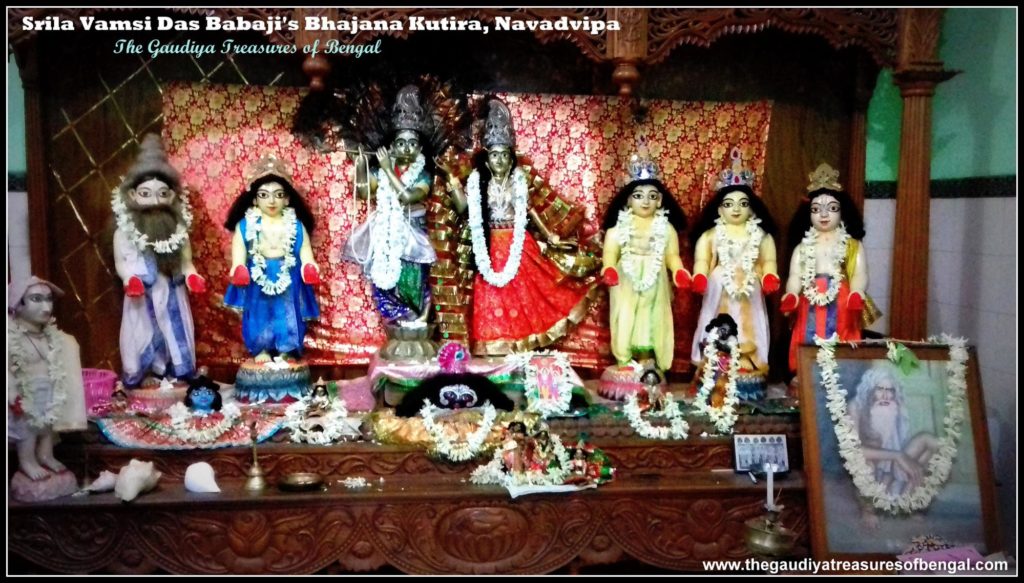
Once he settled at Navadvipa, Vamsi Dasa Babaji lived a life that struck almost everyone who saw it as strange, even by the standards of Bengal's renunciate tradition. He is remembered as being on the avadhuta platform. This means he was considered so advanced in spontaneous devotion that ordinary rules of conduct no longer applied to him. Most of the stories that survive about him show exactly this gap between what an outsider expected to see and what he actually did.
| Detail | Description |
|---|---|
| Possessions | A kaupina, a karanga (waterpot), and a kantha (patched cloth), nothing else |
| Deities | Gaura-Gadadhara, Nitai, Radha-Krishna, and Gopala, carried in two cloth bags |
| Worship style | No fixed mantra, no fixed schedule; deities served mentally, through direct conversation |
| Residence | An unlocked kutira near Baral Ghata, Koladvipa |
| Appearance | Uncut, matted hair and beard; over six feet tall; walked faster than younger companions even at eighty |
Two Bags and No Temple #
He kept his deities in two cloth bags, not in a temple room, and took Them out to worship only when he chose to. By one detailed count, the deities were Gaura-Gadadhara, Nitai, Radha-Krishna, and Gopala. His day had no fixed pattern. In the morning he would go out to collect flowers and beg for bhiksa. Around noon he would return to make garlands. Then he would spend hours slowly washing vegetables and picking through rice grain by grain. All the while he was talking or singing to the deities about Radha-Krishna's or Gaura-Nitai's lila. He often did not cook and offer bhoga until late in the evening, and stayed awake talking and singing through much of the night. When one visiting Vaishnava, Haridasa Gosvami, remarked that it would be better to prepare bhoga at a fixed morning hour, Babaji Maharaj gave a typical answer: "I do not know morning or evening. Am I their father's servant, so to feed them at appointed hours? If They want to eat like that, let Them make Their own arrangements for cooking."
The Three Keys #
He never locked the door of his kutira, even when robbed repeatedly, and gave the same explanation whenever asked: the lock had three keys, and all three belonged to his deities. "One is with Gaura, one with Nitai, and one with Gadadhara," he would say. "If the owner of the house Himself does not keep a watch, what is the use of locking the house?" Once a cow wandered in and knocked everything over, and once thieves stole his cooking pots. He treated such things as a matter between himself and his deities, not as a problem to be solved in a practical way. Sometimes he scolded Them for letting it happen. At other times he brushed it aside, remarking that Gaura had "a soft corner for the residents of His own dhama" and simply gave things away to them.
When the Deities Were Punished #
One incident shows how far he took this way of thinking. When two brass pots he used to cook for Gaura-Nitai were stolen, he scolded the deities directly, accused Them of allowing it, and refused to offer Them any food that day. The next day, one of the stolen pots was mysteriously returned. "This small pot is Nitai's," he announced. "He will be fed today. If Gaura wants to eat, He must also bring His pot." He cooked and fed only Nitai while Gaura, he said, watched with a long face, until the second pot turned up and he could finally feed both. On another occasion, a gold necklace given to his Gaura deity was stolen while he was out begging. He confronted the man he suspected, and the man pushed him down a flight of steps. Babaji Maharaj said nothing more about it. Several sources add that the thief and his entire family died soon afterward. The sources do not present this as something Babaji Maharaj claimed to have caused. They present it as something the devotees around him took as proof that an offense against a Vaishnava does not go unanswered.
A Momentary Weakness #
One story is repeated in almost the same words in several independent sources. This suggests it was widely told among those who knew him. A fish-seller once offered him her catch, and for a moment his mind was drawn to the idea of tasting it. For a strict Vaishnava renunciate, such a lapse would have been serious. He caught himself immediately, shouted at the woman to leave, and then turned on his own deities in genuine distress: "I've surrendered my life to Radha-Krishna, I'm under Their protection, and still this happens! Why are You not protecting me?" He stormed into his kutira, came back out with the deities tied by a rope, and threw Them into the Ganges, holding the other end of the rope under his foot. When a bystander asked why, he threw a stone at him. Word of the incident reached Srila Bhaktisiddhanta Sarasvati Thakura. He then forbade his own disciples to visit Babaji Maharaj at all, except for one who would simply deliver supplies. Bhaktisiddhanta Sarasvati Thakura explained afterward that this was not because Babaji Maharaj was in maya. It was because an ordinary disciple could not understand this bhava and would only commit an offense by trying to.
