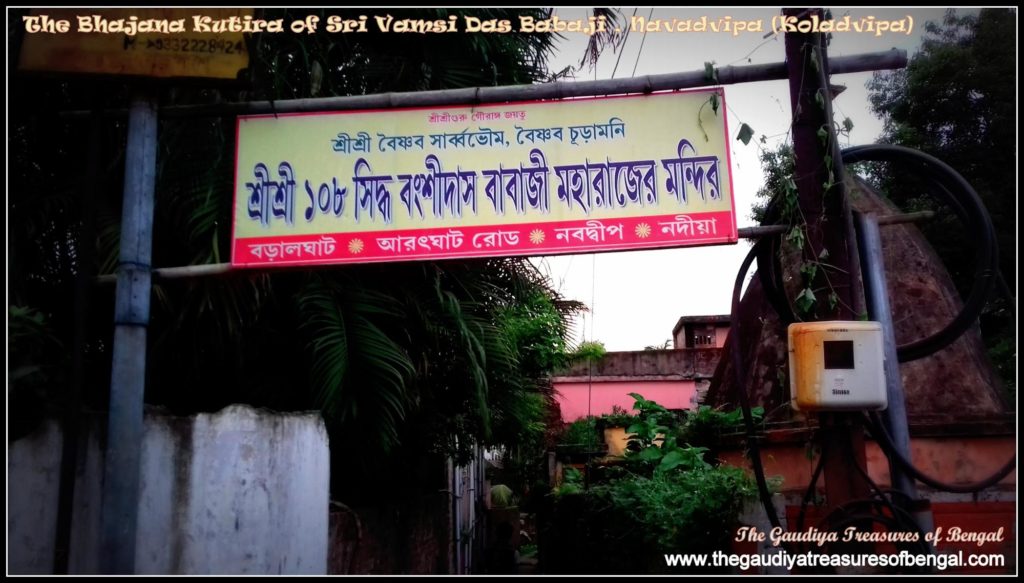
Almost everything known about Vamsi Dasa Babaji's early life comes down through a handful of Bengali-language biographies written well after his death, and they do not always agree with each other. What they agree on is enough to sketch a real outline: a poor household, a strong early pull toward Gauranga and Nityananda, a marriage that failed to hold him, and a final, permanent break with family life.
| Detail | Description |
|---|---|
| Birth name | Bhairab Chandra (also recorded as Bhairava) |
| Born | 1859, Majidpur village, Jamalpur, Mymensingh district (now Bangladesh) |
| Parents | Sanatana Mallabrahma (a fisherman) and Sarvasundari Devi |
| Position in family | Eldest of seven children |
| Son | Haracandra, left behind at renunciation |
| Guru | Disputed, see below |
A Poor Fisherman's Household #
He was born in 1859 in Majidpur, a village near Jamalpur. At that time it was in the Mymensingh district of Bengal, and today it is in Bangladesh. He was the eldest of seven children of Sanatana Mallabrahma, who supported the family by fishing, and his wife Sarvasundari Devi. As a boy he worked the family trade, but on the way back from selling fish he would stop at a nearby Gaura-Nitai temple and stand there for hours, simply looking at the deities. He also spent time in the company of a devotee who lived there, a sadhu remembered as Narottama Dasa Babaji. From this babaji he learned bhajans of the great sixteenth-century poet-saint Narottama Dasa Thakura and developed what one source calls a deep attraction to Chaitanya Mahaprabhu and Nityananda Prabhu. His parents were worried about where this was heading, so they arranged his marriage while he was still young. Parents often do this in the life stories of Bengal's renunciate saints, and it often fails.
Marriage and Renunciation #
The marriage did not settle him. Every available source agrees that he finally left his wife and young son for good and never returned to householder life. But the details differ, and we give them honestly here instead of smoothing them over. One biography, compiled by Bhakti Vikasa Swami, says he left his wife after only a single day of married life together, at his mother's repeated urging, and that his son was about six months old. A separate account, drawn from O. B. L. Kapoor's The Saints of Bengal, says instead that his son Haracandra was nine or ten years old when he renounced the world. That would place his leaving home as much as a decade later than the first account suggests. Neither source explains the gap, and it is not resolved here. Both accounts agree on what happened next. After leaving home he spent some years at Majidpur itself and then went on a long pilgrimage across India. At last he settled at Navadvipa around 1906 and took the name Vamsi Dasa (sometimes written Vamsidasa or Vamshi Das).
Which Guru? Three Different Answers #
The sources give different answers about who initiated him. We give all of them here plainly, instead of picking whichever answer sounds most authoritative. Bhakti Vikasa Swami's compilation says his diksha-guru was the same Narottama Dasa Babaji he had known as a boy at the village temple, and that this guru gave him the name Vamsidasa. This Narottama Dasa Babaji was a babaji and should not be confused with the medieval poet Narottama Dasa Thakura, even though they share a name. O. B. L. Kapoor's earlier biography, on the other hand, names a diksha-guru called Harilal Vrajavasi and a separate vesa-guru (the one who gave him formal babaji vesha) called Ramananda Vrajavasi. These two names appear nowhere else in the available sources. A reminiscence from His Holiness Bhakti Pramode Puri Maharaja offers yet a third possibility. He was a disciple of Bhaktisiddhanta Sarasvati Thakura who knew Vamsi Dasa Babaji personally, and he gives this as something heard, not witnessed: "We have heard that Vamshi Das took vesha from our Parama Gurudeva, Srila Gaura Kishora Dasa Babaji Maharaj." These three claims cannot all describe the same event, and no source explains the contradiction. One broader point is more certain, because two independent sources agree on it without contradicting each other. He belonged in a general way to the disciplic line coming from Narottama Dasa Thakura. This is a claim about his lineage, not the name of a particular guru. Readers should treat the question of his particular guru as still open.
