Srila Vamsi Dasa Babaji Maharaj
The Paramahamsa Avadhuta of Navadvipa
The complete life, on one page: The main biography and every pastime page, in order, in one place
Introduction
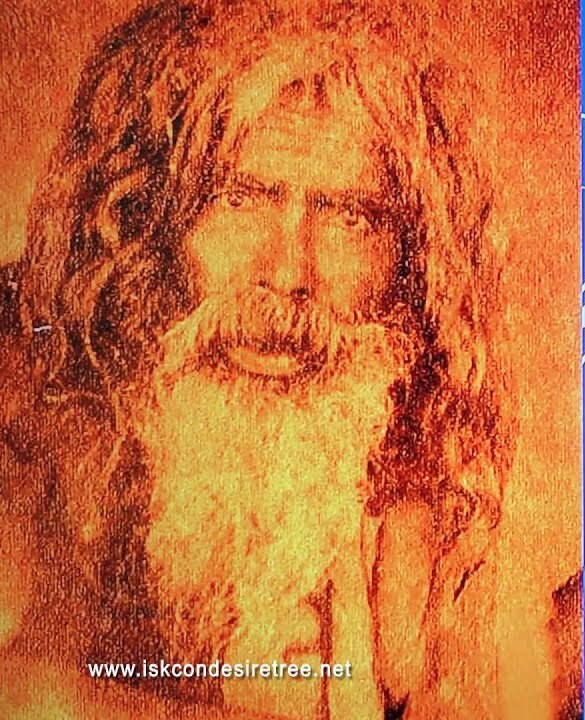
Srila Vamsi Dasa Babaji Maharaj was a renunciate of Navadvipa who lived from about 1859 to 1944. He spent most of that life on the bank of the Ganges at Koladvipa, living as an avadhuta. He had matted hair and wore a single kaupina. Outwardly he seemed to care nothing for the world, except for the two cloth bags that held his deities. He should not be confused with the far better known Srila Gaura Kishora Dasa Babaji, the guru of Bhaktisiddhanta Sarasvati Thakura. Gaura Kishora Dasa Babaji also carried the name Vamsi Dasa before he took babaji vesha. They were two different men, born about twenty years apart in different parts of Bengal, who happened to share an early name. The two are easy to mix up in a quick search. This Vamsi Dasa Babaji kept that name his whole life. Srila Bhaktisiddhanta Sarasvati Thakura, who founded the Gaudiya Matha, respected him so much that he would bow to him from a distance. But Bhaktisiddhanta Sarasvati Thakura did not allow his own disciples to go close to him. This was not because he had any doubt about the old babaji's spiritual position. He was afraid that a beginner might misunderstand the babaji's behavior and commit an offense at his feet.
| Detail | Description |
|---|---|
| Also known as | Vamsidas Babaji, Vamshi Das Babaji, Bhairab Chandra (his name before renunciation) |
| Born | 1859, Majidpur village, Jamalpur, Mymensingh district (now Bangladesh) |
| Renounced | Left his wife and young son and eventually settled in Navadvipa around 1906 |
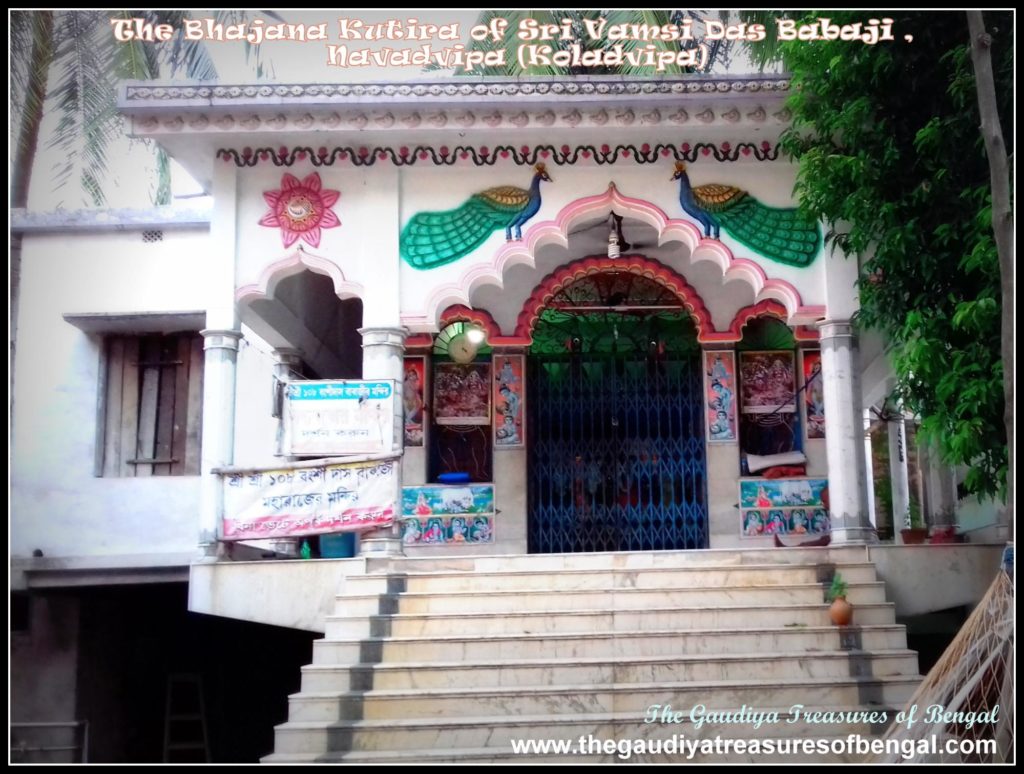
| Residence | A riverside kutira near Baral Ghata, Koladvipa, one of the nine islands of Navadvipa |
| Order | A babaji of the avadhuta type, in the general disciplic line of Narottama Dasa Thakura |
| Disappeared | Shukla Chaturthi of Shravana, 1944, at Majidpur |
| Not to be confused with | Srila Gaura Kishora Dasa Babaji, who also bore the name Vamsi Dasa before taking babaji vesha |
At a Glance
- Born Bhairab Chandra in 1859 to a poor fisherman's family in Majidpur, East Bengal; he later renounced his wife and infant son to become a wandering sadhu.
- Settled at Navadvipa around 1906 and lived as an avadhuta, with uncut hair and beard and one kaupina. He deliberately paid no attention to ordinary social rules.
- Carried his deities, Gaura-Nitai and Radha-Govinda, in two cloth bags and spoke to them directly, as a parent or a lover speaks, instead of following a fixed order of worship.
- Bhaktisiddhanta Sarasvati Thakura revered him but kept his own disciples at a careful distance, fearing they would misunderstand him and commit an offense.
- At over eighty years old he walked, rode ox-cart, and took the train across North India to Vrindavana and back, then died at his birthplace, Majidpur, in 1944.
Chapter 1
Life and Lineage
From a fisherman's son in East Bengal to a nameless sadhu on the Ganges - and a disputed question about who gave him diksha.
Almost everything known about Vamsi Dasa Babaji's early life comes down through a handful of Bengali-language biographies written well after his death, and they do not always agree with each other. What they agree on is enough to sketch a real outline: a poor household, a strong early pull toward Gauranga and Nityananda, a marriage that failed to hold him, and a final, permanent break with family life.
| Detail | Description |
|---|---|
| Birth name | Bhairab Chandra (also recorded as Bhairava) |
| Born | 1859, Majidpur village, Jamalpur, Mymensingh district (now Bangladesh) |
| Parents | Sanatana Mallabrahma (a fisherman) and Sarvasundari Devi |
| Position in family | Eldest of seven children |
| Son | Haracandra, left behind at renunciation |
| Guru | Disputed, see below |
A Poor Fisherman's Household #
He was born in 1859 in Majidpur, a village near Jamalpur. At that time it was in the Mymensingh district of Bengal, and today it is in Bangladesh. He was the eldest of seven children of Sanatana Mallabrahma, who supported the family by fishing, and his wife Sarvasundari Devi. As a boy he worked the family trade, but on the way back from selling fish he would stop at a nearby Gaura-Nitai temple and stand there for hours, simply looking at the deities. He also spent time in the company of a devotee who lived there, a sadhu remembered as Narottama Dasa Babaji. From this babaji he learned bhajans of the great sixteenth-century poet-saint Narottama Dasa Thakura and developed what one source calls a deep attraction to Chaitanya Mahaprabhu and Nityananda Prabhu. His parents were worried about where this was heading, so they arranged his marriage while he was still young. Parents often do this in the life stories of Bengal's renunciate saints, and it often fails.
Marriage and Renunciation #
The marriage did not settle him. Every available source agrees that he finally left his wife and young son for good and never returned to householder life. But the details differ, and we give them honestly here instead of smoothing them over. One biography, compiled by Bhakti Vikasa Swami, says he left his wife after only a single day of married life together, at his mother's repeated urging, and that his son was about six months old. A separate account, drawn from O. B. L. Kapoor's The Saints of Bengal, says instead that his son Haracandra was nine or ten years old when he renounced the world. That would place his leaving home as much as a decade later than the first account suggests. Neither source explains the gap, and it is not resolved here. Both accounts agree on what happened next. After leaving home he spent some years at Majidpur itself and then went on a long pilgrimage across India. At last he settled at Navadvipa around 1906 and took the name Vamsi Dasa (sometimes written Vamsidasa or Vamshi Das).
Which Guru? Three Different Answers #
The sources give different answers about who initiated him. We give all of them here plainly, instead of picking whichever answer sounds most authoritative. Bhakti Vikasa Swami's compilation says his diksha-guru was the same Narottama Dasa Babaji he had known as a boy at the village temple, and that this guru gave him the name Vamsidasa. This Narottama Dasa Babaji was a babaji and should not be confused with the medieval poet Narottama Dasa Thakura, even though they share a name. O. B. L. Kapoor's earlier biography, on the other hand, names a diksha-guru called Harilal Vrajavasi and a separate vesa-guru (the one who gave him formal babaji vesha) called Ramananda Vrajavasi. These two names appear nowhere else in the available sources. A reminiscence from His Holiness Bhakti Pramode Puri Maharaja offers yet a third possibility. He was a disciple of Bhaktisiddhanta Sarasvati Thakura who knew Vamsi Dasa Babaji personally, and he gives this as something heard, not witnessed: "We have heard that Vamshi Das took vesha from our Parama Gurudeva, Srila Gaura Kishora Dasa Babaji Maharaj." These three claims cannot all describe the same event, and no source explains the contradiction. One broader point is more certain, because two independent sources agree on it without contradicting each other. He belonged in a general way to the disciplic line coming from Narottama Dasa Thakura. This is a claim about his lineage, not the name of a particular guru. Readers should treat the question of his particular guru as still open.
Scriptural evidence for this chapter (1)
se sambandha nahi yara, brtha janma gelo tar
ei pashu boro duracara
One who has no relationship with Lord Nityananda has wasted his birth; such a person is no better than this lowly animal.
According to one biography, Vamsi Dasa Babaji sang this line of Narottama Dasa Thakura on seeing an elephant, in a mood of deep humility, applying "this animal" to himself.
Chapter 2
The Avadhuta of Navadvipa
Two cloth bags, three keys held by his deities, and a style of worship that even devoted onlookers struggled to follow.
Once he settled at Navadvipa, Vamsi Dasa Babaji lived a life that struck almost everyone who saw it as strange, even by the standards of Bengal's renunciate tradition. He is remembered as being on the avadhuta platform. This means he was considered so advanced in spontaneous devotion that ordinary rules of conduct no longer applied to him. Most of the stories that survive about him show exactly this gap between what an outsider expected to see and what he actually did.
| Detail | Description |
|---|---|
| Possessions | A kaupina, a karanga (waterpot), and a kantha (patched cloth), nothing else |
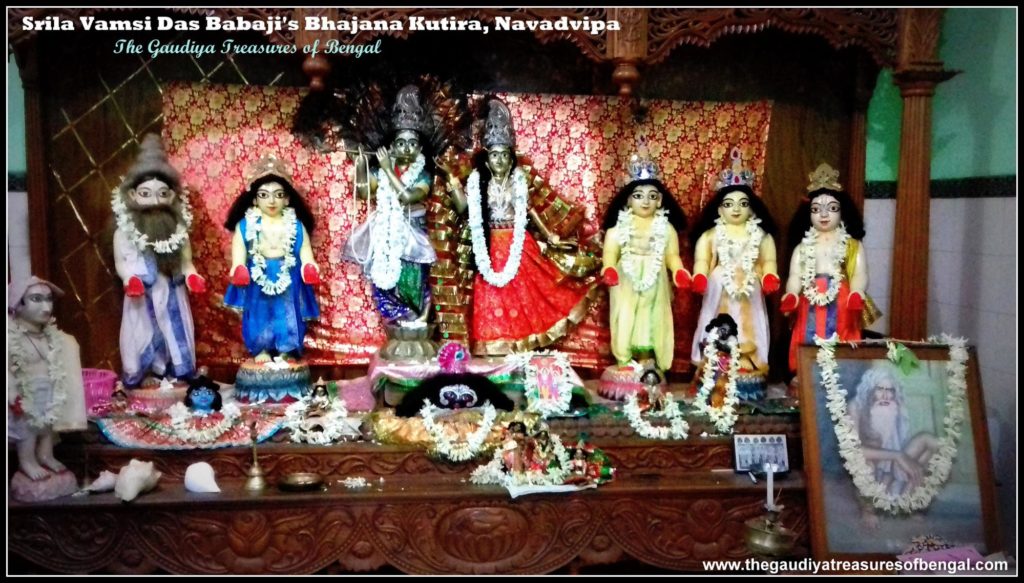
| Deities | Gaura-Gadadhara, Nitai, Radha-Krishna, and Gopala, carried in two cloth bags |
| Worship style | No fixed mantra, no fixed schedule; deities served mentally, through direct conversation |
| Residence | An unlocked kutira near Baral Ghata, Koladvipa |
| Appearance | Uncut, matted hair and beard; over six feet tall; walked faster than younger companions even at eighty |
Two Bags and No Temple #
He kept his deities in two cloth bags, not in a temple room, and took Them out to worship only when he chose to. By one detailed count, the deities were Gaura-Gadadhara, Nitai, Radha-Krishna, and Gopala. His day had no fixed pattern. In the morning he would go out to collect flowers and beg for bhiksa. Around noon he would return to make garlands. Then he would spend hours slowly washing vegetables and picking through rice grain by grain. All the while he was talking or singing to the deities about Radha-Krishna's or Gaura-Nitai's lila. He often did not cook and offer bhoga until late in the evening, and stayed awake talking and singing through much of the night. When one visiting Vaishnava, Haridasa Gosvami, remarked that it would be better to prepare bhoga at a fixed morning hour, Babaji Maharaj gave a typical answer: "I do not know morning or evening. Am I their father's servant, so to feed them at appointed hours? If They want to eat like that, let Them make Their own arrangements for cooking."
The Three Keys #
He never locked the door of his kutira, even when robbed repeatedly, and gave the same explanation whenever asked: the lock had three keys, and all three belonged to his deities. "One is with Gaura, one with Nitai, and one with Gadadhara," he would say. "If the owner of the house Himself does not keep a watch, what is the use of locking the house?" Once a cow wandered in and knocked everything over, and once thieves stole his cooking pots. He treated such things as a matter between himself and his deities, not as a problem to be solved in a practical way. Sometimes he scolded Them for letting it happen. At other times he brushed it aside, remarking that Gaura had "a soft corner for the residents of His own dhama" and simply gave things away to them.
When the Deities Were Punished #
One incident shows how far he took this way of thinking. When two brass pots he used to cook for Gaura-Nitai were stolen, he scolded the deities directly, accused Them of allowing it, and refused to offer Them any food that day. The next day, one of the stolen pots was mysteriously returned. "This small pot is Nitai's," he announced. "He will be fed today. If Gaura wants to eat, He must also bring His pot." He cooked and fed only Nitai while Gaura, he said, watched with a long face, until the second pot turned up and he could finally feed both. On another occasion, a gold necklace given to his Gaura deity was stolen while he was out begging. He confronted the man he suspected, and the man pushed him down a flight of steps. Babaji Maharaj said nothing more about it. Several sources add that the thief and his entire family died soon afterward. The sources do not present this as something Babaji Maharaj claimed to have caused. They present it as something the devotees around him took as proof that an offense against a Vaishnava does not go unanswered.
A Momentary Weakness #
One story is repeated in almost the same words in several independent sources. This suggests it was widely told among those who knew him. A fish-seller once offered him her catch, and for a moment his mind was drawn to the idea of tasting it. For a strict Vaishnava renunciate, such a lapse would have been serious. He caught himself immediately, shouted at the woman to leave, and then turned on his own deities in genuine distress: "I've surrendered my life to Radha-Krishna, I'm under Their protection, and still this happens! Why are You not protecting me?" He stormed into his kutira, came back out with the deities tied by a rope, and threw Them into the Ganges, holding the other end of the rope under his foot. When a bystander asked why, he threw a stone at him. Word of the incident reached Srila Bhaktisiddhanta Sarasvati Thakura. He then forbade his own disciples to visit Babaji Maharaj at all, except for one who would simply deliver supplies. Bhaktisiddhanta Sarasvati Thakura explained afterward that this was not because Babaji Maharaj was in maya. It was because an ordinary disciple could not understand this bhava and would only commit an offense by trying to.
Scriptural evidence for this chapter (2)
Quoted in the text above:
- On why he never locked his kutira Reminiscence of Vamsi Dasa Babaji
Further verses:
যাঁর চিত্তে কৃষ্ণপ্রেমা করয়ে উদয় ।
তাঁর বাক্য, ক্রিয়া, মুদ্রা বিজ্ঞেহ না বুঝয় ॥
yanra citte krsna-prema karaye udaya
tanra vakya, kriya, mudra vijneha na bujhaya
Word for word
yanra citte: in whose heart; krsna-prema: love of Krishna; karaye udaya: awakens; tanra: his; vakya: words; kriya: activities; mudra: symptoms; vijneha: even a learned scholar; na bujhaya: does not understand.
Even the most learned man cannot understand the words, activities, and symptoms of a person situated in love of Godhead.
This verse from Chaitanya-bhagavata, quoted in Chaitanya-charitamrita, is cited by a pilgrimage account of Vamsi Dasa Babaji to explain why his behavior - throwing his own deities into the Ganges, punishing Them for thefts - could not be judged by ordinary standards.
Chapter 3
Pilgrimage to Vraja
At over eighty years old, he walked, rode in an ox-cart, and took the train across North India to sit once more under Krishna's flute-tree.
Vamsi Dasa Babaji did not stay at Navadvipa all the time. Several accounts describe long journeys during his life. The one recorded in most detail is a journey of roughly three months to Vrindavana, made when he was already in his eighties. It gives an unusually detailed picture of how he lived and travelled even in old age.
| Detail | Description |
|---|---|
| Departure | 24 February 1941 (12th of Phalguna, 1347 Bengali era), from Navadvipa |
| Route | Katwa, Bhagalpur, Gaya, Benares, Ayodhya, Prayag, Mathura, Vrindavana |
| Duration | About three months, returning in the month of Jyestha |
| Signature habit | Sitting under any peepal (bata) tree he found, taking it to be Krishna's Vamsi-vata |
| Later travels | Bengal (Ambika Kalna) and Odisha (Baleshvara, Puri), then northern India again, 1943-1944 |
Leaving Navadvipa #
He left Navadvipa on 24 February 1941, the 12th of Phalguna in the year 1347 of the Bengali calendar. He travelled by whatever means he could find: on foot, by ox-cart, and by rail in turns. His first stop was Katwa, where he stayed two days under a bata tree by the railway station. From there he went to Bhagalpur, and then to Gaya, where he spent three days on the bank of the Phalgu river. Wherever he found a peepal tree along the way, he would treat it as the Vamsi-vata of Vrindavana, the tree under which Krishna is said to have played His flute to call the gopis. Once he had settled beneath such a tree, it was reportedly very difficult to get him to move again.
Through Vraja-mandala #
From Gaya he continued to Benares, where he stayed on a boat near Dashashvamedha Ghat for three days. Then he went to Ayodhya on the Sarayu, and to the Triveni confluence at Prayag for ten days. After that he went on into Vraja itself. There he visited Mathura's Vishrama Ghat, the Vamsi-vata at Vrindavana, the banks of the Yamuna at Madhya-curia, the Govindaji temple, Kaliya-daha, a tamala tree at Nandagrama, and Pavana-sarovara. At the end he spent nine more days back at Vamsi-vata Ghat before turning home. Those who travelled with him remembered that his mood changed without warning. One moment he was singing about Krishna's lila, and the next he was glorifying Navadvipa-dhama. Sometimes he laughed, and sometimes he fell into long silences. In the temples he visited, he was often seen murmuring privately to the deities, as if revealing to Them some personal feeling that he could not share with anyone else. He returned to Navadvipa in the month of Jyestha, roughly three months after he had left.
An Unexpected Guest at Midnapore #
One story from these travels shows how far his reputation reached beyond Bhaktisiddhanta Sarasvati Thakura's own immediate circle. His Divine Grace Bhaktidayita Madhava Goswami Maharaj, founder of the Chaitanya Gaudiya Math at Midnapore, once heard that Vamsi Dasa Babaji's party was passing through the city by ox-cart and sent a disciple to invite him to the math. Babaji Maharaj agreed to come. But the midday offering was made and still no one arrived, so Madhava Maharaj went out to look for him in person. He found that Babaji Maharaj had simply stopped at the first peepal tree he saw, decided it was the Vamsi-vata, and made camp there to feed his deities and his travelling companions. When Babaji Maharaj recognized Madhava Maharaj, he remembered his own long affection for Bhaktisiddhanta Sarasvati Thakura. He offered Madhava Maharaj sweet rice prasada with his own hands. It was a small gesture, but Madhava Maharaj is said to have remembered it fondly for years afterward.
Later Travels #
An old issue of the Gaudiya weekly magazine records further journeys from March 1943: to Ambika Kalna, Kharagpur, Baleshvara (Balasore), Soro, Bhadrak, Khurda Road, and Puri, then back through Gaya, Kashi (Benares), Saidpur, Patna, and Munger. Some retellings of this report say these journeys went on until 1947, but that cannot be right, because he returned to Majidpur in March 1944 and passed away there that July. At one point, devotees from his birthplace, Majidpur, invited him to visit. He agreed to go, though without much interest, remarking only that it was a place "which the Pandavas had neglected." Throughout these years, sadhus of the Gaudiya Matha are recorded as serving him a great deal on the road. This was so even though, at Navadvipa itself, Bhaktisiddhanta Sarasvati Thakura's own disciples kept a more formal distance from him.
Scriptural evidence for this chapter (1)
কৃষ্ণভক্তিরসভাবিতা মতিঃ
ক্রীয়তাং যদি কুতোঽপি লভ্যতে ।
তত্র লৌল্যমপি মূল্যমেকলং
জন্মকোটিসুকৃতৈর্ন লভ্যতে ॥
krsna-bhakti-rasa-bhavita matih
kriyatam yadi kuto 'pi labhyate
tatra laulyam api mulyam ekalam
janma-koti-sukrtair na labhyate
Word for word
krsna-bhakti-rasa-bhavita: absorbed in the mellows of executing devotional service to Krishna; matih: intelligence; kriyatam: let it be purchased; yadi: if; kutah api: somewhere; labhyate: is available; tatra: there; laulyam: greed; api: indeed; mulyam: price; ekalam: only; janma-koti: of millions of births; sukrtaih: by pious activities; na labhyate: is not obtained.
Pure devotional service in Krishna consciousness cannot be had even by pious activity in hundreds and thousands of lives. It can be attained only by paying one price - that is, intense greed to obtain it. If it is available somewhere, one must purchase it without delay.
From the purport: Purport excerpt: "The previous two verses are included in the Padyavali (13, 14), an anthology compiled by Srila Rupa Gosvami... verse 70 refers to devotional service rendered out of intense greed."
A biography of Vamsi Dasa Babaji describes him as having embodied this exact verse, remaining absorbed in Krishna-rasa wherever his travels took him.
Chapter 4
Weep for Him
He rarely quoted scripture. When people asked how to reach God, he usually gave them one word.
Vamsi Dasa Babaji was not a preacher and did not run a school of instruction. Visitors came to him constantly. Some came out of genuine longing, and many were simply drawn by his reputation. Most of them he ignored completely, or he answered so briefly that those few words were the whole teaching. What survives of his instruction is therefore short: a handful of one-line exchanges, a couple of songs, and one word repeated often enough that it became the thing devotees remembered him for.
| Detail | Description |
|---|---|
| Teaching style | Almost no scriptural quotation; short, direct answers from personal realization |
| Best-known teaching | A single word, "Cry" (or "Weep"), as the answer to how one attains God |
| Compositions | At least two short Bengali padas in the mood of a Nadiya-nagari |
| Preserved through | Oral reminiscence, later written down by Bhakti Pramode Puri Maharaja and others |
One Word: Cry #
One regular visitor kept coming back with the same question, how can we attain God, and for a long time got no answer at all. Then one day Babaji Maharaj looked directly at him and asked, "What do you want?" "I want to see Bhagavan," the man said. Babaji Maharaj answered in a single word: "Weep." A later commentator, Srila Bhakti Ballabh Tirtha Maharaj, built an entire teaching around that one exchange. He taught that ordinary chanting of the holy names, done without real longing, brings the Lord no closer than reciting a shopping list would. Only real, tearful eagerness moves Him to respond. In the same way, a mother finally comes running only when her baby's crying can no longer be ignored. Babaji Maharaj is remembered making the same point more simply. A devotee was singing a well-known couplet of Bhaktivinoda Thakura about longing to roll in the dust of Vrindavana. "You are only singing a song. For someone who has exploded, it has exploded," Babaji Maharaj told him. He meant that devotees keep singing the words of the great teachers without actually feeling what those teachers felt.
Short Answers to Big Questions #
Other exchanges were recorded in the same short style. Asked how one becomes free of the demands of the senses, he answered by quoting a song of Narottama Dasa Thakura comparing the sound of Govinda's name to a lion's roar that scatters deer. Asked whether he found any happiness in this world, he said there was none, apart from worshiping Gaura-Nitai: "that is our eternal world, while this illusion is your world." Asked how to recognize the blessing of Krishna or the Vaishnavas, he answered indirectly, in a few broken phrases. Together they gave a warning: an offense at a Vaishnava's feet has no pardon. Once he was asked whether he had ever been to Mayapur, and he told a small, quiet story of his own. He had gone there once with nothing but a torn wrapper and a waterpot. Then Sachinandana Gosani, Mahaprabhu Himself, had come and taken his waterpot from him, and a few minutes later He had brought it back.
Two Songs of a Nadiya-Nagari #
According to one biographer, Haridasa Gosvami, Babaji Maharaj's mood toward Gaura combined sakhya, vatsalya, and madhurya all at once. This shows most clearly in two short Bengali padas he is said to have composed himself. They are written from the viewpoint of a Nadiya-nagari, literally, a woman of Nadiya captivated by Gauranga's glance. In one, he pictures himself asking a companion what to do now that Gaura has "stolen my heart" with a single sidelong look on the Ganges bank. In the other, the same anguished question repeats: "what has Gaura done to me?", as home, family, and self-possession all slip away. These two padas survive only through this one biographer's Bengali quotation and English translation. No independent manuscript or earlier printed source could be found. So we report them here as songs said to be his, not as songs proved to be his.
Scriptural evidence for this chapter (6)
tyajiya sayana sukha, vicitra palanka
kabe vrajera dhulaya dhusara habe anga
When will I give up the pleasure of sleeping in a comfortable bed and roll in the dust of Vrindavana?
Vamsi Dasa Babaji heard a devotee singing this line of Bhaktivinoda Thakura and remarked that mere singing without real longing changes nothing - the exact song and its formal source were not independently verified beyond the secondary account that quotes it.
shuniya govinda-rab, apani palabe sab
simha-rabe yatha kari-gan
They will all flee at the sound of Govinda's name, just as a herd of deer flees at the roar of a lion.
Vamsi Dasa Babaji quoted this line of Narottama Dasa Thakura when asked how one becomes free of the demands of the senses; the specific song within Narottama's Prarthana this line comes from could not be independently confirmed.
kena giya chilama ganga-tire o nagari
nayana kataksa bane gaura kaila mana churi
ami ekhana ki kari o nagari ki kari
O Nagari, how I regret having gone to the bank of the Ganges - Gaura cast a sidelong glance and stole my heart. What shall I do now, O Nagari? What shall I do?
One of two short devotional padas attributed to Vamsi Dasa Babaji himself by his biographer Haridasa Gosvami; no independent manuscript could be located, so it is reported as attributed rather than verified.
bala go nagari gaura kallena ki
grha gela kula gela mana kaila curi
sajani, ekhana ami ki kari
Tell me, O Nagari, what Gaura has done to me - my home is gone, my family name is gone, He has stolen my mind. O friend, now what shall I do?
The second of two padas attributed to Vamsi Dasa Babaji by Haridasa Gosvami; reported here as attributed, not independently verified.
jive doya, name ruci, vaishnava-sevana
iha chara dharma nai, shuno sanatana
Kindness to all living beings, a taste for the holy name, and service to the Vaishnavas - apart from this, there is no other religion.
Recorded as an instruction Vamsi Dasa Babaji gave to a sincere seeker; the phrasing closely echoes a widely repeated Gaudiya Vaishnava teaching, without any claim that he originated it.
"What do you want?" "I want to see Bhagavan." "Weep."
Vamsi Dasa Babaji's best-remembered single teaching, given as a one-word answer; recorded by Srila Bhakti Ballabh Tirtha Maharaj in Sri Chaitanya: His Life and Associates.
Chapter 5
Disappearance and Legacy
He returned home to Majidpur to die, leaving behind a bhajan kutira that Vaishnavas still visit on the banks of the Ganges.
By his final years, Vamsi Dasa Babaji had spent almost four decades in Navadvipa and had become one of its fixed, familiar figures. Bhaktisiddhanta Sarasvati Thakura's own disciples were taught to revere him from a careful distance. To the Vaishnavas around him, his unusual daily life had itself become a kind of teaching, open for all to see.
| Detail | Description |
|---|---|
| Final departure from Navadvipa | Returned to birthplace, Majidpur, near the end of his life |
| Disappearance | Shukla Chaturthi, Shravana, 1944 (one source: 23 July 1944) |
| Age at disappearance | Approximately 85 |
| Present-day site | A kutira/mandir near Baral Ghata, Koladvipa, Navadvipa, still visited by pilgrims |
Bhaktisiddhanta Sarasvati Thakura's Blessing #
The relationship between Vamsi Dasa Babaji and Srila Bhaktisiddhanta Sarasvati Thakura is one of the better-recorded parts of his life. This is because Bhaktisiddhanta's own disciples wrote it down. Bhaktisiddhanta arranged regular supplies of rice and grain for the old babaji through brahmacharis sent from the Yoga-pitha. He would bow to him personally whenever their paths crossed, and he once remarked that Vamsi Dasa Babaji was "not within this world, but is moving in the transcendental realm." Vamsi Dasa Babaji, in turn, is remembered greeting Bhaktisiddhanta warmly on sight. "Someone very close to my Gaura has come to me," he said. On another occasion, he saw Bhaktisiddhanta approaching and exclaimed, "Oh, a manjari has come, so won't Radha come also? She will come! She will come!" At the same time, Bhaktisiddhanta was careful never to let ordinary disciples treat this closeness as an invitation. After the incident in which Babaji Maharaj threw his own deities into the Ganges over a moment's attraction to fish, Bhaktisiddhanta forbade all visits outright. He told his disciples plainly that they lacked the spiritual maturity to witness such behavior without misunderstanding it. Some time later, one brahmachari visited anyway. Babaji Maharaj threw a stone at him and said, "If you want to please me, then never return here again!"
The Final Return to Majidpur #
Toward the end of his life, Vamsi Dasa Babaji made his way back to Majidpur. This was the village where he had been born and where he had left his family behind decades earlier. He carried his deities with him the whole way. By one account, he did not eat, sleep or stop along the road. Renunciate tradition generally holds that a sadhu should not return to his former household. True to this, he did not formally re-enter the town. He is said to have stayed instead in an old, broken-down temple nearby. Vamsi Dasa Babaji left his body there, at roughly eighty-five years of age. According to the one source that gives a precise date, this was on Chaturthi, 23 July 1944. The wider tradition simply marks his disappearance day as Shukla Chaturthi of the month of Shravana.
The Kutira Today #
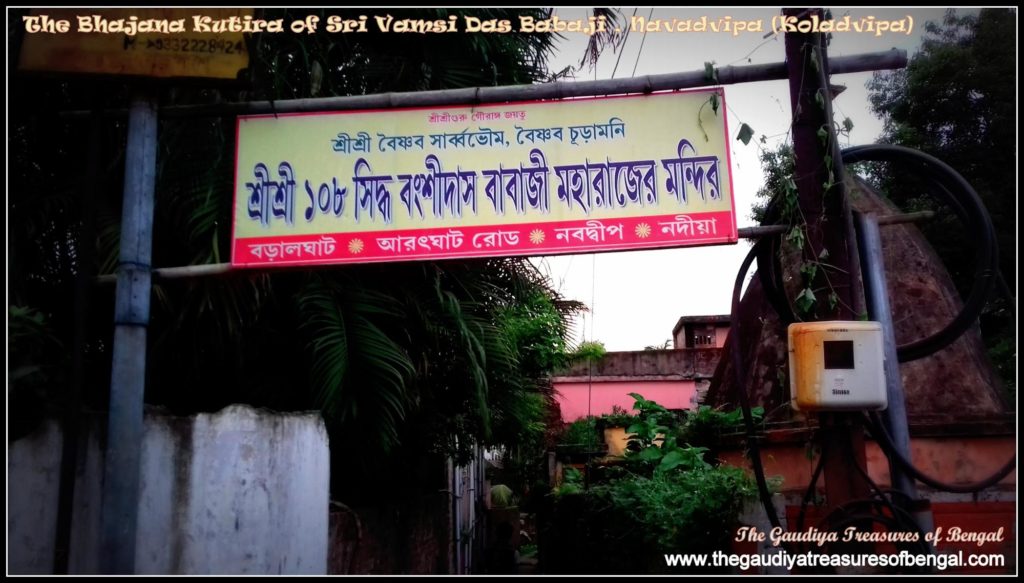
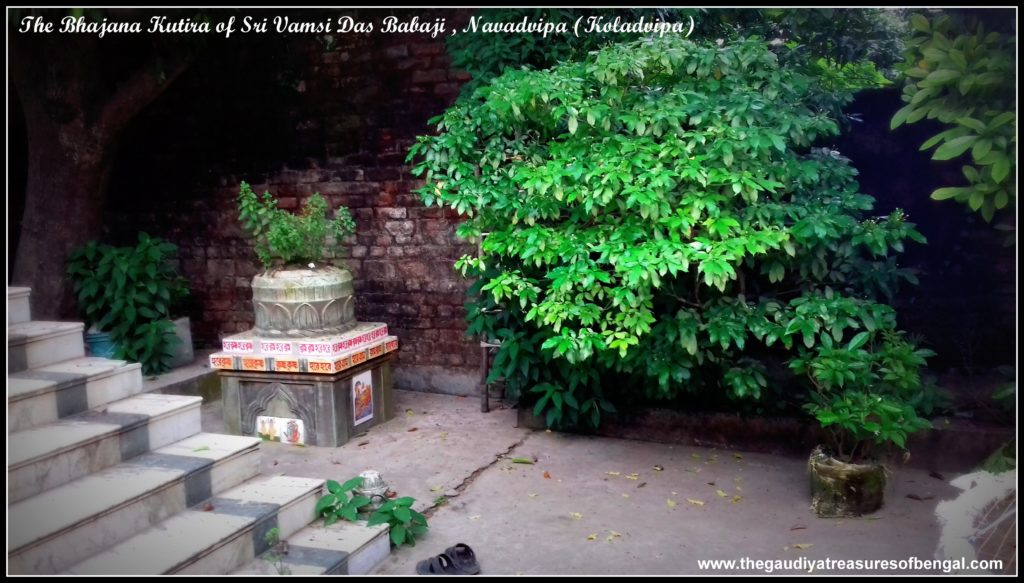
His bhajana kutira on the western side of Navadvipa, in the area known as Koladvipa, still stands and is still maintained as a small mandir. It is marked today by a signboard reading "Sri Sri 108 Siddha Vamshidasa Babaji Maharaj's Mandir" at Baral Ghata on the Aranghat Road. Modern pilgrimage accounts note that Koladvipa itself has an older importance in Gaudiya Vaishnava tradition. It is remembered as the place where Sri Chaitanya Mahaprabhu once excused the offense committed against Srivasa Thakura by Capala Gopala and Devananda Pandita. The same accounts note that Vamsi Dasa Babaji's own kutira is in the same general stretch of Navadvipa where Jagannatha Dasa Babaji spent his later years. Jagannatha Dasa Babaji was another renunciate revered by Bhaktivinoda Thakura's generation. His own bhajana kutira and samadhi are counted among the area's pilgrimage stops today. There is no record that the two babajis knew each other personally. The only connection is that visitors to Navadvipa today can walk from one man's memorial to the other's in the same afternoon. So two very different lives of renunciation are remembered a short distance apart on the same stretch of the Ganges.
Scriptural evidence for this chapter (1)
Someone very close to my Gaura has come to me.
Vamsi Dasa Babaji's remark on seeing Bhaktisiddhanta Sarasvati Thakura, recorded by disciples of the latter and repeated in several biographical accounts.
Closing
A Fisherman's Son in Majidpur #
He was born Bhairab Chandra (sometimes recorded as Bhairava) in 1859. He was the eldest of seven children of Sanatana Mallabrahma, a poor fisherman, and Sarvasundari Devi. They lived in the village of Majidpur near Jamalpur, then part of the Mymensingh district of Bengal and today in Bangladesh. From childhood he was drawn to the Gaura-Nitai deities at a nearby temple, and he sometimes stared at Them for hours. His worried parents arranged an early marriage, hoping this would settle him down. It did not work. Sources disagree on exactly how old his son, Haracandra, was when Bhairab Chandra walked away from married life for good. One account says the boy was only about six months old. Another says he was nine or ten. But every source agrees that the break was final. He left behind his family, his caste occupation and his given name. He travelled on pilgrimage across India and at last settled at Navadvipa around 1906, where he became known as Vamsi Dasa. One early account adds, without much explanation, that he first followed something it calls the "Kalachanda doctrine" before taking up ordinary Gaudiya Vaishnava practice. No other available source mentions this detail, so we report it here only as an open question, not a settled fact.
A Disputed Guru #
It is not clear who gave Vamsi Dasa Babaji his diksha and his babaji vesha, and the sources do not agree. His Holiness Bhakti Pramode Puri Maharaja was a disciple of Bhaktisiddhanta Sarasvati Thakura who knew Vamsi Dasa Babaji personally. His reminiscence says only, "We have heard that Vamshi Das took vesha from our Parama Gurudeva, Srila Gaura Kishora Das Babaji Maharaj," and he gives it as something he had heard, not something he saw. A separate biography by O. B. L. Kapoor (himself a godbrother of Srila Prabhupada), used for his book The Saints of Bengal, names instead a diksha-guru called Harilal Vrajavasi and a vesha-guru called Ramananda Vrajavasi. These two names do not appear in any other published source. A third account is compiled from Bhakti Vikasa Swami's biography of Vamsidasa Babaji. It says he received diksha as a young man from a sadhu called Narottama Dasa Babaji, and that this guru gave him the name Vamsidasa. This Narottama Dasa Babaji should not be confused with the sixteenth-century poet-saint Narottama Dasa Thakura, who lived roughly three centuries earlier. Two of these sources, independently of each other, do agree on one broader point: he belonged in a general way to the disciplic line coming from Narottama Dasa Thakura. Because these accounts clearly conflict on the actual names, we leave the question open here and do not state any one guru as established fact.
- Gaudiya History (ISKCON Desire Tree): Vamshi das Babaji - Biography
- Gaudiya History (ISKCON Desire Tree): Vamsi Dasa Babaji Maharaj
- Shyam Das Baba: Srila Vamshi das Babaji (Lord Chaitanya's Associates)
- ISKCON Desire Tree: Srila Vamsidasa Babaji - Disappearance (excerpts from O.B.L. Kapoor's The Saints of Bengal, and Bhakti Ballabh Tirtha Maharaj's A Taste of Transcendence)
- Stephen Knapp: Vamsidasa Babaji
- The Gaudiya Treasures of Bengal: Vamsi Das Babaji - Biography, His Sripat in Mayapur Nabadwip Dham
- Sri Chaitanya-charitamrita, Madhya-lila 8.70
- Sri Chaitanya-charitamrita, Madhya-lila 23.39
