By his final years, Vamsi Dasa Babaji had spent almost four decades in Navadvipa and had become one of its fixed, familiar figures. Bhaktisiddhanta Sarasvati Thakura's own disciples were taught to revere him from a careful distance. To the Vaishnavas around him, his unusual daily life had itself become a kind of teaching, open for all to see.
| Detail | Description |
|---|---|
| Final departure from Navadvipa | Returned to birthplace, Majidpur, near the end of his life |
| Disappearance | Shukla Chaturthi, Shravana, 1944 (one source: 23 July 1944) |
| Age at disappearance | Approximately 85 |
| Present-day site | A kutira/mandir near Baral Ghata, Koladvipa, Navadvipa, still visited by pilgrims |
Bhaktisiddhanta Sarasvati Thakura's Blessing #
The relationship between Vamsi Dasa Babaji and Srila Bhaktisiddhanta Sarasvati Thakura is one of the better-recorded parts of his life. This is because Bhaktisiddhanta's own disciples wrote it down. Bhaktisiddhanta arranged regular supplies of rice and grain for the old babaji through brahmacharis sent from the Yoga-pitha. He would bow to him personally whenever their paths crossed, and he once remarked that Vamsi Dasa Babaji was "not within this world, but is moving in the transcendental realm." Vamsi Dasa Babaji, in turn, is remembered greeting Bhaktisiddhanta warmly on sight. "Someone very close to my Gaura has come to me," he said. On another occasion, he saw Bhaktisiddhanta approaching and exclaimed, "Oh, a manjari has come, so won't Radha come also? She will come! She will come!" At the same time, Bhaktisiddhanta was careful never to let ordinary disciples treat this closeness as an invitation. After the incident in which Babaji Maharaj threw his own deities into the Ganges over a moment's attraction to fish, Bhaktisiddhanta forbade all visits outright. He told his disciples plainly that they lacked the spiritual maturity to witness such behavior without misunderstanding it. Some time later, one brahmachari visited anyway. Babaji Maharaj threw a stone at him and said, "If you want to please me, then never return here again!"
The Final Return to Majidpur #
Toward the end of his life, Vamsi Dasa Babaji made his way back to Majidpur. This was the village where he had been born and where he had left his family behind decades earlier. He carried his deities with him the whole way. By one account, he did not eat, sleep or stop along the road. Renunciate tradition generally holds that a sadhu should not return to his former household. True to this, he did not formally re-enter the town. He is said to have stayed instead in an old, broken-down temple nearby. Vamsi Dasa Babaji left his body there, at roughly eighty-five years of age. According to the one source that gives a precise date, this was on Chaturthi, 23 July 1944. The wider tradition simply marks his disappearance day as Shukla Chaturthi of the month of Shravana.
The Kutira Today #
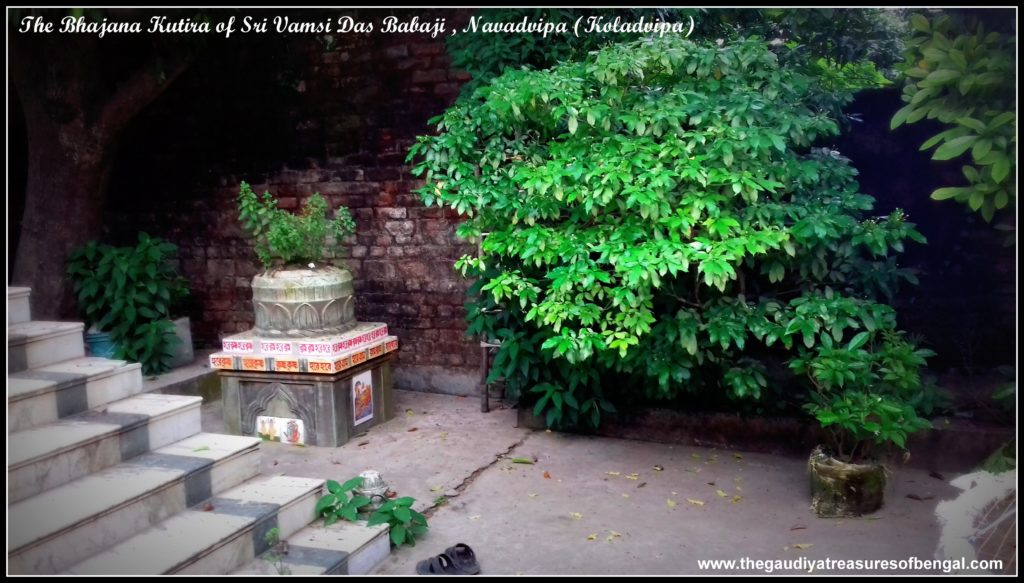
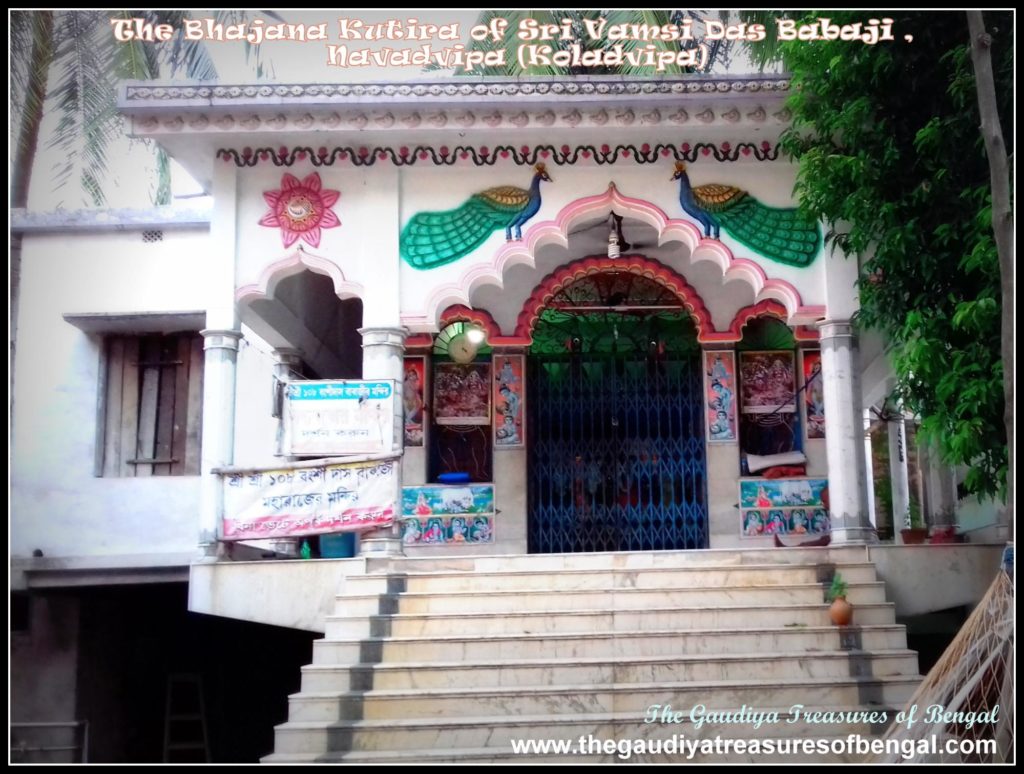
His bhajana kutira on the western side of Navadvipa, in the area known as Koladvipa, still stands and is still maintained as a small mandir. It is marked today by a signboard reading "Sri Sri 108 Siddha Vamshidasa Babaji Maharaj's Mandir" at Baral Ghata on the Aranghat Road. Modern pilgrimage accounts note that Koladvipa itself has an older importance in Gaudiya Vaishnava tradition. It is remembered as the place where Sri Chaitanya Mahaprabhu once excused the offense committed against Srivasa Thakura by Capala Gopala and Devananda Pandita. The same accounts note that Vamsi Dasa Babaji's own kutira is in the same general stretch of Navadvipa where Jagannatha Dasa Babaji spent his later years. Jagannatha Dasa Babaji was another renunciate revered by Bhaktivinoda Thakura's generation. His own bhajana kutira and samadhi are counted among the area's pilgrimage stops today. There is no record that the two babajis knew each other personally. The only connection is that visitors to Navadvipa today can walk from one man's memorial to the other's in the same afternoon. So two very different lives of renunciation are remembered a short distance apart on the same stretch of the Ganges.
