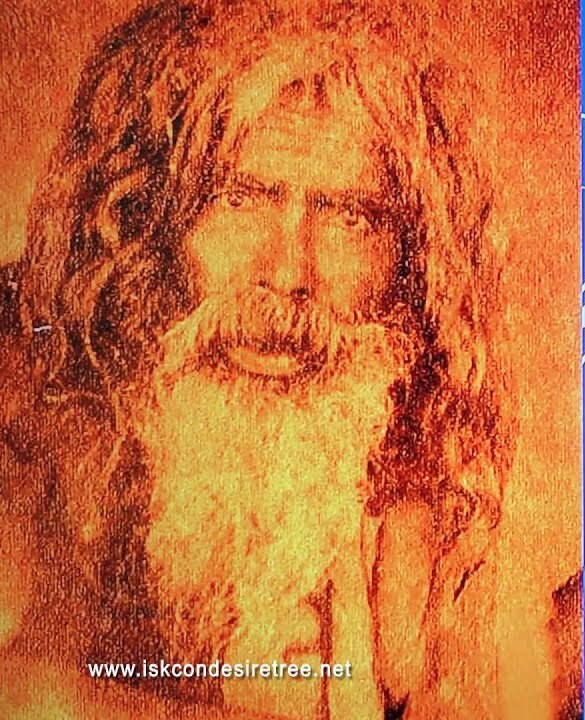
Srila Vamsi Dasa Babaji Maharaj
The Paramahamsa Avadhuta of Navadvipa
Also known as Vamsidas Babaji, Vamshi Das Babaji, Vamsi Das Babaji, Bhairab Chandra, Bhairava (his name before renunciation)
“Cry. If you cry with tears of love, you will get the Lord's mercy.”
Babaji Maharaj's answer to a visitor who kept asking how to attain God, as recorded by Srila Bhakti Ballabh Tirtha Maharaj in Sri Chaitanya: His Life and Associates
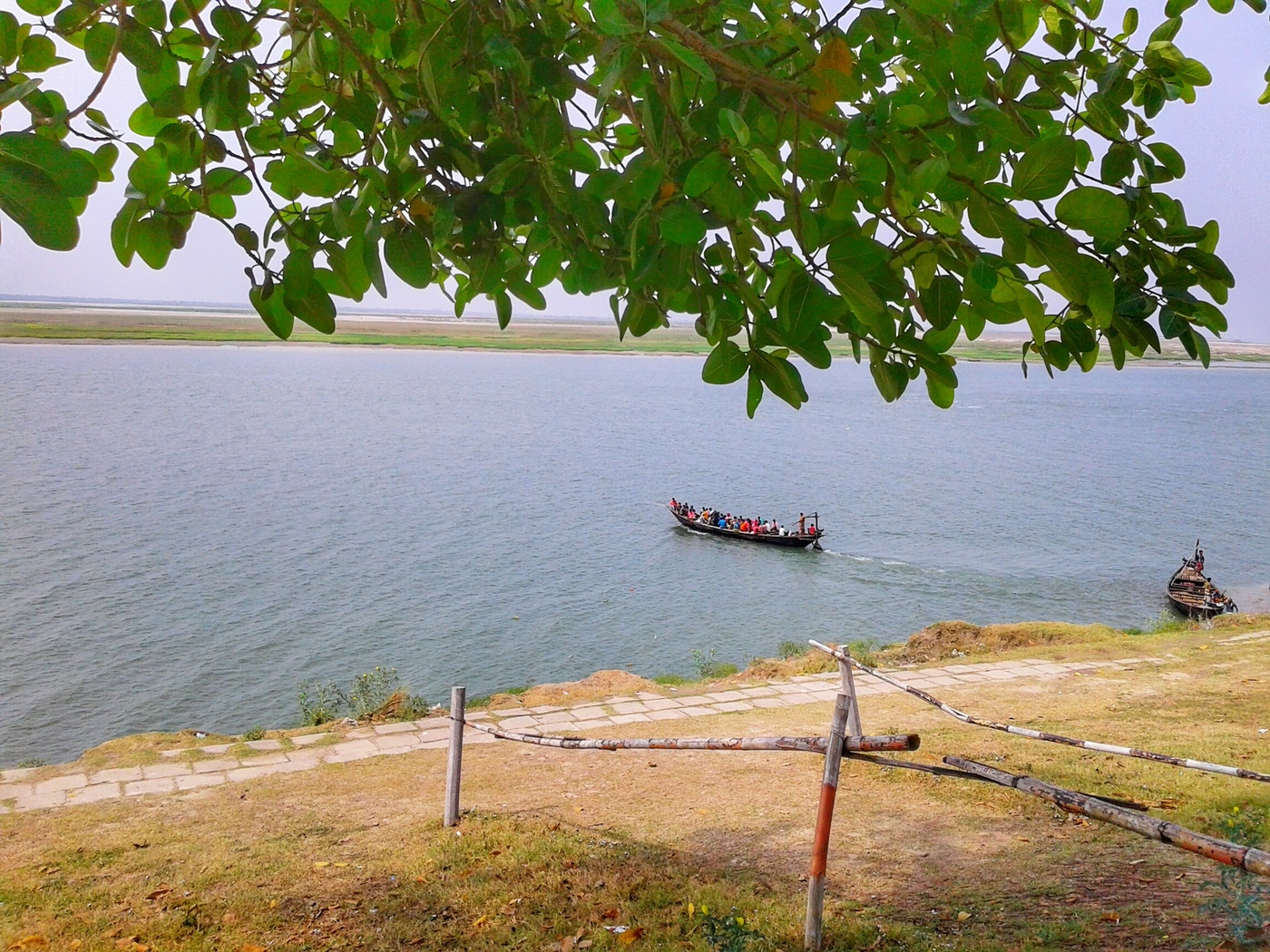
Srila Vamsi Dasa Babaji Maharaj was a renunciate of Navadvipa who lived from about 1859 to 1944. He spent most of that life on the bank of the Ganges at Koladvipa, living as an avadhuta. He had matted hair and wore a single kaupina. Outwardly he seemed to care nothing for the world, except for the two cloth bags that held his deities. He should not be confused with the far better known Srila Gaura Kishora Dasa Babaji, the guru of Bhaktisiddhanta Sarasvati Thakura. Gaura Kishora Dasa Babaji also carried the name Vamsi Dasa before he took babaji vesha. They were two different men, born about twenty years apart in different parts of Bengal, who happened to share an early name. The two are easy to mix up in a quick search. This Vamsi Dasa Babaji kept that name his whole life. Srila Bhaktisiddhanta Sarasvati Thakura, who founded the Gaudiya Matha, respected him so much that he would bow to him from a distance. But Bhaktisiddhanta Sarasvati Thakura did not allow his own disciples to go close to him. This was not because he had any doubt about the old babaji's spiritual position. He was afraid that a beginner might misunderstand the babaji's behavior and commit an offense at his feet.
| Detail | Description |
|---|---|
| Also known as | Vamsidas Babaji, Vamshi Das Babaji, Bhairab Chandra (his name before renunciation) |
| Born | 1859, Majidpur village, Jamalpur, Mymensingh district (now Bangladesh) |
| Renounced | Left his wife and young son and eventually settled in Navadvipa around 1906 |
| Residence | A riverside kutira near Baral Ghata, Koladvipa, one of the nine islands of Navadvipa |
| Order | A babaji of the avadhuta type, in the general disciplic line of Narottama Dasa Thakura |
| Disappeared | Shukla Chaturthi of Shravana, 1944, at Majidpur |
| Not to be confused with | Srila Gaura Kishora Dasa Babaji, who also bore the name Vamsi Dasa before taking babaji vesha |
At a Glance
- Born Bhairab Chandra in 1859 to a poor fisherman's family in Majidpur, East Bengal; he later renounced his wife and infant son to become a wandering sadhu.
- Settled at Navadvipa around 1906 and lived as an avadhuta, with uncut hair and beard and one kaupina. He deliberately paid no attention to ordinary social rules.
- Carried his deities, Gaura-Nitai and Radha-Govinda, in two cloth bags and spoke to them directly, as a parent or a lover speaks, instead of following a fixed order of worship.
- Bhaktisiddhanta Sarasvati Thakura revered him but kept his own disciples at a careful distance, fearing they would misunderstand him and commit an offense.
- At over eighty years old he walked, rode ox-cart, and took the train across North India to Vrindavana and back, then died at his birthplace, Majidpur, in 1944.
A Fisherman's Son in Majidpur #
He was born Bhairab Chandra (sometimes recorded as Bhairava) in 1859. He was the eldest of seven children of Sanatana Mallabrahma, a poor fisherman, and Sarvasundari Devi. They lived in the village of Majidpur near Jamalpur, then part of the Mymensingh district of Bengal and today in Bangladesh. From childhood he was drawn to the Gaura-Nitai deities at a nearby temple, and he sometimes stared at Them for hours. His worried parents arranged an early marriage, hoping this would settle him down. It did not work. Sources disagree on exactly how old his son, Haracandra, was when Bhairab Chandra walked away from married life for good. One account says the boy was only about six months old. Another says he was nine or ten. But every source agrees that the break was final. He left behind his family, his caste occupation and his given name. He travelled on pilgrimage across India and at last settled at Navadvipa around 1906, where he became known as Vamsi Dasa. One early account adds, without much explanation, that he first followed something it calls the "Kalachanda doctrine" before taking up ordinary Gaudiya Vaishnava practice. No other available source mentions this detail, so we report it here only as an open question, not a settled fact.
A Disputed Guru #
It is not clear who gave Vamsi Dasa Babaji his diksha and his babaji vesha, and the sources do not agree. His Holiness Bhakti Pramode Puri Maharaja was a disciple of Bhaktisiddhanta Sarasvati Thakura who knew Vamsi Dasa Babaji personally. His reminiscence says only, "We have heard that Vamshi Das took vesha from our Parama Gurudeva, Srila Gaura Kishora Das Babaji Maharaj," and he gives it as something he had heard, not something he saw. A separate biography by O. B. L. Kapoor (himself a godbrother of Srila Prabhupada), used for his book The Saints of Bengal, names instead a diksha-guru called Harilal Vrajavasi and a vesha-guru called Ramananda Vrajavasi. These two names do not appear in any other published source. A third account is compiled from Bhakti Vikasa Swami's biography of Vamsidasa Babaji. It says he received diksha as a young man from a sadhu called Narottama Dasa Babaji, and that this guru gave him the name Vamsidasa. This Narottama Dasa Babaji should not be confused with the sixteenth-century poet-saint Narottama Dasa Thakura, who lived roughly three centuries earlier. Two of these sources, independently of each other, do agree on one broader point: he belonged in a general way to the disciplic line coming from Narottama Dasa Thakura. Because these accounts clearly conflict on the actual names, we leave the question open here and do not state any one guru as established fact.
Life as an Avadhuta #
Once settled at Navadvipa, Vamsi Dasa Babaji lived in a way that puzzled almost everyone who met him. All accounts agree that his only possessions were a kaupina, a karanga (waterpot), and a kantha (patched cloth). He once said that these were the "ka" and "ka" and "ka", the only letters he needed. He flatly refused the "ba" of bahirvasa, an outer garment, because it would tie him to people who were bahiranga, attached to the outside world. He kept his Gaura-Nitai and Radha-Govinda deities in two cloth bags, not in a temple. He took them out to worship mentally, with no fixed mantra and no fixed schedule. He spent long hours in what looked, to onlookers, like ordinary conversation with Them: laughing, scolding, pleading. He never locked the door of his kutira. He explained that the lock's three keys belonged to Gaura, Nitai, and Gadadhara, and that it was their house to look after, not his. When thieves or a stray cow ransacked the place anyway, he treated it as their business, not his. A fuller account of this daily life, including what happened when a golden necklace was stolen and how he once punished his own deities for a theft, is told on The Avadhuta of Navadvipa.
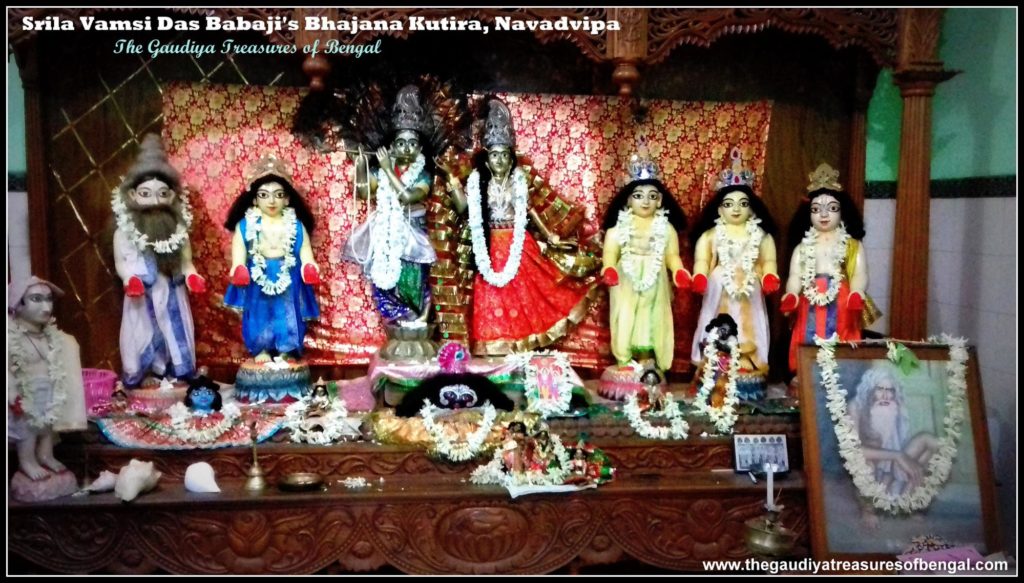
Bhaktisiddhanta Sarasvati Thakura and the Wider Gaudiya Matha #
Srila Bhaktisiddhanta Sarasvati Thakura, founder of the Gaudiya Matha and initiating spiritual master of Srila Prabhupada, lived at Navadvipa during the same years. He arranged for his own brahmacharis to bring Vamsi Dasa Babaji regular supplies of rice and grain. He would bow to the old babaji from a distance himself but told his disciples plainly why he restricted their visits: "You will not be able to understand this bhava and will only commit offenses. So better you stay away." Vamsi Dasa Babaji, in turn, is remembered greeting Bhaktisiddhanta Sarasvati warmly. "Someone very close to my Gaura has come to me," he said. His reputation also reached beyond Bhaktisiddhanta's own circle. A separate account says he was received with honor at a Gaudiya Matha ashrama in Midnapore that belonged to a completely different godbrother's line. This shows that he was known and respected in more than one branch of the movement in his generation. That relationship, and the incident that once made Bhaktisiddhanta forbid all visits outright, are told in full on Disappearance and Legacy.
The Long Walk to Vraja #
On 24 February 1941, already in his eighties, Vamsi Dasa Babaji left Navadvipa for Vrindavana. He walked, rode in an ox-cart and took the train by turns. Wherever a peepal tree let him imagine himself under the Vamsi-vata, where Krishna once played His flute for the gopis, he would stop for days at a time. He reached Vrindavana and stayed at several of its holiest spots for more than a month in all. He returned to Navadvipa three months later. From March 1943 into early 1944 he travelled again, this time through Bengal and Odisha, visiting Ambika Kalna, Baleshvara, Puri and other sites. His companions said he was always absorbed in chanting and in Krishna-katha. The fuller itinerary, and the story of an unplanned visit to a Gaudiya Matha ashrama in Midnapore along the way, are told on Pilgrimage to Vraja.
"Weep for Him" #
Vamsi Dasa Babaji rarely quoted scripture and almost never preached in any conventional sense; visitors who came for advice were more likely to be ignored than answered. But when he did speak, his answers were short and direct. Asked again and again by one regular visitor how to attain God, he finally looked up and asked the man what he wanted. "I want to find God," the man said. Babaji Maharaj answered with a single word: "Cry." He also composed at least two short devotional padas of his own, in the mood of a Nadiya-nagari, a woman of Nadiya captivated by Gauranga's glance. But these songs survive only in a later biographer's Bengali quotation and translation. They are not found in any independent manuscript that could be checked. The full text of his teaching exchanges and these two songs are given on Weep for Him.
Disappearance and Legacy #
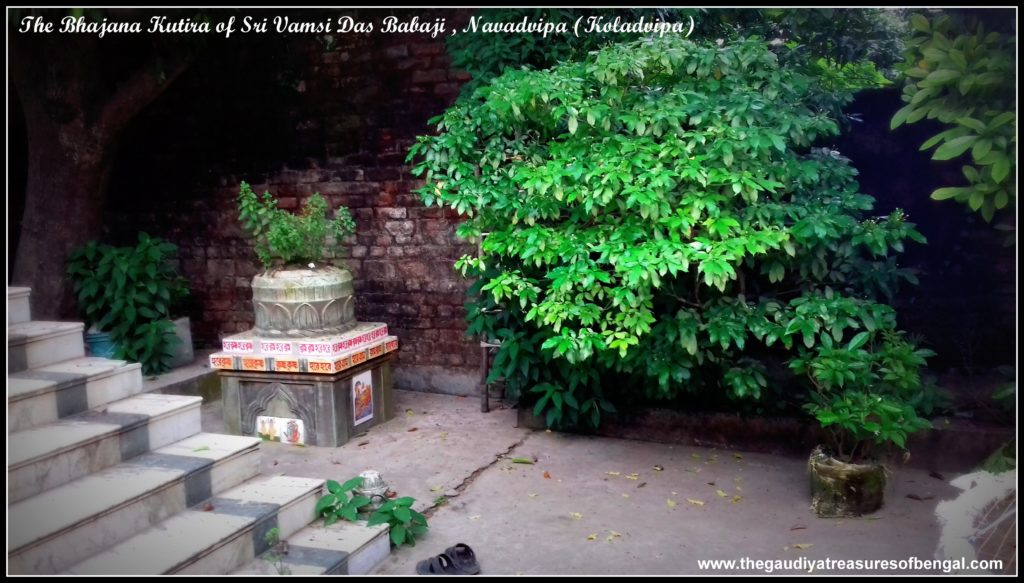
Near the end of his life Vamsi Dasa Babaji returned once more to Majidpur, the village of his birth, carrying his deities with him, and he died there. One biographer gives the exact date as Chaturthi, 23 July 1944. The wider tradition simply marks his disappearance day as Shukla Chaturthi of Shravana. His riverside kutira at Koladvipa still stands, now marked by a signboard reading "Sri Sri 108 Siddha Vamshidasa Babaji Maharaj's Mandir," and pilgrims visiting Navadvipa still stop there today. It is not far from where Jagannatha Dasa Babaji also spent his last decades. So these two very different renunciates of the same dhama are remembered a short walk apart. The full story of his final years, and of what remains of his bhajana kutira today, is told on Disappearance and Legacy.
- Gaudiya History (ISKCON Desire Tree): Vamshi das Babaji - Biography
- Gaudiya History (ISKCON Desire Tree): Vamsi Dasa Babaji Maharaj
- Shyam Das Baba: Srila Vamshi das Babaji (Lord Chaitanya's Associates)
- ISKCON Desire Tree: Srila Vamsidasa Babaji - Disappearance (excerpts from O.B.L. Kapoor's The Saints of Bengal, and Bhakti Ballabh Tirtha Maharaj's A Taste of Transcendence)
- Stephen Knapp: Vamsidasa Babaji
- The Gaudiya Treasures of Bengal: Vamsi Das Babaji - Biography, His Sripat in Mayapur Nabadwip Dham
- Sri Chaitanya-charitamrita, Madhya-lila 8.70
- Sri Chaitanya-charitamrita, Madhya-lila 23.39
Frequently asked
When was Srila Vamsi Dasa Babaji Maharaj born?
Srila Vamsi Dasa Babaji Maharaj appeared 1859 (given by one source only; not confirmed by others) in Majidpur (also written Majitpur, Majeedpur), Jamalpur, Mymensingh district, Bengal - now in Bangladesh.
When and where did Srila Vamsi Dasa Babaji Maharaj disappear?
Srila Vamsi Dasa Babaji Maharaj disappeared Shukla Chaturthi, Shravana, 1944 (one source dates this precisely to July 23, 1944) at Majidpur, his birthplace, where he returned near the end of his life.
What are the main pastimes of Srila Vamsi Dasa Babaji Maharaj?
The pastimes covered here include: Life and Lineage, The Avadhuta of Navadvipa, Pilgrimage to Vraja, Weep for Him, Disappearance and Legacy.