When Sri Chaitanya Mahaprabhu accepted the sannyasa order and left Navadwip, He left behind two women who had built their lives around Him: Sachi Devi, His mother, and Vishnupriya Devi, His young wife. Vamsivadana Thakura, together with a devotee named Ishana Thakura, stayed close to both of them for the rest of their lives. This is one of the clearer facts in a historical record that is otherwise thin. Whatever else is uncertain about Vamsivadana Thakura, his decades of quiet service to Mahaprabhu's mother and wife are described in the same way in all the devotional literature that remembers him at all.
A Vow Neither Woman Could Be Talked Out Of #
All accounts agree that separation from Mahaprabhu was not a grief Vishnupriya Devi could manage. It shaped the whole of the rest of her life. Tradition preserves one specific moment from that grief when Vamsivadana Thakura appears directly at her side. At that time Vishnupriya Devi and Vamsivadana Thakura together decided to stop taking food and water altogether. Separation from Mahaprabhu had already taken away all purpose from their bodies, and they saw no reason to go on keeping them alive. Mahaprabhu Himself, tradition says, would not allow it. He is remembered as appearing before them, asking them not to act so rashly, and telling them to worship a Deity of Himself instead. In this way they could hold on to His presence without giving up their own lives to do it.
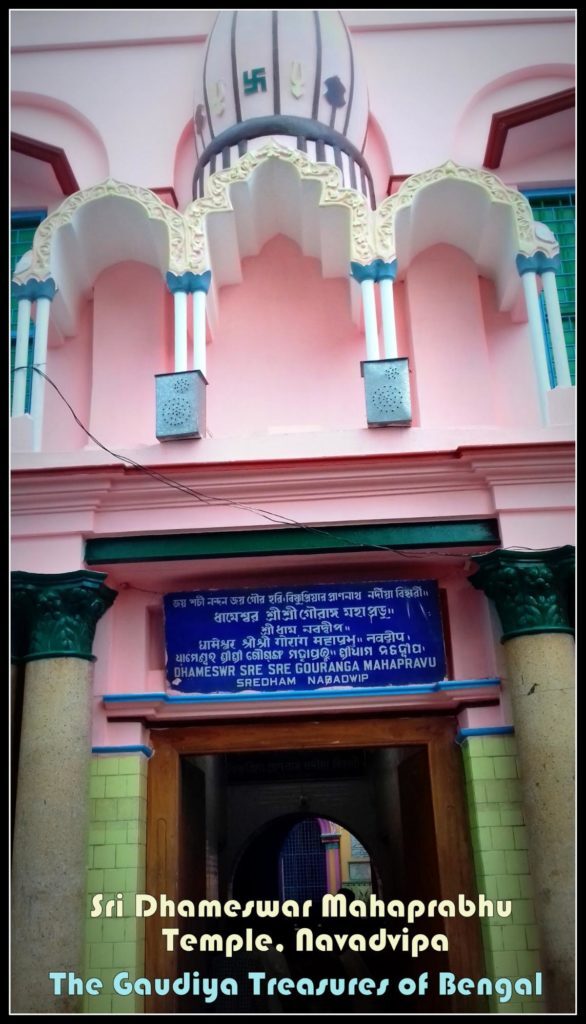
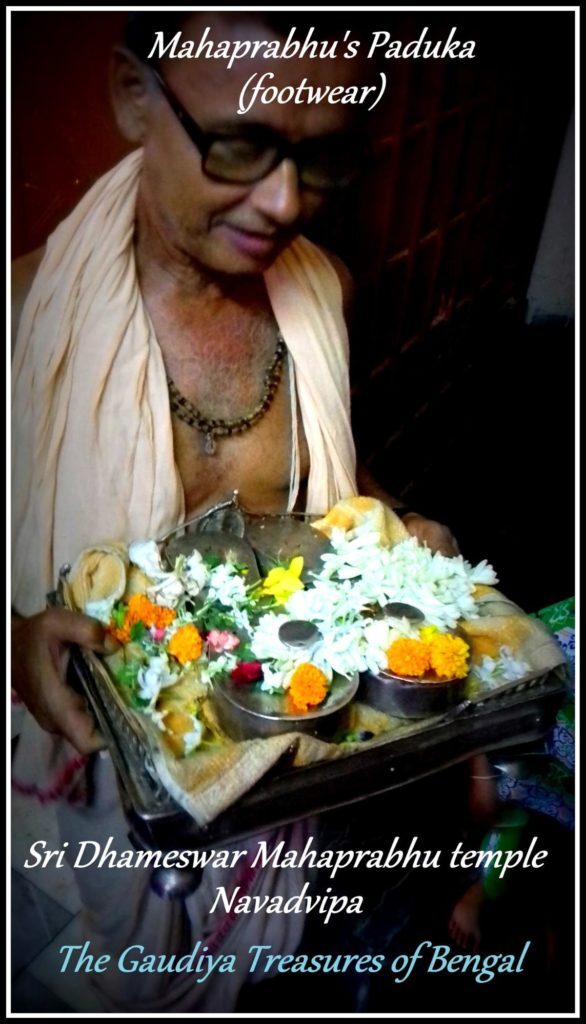
According to tradition, that instruction is the origin of a Deity still worshiped today. This Deity is a neem-wood image of Gauranga, carved on Vishnupriya Devi's own instruction after a dream, and now known as Sri Dhameshvara Mahaprabhu. The fuller story of how that Deity came to be carved, and of the pair of Mahaprabhu's own paduka kept and worshiped alongside it, is told on Vishnupriya Devi's own page, in Worship and Legacy. It is not repeated here. This page tells only the part where Vamsivadana Thakura's own life touches it directly.
A Name Carved Into the Deity's Base #
Vishnupriya Devi kept that Deity and those paduka in her own household worship for as long as she lived. By temple tradition, this was roughly eighty years, until her disappearance at about the age of ninety-six. Care of the Deity then passed to a cousin, who kept it at his home on the eastern bank of the Ganges. In time the river wore away the bank and that home was lost. This was a common fate for settlements on that stretch of the Ganges in this period. The family then moved across the river to Kuliya-grama, Vamsivadana Thakura's own village, which by then was known simply as part of Navadwip. According to some accounts, it was here that Vamsivadana Thakura formally established the Deity's worship, at what became its lasting home. One detail from the temple's own tradition has lasted better than almost anything else recorded about him. The name Vamsivadana is carved into the underside of the Deity's base, where ordinary worshipers cannot see it. If the tradition is accurate, it is a signature left by the man who gave the image a permanent place to be served.
Sons, a Grandson, and a Line to Jahnava Mata #
Vamsivadana Thakura lived as a householder, not as a sannyasi. He had two sons, Chaitanya Dasa and Nityananda Dasa. Besides caring for the Dhameshvara Deity, he also installed a Deity of Krishna named Pranavallabha. He also maintained an older, ancestral Deity of Gopinatha in the same household. His grandson, named Ramachandra and known to tradition as Ramai Thakura, was taken in as a disciple by Jahnava Mata, the wife of Nityananda Prabhu. Ramai Thakura went on to discover Deities of Krishna and Balarama as Kanai-Balai, and to establish Their worship at Baghnapara. Vamsivadana Thakura is also remembered as a poet. His songs expressed the grief of Sachi Devi and Vishnupriya Devi on the night Mahaprabhu left for sannyasa. Gaudiya tradition notes that this was fitting work for a devotee identified as Krishna's own flute, the instrument whose every note in Vraja was already a cry of separation. No source preserves enough of any specific song to quote its actual words here.
Vamsivadana Thakura's own descendants still maintain the Dhameshvara Mahaprabhu temple at Navadwip today. By the tradition's own count, this service has now been kept in one family for five centuries. No source records when or how Vamsivadana Thakura's own life ended. Just as his birth year is remembered only approximately, his disappearance goes unrecorded. What survives instead is the service itself. According to every account that names him at all, Vamsivadana Thakura, remembered as Krishna's own flute, did not spend his life performing austerities of his own. He simply stayed close to a grieving mother and a grieving wife, and made sure that what they had left of their Lord had somewhere to be kept.
