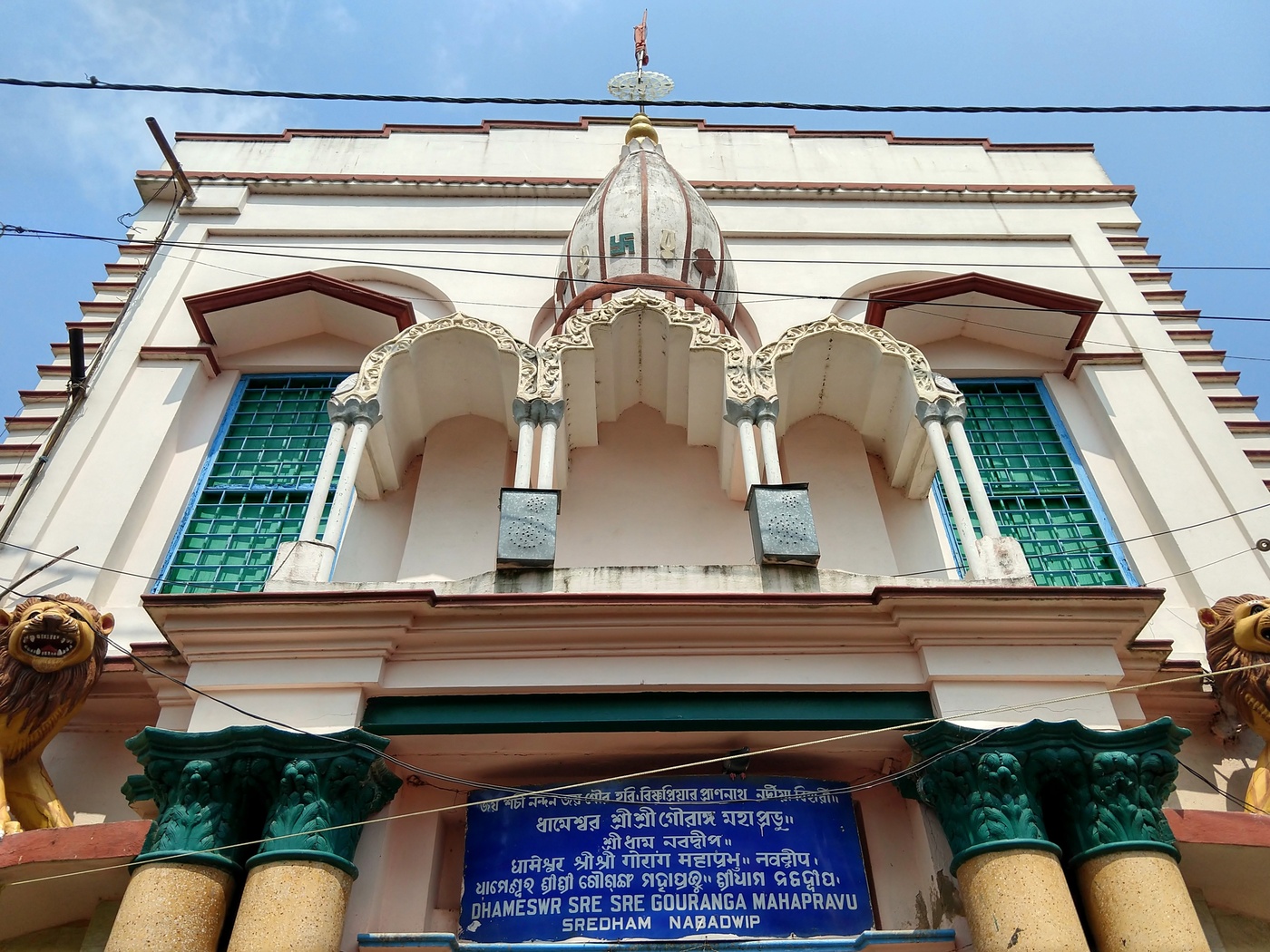
Gaudiya Vaishnava tradition remembers Vishnupriya Devi for one more specific act, beyond her austerity. Devotional literature credits her with being the first person to establish worship of a Deity of Gauranga, that is, of Chaitanya Mahaprabhu Himself, in His own visible form. Murari Gupta was a contemporary of Mahaprabhu who wrote one of the earliest biographical accounts of His life. Later Gaudiya literature quotes him describing the theology behind this worship directly. According to him, Krishna came to His beloved wife in an expansion form, to remain by her side as the Mahaprabhu Deity. In this way she, herself the goddess of fortune in human form, could go on serving Him constantly.
| Detail | Description |
|---|---|
| The Deity | A neem-wood image of Chaitanya Mahaprabhu, known today as Dhameswar Mahaprabhu |
| Origin | Carved by the sculptor Nabinananda Acharya, on instructions Vishnupriya reportedly received in a dream |
| Also worshiped alongside it | A pair of paduka (wooden footwear), traditionally said to have been Mahaprabhu's own personal gift to her |
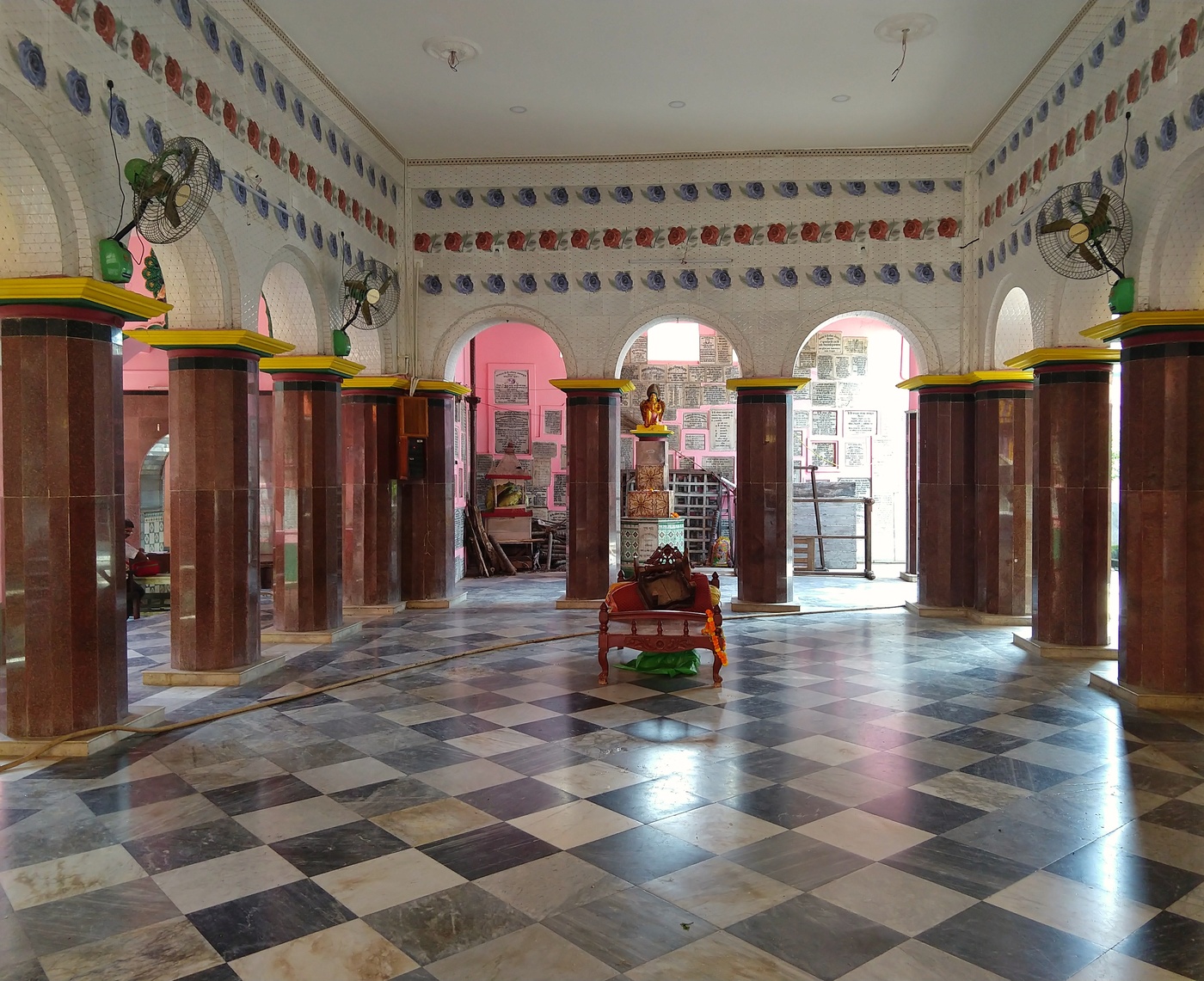
| Current location | Sri Dhameswar Mahaprabhu Temple, also called Mahaprabhu Bari, in Koladvipa, one of the nine islands of Navadwip |
| Site significance | Stands on the site of Sanatana Mishra's own household compound; his descendants still maintain the daily worship |
| Her appearance day | Traditionally observed on Vasanta Panchami / Magh-shukla Panchami, alongside the worship of Sarasvati by others on the same date |
A Deity Carved From A Dream #
The tradition gives specific details about how the image came to be made, even if those details cannot be independently confirmed outside devotional sources. Vishnupriya is said to have received instructions in a dream to have a Deity of her husband carved. She is said to have asked Nabinananda Acharya, a sculptor fairly well known in the area, to carve it in neem wood. Devotees who describe the finished image today say it has a strikingly gentle expression, with its arms stretched outward as though reaching toward whoever stands before it. Alongside the Deity, she is said to have kept and worshiped a pair of Mahaprabhu's own paduka, given to her personally before He left. If this is accurate, the paduka would be the one physical object in her story that can be traced directly back to Mahaprabhu Himself, not to a devotional image made afterward.
Gaudiya devotional writers have compared her act to a story about Lord Ramachandra. He had taken a vow to have only one wife. So, it is said, He performed a sacrifice using a golden image of Sita instead of marrying again, after Sita had been sent away to live in the forest. The comparison presents Vishnupriya's Deity worship as the same kind of faithfulness, made visible. She did not treat her husband's absence as an ending. Instead, she made an image of Him the center of everything she did for the rest of her life.
From Her House To Koladvipa #
According to the temple's own tradition, the Deity and the paduka stayed in Vishnupriya's own household worship for as long as she lived. After her disappearance, care of the Deity passed to a cousin. He kept it at his own residence on the eastern bank of the Ganges, likely near the original site of Sanatana Mishra's family compound. Eventually the river wore away the land and that residence was lost. This often happened to riverside settlements in this part of Bengal. The family then moved across the river to Kuliya-grama, on the western bank, a place better known today simply as Navadwip. Vamsivadana Thakura was one of the two devotees (with Ishana Thakura) who had cared for Vishnupriya and Sachi Devi in their later years. Some accounts credit Vamsivadana Thakura with formally establishing the Deity's worship at its present location. The family that maintains the temple today still speaks of Mahaprabhu, in their own family terms, as their honored son-in-law. It is the same relationship that began with Sanatana Mishra giving his daughter's hand at that first wedding, and it has been kept alive across five centuries.
One further tradition is recorded in the Sri Navadvipa-Dhama-Mahatmya and preserved on some pilgrimage-guide sites. It presents the Deity's later history as the fulfilment of an old prophecy: that four hundred years after Mahaprabhu's appearance, worship of this particular image would be restored to its highest standard. The prophecy is reported here only as it survives in that secondary source. It is not independently confirmed, since no primary Gaudiya scriptural text available to us contains it.
Remembered As Mother Of The Universe #
Gaudiya theology uses its highest language when it speaks of Vishnupriya Devi's identity. The Gaura-Ganoddesha-Dipika is the traditional list that identifies who each of Mahaprabhu's associates had been in Krishna's own pastimes. According to it, she is Bhu-sakti: the Lord's own potency as the earth, and, in that role, "the mother of the universe." The same text identifies her father, Sanatana Mishra, as King Satrajit from Krishna-lila. In this way it also presents her marriage to Mahaprabhu as a reflection of Krishna's marriage to Satyabhama. The tradition makes similar theological claims elsewhere. For instance, it identifies Sita Thakurani as Yogamaya. Like those claims, this is a statement of who the tradition understands Vishnupriya Devi to be at the deepest level. It is not a claim that can be checked against an outside historical record, and it is presented here with that understanding.
Alongside Sachi Devi, Sita Thakurani, and Malini Devi (the wife of Srivasa Thakura), Vishnupriya Devi is remembered as one of four leading women devotees who gave strength to Mahaprabhu's mission during His own lifetime. What sets her apart within that group is simply how long her own part of the story continued after His visible mission ended. For decades she kept a single, unbroken discipline. She was sustained by the promise she received that night in Navadwip, that wherever He went, He would remain wherever she kept Him in her heart.
