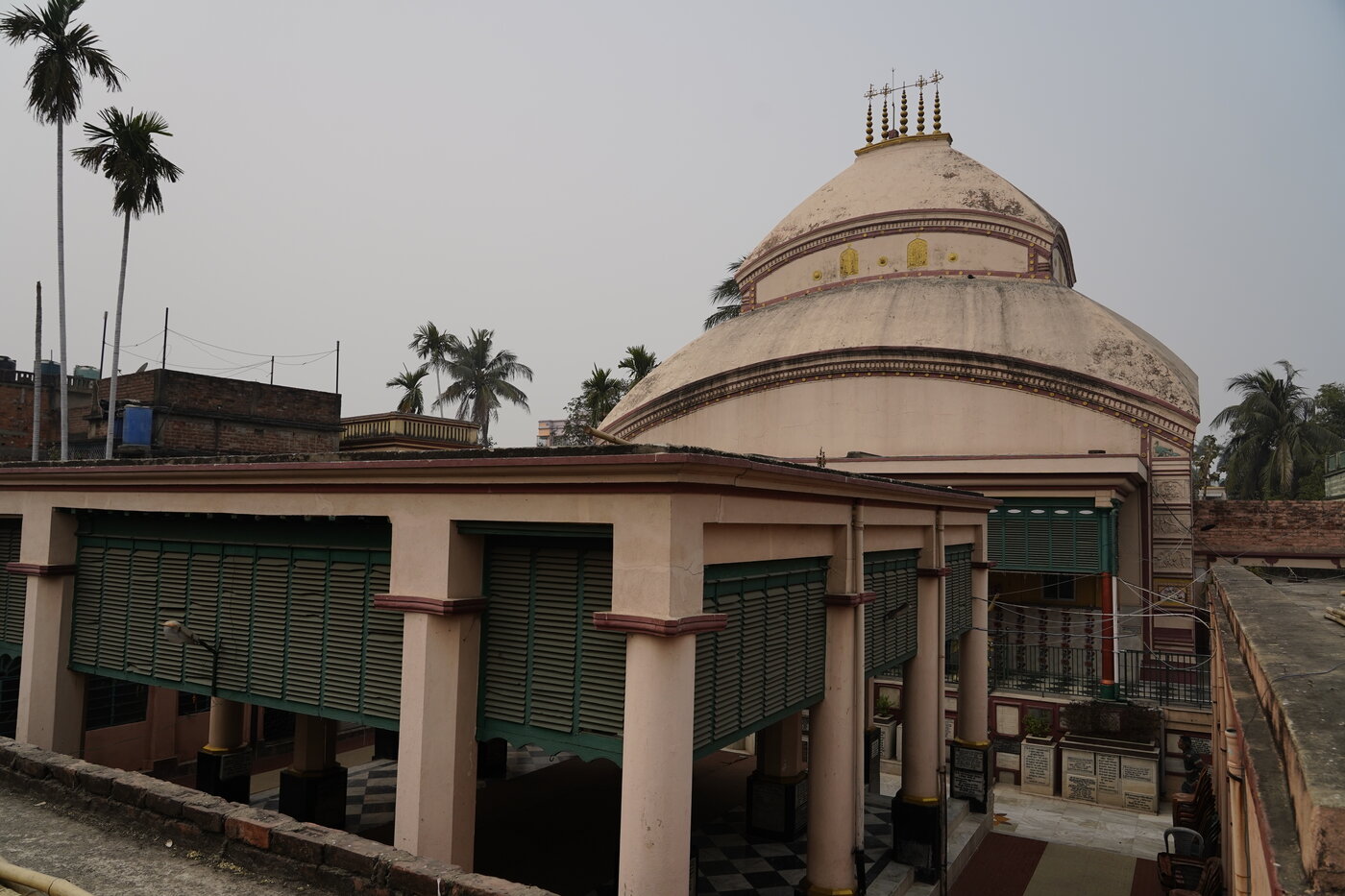
Viracandra's later years are far less well recorded than his youth. What survives is mostly about the institution he built at Khardaha, not about the man himself in old age. And on the most important question a life story should answer, there is a plain gap. No source available records when, or how, he disappeared from this world.
| Detail | Description |
|---|---|
| Wives | Shrimati and Narayani, daughters (one by birth, one by fosterage) of Yadunandana Acharya of Jhamatpura, Hooghly district |
| Marriage arranged by | Jahnava Devi |
| Deity installation | Shyamsundar at Khardaha, Radhavallabha (Vallabhji) at Ballavpur, Nandadulal at Saibona, all three, by temple tradition, carved from one sacred stone |
| Manuscript tradition | A handwritten copy of Srimad-Bhagavatam, said to be in his own hand, preserved at the Khardaha temple |
| Disappearance | Not recorded in any source available |
| Temple status today | The Radha-Shyamsundar Jiu temple at Khardaha was declared a heritage structure by the West Bengal Heritage Commission in 2018 |
Two Marriages at Jahnava's Request #
At Jahnava Devi's own instruction, Viracandra married two daughters of the brahmana Yadunandana Acharya of Jhamatpura, in Hooghly district. They were Shrimati, Yadunandana's own daughter, and Narayani, his foster daughter. Both women received mantra initiation directly from Jahnava Devi. Tradition says that Yadunandana Acharya himself had become a Vaishnava through Jahnava's mercy. This places the marriage inside a pattern seen throughout Viracandra's own life. His family and his following were built up through Jahnava's own initiations as much as through Viracandra's. No source checked records whether the marriage itself produced children of Viracandra's own. The "sons" the tradition remembers him for were disciples, not his own children, as Founding the Nityananda-vamsa explains in full.
A Stone That Came Down the Ganges #
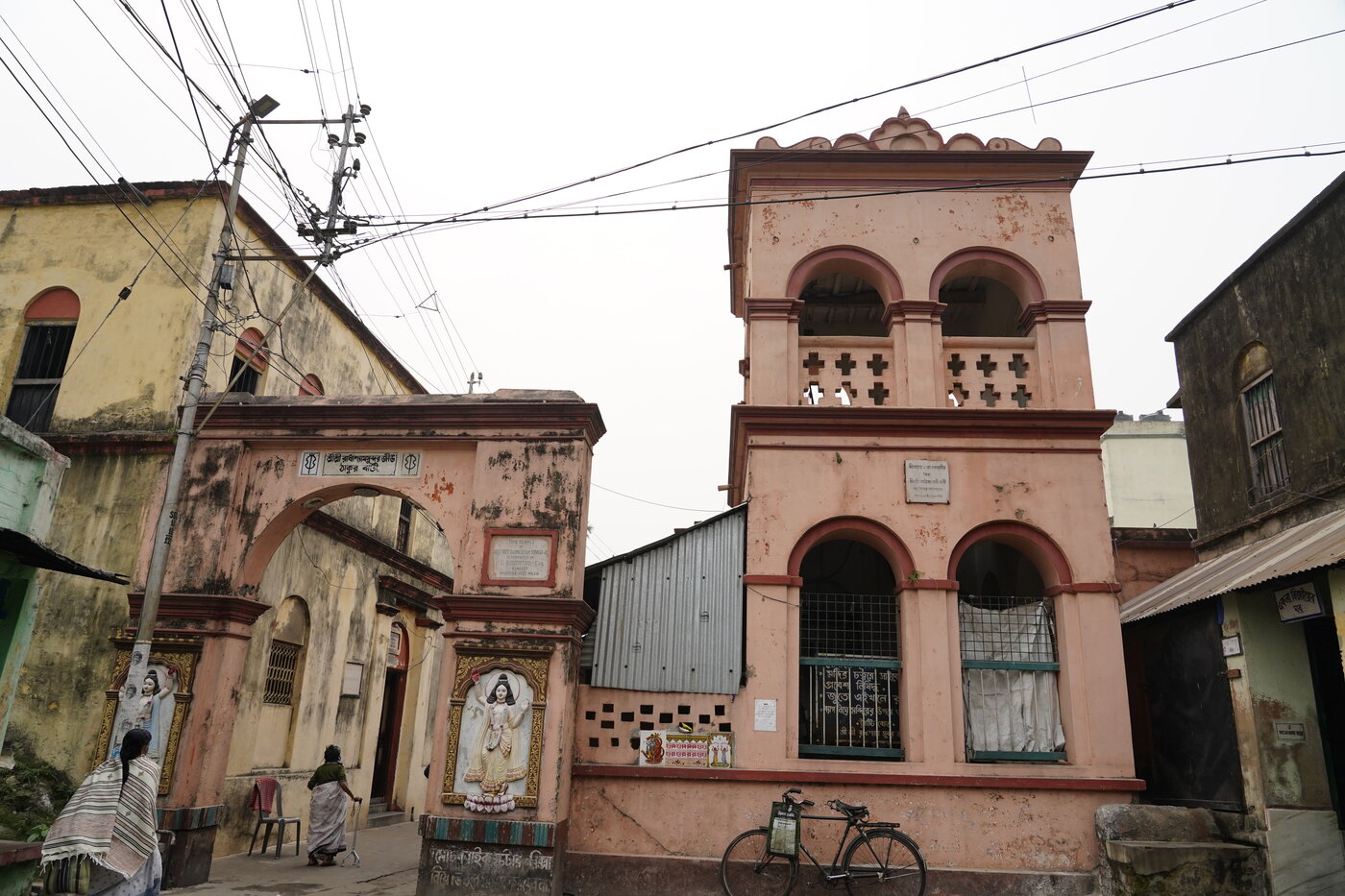
The Radha-Shyamsundar Jiu temple at Khardaha keeps its own temple history. It tells a specific story about how the temple's central Deity came to be installed there. We give it here as the temple's own legend, not as documented history. The account says that Viracandra gathered Vaishnavas from across Bengal and traveled with them, chanting the holy name, to the Muslim ruler of Gauda. He went to ask for a particular black stone, said to be the very stone on which Krishna stood during Maharaja Yudhishthira's Rajasuya sacrifice. The ruler agreed to release it. But in the story, the stone could not be carried by the ordinary route. Krishna appeared to Viracandra in a dream and said He would instead come flowing down the river Ganges. The stone was set afloat and came to rest at what is still called Shyamer Ghat in Khardaha. There a devotee-artist named Nayan carved it into three Deities: Vallabhji, installed at Ballavpur; Shyamsundarji, installed at Khardaha itself; and Nandadulalji, installed at Saibona. A closely related account, separate from the temple's own history, adds that the stone came specifically as a salagrama-sila obtained from the Nawab at Murshidabad. This detail does not quite match the temple's own naming of Gauda. We give both versions here instead of quietly choosing one.
Building Khardaha's Devotional Life #
Beyond the Shyamsundar Deity, Viracandra is credited with bringing sacred stones from Vrindavana itself for further Deities at Khardaha. He is also credited with starting the yearly celebration there of his own father Nityananda Prabhu's birth anniversary, a festival still central to Khardaha's calendar. A handwritten manuscript of Srimad-Bhagavatam, said to be in Viracandra's own hand, is preserved at the temple to this day. Taken together, these traditions describe a man who cared less about his own life story than about building something that would outlast him: a temple, a calendar of festivals, and a settled Vaishnava community in the town where he had been born.
An Undated Disappearance and a Living Temple #
No source available gives a date, or even an approximate period, for Viracandra's disappearance. This is a real gap in the record, and we state it plainly instead of filling it with a guess. But we can say what remains. The Radha-Shyamsundar Jiu temple he is credited with founding still stands at Khardaha. It still receives what one source calls "lakhs of pilgrims," and it was formally declared a heritage structure by the West Bengal Heritage Commission in 2018. The hereditary Gosvami families of Khardaha are descended through his disciple Ramachandra, not through his own blood. For generations afterward they continued the life of the institution he began. They did it imperfectly and unevenly, as any human institution does. But they carried forward the work of a man whom Krishnadasa Kaviraja Goswami once called the main pillar in the hall of devotional service Chaitanya Mahaprabhu built.
