Srila Viracandra Prabhu
Son of Nityananda Prabhu and Founding Figure of the Nityananda-vamsa
The complete life, on one page: The main biography and every pastime page, in order, in one place
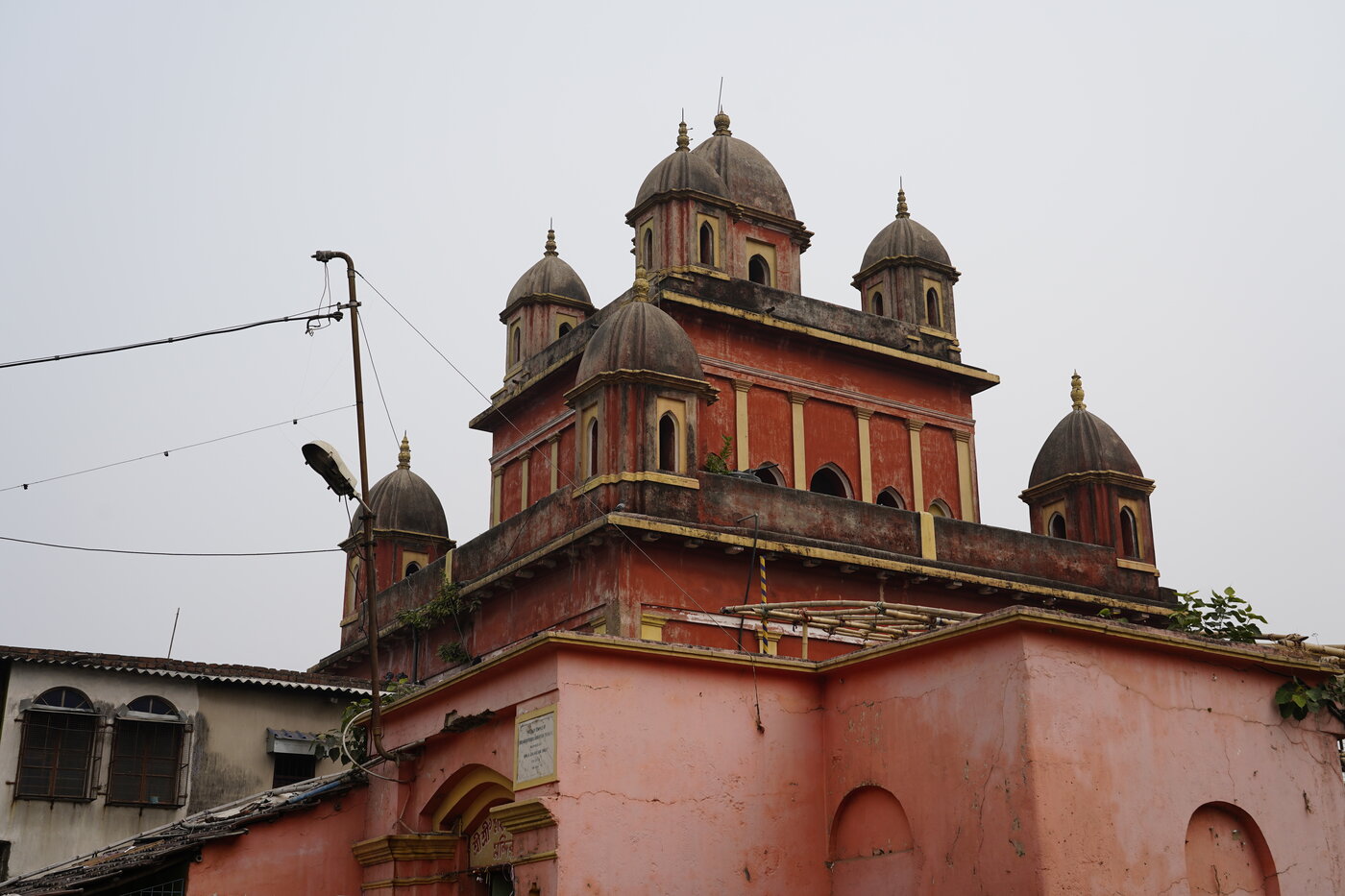
Introduction
Srila Viracandra Prabhu, also spelled Virabhadra, was the son of Nityananda Prabhu and the disciple of Nityananda's second wife, Jahnava Devi. In the 1530s, Chaitanya Mahaprabhu, Nityananda Prabhu, Advaita Acharya and Srivasa Thakura all disappeared within a few years of one another. The Gaudiya Vaishnava movement in Bengal had been built around these leaders, and now it lost every one of them. Viracandra, still a young man, became one of the figures who kept it standing. Krishnadasa Kaviraja Goswami wrote Sri Chaitanya-charitamrita decades later. In it he calls Viracandra "the greatest branch" of Nityananda Prabhu's tree of devotional service. He takes shelter of Viracandra's feet even before he begins the book. This is about as strong a mark of honor as this tradition gives anyone. Today Viracandra is remembered mainly for three things. The first is a mass return of outsiders into Vaishnava life, on a larger scale than anything else in this generation. The second is his standing among the senior Vaishnavas who were active after Chaitanya Mahaprabhu's own associates had passed away. The third is that an entire hereditary family line of Gosvamis, the Nityananda-vamsa, traces its descent from him. But when the record is read carefully, this descent is not quite what is usually assumed.
| Detail | Description |
|---|---|
| Father | Nityananda Prabhu |
| Birth mother | Vasudha, Nityananda Prabhu's first wife |
| Guru | Jahnava Devi, Nityananda Prabhu's second wife, who raised him after Vasudha's early death and later gave him initiation |
| Birthplace | Khardaha, on the Ganges north of present-day Kolkata |
| Sister | Ganga Devi |
| Identity | Kshirodakashayi Vishnu, an expansion of Sankarshana, non-different from Sri Chaitanya (Gaura-ganoddesha-dipika 67; Chaitanya-charitamrita Adi 11.8 purport) |
| Chief legacy | The mass conversion of the neda-nedi ascetics; founder-figure of the Nityananda-vamsa |
At a Glance
- Born at Khardaha to Vasudha, Nityananda Prabhu's first wife, but raised and formally initiated by Jahnava Devi, his father's second wife.
- Held by Gaudiya Vaishnava tradition to be an expansion of Kshirodakashayi Vishnu (Gaura-ganoddesha-dipika 67), yet lived as an ordinary devotee and strictly followed Vedic household life.
- Remembered for leading a mass return of over a thousand neda and nedi ascetics, former tantric Buddhist practitioners, into Vaishnava devotional life.
- Traveled through Bengal and on to Vrindavana, meeting the Goswamis there and the Vaishnavas of Narottama Dasa Thakura's own generation.
- Is the figure from whom the hereditary Nityananda-vamsa families trace their descent, though the earliest record says he had no surviving son of his own.
Scriptural evidence for the introduction (3)
অদ্যাপি যাঁহার কৃপা–মহিমা হইতে ।
চৈতন্য–নিত্যানন্দ গায় সকল জগতে ॥
adyapi yanhara krpa-mahima ha-ite
caitanya-nityananda gaya sakala jagate
Word for word
adyapi -- until today; yanhara -- whose; krpa -- mercy; mahima -- glorious; ha-ite -- from; caitanya-nityananda -- Sri Caitanya-Nityananda; gaya -- sing; sakala -- all; jagate -- in the world.
It is by the glorious mercy of Sri Virabhadra Gosani that people all over the world now have the chance to chant the names of Caitanya and Nityananda.
Used as the opening quote here; Krishnadasa Kaviraja Goswami credits Viracandra directly with the worldwide spread of the Chaitanya-Nityananda sankirtana movement.
सङ्कर्षणस्य यो व्यूहः पयोब्धिशायिनामकः ।
स एव वीरचन्द्रोऽभूच्चैतन्याभिन्नविग्रहः ॥६७॥
saṅkarṣaṇasya yo vyūhaḥ payobdhi-śāyi-nāmakaḥ |
sa eva vīracandro’bhūc caitanyābhinna-vigrahaḥ ||67||
The expansion of Lord Sankarsana known as Lord Ksirodakasayi Visnu appeared in Lord Caitanya's pastimes as Viracandra Prabhu. Lord Viracandra was non-different from Lord Caitanya Himself.
From the purport: In the Gaura-gaṇoddeśa-dīpikā (67) He is mentioned as an incarnation of Kṣīrodakaśāyī Viṣṇu. Therefore Vīrabhadra Gosāñi is nondifferent from Śrī Kṛṣṇa Caitanya Mahāprabhu.
Kavi Karnapura's verse identifying Viracandra Prabhu with Kshirodakashayi Vishnu, the expansion of Sankarshana; Srila Bhaktisiddhanta Sarasvati Thakura's Anubhashya, given in Srila Prabhupada's purport to Chaitanya-charitamrita Adi 11.8, cites it. Sanskrit: diacritic edition of the Gaura-ganoddesha-dipika; English translation as published at bvmlu.org.
śrī-vīrabhadra gosāñi — skandha-mahāśākhā
tāṅra upaśākhā yata, asaṅkhya tāra lekhā
After Nityānanda Prabhu, the greatest branch is Vīrabhadra Gosāñi, who also has innumerable branches and subbranches. It is not possible to describe them all.
From the purport: Vīrabhadra Gosāñi was the direct son of Śrīla Nityānanda Prabhu and a disciple of Jāhnavā-devī. His real mother was Vasudhā. In the Gaura-gaṇoddeśa-dīpikā (67) He is mentioned as an incarnation of Kṣīrodakaśāyī Viṣṇu. Therefore Vīrabhadra Gosāñi is nondifferent from Śrī Kṛṣṇa Caitanya Mahāprabhu.
The verse that calls Virabhadra (Viracandra) Gosani the greatest branch after Nityananda Prabhu; the purport gives Srila Bhaktisiddhanta Sarasvati Thakura's Anubhashya on his parentage and his identity in Gaura-ganoddesha-dipika 67.
Chapter 1
Birth and Early Life
Son of Vasudha, raised and initiated by Jahnava Devi
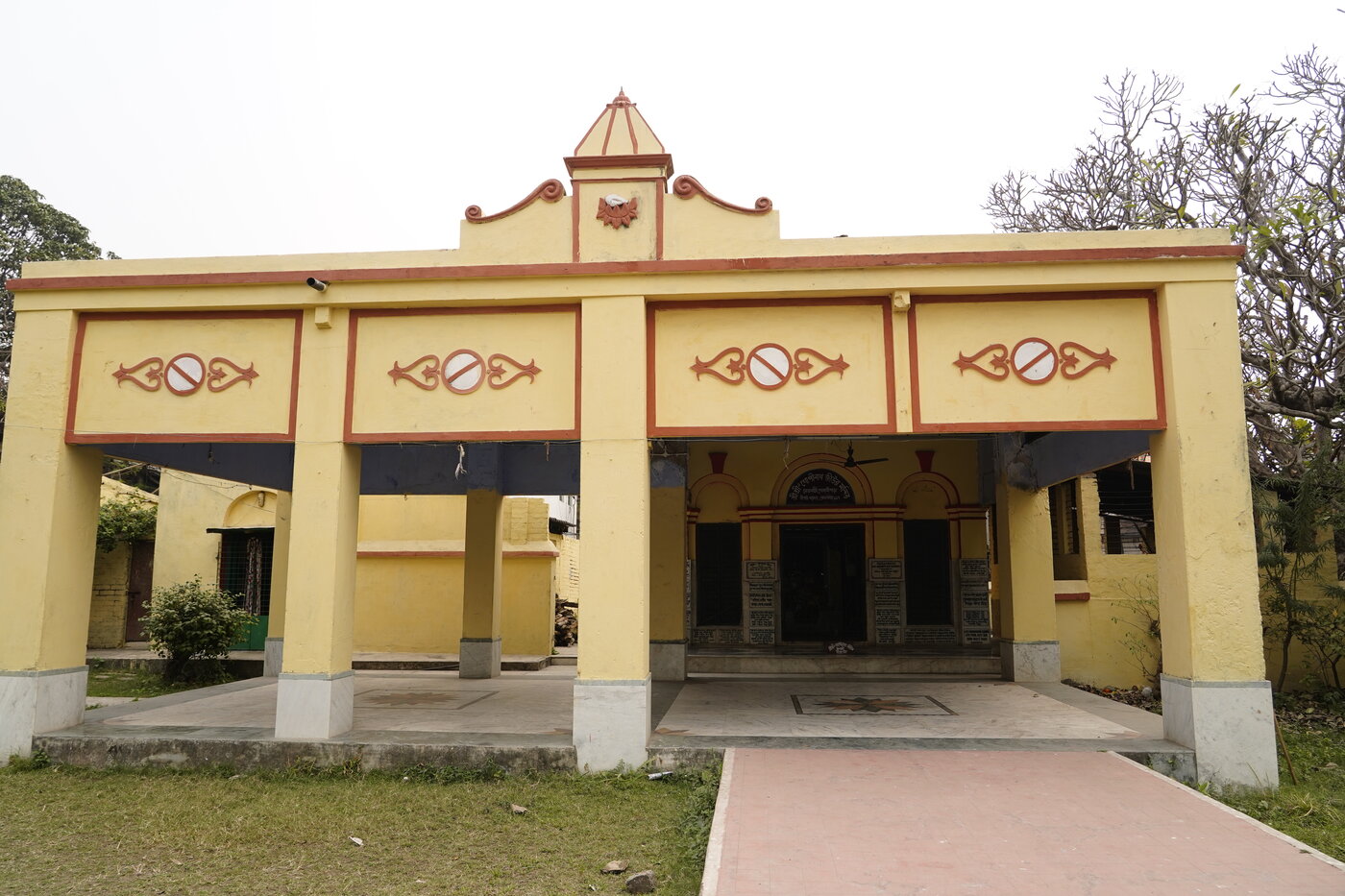
Nityananda Prabhu spent the first half of his life as a wandering avadhuta, a renounced holy man who had gone completely beyond the ordinary rules of caste and custom. Yet he ended his life as a married householder at Khardaha, with two wives and children. This is one of the more surprising turns in Gaudiya Vaishnava history, and Viracandra's own story begins there.
| Detail | Description |
|---|---|
| Father | Nityananda Prabhu |
| Birth mother | Vasudha, elder daughter of Suryadasa Sarakhela |
| Guru and foster mother | Jahnava Devi, younger daughter of Suryadasa Sarakhela |
| Siblings | Ganga Devi (surviving sister); seven elder brothers, all of whom died in infancy |
| Birthplace | Khardaha, on the Ganges north of present-day Kolkata |
| Traditional identity | Incarnation of Kshirodakashayi Vishnu (Gaura-ganoddesha-dipika 67) |
A Marriage Chaitanya Mahaprabhu Asked For #
Later Bengali biographies record that Chaitanya Mahaprabhu personally asked Nityananda to give up the wandering life of an avadhuta, free of ordinary rules, and settle down as a married householder. These biographies include the Bhakti-ratnakara, the Premavilasa, and the wider body of devotional biographies that grew up around the Nityananda line. The purpose was that the preaching mission in Bengal would have a family ordinary people could actually copy. However, this account does not appear in Krishnadasa Kaviraja Goswami's own Sri Chaitanya-charitamrita. Still, it fits everything else known about the Bengal mission, which was built around householders from the start. Nityananda married two sisters, Vasudha and Jahnava, daughters of Suryadasa Sarakhela of Saligrama, and settled at Khardaha. The fuller story of that courtship and marriage is told on Nityananda Prabhu's own page.
Vasudha's Son, Jahnava's Disciple #
Vasudha, the elder of the two sisters, bore Nityananda eight sons and one daughter. Seven of the sons died as infants. The two who survived were the daughter, Ganga Devi, and the youngest son, Viracandra. Vasudha herself died not long after his birth, and Jahnava, who had no children of her own, raised both children as her own. Srila Bhaktisiddhanta Sarasvati Thakura's Anubhasya commentary to Chaitanya-charitamrita, Adi-lila 11.8, states the relationship more plainly than any other source in this tradition: "Virabhadra Gosani was the direct son of Srila Nityananda Prabhu and a disciple of Jahnava-devi. His real mother was Vasudha." Some traditional accounts, drawing on the Premavilasa, add a further detail. They say that Viracandra decided to accept Jahnava as his diksha-guru after he saw her in a four-armed form and understood who she really was. The Anubhasya quoted in that purport itself states both halves of this: Vasudha was his mother and Jahnava his guru. Looser retellings that simply call him "the son of Nityananda and Jahnava" are not wrong about the household he grew up in. But they blur a difference that the earliest and most careful sources take care to keep clear.
An Incarnation Who Lived Like a Devotee #
The Gaura-ganoddesha-dipika is a traditional Gaudiya Vaishnava text that identifies the eternal spiritual identities of Chaitanya Mahaprabhu's associates. In its sixty-seventh verse it names Viracandra as an incarnation of Kshirodakashayi Vishnu. This is the form of Krishna's expansion Sri Sankarshana who dwells within every living being. Bhaktisiddhanta Sarasvati Thakura's own commentary draws the conclusion directly: Viracandra Gosani is therefore non-different from Sri Krishna Chaitanya Mahaprabhu Himself. A separate tradition, preserved in the Bengali devotional biography Sri Nityananda Charitamrita, traces this claim back to a promise. Chaitanya Mahaprabhu is said to have made this promise to Nityananda Prabhu at Puri, before sending him back to Bengal to marry. He promised that He would appear again within Nityananda's own family, in secret, in a way scripture itself would not openly announce. Krishnadasa Kaviraja Goswami's Chaitanya-charitamrita takes this identity seriously, but does not make a show of it: "Although Virabhadra Gosani was the Supreme Personality of Godhead, He presented Himself as a great devotee. And although the Supreme Godhead is transcendental to all Vedic injunctions, He strictly followed the Vedic rituals" (Adi-lila 11.9). The tradition remembers him living in exactly this way for the rest of his life, with real divinity but without any outward claim to it.
A Birth Date No Two Sources Agree On #
Even the date of Viracandra's birth is not settled. One tradition gives it as the ninth day of the dark fortnight of the month of Kartika. A different source, the Gaudiya Vaishnava Abhidhana, gives Agrahayana shukla chaturdashi instead, a different month and a different lunar fortnight entirely. We report both here instead of picking one. Another claim is found on a Wikimedia Commons description of the Khardaha temple Viracandra later built. It gives his birth year as 1457 CE. This date cannot be correct, because Nityananda Prabhu himself was born around 1474, some seventeen years later. That single detail looks like a simple copying mistake, not a real separate tradition, so we do not repeat it here as fact. More can be said with confidence about the place. It was Khardaha, at the family home the tradition calls Kunja Vatika, on the Ganges north of present-day Kolkata. This town would remain the center of Viracandra's own life and work.
Scriptural evidence for this chapter (4)
Quoted in the text above:
- Adi 11.9 Sri Chaitanya-charitamrita
Further verses:
শ্ৰীবীরভদ্র গোসাঞি—স্কন্ধ–মহাশাখা ।
তাঁর উপশাখা যত, অসংখ্য তার লেখা ॥
sri-virabhadra gosani -- skandha-mahasakha
tanra upasakha yata, asankhya tara lekha
Word for word
sri-virabhadra gosani -- Sri Virabhadra Gosani; skandha -- of the trunk; maha-sakha -- the biggest branch; tanra -- his; upasakha -- subbranches; yata -- all; asankhya -- innumerable; tara -- of that; lekha -- the description.
After Nityananda Prabhu, the greatest branch is Virabhadra Gosani, who also has innumerable branches and subbranches. It is not possible to describe them all.
From the purport: Purport excerpt: "Virabhadra Gosani was the direct son of Srila Nityananda Prabhu and a disciple of Jahnava-devi. His real mother was Vasudha."
This is the single clearest primary-source statement of Viracandra's parentage: Bhaktisiddhanta Sarasvati Thakura's own Anubhasya, quoted in Srila Prabhupada's purport, distinguishes his birth mother Vasudha from his guru and foster mother Jahnava-devi.
Sri Sankarshana Deva expands Himself as Kshirodakashayi Vishnu; His avatara is Virabhadra Prabhu.
The textual basis, within Gaudiya Vaishnava tradition, for identifying Viracandra as an incarnation of Kshirodakashayi Vishnu and therefore non-different from Chaitanya Mahaprabhu Himself; reaches here via Bhaktisiddhanta Sarasvati Thakura's own commentary, since Gaura-ganoddesha-dipika has no standalone corpus on vedabase.
tumi yao gaudadese karaha samsara
tabe e saba lokera haibe nistara
punaha asiba ami tomara mandire
tomara grihe habe amara avatare
bhakti bilaiya punah asiba samsara
gupu avatara sastre naheta pracara
acintya amara shakti keha nahi jane
sei se janaye tumi janaha sei khane
"Dear Shripada, return to Bengal and get married, then all the people will be delivered. I'll again manifest in Your family and stay in Your home. I'll distribute krishna-bhakti and deliver the whole world. These incarnations of Mine are secret and hidden in the scriptures. No one knows My inconceivable energies. Only You know them perfectly and others know only by Your mercy."
This verse, spoken by Chaitanya Mahaprabhu to Nityananda Prabhu at Puri before his marriage, is the traditional textual basis for the belief that Viracandra's birth was itself a promised, hidden manifestation. It has no standalone corpus on vedabase, so it is cited here via a secondary translation posted on Gaudiya History, and reported as tradition rather than as established history.
Chapter 2
The Grand Reconciliation
The mass return of the neda-nedi ascetics, and two related episodes
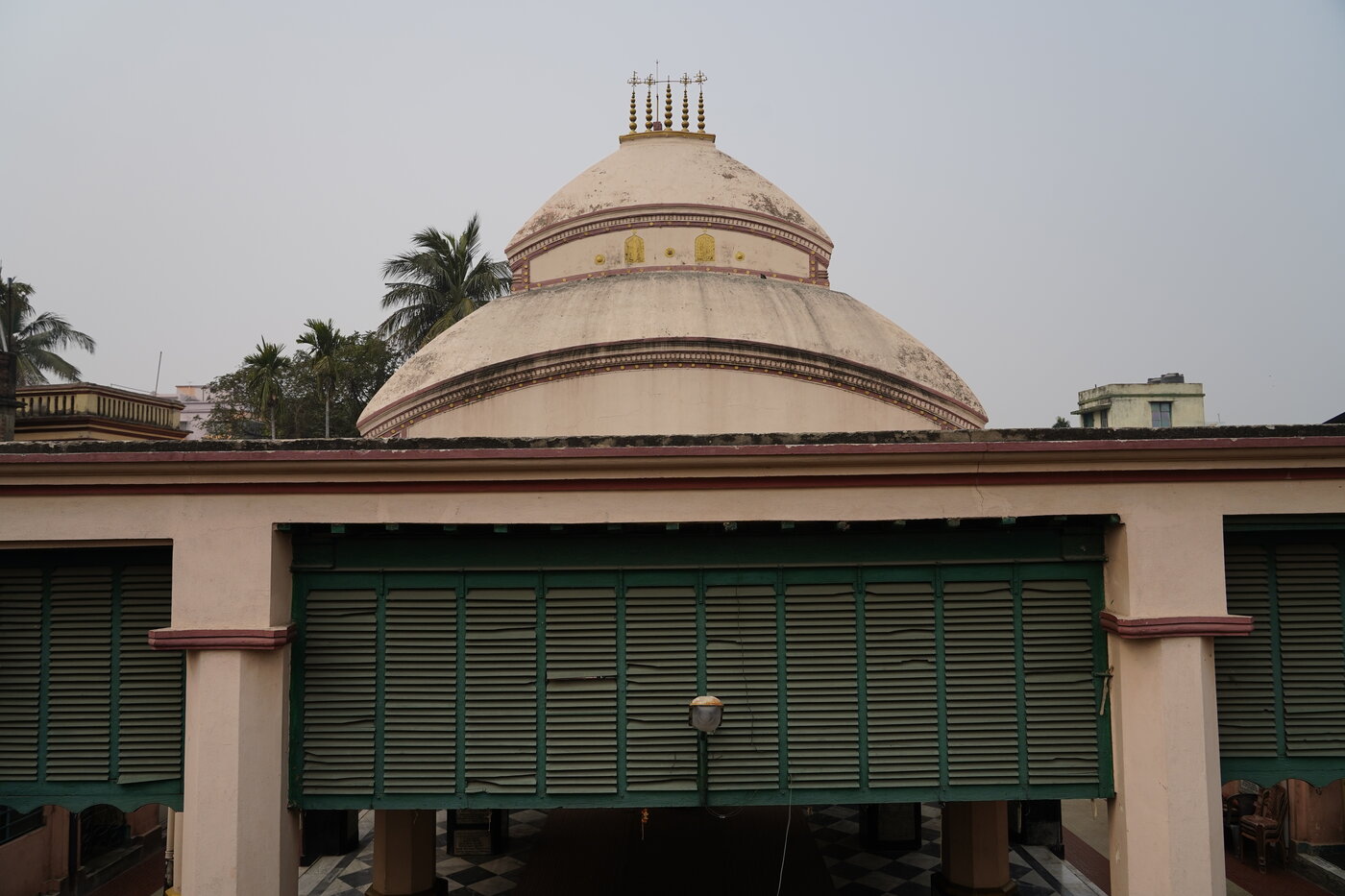
Of everything remembered about Viracandra, one claim is repeated more often than any other. It is that he brought well over a thousand outsiders into Vaishnava devotional life in one connected effort. Nothing else in this generation of Gaudiya Vaishnavism matches it in scale. This page reports what the sources actually say about that claim, and what they say about two smaller, related episodes. It also shows where the tradition itself admits that the story later became complicated.
| Detail | Description |
|---|---|
| Best-documented episode | Mass conversion of the neda-nedi ascetics |
| Who they were | Shaven-headed tantric Buddhist ascetics (nedas) and their female companions (nedis), based mainly around Navadvipa |
| Scale reported | Over a thousand nedas and a roughly equal number of nedis |
| What changed | Chanting of the Hare Krishna maha-mantra; regularized marriage in place of earlier tantric relationships |
| Related traditions | Gathering Bengal's Vaishnavas for a journey to Gauda's ruler to secure a sacred stone; preaching Harinama among Muslims in East Bengal |
| Later complication | Some neda-nedis reverted to earlier practices while still presenting themselves as Vaishnavas; the group is now generally classed among the Baul lineages |
A Thousand and More Return to Krishna #
The word neda means a man with a shaved head, and nedi means a woman with a shaved head. Around Navadvipa, in Viracandra's own lifetime, there lived a community of tantric Buddhist ascetics. They practiced a form of meditation that involved paired male and female partners outside ordinary marriage. Gaudiya Vaishnava tradition credits Viracandra with converting more than a thousand nedas and a roughly equal number of nedis to Vaishnavism. The tradition is recorded in more than one place. One of them is Srila Bhaktivinoda Thakura's own list of movements that grew up alongside the main Gaudiya line, and sometimes away from it. Under Viracandra's direction they took up chanting of the Hare Krishna maha-mantra, and most of them were properly married. The tradition describes this as ending the "illicit connections" their earlier practice had involved. Like other Vaishnavas of the period, they adopted tilak and white cloth. For a time, it was said, no one could tell them apart from any other shaven-headed Vaishnava in the renounced order in that area. The number given here, over a thousand of each, is exactly as the tradition states it. No source available gives an independent count. So readers should take it as the tradition's own figure, not as a verified count.
Gathering the Vaishnavas of Bengal #
A separate tradition is preserved in the history of the Radha-Shyamsundar temple at Khardaha, and it is repeated in at least one other account of Viracandra's life. It describes him gathering Vaishnavas from across Bengal for a different purpose. They were to travel together, chanting the holy name, to the Muslim ruler of Gauda and ask for a particular sacred stone. This is said to be the very stone on which Krishna stood during Maharaja Yudhishthira's Rajasuya sacrifice. The story of what happened to that stone, and of the Deities later carved from it, belongs to the history of Khardaha's temples. It is told on Final Days and Legacy. Here the main point is the kind of event this was. It was an act of public devotion, shared by many, large enough to draw the attention of those who ruled the region, and in the end their cooperation. In itself this was a kind of reconciliation, between a Vaishnava community that felt persecuted and the government it lived under.
Preaching Beyond the Vaishnava Fold #
The Bengali devotional biography Prema-vilasa has a chapter devoted mainly to Viracandra and Shrinivasa Acharya. This chapter is said to record a further episode. In this account, Viracandra traveled into East Bengal and preached Harinama among Muslims there, with the help of some of the same nedas. On one occasion, the account says, he showed an eight-armed form to a local Nawab, who then showed him favor. We report this account with caution. It comes down to us only through a summary of Prema-vilasa's chapter divisions in another work, not through the full text itself. No other source available confirms the specific detail of the eight-armed form. Still, it fits the larger pattern the tradition remembers. Again and again, Viracandra was willing to cross whatever line stood between a group of people and Vaishnava devotional life, whether of caste, religion or ascetic order. And he did it in public, on a large scale, not one convert at a time.
A Complicated Afterlife #
The tradition does not let this story end neatly. After some time, a number of the converted neda-nedis are said to have quietly returned to their earlier practices, while still presenting themselves outwardly as Vaishnavas. Over time this pattern slowly turned into what later observers counted as a form of the Baul tradition. The Bauls are one of several groups discussed at length in Bhaktivinoda Thakura's own study of sampradayas that had gone astray. The sources available do not blame Viracandra for any of this. A founder is not usually blamed for what later generations do with what he started. But an honest account of "the grand reconciliation" should include it. One reason is that a complete history must show its difficult parts as honestly as its flattering ones. Another is that this problem is itself part of what later Gaudiya Vaishnavas learned from the episode. They learned that bringing someone into the fold and keeping them there are two different kinds of work.
Chapter 4
Founding the Nityananda-vamsa
A hereditary line that, according to the records, did not begin quite the way it is usually told
Viracandra is remembered as the founding figure of the Nityananda-vamsa. This is the network of hereditary Gosvami families in Bengal that descend from Nityananda Prabhu's own household, in name and in the memory of their institutions. It is one of two different kinds of succession this tradition produced. The other is the renounced line that comes down from the Six Goswamis of Vrindavana: Rupa Goswami, Sanatana Goswami, Raghunatha Bhatta Goswami, Gopala Bhatta Goswami, Jiva Goswami and Raghunatha Dasa Goswami. None of them married, and none of them passed their position down by blood. But when the record about Viracandra himself is read carefully, it makes the usual story of how the Nityananda-vamsa began less simple.
| Detail | Description |
|---|---|
| Traditional "sons" | Gopijanavallabha (Lata, near Mankar, Burdwan), Ramakrishna (Gayeshapura, near Malda), Ramachandra (Khardaha) |
| What Bhaktisiddhanta Sarasvati Thakura's own commentary says | These three belonged to different gotras, surnames and villages, so "it is not possible to accept them as real sons of Virabhadra Gosani"; they were disciples, later honored as sons |
| Actual hereditary line | Descends from Ramachandra (Shandilya gotra, surname Vatavyala), traced across nine further generations to Shyamalala Gosvami |
| Later term for this pattern | Jata-gosani, "hereditary Gosvamis," sometimes criticized as "caste goswamis" |
| Contrasted with | The renunciate line of the Six Goswamis of Vrindavana, none of whom married or had blood successors |
| Bhaktisiddhanta Sarasvati Thakura's position | Did not recognize caste goswamis who relied on birth alone rather than the qualification and renunciation of the Six Goswamis' own example |
Two Ways to Inherit an Acharya's Work #
After Chaitanya Mahaprabhu's own generation, Gaudiya Vaishnavism produced two quite different kinds of succession. Rupa Goswami, Sanatana Goswami and the other Six Goswamis of Vrindavana took sannyasa and lived without family. They passed their teaching authority to disciples chosen for their qualification, not for their birth. In this way Jiva Goswami succeeded his uncles, and Krishnadasa Kaviraja Goswami came after him. Nityananda Prabhu's own line, by contrast, became a household. Viracandra stands at the point where that household turned into something larger. It became an institution with land and temples. In time it also held a hereditary claim to spiritual authority, a claim that outlived the qualification of any single person. Both patterns produced real saints. Both, in different ways, also produced real problems. For the renounced line, the problem was the great difficulty of keeping institutions going without family continuity. For the householder line, it was the opposite difficulty. In time, a family name came to take the place of the qualification it was meant to represent.
The Three Disciples Called Sons #
Here the record holds a real surprise. Two sources confirm it, and they do not depend on each other. One is Srila Bhaktisiddhanta Sarasvati Thakura's own Anubhasya commentary to Chaitanya-charitamrita. The other is a separate scholarly summary of how Bhaktivinoda Thakura classified the Gaudiya Vaishnava apasampradayas, or branches that went astray. Both describe Viracandra as having no surviving son of his own. The isvara.org summary calls him directly "Lord Nityananda's only and childless son." Three men, Gopijanavallabha, Ramakrishna and Ramachandra, were later "celebrated as his sons," but in Bhaktisiddhanta Sarasvati Thakura's own words they were disciples: "since these three disciples belonged to different gotras, or dynasties, and also had different surnames and lived in different places, it is not possible to accept them as real sons of Viracandra Gosani." Gopijanavallabha lived at Lata, near the Mankar railway station in Burdwan district. Ramakrishna lived near Maladaha, in a village called Gayeshapura. Only Ramachandra (of the Shandilya gotra, with the surname Vatavyala) actually settled a family at Khardaha itself.
The Khardaha Gosvamis and Their Descendants #
The actual hereditary Nityananda-vamsa families, still known today as the Gosvamis of Khardaha, came from Ramachandra's own line, not from Viracandra's blood. Bhaktisiddhanta Sarasvati Thakura's own family tree, preserved in his Anubhasya, traces the line nine generations deep. Ramachandra's eldest son was Radhamadhava. Radhamadhava's own third son, Yadavendra, fathered Nandakishora. Nandakishora's line continued through Nidhikrishna, Chaitanyacanda, Krishnamohana, Jaganmohana and Vrajanatha, down to Shyamalala Gosvami. This is a real, recorded family line, though its members are not, strictly speaking, Viracandra's own descendants. Over time, similar hereditary Gosvami families multiplied across Bengal. They traced their spiritual authority to family connection with Chaitanya Mahaprabhu's associates, or with the disciples of those associates, not to any personal qualification. Later Vaishnava reformers gave this pattern a name, jata-gosani, or "hereditary Gosvamis." As one critical account puts it, these were families who, "though sunken in mundane family affairs, think themselves as important as the renounced gosvamis of the Gaudiya Sampradaya."
A Name Worth Living Up To #
Bhaktisiddhanta Sarasvati Thakura is recorded as having refused to recognize caste goswamis for exactly this reason. His ground was that they were not in the renounced line of the Six Goswamis, and that "one who is still in family life should not misuse the title gosvami." Srila Prabhupada, his own disciple, made a closely related point in a lecture at Vrindavana in October 1972. In it he gave a new definition of the very name that Viracandra's family line carries: "Nityananda-vamsa means one who takes the risk of preaching work, he can claim Nityananda-vamsa. Not that easy-going... Simply taking advantage of coming from Nityananda-vamsa, 'I have become guru, give me your money,' and sit down, 'Let me enjoy life with my wife and children' - that kind of Nityananda-vamsa will not help." None of this is a judgment on Viracandra himself. According to every source checked, he lived and preached exactly the way Prabhupada describes. It is a judgment on what later generations sometimes did with his name. It is also a reminder that, for this whole tradition, an acharya's real inheritance was always meant to be a standard of practice to follow, not a surname.
Scriptural evidence for this chapter (2)
সর্বশাখা–শ্রেষ্ঠ বীরভদ্র গোসাঞি ।
তাঁর উপশাখা যত, তার অন্ত নাই ॥
sarva-sakha-srestha virabhadra gosani
tanra upasakha yata, tara anta nai
Word for word
sarva-sakha-srestha -- the best of all the branches; virabhadra gosani -- Virabhadra Gosani; tanra upasakha -- His subbranches; yata -- all; tara -- of them; anta -- limit; nai -- there is not.
Among all the branches of Sri Nityananda Prabhu, Virabhadra Gosani was the topmost. His subbranches were unlimited.
Krishnadasa Kaviraja Goswami's closing word on Viracandra's place among Nityananda Prabhu's spiritual family, cited here to introduce the unlimited subbranches that became the Nityananda-vamsa.
From the purport: Purport excerpt: "...since these three disciples belonged to different gotras, or dynasties, and also had different surnames and lived in different places, it is not possible to accept them as real sons of Virabhadra Gosani."
Bhaktisiddhanta Sarasvati Thakura's own genealogical note is the primary source establishing that Viracandra's three traditional 'sons' were disciples, and that the real hereditary Khardaha Gosvami line descends from one of them, Ramachandra, across nine further generations.
Chapter 5
Final Days and Legacy
Marriage, the Deities of Khardaha, and an undated disappearance
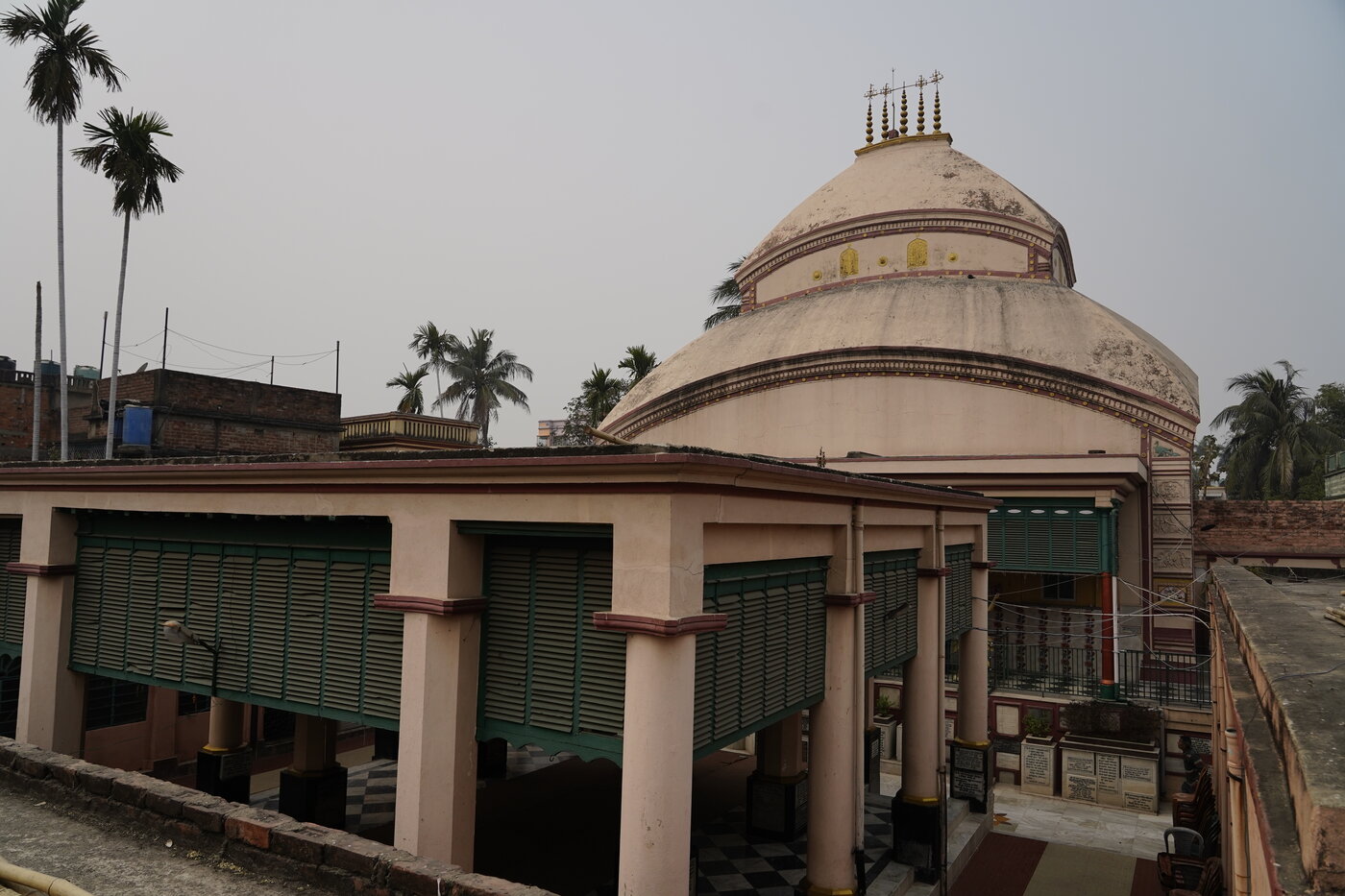
Viracandra's later years are far less well recorded than his youth. What survives is mostly about the institution he built at Khardaha, not about the man himself in old age. And on the most important question a life story should answer, there is a plain gap. No source available records when, or how, he disappeared from this world.
| Detail | Description |
|---|---|
| Wives | Shrimati and Narayani, daughters (one by birth, one by fosterage) of Yadunandana Acharya of Jhamatpura, Hooghly district |
| Marriage arranged by | Jahnava Devi |
| Deity installation | Shyamsundar at Khardaha, Radhavallabha (Vallabhji) at Ballavpur, Nandadulal at Saibona, all three, by temple tradition, carved from one sacred stone |
| Manuscript tradition | A handwritten copy of Srimad-Bhagavatam, said to be in his own hand, preserved at the Khardaha temple |
| Disappearance | Not recorded in any source available |
| Temple status today | The Radha-Shyamsundar Jiu temple at Khardaha was declared a heritage structure by the West Bengal Heritage Commission in 2018 |
Two Marriages at Jahnava's Request #
At Jahnava Devi's own instruction, Viracandra married two daughters of the brahmana Yadunandana Acharya of Jhamatpura, in Hooghly district. They were Shrimati, Yadunandana's own daughter, and Narayani, his foster daughter. Both women received mantra initiation directly from Jahnava Devi. Tradition says that Yadunandana Acharya himself had become a Vaishnava through Jahnava's mercy. This places the marriage inside a pattern seen throughout Viracandra's own life. His family and his following were built up through Jahnava's own initiations as much as through Viracandra's. No source checked records whether the marriage itself produced children of Viracandra's own. The "sons" the tradition remembers him for were disciples, not his own children, as Founding the Nityananda-vamsa explains in full.
A Stone That Came Down the Ganges #
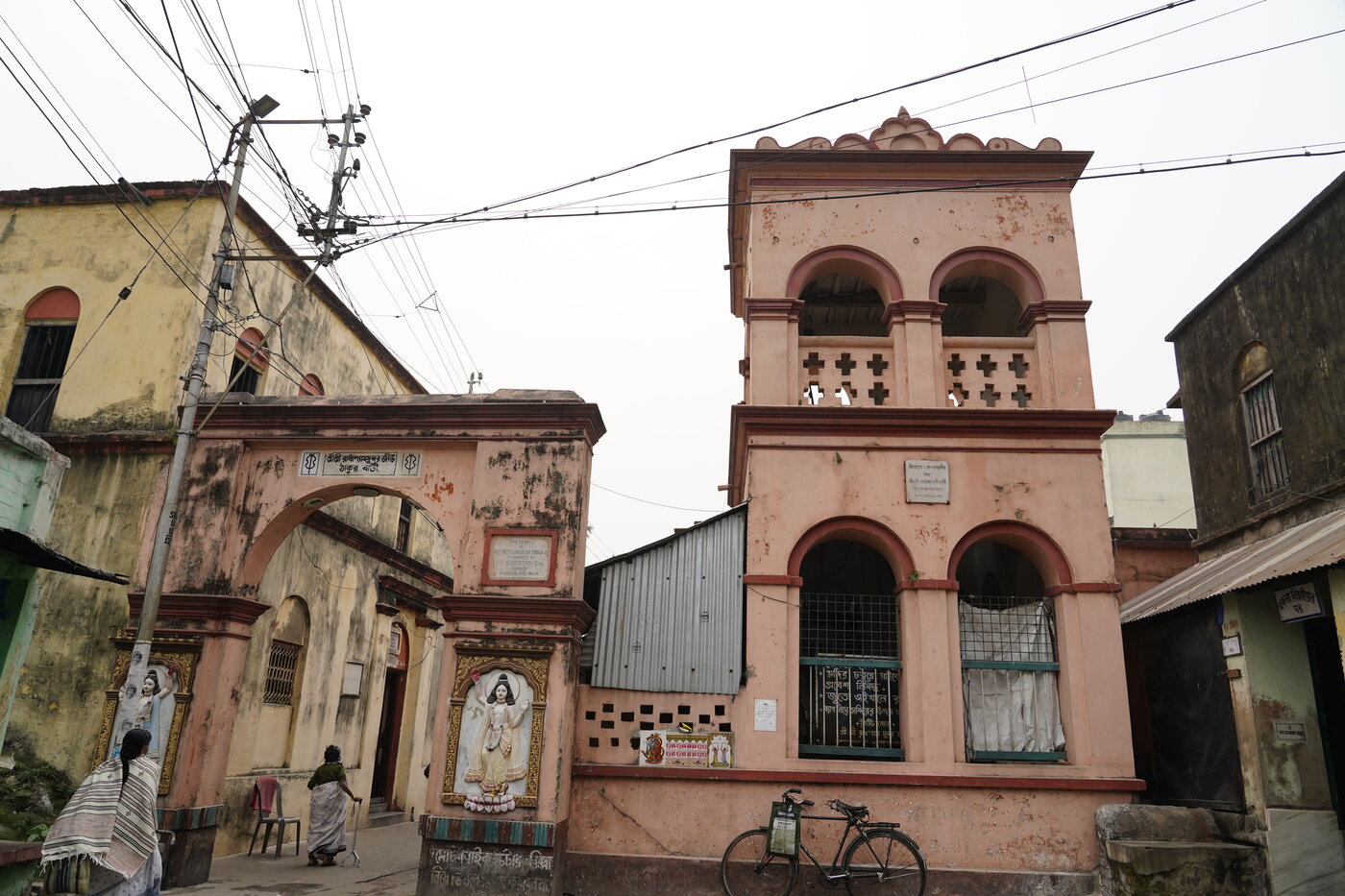
The Radha-Shyamsundar Jiu temple at Khardaha keeps its own temple history. It tells a specific story about how the temple's central Deity came to be installed there. We give it here as the temple's own legend, not as documented history. The account says that Viracandra gathered Vaishnavas from across Bengal and traveled with them, chanting the holy name, to the Muslim ruler of Gauda. He went to ask for a particular black stone, said to be the very stone on which Krishna stood during Maharaja Yudhishthira's Rajasuya sacrifice. The ruler agreed to release it. But in the story, the stone could not be carried by the ordinary route. Krishna appeared to Viracandra in a dream and said He would instead come flowing down the river Ganges. The stone was set afloat and came to rest at what is still called Shyamer Ghat in Khardaha. There a devotee-artist named Nayan carved it into three Deities: Vallabhji, installed at Ballavpur; Shyamsundarji, installed at Khardaha itself; and Nandadulalji, installed at Saibona. A closely related account, separate from the temple's own history, adds that the stone came specifically as a salagrama-sila obtained from the Nawab at Murshidabad. This detail does not quite match the temple's own naming of Gauda. We give both versions here instead of quietly choosing one.
Building Khardaha's Devotional Life #
Beyond the Shyamsundar Deity, Viracandra is credited with bringing sacred stones from Vrindavana itself for further Deities at Khardaha. He is also credited with starting the yearly celebration there of his own father Nityananda Prabhu's birth anniversary, a festival still central to Khardaha's calendar. A handwritten manuscript of Srimad-Bhagavatam, said to be in Viracandra's own hand, is preserved at the temple to this day. Taken together, these traditions describe a man who cared less about his own life story than about building something that would outlast him: a temple, a calendar of festivals, and a settled Vaishnava community in the town where he had been born.
An Undated Disappearance and a Living Temple #
No source available gives a date, or even an approximate period, for Viracandra's disappearance. This is a real gap in the record, and we state it plainly instead of filling it with a guess. But we can say what remains. The Radha-Shyamsundar Jiu temple he is credited with founding still stands at Khardaha. It still receives what one source calls "lakhs of pilgrims," and it was formally declared a heritage structure by the West Bengal Heritage Commission in 2018. The hereditary Gosvami families of Khardaha are descended through his disciple Ramachandra, not through his own blood. For generations afterward they continued the life of the institution he began. They did it imperfectly and unevenly, as any human institution does. But they carried forward the work of a man whom Krishnadasa Kaviraja Goswami once called the main pillar in the hall of devotional service Chaitanya Mahaprabhu built.
- Sri Chaitanya-charitamrita, Adi-lila 11.8-13, with Prabhupada's purport quoting Bhaktisiddhanta Sarasvati Thakura's Anubhasya
- Sri Chaitanya-charitamrita, Adi-lila 11.56
- Room Conversation, San Diego, 29 June 1972 (Srila Prabhupada on Jahnava Devi as acharya)
- Srimad-Bhagavatam 1.2.5 Lecture, Vrindavana, 16 October 1972 (Srila Prabhupada on the meaning of Nityananda-vamsa)
- Apasampradaya: Deviation of the Disciplic Succession (Sri Narasingha Chaitanya Ashram / isvara.org)
- Viracandra Prabhu - Biography (Gaudiya History, ISKCON Desire Tree)
- Viracandra Prabhu (Gaudiya History, ISKCON Desire Tree)
- Bircandra Prabhu - Biography (Gaudiya History, ISKCON Desire Tree)
- Pastime of Birth of Lord Virachandra (Gaudiya History, ISKCON Desire Tree, quoting Sri Nityananda Charitamrita, Antya-khanda 11)
- Sri Viracandra Prabhu (Virabhadra) - Shyam Das Baba
- Sri Virabhadra Goswami - Official Blog of ISKCON Bangalore
- Saints and Incarnations, Topic Index (Krishna.com / Back to Godhead)
- File: Radha Shyamsundar Jiu temple at Khardaha (Wikimedia Commons, with temple history)
