Baladeva Mandira (Tālavana)
बलदेव मन्दिर (तालवन) Hindi name proposed
Also called Dauji Mandir
- What it is
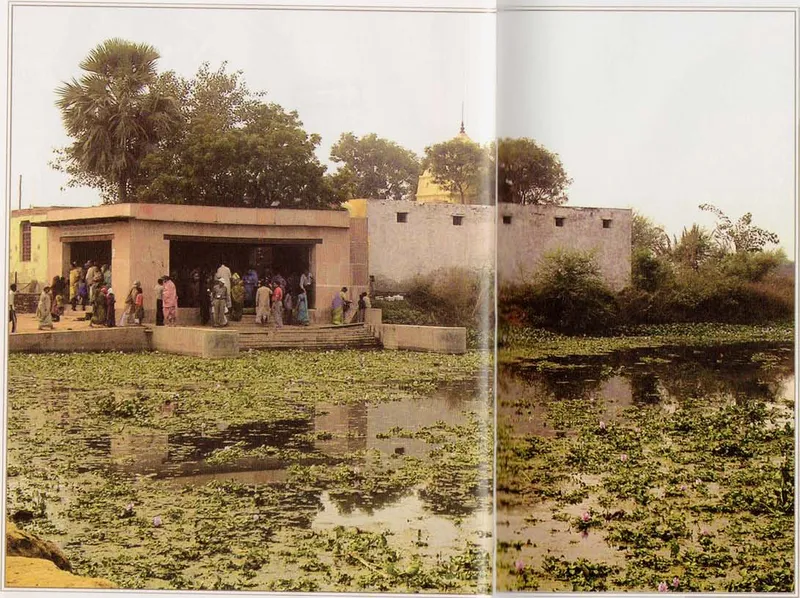
- The temple of Baladeva, locally called the Dāūjī Mandira, stands beside the Balabhadra-kuṇḍa, the lake of Tālavana.
- Visiting
- Śrī Vraja-maṇḍala Parikramā (2007) prints photographs of the Deity of Baladeva and of the Balabhadra-kuṇḍa with the temple.
In short
The temple of Baladeva, locally called the Dāūjī Mandira, stands beside the Balabhadra-kuṇḍa, the lake of Tālavana. Two guidebooks, of 2007 and about 1986, describe its Deity of Balarāma, and the undated parikramā notes Tālavana say that the Deity stands with His wife Revatī.[1 +4] According to those notes, the temple is dedicated to Balarāma, who killed the ass-demon Dhenukāsura at Tālavana, and call it ancient, which is not certain, since no date or builder is known.[5] Śrīmad-Bhāgavatam tells that pastime in Tālavana but names no temple.[6 +4]
Key facts
| Kind | temple |
|---|---|
| Region · area | Madhuvana · Tālavana |
Why it is glorified
Śrīla Rūpa Gosvāmī's Mathurā-māhātmya quotes a verse that he ascribes to the Mathurā-khaṇḍa of the Skanda Purāṇa: Tālavana is …
Śrīla Rūpa Gosvāmī's Mathurā-māhātmya quotes a verse that he ascribes to the Mathurā-khaṇḍa of the Skanda Purāṇa: Tālavana is holy, for there the demon was killed among the palm trees, for the good of the Yādavas and for the Lord's own play (summarised here, not translated).[11 +4]
Divine pastimes
The killing of Dhenuka in the Bhāgavatam
Śrīmad-Bhāgavatam (10.15.20–40) tells that the cowherd boys told Kṛṣṇa and Balarāma of a great forest full of palm trees, guarded by Dhenuka, where the ripe fruits lay uneaten. Laughing, the two brothers went there with the boys.[6 +4]
evaṃ suhṛd-vacaḥ śrutvā suhṛt-priya-cikīrṣayā / prahasya jagmatur gopair vṛtau tālavanaṃ prabhū
Hearing the words of Their dear companions, Kṛṣṇa and Balarāma laughed and, desiring to please them, set off for the Tālavana surrounded by Their cowherd boyfriends.
Translation: Śrīla Prabhupāda's disciples (BBT)Śrīla Prabhupāda's Kṛṣṇa book retells the chapter:[10]
General teaching (does not name the place)“Immediately upon entering the Tālavana, Balarāma began to yank the trees with His arms, exhibiting the strength of an elephant. Because of this jerking, all the ripe fruits fell down on the ground.”
Śrīla Prabhupāda, Kṛṣṇa, the Supreme Personality of Godhead, Chapter 15, 'The Killing of Dhenukāsura' · vedabase.io
When the ass-demon attacked, Balarāma seized him by his hooves and whirled him into the top of a palm tree, and the whirling killed him. Kṛṣṇa and Balarāma then killed the demon's companions in the same way, and afterwards people came back to the forest without fear and the cows grazed there freely.[6 +4]
sa taṃ gṛhītvā prapador bhrāmayitvaika-pāṇinā / cikṣepa tṛṇa-rājāgre bhrāmaṇa-tyakta-jīvitam
Lord Balarāma seized Dhenuka by his hooves, whirled him about with one hand and threw him into the top of a palm tree. The violent wheeling motion killed the demon.
Translation: Śrīla Prabhupāda's disciples (BBT)Other accounts
The Garga-saṁhitā (Vṛndāvana-khaṇḍa, chapter 8; chapter 11 in another edition) tells it differently. In its account the cowherd boys, afraid of Dhenuka, and Kṛṣṇa too stayed out of the forest, and Balarāma went in alone. In the long fight that followed, the boys also struck the demon and Kṛṣṇa threw him onto Govardhana, and at last Dhenuka died from a blow of Balarāma's fist (summarised here, not translated).[16 +2] It also tells Dhenuka's previous life: he had been Sāhasika, a son of Bali, whom the sage Durvāsā cursed to become an ass and to be freed by Balarāma in Tālavana.[16 +2] Who killed Dhenuka, and how, the Bhāgavatam, the Garga-saṁhitā and the other sources tell differently; their accounts are set side by side on the page of Tālavana.[16 +2] Read more: The killing of Dhenuka at Tālavana →
In his Gopāla-campū Śrīla Jīva Gosvāmī sets the pastime in the rainy season, when the palm fruits ripen: the east wind brought the fragrance of Tālavana's fruits from far away while Kṛṣṇa, Balarāma and the boys were grazing the cows south-east of Govardhana Hill (summarised here, not translated).[19] Śrīla Sanātana Gosvāmī and Śrīla Jīva Gosvāmī place Tālavana within four krośas east of Govardhana, and Śrīla Viśvanātha Cakravartī Ṭhākura within four krośas of Govardhana, in the region known as Tālasī, south-west of Mathurā.[20 +1]
The Gosvāmīs and ācāryas
In his Vraja-vilāsa-stava Śrīla Raghunātha dāsa Gosvāmī praises Balarāma as the enemy of Dhenuka, who out of love never leaves …
In his Vraja-vilāsa-stava Śrīla Raghunātha dāsa Gosvāmī praises Balarāma as the enemy of Dhenuka, who out of love never leaves His younger brother alone in the forest even for a moment (summarised here, not translated). The verse does not name Tālavana; the guidebook Vṛndāvana-Dhāma Ki Jaya! (c. 1986) prints it in its Tālavana entry, facing its photograph of this temple's Deity.[22 +1]
Śrīla Prabhupāda
The Deity of Balarāma here stands with Revatī.
The Deity of Balarāma here stands with Revatī. As general background, in his translation of Śrīmad-Bhāgavatam (9.3.29–36) Śrīla Prabhupāda tells how King Kakudmī gave his daughter Revatī in marriage to Baladeva; the verses concern Revatī, not this temple.[1 +5]
General teaching (does not name the place)“Thereafter, the King gave his most beautiful daughter in charity to the supremely powerful Baladeva”
Śrīla Prabhupāda, Śrīmad-Bhāgavatam, Canto 9, 3.36, translation · vedabase.io
Songs
The song book has verses of the Kṛṣṇa-līlā-stava ("Obeisance 43") that praise Kṛṣṇa, who played in Tālavana while Balarāma felled …
The song book has verses of the Kṛṣṇa-līlā-stava ("Obeisance 43") that praise Kṛṣṇa, who played in Tālavana while Balarāma felled Dhenuka; the song book credits them to Śrīla Sanātana Gosvāmī, a credit its own data mark as uncertain.[26]
Visiting today
Śrī Vraja-maṇḍala Parikramā (2007) prints photographs of the Deity of Baladeva and of the Balabhadra-kuṇḍa with the temple. Vṛndāvana-Dhāma Ki Jaya! (c. 1986) describes a small temple next to the lake, with a Deity of Balarāma shown with His wife Revatī and His younger brother Kṛṣṇa. The undated notes Tālavana describe a Deity of Balarāma about three and a half feet tall, with Revatī, and call the temple the Dāūjī Mandira.[1 +4]
Location
| Where it is | At Tālavana, by Balabhadra-kuṇḍa[27] |
|---|
Nearby places
Balabhadra-kuṇḍa (Tālavana)
History
No date, builder, inscription or document for the temple has been found; only the undated notes Tālavana call it ancient, so its age is not certain.[5]
More on this place
The killing of Dhenuka at Tālavana
References
27 references
- Śrī Vraja-maṇḍala Parikramā (2007), PDF p. 67
- Śrī Vraja-maṇḍala Parikramā (2007), PDF p. 68
- Vṛndāvana-Dhāma Ki Jaya! (c. 1986), by Dhruva Mahārāja dāsa, PDF p. 28
- the undated parikramā notes Tālavana, ¶18
- the undated parikramā notes Tālavana, ¶19
- Śrīmad-Bhāgavatam 10.15.21, GRETIL
- Śrīmad-Bhāgavatam 10.15.27, GRETIL
- Śrīmad-Bhāgavatam 10.15.32, GRETIL
- Śrīmad-Bhāgavatam 10.15.40, GRETIL
- Śrīla Prabhupāda, Kṛṣṇa, the Supreme Personality of Godhead, Chapter 15, 'The Killing of Dhenukāsura' · vedabase.io
- Śrīla Rūpa Gosvāmī, Mathurā-māhātmya vv. 334-335
- Śrī Vraja-maṇḍala Parikramā (2007), PDF p. 66
- the undated parikramā notes Tālavana, ¶39
- the undated parikramā notes Tālavana, ¶40
- the undated parikramā notes Tālavana, ¶41
- Garga-saṁhitā, Vṛndāvana-khaṇḍa (2) 8.2, Sanskrit Wikisource
- Garga-saṁhitā, Vṛndāvana-khaṇḍa (2) 8.25-26, Sanskrit Wikisource
- Garga-saṁhitā, Vṛndāvana-khaṇḍa (2) 8.38-39, Sanskrit Wikisource
- Gopāla-campū, Pūrva-campū 14 (caturdaśa pūraṇa) ¶[8]-[9]
- Śrīmad-Bhāgavatam canto 10 with commentaries: Śrīla Sanātana Gosvāmī's Bṛhad-vaiṣṇava-toṣaṇī: commentary on 10.15.22 (Grantha Mandira numbering; vedabase 10.15.21), Bhagavata Vidya Pith edition, ed. Bhagavata Rishi and Krishna Shankar Shastri, 1996
Show all 27 references
- Śrīla Viśvanātha Cakravartī Ṭhākura, Baladeva Vidyābhūṣaṇa: commentary on ŚB 10.15.21, Bhagavata Vidya Pith edition, ed. Bhagavata Rishi and Krishna Shankar Shastri, 1996
- Śrīla Raghunātha dāsa Gosvāmī, Stavāvalī: Vraja-vilāsa-stava, Vraja-vilāsa-stava v.12 (Stavāvalī hymn (9) in the Grantha Mandira text)
- Vṛndāvana-Dhāma Ki Jaya! (c. 1986), by Dhruva Mahārāja dāsa, PDF p. 29
- Śrīla Raghunātha dāsa Gosvāmī, Stavāvalī: Vraja-vilāsa-stava, Vraja-vilāsa-stava v.12 (Stavāvalī hymn (9) in the Grantha Mandira text)
- Śrīla Prabhupāda, Śrīmad-Bhāgavatam, Canto 9, 3.36, translation · vedabase.io
- Obeisance 43 (Sanātana Gosvāmī (as the song book credits it; marked as inferred in the song book database)) · song book
- Śrī Vraja-maṇḍala Parikramā (2007), p. 108-109