Batharan-bihārī Mandira
भतरौड-बिहारी मन्दिर Hindi name proposed
Also called Batharan Bihārī Temple, Bhatharan-bihārī, Bhojana Sthālī
- What it is
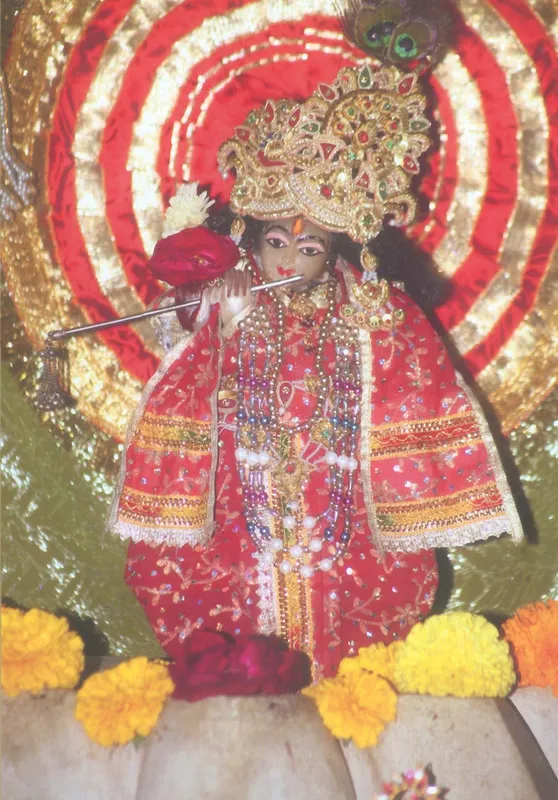
- The Batharan-bihārī Mandira is a small temple with a standing Deity of Kṛṣṇa playing the flute.
- Visiting
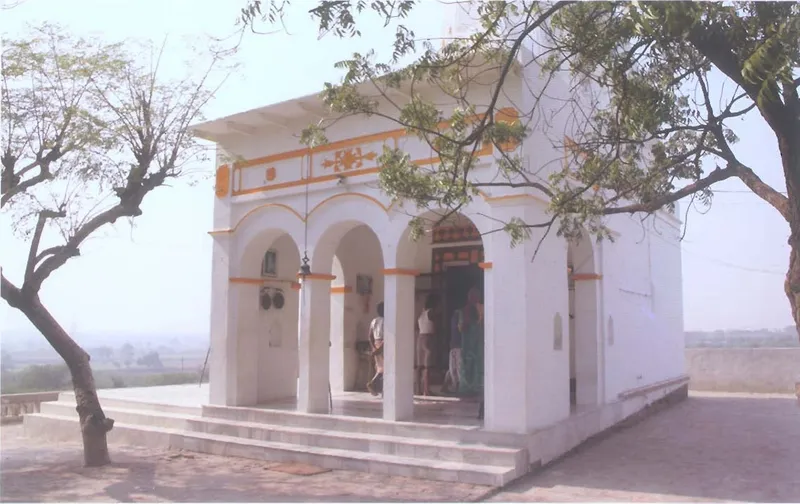
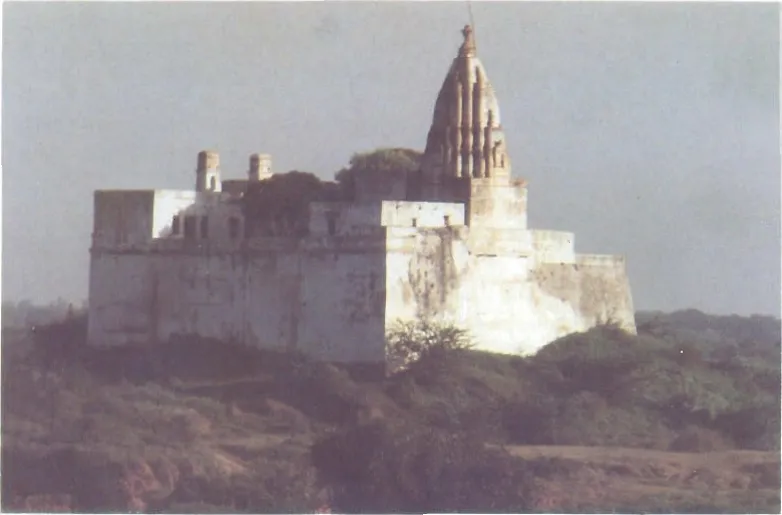
- The 2010 guidebook shows a small whitewashed temple with an arched veranda, and the 2000 guidebook an old stone temple with a spire on a rise; the two photographs differ, perhaps by date or view.
In short
The Batharan-bihārī Mandira is a small temple with a standing Deity of Kṛṣṇa playing the flute.[1 +2] According to the guidebooks Vṛndāvana, the Playground of God (2010) and The Color Guide to Vṛndāvana (2000), it marks the place where Kṛṣṇa, Balarāma and the cowherd boys ate the food brought by the wives of the brāhmaṇas, and so it is also called Bhojana-sthalī, "the Eating Place".[1 +4] Śrīmad-Bhāgavatam tells the meal without naming a place.[7 +5] Whether the temple stands at Bhātrola, the "place of the meal" of another guidebook, is not stated in any source.[1 +4]
Key facts
| Kind | temple |
|---|---|
| Region · area | Vṛndāvana |
| Also part of | Yamunā |
Divine pastimes
Śrīmad-Bhāgavatam (10.22–23) tells how the hungry cowherd boys were refused food by brāhmaṇas at a sacrifice, and how the brāhmaṇas' wives brought four kinds of food to Kṛṣṇa in a grove of aśoka trees by the Yamunā.[1 +8] Vṛndāvana, the Playground of God quotes at this temple the wives' wish to stay with Kṛṣṇa in the forest, and His answer, which sends them home:[1 +3]
śravaṇād darśanād dhyānān mayi bhāvo 'nukīrtanāt / na tathā sannikarṣeṇa pratiyāta tato gṛhān
It is by hearing about Me, seeing My Deity form, meditating upon Me and chanting My names and glories that love for Me develops, not by physical proximity. Therefore please go back to your homes.
Translation: Śrīla Prabhupāda's disciples (BBT)After the wives had gone, Kṛṣṇa fed the boys with their food and then ate Himself.[12 +3] Śrīla Sanātana Gosvāmī describes the boys sitting in a circle around Him like the petals of a lotus, and Śrīla Jīva Gosvāmī and Śrīla Viśvanātha Cakravartī Ṭhākura say that the little food filled them all by His power (summarised here, not translated). None of them names the place.[18 +1] The commentators and the other accounts of where it happened are told on the Bhātrola page.[11 +9] Read more: Kṛṣṇa and the wives of the brāhmaṇas: the pastime and its places →
Traditional accounts
The Color Guide to Vṛndāvana tells the pastime at this temple in the words of Śrīla Prabhupāda's Kṛṣṇa book, without naming it …
The Color Guide to Vṛndāvana tells the pastime at this temple in the words of Śrīla Prabhupāda's Kṛṣṇa book, without naming it: the boys are told to beg in Balarāma's name, and the wives, who thought of Kṛṣṇa constantly, are described as following the Bhagavad-gītā's instruction to surrender.[3 +2]
Names this place“Being advanced by thinking of Kṛṣṇa constantly, they were performing the greatest form of mystic meditation. All the wives then became very busily engaged in filling up different pots with nice food.”
Śrīla Prabhupāda, Kṛṣṇa, the Supreme Personality of Godhead, Chapter 23, 'Delivering the Wives of the Brāhmaṇas Who Performed Sacrifices' · vedabase.io
Vṛndāvana, the Playground of God says that the brāhmaṇas were performing an animal sacrifice. The Bhāgavatam calls it the sacrifice named Āṅgirasa; three commentators on 10.23.8, Śrīla Jīva Gosvāmī, Śrīla Viśvanātha Cakravartī Ṭhākura and Śrīla Baladeva Vidyābhūṣaṇa, say that its animal offering had already been made when the boys came.[1 +5] In whose name the boys were to ask is told differently (see below).
Songs
The Kṛṣṇa-līlā-stava, which the song book credits to Śrīla Sanātana Gosvāmī, follows the pastime verse by verse; its last verse …
The Kṛṣṇa-līlā-stava, which the song book credits to Śrīla Sanātana Gosvāmī, follows the pastime verse by verse; its last verse praises Kṛṣṇa as pleased by the food the sacrificers' wives gave.[37]
Visiting today
The 2010 guidebook shows a small whitewashed temple with an arched veranda, and the 2000 guidebook an old stone temple with a spire on a rise; the two photographs differ, perhaps by date or view. Both show the standing, flute-playing Deity called Batharan-bihārī.[1 +2]
Location
| Where it is | 'on the banks of the River Yamunā'[39] |
|---|
Pictures
3 pictures
History
No source gives a date or a founder for this temple.[1 +2] Older books describe a temple at the place they call Bhat-rond, Bhātarol or Bhatror, near Akrūra: F. S. Growse in 1883, a single tower with an image of Bihārī Jī; the Bengali Vṛndāvana-kathā in 1920, a ruin on a mound whose Deity, Bihārījī of Śrī Vallabhācārya's sampradāya, was then in Mathurā; and the historian A. W. Entwistle in 1987, a temple of Bhatror Bihārī on a mound near the parikramā path.[31 +3] Whether any of these is the Batharan-bihārī temple of the guidebooks is not stated.[33] The historians Entwistle (1987) and Mītal (1966) also record that Gokuldās Pārikh of Gwalior camped near Bhatarod with his Deity of Dvārakādhīśa before building his temple in Mathurā in 1814–15.[35 +1]
Where the sources differ
Which place honours the sacrifice and which the meal, and under what names, is told differently by the guidebooks, the …
Which place honours the sacrifice and which the meal, and under what names, is told differently by the guidebooks, the Bhakti-ratnākara and the Vraja-bhakti-vilāsa; the full comparison is on the Bhātrola page.[1 +5]
In whose name the boys were to beg, and who performed the sacrifice: the Bhāgavatam names the Lord, His elder brother and Kṛṣṇa Himself, and calls the sacrifice the satra named Āṅgirasa; Śrīla Prabhupāda's Kṛṣṇa book has the boys beg in Balarāma's name; Vṛndāvana, the Playground of God (2010) speaks of an animal sacrifice, which the Bhāgavatam does not call it. The accounts are set side by side on the Yajña-sthala page.[1 +7]
More on this place
Kṛṣṇa and the wives of the brāhmaṇas: the pastime and its places
References
39 references
- Vṛndāvana, the Playground of God (2010), Bhakti Caitanya Svāmī, PDF p. 239
- Vṛndāvana, the Playground of God (2010), Bhakti Caitanya Svāmī, PDF p. 241
- The Color Guide to Vṛndāvana (2000), Written and Photographed by Rājaśekhara dāsa Brahmacārī, PDF p. 153
- Vṛndāvana, the Playground of God (2010), Bhakti Caitanya Svāmī, PDF p. 240
- The Color Guide to Vṛndāvana (2000), Written and Photographed by Rājaśekhara dāsa Brahmacārī, PDF p. 154
- Śrīla Narahari Cakravartī, Bhakti-ratnākara, Fifth Wave (pañcama taraṅga), 1912 ed. p. 289, 2nd ed., 1912
- Śrīmad-Bhāgavatam 10.23.7, GRETIL
- Śrīmad-Bhāgavatam 10.23.15-17, GRETIL
- Śrīmad-Bhāgavatam 10.23.28, GRETIL
- Śrīmad-Bhāgavatam 10.23.34, GRETIL
- Śrīmad-Bhāgavatam 10.22.36-38, GRETIL
- Śrīmad-Bhāgavatam 10.23.20-21, GRETIL
- Śrīmad-Bhāgavatam 10.22.29, GRETIL
- Śrīmad-Bhāgavatam 10.23.3-4, GRETIL
- Śrīla Prabhupāda, Kṛṣṇa, the Supreme Personality of Godhead, Chapter 23, 'Delivering the Wives of the Brāhmaṇas Who Performed Sacrifices' · vedabase.io
- Śrī Vraja-maṇḍala Parikramā (2007), PDF p. 286
- Śrīmad-Bhāgavatam 10.23.33, GRETIL
- Śrīmad-Bhāgavatam 10.23.35-36, GRETIL
- Śrīmad-Bhāgavatam 10.23.29, GRETIL
- Śrīla Sanātana Gosvāmī, Śrīla Jīva Gosvāmī, Śrīla Viśvanātha Cakravartī Ṭhākura: commentary on ŚB 10.23.36, Bhagavata Vidya Pith edition, ed. Bhagavata Rishi and Krishna Shankar Shastri, 1996
Show all 39 references
- Śrīla Sanātana Gosvāmī, Śrīla Jīva Gosvāmī, Śrīla Viśvanātha Cakravartī Ṭhākura: commentary on ŚB 10.22.38, Bhagavata Vidya Pith edition, ed. Bhagavata Rishi and Krishna Shankar Shastri, 1996
- Śrīla Sanātana Gosvāmī, Śrīla Jīva Gosvāmī, Śrīla Viśvanātha Cakravartī Ṭhākura: commentary on ŚB 10.23.52, Bhagavata Vidya Pith edition, ed. Bhagavata Rishi and Krishna Shankar Shastri, 1996
- Śrīla Jīva Gosvāmī: commentary on ŚB 10.22.29'), Bhagavata Vidya Pith edition, ed. Bhagavata Rishi and Krishna Shankar Shastri, 1996
- Śrīmad-Bhāgavatam 10.23.52, GRETIL
- Śrīla Jīva Gosvāmī, Gopāla-campū, Pūrva-campū, pūraṇa 22 ('yajña-bhāryā-sad-upacaryā-paryāptiḥ'), sections [12]-[13], GRETIL
- Śrīla Sanātana Gosvāmī: commentary on ŚB 10.11.29, Bhagavata Vidya Pith edition, ed. Bhagavata Rishi and Krishna Shankar Shastri, 1996
- Śrīla Jīva Gosvāmī: commentary on ŚB 10.11.34-35, Bhagavata Vidya Pith edition, ed. Bhagavata Rishi and Krishna Shankar Shastri, 1996
- Garga-saṁhitā, Mādhurya-khaṇḍa (4) 21.8, Sanskrit Wikisource
- Śrīmad-Bhāgavatam 10.23.8, GRETIL
- Śrīla Jīva Gosvāmī, Śrīla Viśvanātha Cakravartī Ṭhākura, Śrīla Baladeva Vidyābhūṣaṇa: commentary on ŚB 10.23.8, Bhagavata Vidya Pith edition, ed. Bhagavata Rishi and Krishna Shankar Shastri, 1996
- Mathurá (1883), F. S. Growse, B.C.S., M.A. Oxon., C.I.E. (as the title page gives him, p. 186
- Muttra (1911), D. L. Drake-Brockman, I.C.S. (edited and compiled), p. 241
- Vṛndāvana-kathā, chapter 16 (ṣoḍaśa pariccheda), item 5 'Bhojana ṭīlā', printed p. 192
- A. W. Entwistle, ch. 8 §66.41 'Bhatror', printed p. 417, first sentence of the entry, Egbert Forsten, Groningen, 1987
- A. W. Entwistle, ch. 5, §5.38 'The Pushtimarg in modern times', printed p. 222, the paragraph beginning 'Nowadays the most important temple of the Pushtimarg in Mathura', Egbert Forsten, Groningen, 1987
- Prabhudayāl Mītal, part 2 (history), 'Ādhunik kāl' (the modern period), section 'Gokuladās Pārikh', printed p. 269, third paragraph
- Obeisance 57 (Śrī Kṛṣṇa-līlā-stava) (Sanātana Gosvāmī (as the song book credits it; the credit is marked inferred in the song book data)) · song book
- Śrīla Narahari Cakravartī, Bhakti-ratnākara, Fifth Wave, 1912 ed. pp. 289-290: Vraja-vilāsa-stava 86 as quoted, 2nd ed., 1912
- Vṛndāvana, the Playground of God (2010), Bhakti Caitanya Svāmī, p. 239