Deha-kuṇḍa
देह-कुण्ड Hindi name proposed
On this page
In short
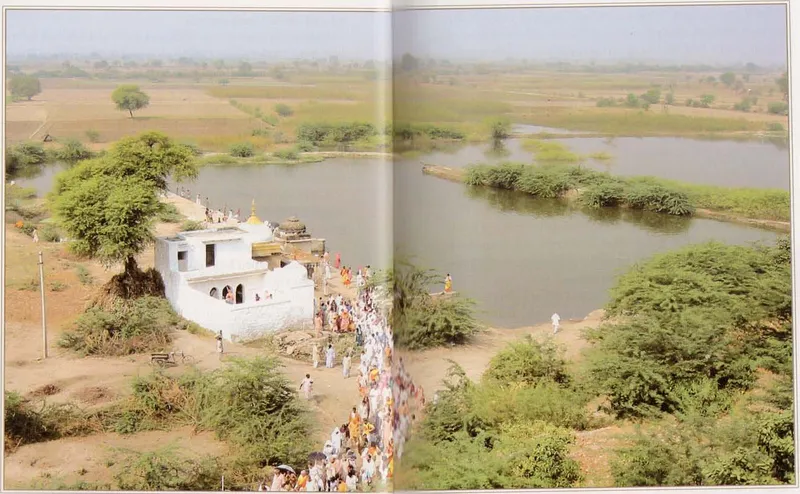
Deha-kuṇḍa is a pond at Ūñcāgaon. Śrīla Nārāyaṇa Bhaṭṭa Gosvāmī's Vraja-bhakti-vilāsa, which calls the village Lalitā-grāma, names it among the village's holy places, with the Śiva image Veṇīśaṅkara Mahādeva beside it.[1 +1] According to the local tradition recorded in Śrī Vraja-maṇḍala Parikramā (2007), Kṛṣṇa gave a poor brāhmaṇa Śrī Rādhā's weight in gold here.[3 +1] The sources place the pond differently: west of Lalitā-sthala in the guidebook, on the north side in the older text.[1 +3]
Key facts
| Kind | kuṇḍa |
|---|---|
| Region · area | Kāmyavana · Ūñcāgaon |
| Ācāryas | Śrīla Nārāyaṇa Bhaṭṭa Gosvāmī |
Traditional accounts
In the Vraja-bhakti-vilāsa
Śrīla Nārāyaṇa Bhaṭṭa Gosvāmī lists the marks of Lalitā-grāma in the second chapter of his Vraja-bhakti-vilāsa. After the small footprints of the sakhīs, Śrī Rādhā's girl companions, on the top of Sakhīgiri, he names "on its north side" the kuṇḍa called Deha-kuṇḍa, and on its south side the image of Śiva called Veṇīśaṅkara (summarised here, not translated).[1 +1] His fourth chapter returns to Deha-kuṇḍa in its section on the village, but the page with that verse is missing from the available copy, so what it says about the pond could not be read.[1 +1]
The gold of Śrī Rādhā
According to the local tradition recorded in Śrī Vraja-maṇḍala Parikramā (2007), a poor brāhmaṇa once asked Kṛṣṇa for wealth for his daughter's wedding. Kṛṣṇa offered him Rādhā, His whole wealth; when the brāhmaṇa still wanted gold, Kṛṣṇa weighed Her in gold and gave him the gold.[3 +1] This story has not been found in any older text.[3 +1]
The same book adds a second account: a wealthy man who suffered from leprosy bathed here, gave ten karṣa (a weight) of gold to brāhmaṇas and was cured.[3 +1]
History
The historian A. W. Entwistle (1987) places the pond on the north side of the village hill. In 1987 he saw beside it a small Śiva temple with a painted dome, like the domes of the memorials of the Bharatpur rulers at Govardhana, and thought that it probably stood on the site of the Veṇīśaṅkara shrine. He gives no date or builder.[5]
Where the sources differ
Accounts differ Where Deha-kuṇḍa lies
- Śrī Vraja-maṇḍala Parikramā (2007)'situated to the west just below Lalitā-sthala'; Lalitā-sthala is 'east of Deha-kuṇḍa'
- Vraja-bhakti-vilāsa ch. 2 v.46on its north side (tad-uttara-pārśve), named right after the sakhīs' footprints on Sakhīgiri's top; the reference point of 'its' is not stated
The wording of these accounts is our summary of the sources, not a published translation.
Location
| Where it is | to the west just below Lalitā-sthala[6] |
|---|
Places at Deha-kuṇḍa
Nearby places
References
- Śrīla Nārāyaṇa Bhaṭṭa, Vraja-bhakti-vilāsa, Second chapter, v.46 (continued), printed p. 46, 1st ed., publ. Bābā Kṛṣṇadāsa, Kusuma-sarovara, Saṁvat 2008
- Śrīla Nārāyaṇa Bhaṭṭa, Vraja-bhakti-vilāsa, Table of contents (adhyāya-sūcī), fourth chapter, the entry for Lalitā-grāma, 1st ed., publ. Bābā Kṛṣṇadāsa, Kusuma-sarovara, Saṁvat 2008
- Śrī Vraja-maṇḍala Parikramā (2007), PDF p. 165
- Śrī Vraja-maṇḍala Parikramā (2007), PDF p. 166
- A. W. Entwistle, printed p. 369, Egbert Forsten, Groningen, 1987
- Śrī Vraja-maṇḍala Parikramā (2007), p. 304-305