Lalitā-sthala (Aṭorā-parvata)
ललिता-स्थल (अटोरा-पर्वत)
Also called Aṭorā-parvata
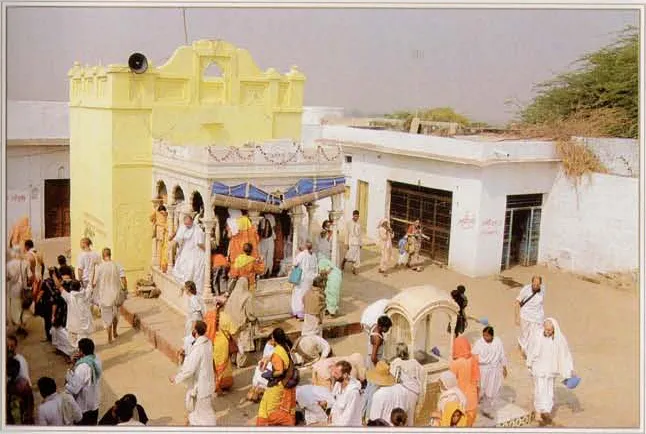
- What it is
- Lalitā-sthala, also called Aṭorā-parvata, is the hill on which the village of Ūñcāgaon is built, east of Deha-kuṇḍa and next to the temple of Dāūjī.
- Places here
- Aṭārī of Lalitājī (Lalitā-sthala)
In short
Lalitā-sthala, also called Aṭorā-parvata, is the hill on which the village of Ūñcāgaon is built, east of Deha-kuṇḍa and next to the temple of Dāūjī. According to the guidebook Śrī Vraja-maṇḍala Parikramā (2007), the balcony (aṭārī) of Lalitā and other places of her childhood play are on this hill.[1 +2] Śrīla Rūpa Gosvāmī describes Lalitā as the first and foremost of Śrī Rādhā's eight sakhīs, Her intimate friends.[4] Śrīla Nārāyaṇa Bhaṭṭa Gosvāmī's Vraja-bhakti-vilāsa names a place of Lalitā's play in this village and gives a prayer to be said at the Lalitā-sthala.[5 +2]
Key facts
| Kind | hill |
|---|---|
| Region · area | Kāmyavana · Ūñcāgaon |
| Ācāryas | Śrīla Nārāyaṇa Bhaṭṭa Gosvāmī |
Traditional accounts
Lalitā
In his Rādhā-Kṛṣṇa-gaṇoddeśa-dīpikā, Śrīla Rūpa Gosvāmī describes Lalitā-devī as the first and best of the eight sakhīs, older than Śrī Rādhā by twenty-seven days. She is also known as Anurādhā; she is contrary and outspoken by nature, her complexion is like gorocanā, a bright yellow pigment, and her dress has the colours of a peacock's feathers. Her mother is Sāradī and her father Viśoka (summarised here, not translated). The book names no village for her.[4] The guidebook gives her father's name differently, as shown below.
The place of Lalitā's play
The Vraja-bhakti-vilāsa, listing the places of Lalitā-grāma, names a hill called Aśokāvāsa, with Lalitā's place of play and a temple of Aśoka Gopa on top of it. Later, in its walk through the village, it gives a prayer at the Lalitā-sthala: the prayer honours the place of Lalitā's play, dear to Kṛṣṇa and delightful with the sakhīs, and says that one who recites it and bows eight times attains a place at the Lord's side (summarised here, not translated).[5 +2]
ततो ललितास्थलप्रार्थनमन्त्रः— ललिताक्रीडनस्थान नमस्ते मोहनप्रिय ! । सखिरम्याय मोक्षाय हरिसांनिध्यहेतवे ॥ इति मन्त्रं समुच्चार्य प्रणामं त्वष्टभिश्चरेत् । सुशीलपदमाप्नोति भगवत्पार्श्वस्थोभवत् ॥४४॥
tato lalitāsthalaprārthanamantraḥ— lalitākrīḍanasthāna namaste mohanapriya !
sakhiramyāya mokṣāya harisāṁnidhyahetave
iti mantraṁ samuccārya praṇāmaṁ tvaṣṭabhiścaret
suśīlapadamāpnoti bhagavatpārśvasthobhavat ||44||
The book does not say whether its Aśokāvāsa hill is the hill that the guidebook calls Aṭorā-parvata, so the identification is not certain.[5 +2]
Lalitā's balcony
Śrī Vraja-maṇḍala Parikramā (2007) says that on this hill one finds the aṭārī, the balcony, of Lalitājī, with other places of her childhood pastimes. It supports this with a verse that it ascribes to the Bṛhad-gautamīya Tantra: in the middle of the village is the aṭā where Lalitā, eight years old, plays with eight sakhīs, and for this reason the village is called Aṭori. The verse has not been found in any available text, and no other source names the balcony, so the account may rest on the guidebook alone.[1 +1]
Location
| Where it is | east of Deha-kuṇḍa; adjacent to and west of the Dāūjī Temple[9] Ūñcāgaon[10] |
|---|
Places at Lalitā-sthala (Aṭorā-parvata)
1 places
Nearby places
Deha-kuṇḍa · Dāūjī Mandira (Ūñcāgaon)
Where the sources differ
Accounts differ The name of Lalitā's father
- Śrī Vraja-maṇḍala Parikramā (2007)'Lalitā Sakhī's parents are Viśobha Gopa and Śāradī Gopī'
- Śrīla Rūpa Gosvāmī, Rādhā-Kṛṣṇa-gaṇoddeśa-dīpikā part 1 v.81born of the mother Sāradī and the father Viśoka
Accounts differ Lalitā's village: Ūñcāgaon (Lalitā-grāma) or Karehlā
- Śrī Vraja-maṇḍala Parikramā (2007)Ūñcāgaon is 'the village of Śrī Lalitā'; on Lalitā-sthala are her balcony and the places of her childhood pastimes
- Vraja-bhakti-vilāsa ch. 4 heading and contents'Lalitā-grāma, Uccagrāma' (Ūñcā-grāma)
- Vṛndāvana-Dhāma Ki Jaya! (c. 1986)Uñchogaon: 'Lalitā-sakhī, one of Śrīmatī Rādhārāṇī's closest friends, lived here'
- Śrī Vraja-maṇḍala Parikramā (2007)Karehlā: 'This is the birthplace of Lalitājī'
References
10 references
- Śrī Vraja-maṇḍala Parikramā (2007), PDF p. 164
- Śrī Vraja-maṇḍala Parikramā (2007), PDF p. 26
- Śrī Vraja-maṇḍala Parikramā (2007), PDF p. 166
- Śrīla Rūpa Gosvāmī, Rādhā-Kṛṣṇa-gaṇoddeśa-dīpikā, part 1 vv.79–81: Lalitā
- Śrīla Nārāyaṇa Bhaṭṭa Gosvāmī, Vraja-bhakti-vilāsa, chapter 2 v.46, printed pp.45-46: the marks (liṅga) of Lalitā-grāma, 1st ed., publ. Bābā Kṛṣṇadāsa, Kusuma-sarovara, Saṁvat 2008
- Śrīla Nārāyaṇa Bhaṭṭa, Vraja-bhakti-vilāsa, Second chapter, v.46 (continued), printed p. 46, 1st ed., publ. Bābā Kṛṣṇadāsa, Kusuma-sarovara, Saṁvat 2008
- Śrīla Nārāyaṇa Bhaṭṭa, Vraja-bhakti-vilāsa, Fourth chapter, v.44 (prayer at the Lalitā-sthala); printed p. 97, 1st ed., publ. Bābā Kṛṣṇadāsa, Kusuma-sarovara, Saṁvat 2008
- Śrīla Nārāyaṇa Bhaṭṭa, Vraja-bhakti-vilāsa, Fourth chapter, v.44 (prayer at the Lalitā-sthala); printed p. 97, 1st ed., publ. Bābā Kṛṣṇadāsa, Kusuma-sarovara, Saṁvat 2008
- Śrī Vraja-maṇḍala Parikramā (2007), p. 302-303
- Śrī Vraja-maṇḍala Parikramā (2007), p. 26