Ūñcāgaon
ऊँचागाँव
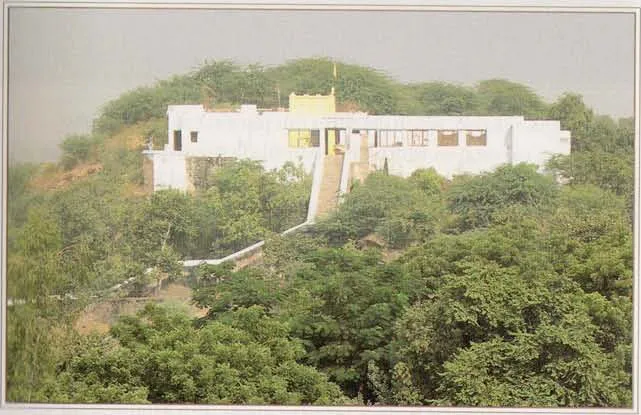
- What it is
- Ūñcāgaon, the "high village", stands on the hill of Lalitā-sthala (Aṭorā-parvata), one mile west of Varṣāṇā, according to the guidebook Śrī Vraja-maṇḍala Parikramā (2007).
- Visiting
- Śrī Vraja-maṇḍala Parikramā (2007) places Ūñcāgaon three miles east of Sunerā-gaon and one mile west of Varṣāṇā, on the hill Lalitā-sthala, with Deha-kuṇḍa below it to the west and the Dāūjī temple …
- Places here
- Dāūjī Mandira (Ūñcāgaon), Deha-kuṇḍa, Gopī-puṣkariṇī, Lalitā-sthala (Aṭorā-parvata), Sakhīgiri-parvata +1 more
In short
Ūñcāgaon, the "high village", stands on the hill of Lalitā-sthala (Aṭorā-parvata), one mile west of Varṣāṇā, according to the guidebook Śrī Vraja-maṇḍala Parikramā (2007).[1 +3] The guidebooks know it as the village of Lalitā, the foremost companion of Śrī Rādhā.[1 +4] Śrīla Nārāyaṇa Bhaṭṭa Gosvāmī's Vraja-bhakti-vilāsa calls it Ucca-grāma and treats it together with Lalitā-grāma, the place where Lalitā and the other cowherd girls played, delighted by Kṛṣṇa's qualities.[7 +4] Śrīla Nārāyaṇa Bhaṭṭa Gosvāmī himself lived here and served Balarāma in the Dāūjī Mandira, and his samādhi is at the foot of the hill.[2 +3]
Key facts
| Kind | village |
|---|---|
| Region · area | Kāmyavana |
| Ācāryas | Śrīla Nārāyaṇa Bhaṭṭa Gosvāmī |
Traditional accounts
Lalitā's village
The Vraja-bhakti-vilāsa heads its section on this place "Lalitā-grāma, Ucca-grāma", and its Hindi edition renders the name as Ūñcā-gāṁv. Quoting the Viṣṇu-rahasya, it says that here all the cowherd girls headed by Lalitā played, delighted by Śrī Kṛṣṇa's qualities, and that the hill is therefore known as Sakhīgiri, the hill of the sakhīs (Sakhīgiri-parvata). It gives the circuit of the place as three krośas (summarised here, not translated).[7 +5]
Śrī Vraja-maṇḍala Parikramā (2007) calls Ūñcāgaon "the village of Śrī Lalitā", with her balcony and the places of her childhood pastimes on Lalitā-sthala, and Vṛndāvana-Dhāma Ki Jaya! (c. 1986) says that Lalitā-sakhī lived here. Śrīmad-Bhāgavatam does not name Lalitā or this village.[1 +4]
The sources do not agree on Lalitā's birthplace, and none of them settles it. Śrī Vraja-maṇḍala Parikramā (2007) calls Ūñcāgaon Lalitā's village, with the places of her childhood, but elsewhere calls Karehlā her birthplace, without relating the two statements. The Vraja-bhakti-vilāsa names Lalitā-grāma and Lalitā's playing place here but does not speak of her birth.[1 +4] The positions are set side by side on the page of Lalitā-sthala, and what the older books say of Karehlā is told on its own page.[1 +4]
The holy places of the village
The Vraja-bhakti-vilāsa lists the marks of Lalitā-grāma, quoting a text it calls the Śrīvatsopaniṣad: the hill Sakhīgiri with the sliding stone beside it, the Triveṇī-tīrtha on the south side of the hill with a rāsa-maṇḍala in its middle and the Sakhī-kūpa (the sakhīs' well) beside it, an image of Baladeva with Revatī to the north, Gopī-puṣkariṇī on the hill, and Deha-kuṇḍa to the north (summarised here, not translated).[6 +3] It also sets here the place where Kṛṣṇa, as a boy of seven, chose Lalitā; this wedding in play is remembered at the Lalitā-vivāha-maṇḍapa, which has its own page.[6 +4]
At the rāsa-maṇḍala the Vraja-bhakti-vilāsa gives a prayer to Kṛṣṇa with the sakhīs, engaged in the rāsa dance.[6 +6] Śrīmad-Bhāgavatam (10.29–33) sets the rāsa dance on the bank of the Yamunā and does not name Ūñcāgaon.[20 +6]
Lalitā-grāma, an adhivana
In a list that it gives as from the Viṣṇu Purāṇa, the Vraja-bhakti-vilāsa counts Lalitā-grāma as the fifth of the twelve adhivanas, which, it says, stand in the middle of Vraja-maṇḍala as the lords of the forests: without seeing them the forest pilgrimage bears no fruit. It names Vraja-kiśora as the presiding Deity of Lalitā-grāma.[27 +1] The book treats Lalitā-grāma and Ucca-grāma as one place, and its Hindi edition glosses Lalitā-grāma as Ūñcā-grāma, as told above.[7 +2]
The Gosvāmīs and ācāryas
Śrīla Nārāyaṇa Bhaṭṭa Gosvāmī wrote of this village in his Vraja-bhakti-vilāsa, with prayers for each of its holy places.
Śrīla Nārāyaṇa Bhaṭṭa Gosvāmī
Śrīla Nārāyaṇa Bhaṭṭa Gosvāmī wrote of this village in his Vraja-bhakti-vilāsa, with prayers for each of its holy places. After the prayer at the Sakhī-kūpa he adds that here Nārada was liberated, and likewise Bhaṭṭa Nārāyaṇa; the edition's Hindi takes this Bhaṭṭa Nārāyaṇa to be the author himself (summarised here, not translated).[6 +3]
According to Śrī Vraja-maṇḍala Parikramā (2007), his main service was in the Dāūjī Mandira of Ūñcāgaon, and Vṛndāvana-Dhāma Ki Jaya! (c. 1986) says that he worshipped the Deity in the Balarāma Mandira here. The Bengali Bhaktamāla of Kṛṣṇadāsa Bābājī (1905) tells that he lived on the hill of a village it prints as Uṭhā-grāma, rejoicing in the service of Dāūjī; the village is probably Ūñcāgaon.[2 +2] A commentary on the rāsa chapters of the Bhāgavatam ascribed to Nārāyaṇa Bhaṭṭa ends with a note that it was written at Ucca-grāma, in the temple of Revatī-ramaṇa (Balarāma); the note gives no year and does not say whether the author or a later copyist wrote it.[9]
The historian A. W. Entwistle (1987), drawing on a biography by Śrīla Nārāyaṇa Bhaṭṭa Gosvāmī's descendant and on his own Vrajotsava-candrikā, reports that after completing the Vraja-bhakti-vilāsa in 1552 he settled at Ūñcāgaon as a householder, and that he founded the Balarāma temple here in 1555.[2 +4] He adds that after Śrīla Nārāyaṇa Bhaṭṭa Gosvāmī's death the service of the Deities here was shared by his son Dāmodara and his disciple Nārāyaṇadāsa Śrotrī, whose descendants still served in 1987.[32] Who built or paid for the temple is told differently on the page of the Dāūjī Mandira.[2 +3]
His samādhi, his tomb, is at the foot of the hill on which the Lalitā Mandira stands, near the Balarāma Mandira, according to Vṛndāvana-Dhāma Ki Jaya! (c. 1986); Entwistle (1987) places it in an enclosure near the Balarāma-Revatī temple at the south foot of the hill (his samādhi).[5 +1]
Visiting today
Śrī Vraja-maṇḍala Parikramā (2007) places Ūñcāgaon three miles east of Sunerā-gaon and one mile west of Varṣāṇā, on the hill Lalitā-sthala, with Deha-kuṇḍa below it to the west and the Dāūjī temple just to its east. Its list of the hills of Vraja gives Aṭorā-parvata and Sakhīgiri-parvata at Ūñcāgaon.[1 +3]
Location
Places at Ūñcāgaon
10 places
- 1Dāūjī Mandira (Ūñcāgaon)temple›
- 2Deha-kuṇḍakuṇḍa›
- 3Gopī-puṣkariṇīkuṇḍa›
- 4Lalitā-sthala (Aṭorā-parvata)hill›
- 5Sakhīgiri-parvatahill›
- 6Triveṇī-kūpawell›
Also described on this page
- Lalitā-grāma village
Also listed here
- Rāsa-maṇḍala (Ūñcāgaon) rāsa-sthalī
- Lalitā Mandira (Ūñcāgaon) temple
- Nārāyaṇa Bhaṭṭa Gosvāmī's samādhi (Ūñcāgaon) samādhi
Nearby places
Sunaharā-gaon · Varṣāṇā
Where the sources differ
How the Triveṇī came to be at Ūñcāgaon is told in different ways: Śrī Vraja-maṇḍala Parikramā (2007) says that Kṛṣṇa made the well with the tip of His flute for Lalitā and the sakhīs; Śrī Priyādāsa's verse commentary in the Hindi Bhaktamāla (1904) says that Śrīla Nārāyaṇa Bhaṭṭa Gosvāmī dug the earth here and showed the source of the Veṇī; and the Bengali Bhaktamāla says that the Triveṇī appeared when he remembered Prayāga near the end of his life.[8 +4] The accounts are set side by side on the page of the Triveṇī-kūpa.[8 +4]
The guidebook gives the Viṣṇu-rahasya as the source of the Vraja-bhakti-vilāsa's list of places here, while the available edition ascribes the list to the Śrīvatsopaniṣad; neither text is available to check.[6 +3]
References
33 references
- Śrī Vraja-maṇḍala Parikramā (2007), PDF p. 161
- Śrī Vraja-maṇḍala Parikramā (2007), PDF p. 164
- Śrī Vraja-maṇḍala Parikramā (2007), PDF p. 165
- Śrī Vraja-maṇḍala Parikramā (2007), PDF p. 26
- Vṛndāvana-Dhāma Ki Jaya! (c. 1986), by Dhruva Mahārāja dāsa, PDF p. 47
- Śrīla Nārāyaṇa Bhaṭṭa Gosvāmī, Vraja-bhakti-vilāsa, chapter 2 v.46, printed pp.45-46: the marks (liṅga) of Lalitā-grāma, 1st ed., publ. Bābā Kṛṣṇadāsa, Kusuma-sarovara, Saṁvat 2008
- Śrīla Nārāyaṇa Bhaṭṭa Gosvāmī, Vraja-bhakti-vilāsa, chapter 4 v.36, printed p.95: heading of the section on Lalitā-grāma and Ucca-grāma, 1st ed., publ. Bābā Kṛṣṇadāsa, Kusuma-sarovara, Saṁvat 2008
- Śrīla Nārāyaṇa Bhaṭṭa Gosvāmī, Vraja-bhakti-vilāsa, chapter 4 vv.39-40, printed p.96: the prayer at the Triveṇī-tīrtha of Ucca-grāma and the start of the rāsa-maṇḍala prayer, 1st ed., publ. Bābā Kṛṣṇadāsa, Kusuma-sarovara, Saṁvat 2008
- Śrīla Nārāyaṇa Bhaṭṭa: commentary colophon after the comment on ŚB 10.33.39
- Bhaktamāla of Nābhā dāsa with Priyādāsa's kavittas and Rūpakalā's tilaka, kavitta 356 (serial 443), printed p. 861
- Śrīla Nārāyaṇa Bhaṭṭa, Vraja-bhakti-vilāsa, second chapter, v.40 (opening): the measure of the circumambulation (pradakṣiṇā) of the hundred and thirty-seven forests and the sixteen banyans (quoted under the label "bhaviṣye"), heading, first entry and the entries for Lalitā-grāma, Kāmanā-vana and Saṅketa-vaṭa, printed p. 40) part 11 v.40, 1st ed., publ. Bābā Kṛṣṇadāsa, Kusuma-sarovara, Saṁvat 2008
- Śrī Śrī Bhaktamāla grantha, 'Caritra Śrī-Nārāyaṇa-bhaṭṭa', printed pp.240-241
- A. W. Entwistle, printed p. 369, Egbert Forsten, Groningen, 1987
- Śrīla Nārāyaṇa Bhaṭṭa, Vraja-bhakti-vilāsa, the edition's Hindi table of contents (adhyāya-sūcī), fourth chapter, entry for Lalitā-grāma, 1st ed., publ. Bābā Kṛṣṇadāsa, Kusuma-sarovara, Saṁvat 2008
- Śrīla Nārāyaṇa Bhaṭṭa Gosvāmī, Vraja-bhakti-vilāsa, chapter 4 vv.41-42, printed p.96: Sakhī-kūpa, and the line 'iti bhaṭṭoktiḥ', 1st ed., publ. Bābā Kṛṣṇadāsa, Kusuma-sarovara, Saṁvat 2008
- Śrī Vraja-maṇḍala Parikramā (2007), PDF p. 162
- Śrī Vraja-maṇḍala Parikramā (2007), PDF p. 163
- Śrīla Nārāyaṇa Bhaṭṭa Gosvāmī, Vraja-bhakti-vilāsa, ch. 4 v.40 (in 'lalitā-grāma ucca-grāma tīrtha-devotpatti-māhātmya-nirūpaṇa', 4.36-49), printed p. 96, 1st ed., publ. Bābā Kṛṣṇadāsa, Kusuma-sarovara, Saṁvat 2008
- Śrī Vraja-maṇḍala Parikramā (2007), PDF p. 166
- Śrīmad-Bhāgavatam 10.29.45-46, translation (Śrīla Prabhupāda's disciples), online edition · vedabase.io
Show all 33 references
- Śrīmad-Bhāgavatam 10.33.2, GRETIL
- Śrīla Prabhupāda, Kṛṣṇa, the Supreme Personality of Godhead (Kṛṣṇa book), Chapter 33, 'Description of the Rāsa Dance' · vedabase.io
- Śrīmad-Bhāgavatam 10.29.45, GRETIL
- Śrīmad-Bhāgavatam 10.32.11–12, GRETIL
- Śrīmad-Bhāgavatam 10.33.3, GRETIL
- Śrīmad-Bhāgavatam 10.33.5, GRETIL
- Śrīla Nārāyaṇa Bhaṭṭa, Vraja-bhakti-vilāsa, first chapter, the twelve adhivanas (quoted under the label "viṣṇupurāṇe"), heading, v.30 (first half), v.32 and vv.33-35, printed p. 3, 1st ed., publ. Bābā Kṛṣṇadāsa, Kusuma-sarovara, Saṁvat 2008
- Śrīla Nārāyaṇa Bhaṭṭa, Vraja-bhakti-vilāsa, first chapter, the presiding deities of the twelve adhivanas (introduced with the label "vaudhāyane", i.e. Baudhāyana), nos. 5 and 12 (the print numbers the whole list v.70), printed p. 6, 1st ed., publ. Bābā Kṛṣṇadāsa, Kusuma-sarovara, Saṁvat 2008
- A. W. Entwistle, ch. 5 (the Gauḍīya devotees in Braj), printed p.149, Egbert Forsten, Groningen, 1987
- A. W. Entwistle, ch. 5, printed p.167, with note 174, Egbert Forsten, Groningen, 1987
- A. W. Entwistle, ch. 6 §14 (Vrajotsava-candrikā), printed p.254, Egbert Forsten, Groningen, 1987
- A. W. Entwistle, ch. 5, printed p.168, with note 176, Egbert Forsten, Groningen, 1987
- Śrīla Nārāyaṇa Bhaṭṭa Gosvāmī, Vraja-bhakti-vilāsa, chapter 4 v.39 (first stanza), printed p.95: the prayer at the Triveṇī-tīrtha of Lalitā-grāma / Ucca-grāma, 1st ed., publ. Bābā Kṛṣṇadāsa, Kusuma-sarovara, Saṁvat 2008