Dholi-kuñja
धोलि-कुंज Hindi name proposed
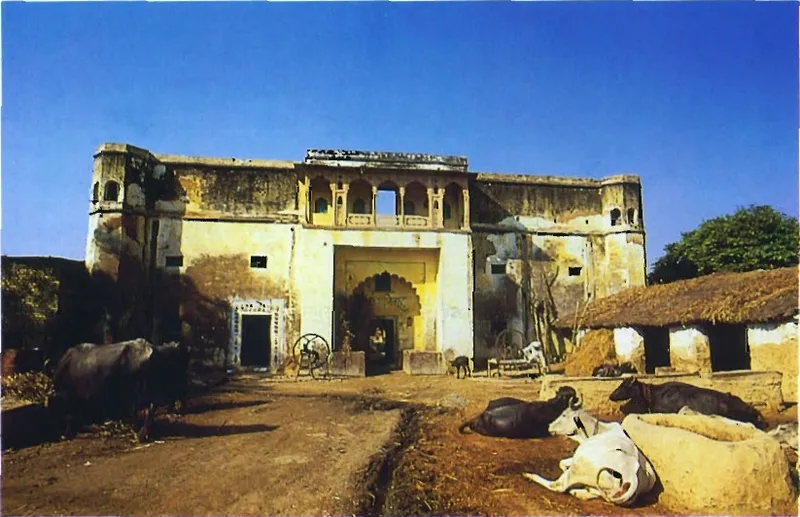
- What it is
- Dholi-kuñja is a building in the village of Rādhā-kuṇḍa that The Colour Guide to Rādhā-kuṇḍa (1999) describes as the palatial residence of a Bengali king, Mahārāja Kumāra.
- Visiting
- The Colour Guide (1999) says that visitors may still enter the courtyard of Dholi-kuñja and offer obeisances at the vacant plot that marks the spot of the samādhi.
In short
Dholi-kuñja is a building in the village of Rādhā-kuṇḍa that The Colour Guide to Rādhā-kuṇḍa (1999) describes as the palatial residence of a Bengali king, Mahārāja Kumāra. In its courtyard, the book says, stood the samādhi mandira, the tomb shrine, of Śrīla Narahari Sarakāra Ṭhākura, until a new owner knocked it down about fifteen years before the book appeared.[1 +1] The Caitanya-caritāmṛta counts Śrīla Narahari Sarakāra Ṭhākura among the branches of the tree of Śrī Caitanya Mahāprabhu's devotees.[3] Śrī Vraja-maṇḍala Parikramā (2007) calls the place the kuñja of Narahari Sarkāra.[4] The sources differ on where he left his body.[5]
Key facts
| Kind | kuñja |
|---|---|
| Region · area | Rādhā-kuṇḍa |
| Also part of | Rādhā-kuṇḍa (village) |
| Ācāryas | Śrīla Narahari Sarakāra Ṭhākura |
The Gosvāmīs and ācāryas
Śrīla Narahari Sarakāra Ṭhākura
According to the Bhakti-ratnākara, which quotes Śrīla Kavi-karṇapūra's Gaura-gaṇoddeśa-dīpikā (177), Śrīla Narahari Sarakāra Ṭhākura, dear to the Lord, was formerly Madhumatī, a prāṇa-sakhī (dear friend) who lived in Vṛndāvana.[6 +1] The Sādhana-dīpikā of Śrīla Rādhā-kṛṣṇa Gosvāmī lists his Śrī Kṛṣṇa-bhajanāmṛta and other works among its authorities and quotes his Bhajanāmṛta; The Colour Guide (1999) also names the Bhajanāmṛta among his best-known books.[2 +1]
The Bhakti-ratnākara tells his passing at Śrīkhaṇḍa. There Śrī Raghunandana tells Śrīla Śrīnivāsa Ācārya that after Śrī Dāsa Gadādhara left this world in the month of Kārttika, Śrīla Narahari Sarakāra Ṭhākura grew weaker moment by moment, spoke with no one and wept without stop, and then on the ekādaśī (eleventh day) of the dark fortnight of Mārgaśīrṣa suddenly disappeared "here", at Śrīkhaṇḍa. The book gives no year.[5] It goes on to tell the great festival held at Śrīkhaṇḍa on that day, with Śrī Raghunandana as host.[9] The Colour Guide (1999) says instead that he spent his last years at Rādhā-kuṇḍa and gave up his body there (see below).[5]
Śrīla Prabhupāda
In his purport to Caitanya-caritāmṛta Ādi 10.78–79, the verses that count Śrīla Narahari Sarakāra Ṭhākura with the devotees of …
In his purport to Caitanya-caritāmṛta Ādi 10.78–79, the verses that count Śrīla Narahari Sarakāra Ṭhākura with the devotees of Śrīkhaṇḍa among the great branches of the Caitanya tree, Śrīla Prabhupāda writes:[3]
General teaching (does not name the place)“Narahari dāsa Sarakāra was a very famous devotee. Locana dāsa Ṭhākura, the celebrated author of Śrī Caitanya-maṅgala, was his disciple.”
Śrīla Prabhupāda, Śrī Caitanya-caritāmṛta, Ādi-līlā 10.78-79, purport · vedabase.io
He says nothing there about Rādhā-kuṇḍa or a samādhi.[3]
Visiting today
The Colour Guide (1999) says that visitors may still enter the courtyard of Dholi-kuñja and offer obeisances at the vacant plot that marks the spot of the samādhi. No source records whether a shrine has been built there again since then.[1 +1] On the walk of Śrī Vraja-maṇḍala Parikramā (2007) the kuñja of Narahari Sarkāra comes after the Jihvā-śilā and Gopī-kūpa and before Lalitā-kuṇḍa; the book does not describe it.[4]
Location
| Where it is | After the Jihvā-śilā / Govindadeva area[12] |
|---|
Nearby places
Jihvā-śilā
History
The Colour Guide (1999) says that Śrīla Narahari Sarakāra Ṭhākura's samādhi mandira stood in the courtyard of Dholi-kuñja, the palatial residence of the Bengali king Mahārāja Kumāra, facing a small temple where Śrī Telimohana was worshipped; the book adds that others give the Deities' name as Rādhā-Śyāmasundara.[1] About fifteen years before 1999, the book says, the Mahārāja sold Dholi-kuñja to a local Vrajavāsī farmer, who knocked down the samādhi mandira and sold the Deities to a family of brāhmaṇas from Badri. A vacant plot measuring ten square feet marks the spot.[1 +1]
Where the sources differ
Where and when Śrīla Narahari Sarakāra Ṭhākura left his body, and which books are his: The Colour Guide (1999) says that he gave …
Where and when Śrīla Narahari Sarakāra Ṭhākura left his body, and which books are his: The Colour Guide (1999) says that he gave up his body at Rādhā-kuṇḍa in 1540 and names the Pāda-kalpa-taru among his books, statements that are not certain. The Bhakti-ratnākara places his passing at Śrīkhaṇḍa and gives no year, and the Sādhana-dīpikā names other books of his but not the Pāda-kalpa-taru.[1 +4]
Accounts differ Where and when Śrīla Narahari Sarakāra Ṭhākura left his body, and which books are his.
- The Colour Guide to Rādhā-kuṇḍa (1999)Born in Bengal in 1480; moved to Rādhā-kuṇḍa in later years and gave up his body there in 1540; prominent books Śrī Bhajanāmṛta and Pāda-kalpa-taru.
- Bhakti-ratnākara, Ninth Taraṅga, printed p. 587 = 9.369–374At Śrīkhaṇḍa Śrī Raghunandana tells Śrīla Śrīnivāsa Ācārya that Narahari 'অকস্মাৎ অদর্শন হৈলা এই খানে' (suddenly disappeared here) on the kṛṣṇa ekādaśī of Mārgaśīrṣa, after Dāsa Gadādhara's passing in Kārttika; no year.
- Bhakti-ratnākara, printed p. 596 = 9.512–514The festival of the Agrahāyaṇa kṛṣṇa ekādaśī 'যাতে অদর্শন শ্রীঠাকুর নরহরি' is held at Śrīkhaṇḍa.
- Sādhana-dīpikā (7) v.7, quoting verses it ascribes to Śrī Rūpa and to KarṇapūraHe is glorious śrīkhaṇḍa-bhūkhaṇḍake and made his residence at Śrīkhaṇḍa ('śrīkhaṇḍe racita-sthitiṁ'); nothing on his death or on Rādhā-kuṇḍa.
The wording of these accounts is our summary of the sources, not a published translation.
His identity in Kṛṣṇa's pastimes: the Gaura-gaṇoddeśa-dīpikā (177), which the Bhakti-ratnākara quotes, calls him Madhumatī, a prāṇa-sakhī (dear friend) who lived in Vṛndāvana.[6 +1] The Colour Guide (1999) calls him instead Madhumatī Mañjarī, a maidservant of Śrīmatī Rādhārāṇī; it names no source, and none has been found for that name.[1 +3]
References
12 references
- The Colour Guide to Rādhā-kuṇḍa (1999), Rājaśekhara dāsa Brahmacārī, PDF p. 121
- The Colour Guide to Rādhā-kuṇḍa (1999), Rājaśekhara dāsa Brahmacārī, PDF p. 120
- Śrīla Prabhupāda, Śrī Caitanya-caritāmṛta, Ādi-līlā 10.78-79, purport · vedabase.io
- Śrī Vraja-maṇḍala Parikramā (2007), PDF p. 94
- Śrīla Narahari Cakravartī, Bhakti-ratnākara, Ninth Taraṅga (নবম তরঙ্গ), printed p. 587 = navama taraṅga vv. 369–374 of the Grantha Mandira text, 2nd ed., 1912
- Śrīla Narahari Cakravartī, Bhakti-ratnākara, Second Taraṅga (দ্বিতীয় তরঙ্গ), printed p. 77; the Sanskrit verse is introduced 'যথা—শ্রীগৌরগণোদ্দেশে', 2nd ed., 1912
- Gaura-gaṇoddeśa-dīpikā, v.177
- Śrīla Rādhākṛṣṇa Gosvāmī, Sādhana-dīpikā, ninth chapter (kakṣā), (9) after v.38
- Śrīla Narahari Cakravartī, Bhakti-ratnākara, Ninth Taraṅga (নবম তরঙ্গ), printed p. 596 = navama taraṅga vv. 512–514 of the Grantha Mandira text, 2nd ed., 1912
- A. W. Entwistle, Bibliography, printed p. 518, Egbert Forsten, Groningen, 1987
- Śrīla Rādhākṛṣṇa Gosvāmī, Sādhana-dīpikā, seventh chapter (kakṣā), (7) v.7
- Śrī Vraja-maṇḍala Parikramā (2007), p. 162-163