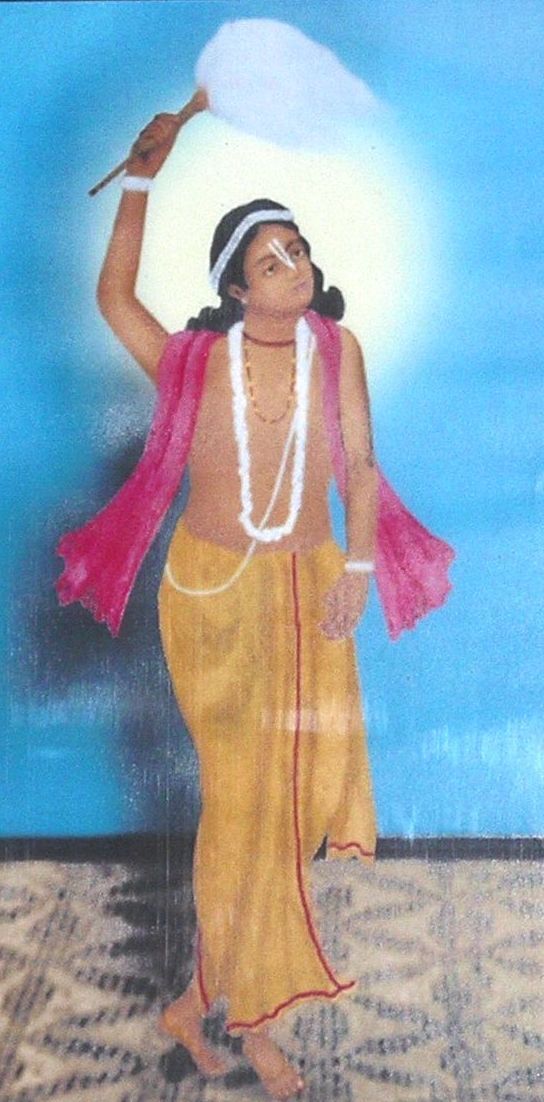
Srila Narahari Sarkar Thakura
Leader of the Srikhanda Vaishnavas and Guru of Lochana Dasa Thakura
Also known as Narahari Dasa, Narahari Sarakara Thakura, Sri Narahari Thakura, Narahari Sarkar
“Narahari and his fellow associates fan the Lord with camaras, while Sanjaya, Mukunda, and Vasu Ghosha sing in accompaniment.”
Sri Gaura-arati, verse 4, a song by Srila Bhaktivinoda Thakura sung daily in Gaudiya Vaishnava temple worship, naming Narahari Sarkar Thakura's own personal service to Sri Chaitanya Mahaprabhu.
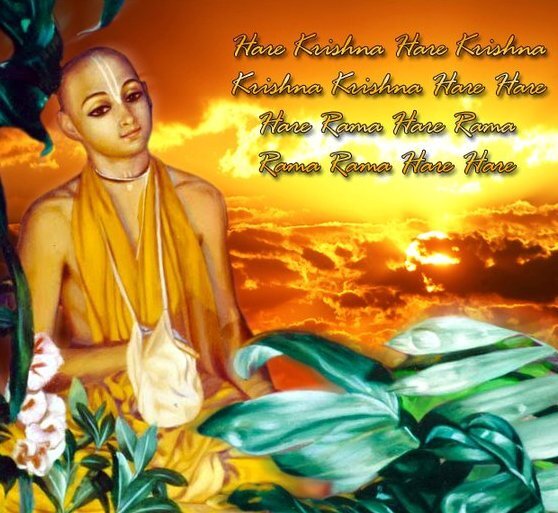
Srila Narahari Sarkar Thakura was one of Sri Chaitanya Mahaprabhu's own associates during the Lord's manifest pastimes. He was born a few years before Mahaprabhu Himself, into a vaidya (physician) family at Srikhanda, a village near Katwa in Bengal. Sri Chaitanya-charitamrita names him among the great branches of Mahaprabhu's own tree of mercy. Srila Prabhupada's purport there records that Lochana Dasa Thakura, the celebrated author of Sri Chaitanya-mangala, was his disciple. He was also uncle to Raghunandana Thakura, the child devotee of Srikhanda who fed the family Deity of Gopinatha with his own hands.
One point needs to be made clear here, because two very similar names have long been confused in Gaudiya Vaishnava writing. This name belongs to Narahari Sarkar Thakura, the Srikhanda associate who served during Mahaprabhu's own lifetime. He is not Narahari Chakravarti Thakura, also called Ghanashyama Dasa. Narahari Chakravarti was a cook-priest based in Vrindavana, who lived a full century and more later. He was a follower of Vishvanatha Chakravarti Thakura's line, and he wrote Bhakti-ratnakara and Narottama-vilasa. Because the names are almost the same, some later summaries have mixed up the two. But they belonged to completely different generations of the tradition, more than a hundred years apart.
| Detail | Description |
|---|---|
| Birth | c. 1479-80 AD (Shaka 1401/1402), some years before Sri Chaitanya Mahaprabhu's own appearance |
| Birthplace | Srikhanda, near Katwa, Bardhaman district, Bengal, into a vaidya (physician) family |
| Parents | Narayana Dasa (father) and Goyi (mother) |
| Brothers | Mukunda Dasa (elder) and Madhava Dasa; Mukunda's son was Raghunandana Thakura |
| Identity | The gopi Madhumati, Srimati Radharani's dear friend in Vrindavana (Gaura-ganoddesha-dipika 177) |
| Major works | Sri Krishna-bhajanamrita, Bhakti-chandrika-patala, Sri Chaitanya-sahasranama, and shorter devotional poems |
| Chief disciple | Lochana Dasa Thakura, author of Sri Chaitanya-mangala |
| Disappearance | Krishna Ekadashi of Agrahayana month; the year itself is disputed (see below) |
A Physician's Family at Srikhanda #
Narahari Sarkar Thakura was born at Srikhanda into a Bengali vaidya household, the hereditary physician caste. He was the son of Narayana Dasa and Goyi. He had two brothers. The eldest, Mukunda Dasa, served for a time as physician to the Muslim ruler at Gaur, and the other was Madhava Dasa. Narahari himself is also recorded as having served briefly as a court physician in the same city, before his life turned firmly toward devotional service. Mukunda Dasa's own son, Raghunandana, grew up close to his uncle and was lovingly cared for by him. Sri Chaitanya-charitamrita's own list of Srikhanda's great devotees does not stop with this family. It also names Chiranjiva and Sulocana as fellow residents. Chiranjiva's two sons, Ramachandra Kaviraja and the poet Govinda Dasa Kaviraja, later became celebrated Vaishnavas themselves. So Srikhanda had not one household of devotees but several, linked to one another by marriage and other ties.
Entering Sri Chaitanya Mahaprabhu's Service #
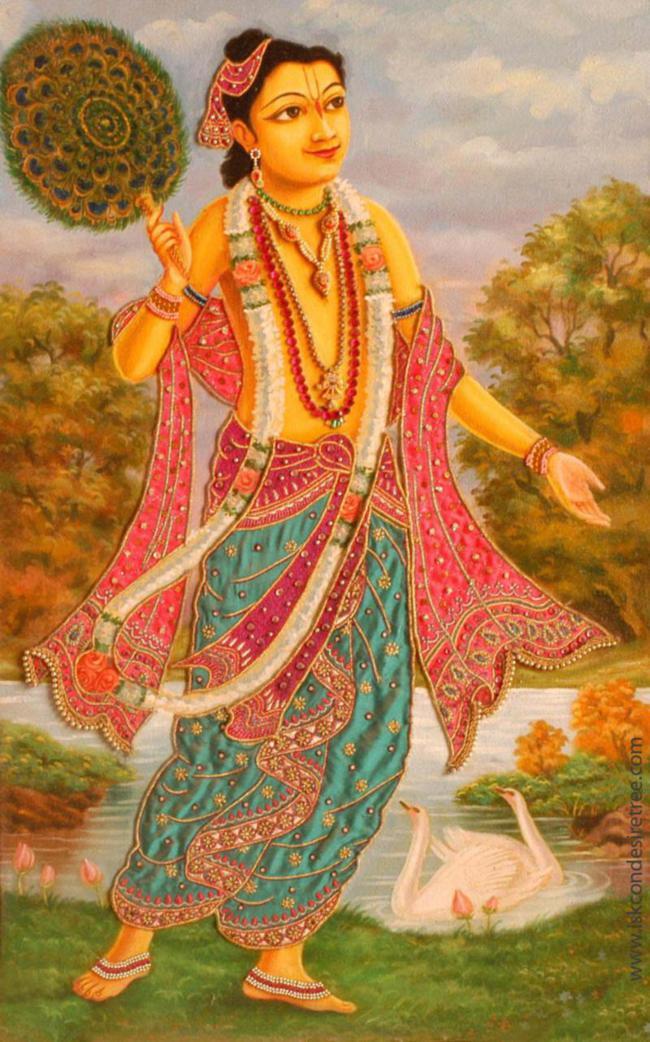
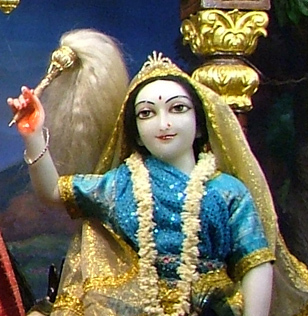
Before he ever met Mahaprabhu, Narahari had already begun composing devotional verses on the pastimes of Radha and Krishna. Tradition records that he came into the Lord's personal association through Gadadhara Pandit, who was always at Mahaprabhu's side. Once Narahari was inside that circle, his poetry turned toward Gauranga Himself. His personal service was to fan the Lord with a camara, a yak-tail whisk, during kirtana. It was a small, humble task. Gaudiya Vaishnavas still remember him by it whenever Bhaktivinoda Thakura's own Gaura-arati is sung, because the song names Narahari among those who fan the Lord. Krishnadasa Kaviraja Goswami places Narahari exactly among Srikhanda's devotees. He names Mukunda Dasa and Raghunandana together as the tree's thirty-ninth branch, Narahari himself as the fortieth, and Chiranjiva and Sulocana as the forty-first and forty-second.
The Honey Pond and the Gauranga Deities #
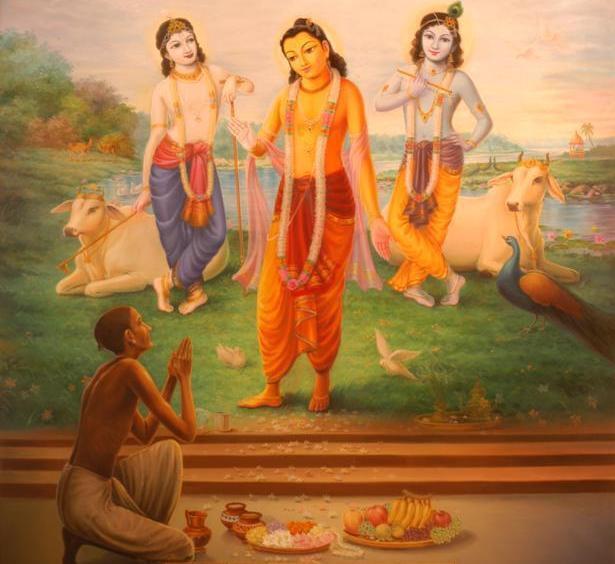
Two pastimes from his Srikhanda years are still told with special affection. In the first, Nityananda Prabhu arrived at Narahari's home and asked, in play, where his honey was. This was a hint at Narahari's own confidential identity. The Gaura-ganoddesha-dipika records him as the gopi Madhumati, Radharani's dear friend; tradition holds that her service in Krishna's own pastimes is to supply honey for Radha and Govinda. Narahari went to a nearby pond and filled a pot with its water. The water itself turned to honey for Nityananda Prabhu and His companions to drink. The pond became known afterward as Madhu-pushkarini, the honey pond, and is still pointed out at Srikhanda. In the second, Mahaprabhu told Narahari in a dream to carve three Deities of Himself in His ecstatic dancing form. Narahari did so, and the three Deities were installed at Srikhanda, Katwa and Ganganagara, where devotees continue to worship them. Both pastimes are told in fuller detail on The Honey Pond and the Gauranga Deities.
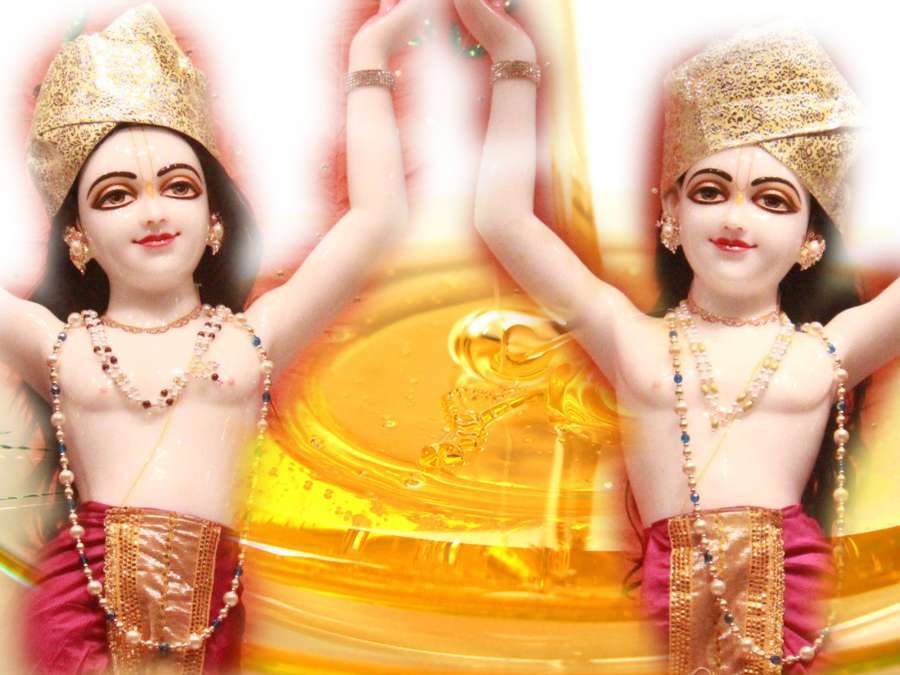
Kavi Karnapura gives this identity in verse 177 of the Gaura-ganoddesha-dipika:
purā madhumatī prāṇa-sakhī vṛndāvane sthitā
adhunā narahary-ākhyaḥ sarakāraḥ prabhoḥ priyaḥ
"Srimati Radharani's dear friend, the vraja-gopi named Madhumati-devi, appeared as Narahari Sarakara, who was very dear to Lord Caitanya." (Gaura-ganoddesha-dipika 177)
Leader of the Srikhanda Vaishnavas #
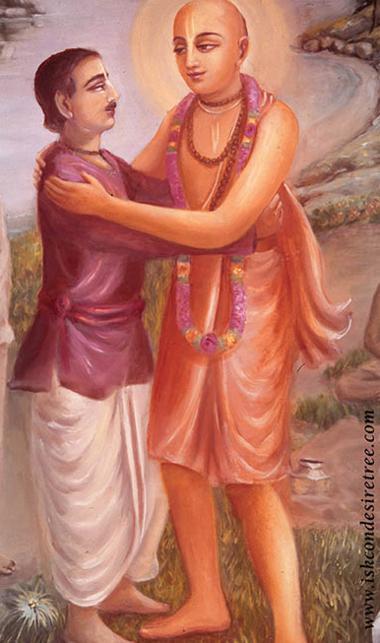
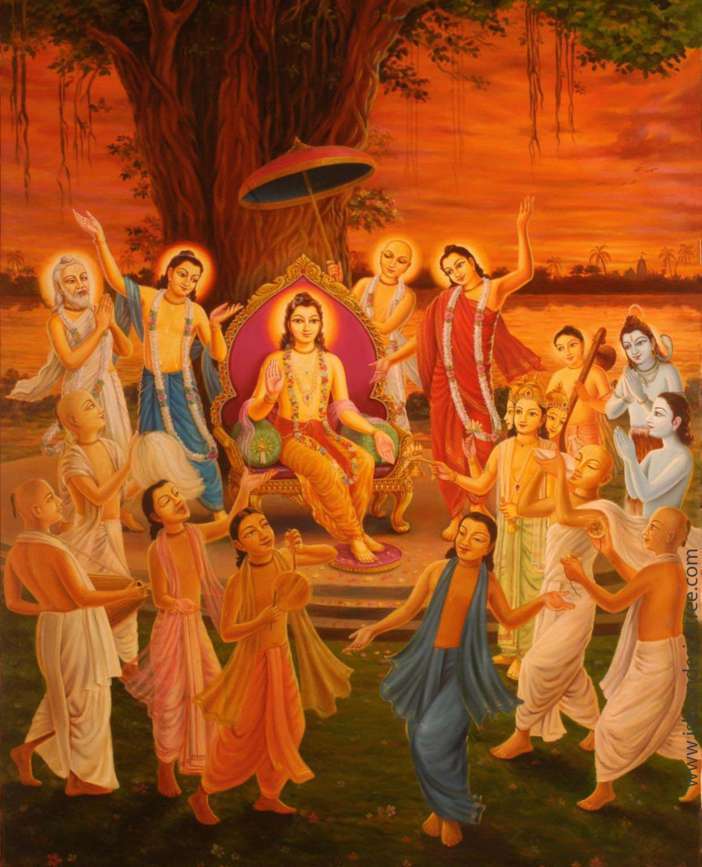
Narahari was not a solitary figure at Srikhanda but one of its recognized leaders. Nearly every year the Srikhanda party, Mukunda Dasa, Narahari, and Raghunandana among them, traveled first to Advaita Acharya's own house at Shantipur, joining a larger gathering there, before continuing on to Jagannatha Puri for chaturmasya. At the Ratha-yatra festival itself, Sri Chaitanya-charitamrita records the people of Khanda forming their own kirtana party, with "Narahari Prabhu and Raghunandana" dancing together in it. Raghunandana Thakura's own life story records that Mahaprabhu assigned Srikhanda's three central men three distinct duties: Mukunda to earn wealth honestly, Raghunandana to serve the family Deity, and Narahari simply to remain always in the association of devotees. The fuller account of these journeys and this shared devotional life is told in Leader of the Srikhanda Vaishnavas.
Guru of Lochana Dasa Thakura #
Narahari's greatest gift to later generations came through a single disciple. The young Lochana Dasa Thakura, from the nearby village of Kograma, came to Srikhanda. Narahari accepted him and trained him personally in the art of kirtana. In time he gave him a specific order. Lochana Dasa was to compose a full account of Mahaprabhu's life and pastimes in Bengali, not in Sanskrit. That order produced Sri Chaitanya-mangala, completed in 1537. It is one of the two main poetic biographies of Mahaprabhu still read today, alongside Krishnadasa Kaviraja Goswami's own Sri Chaitanya-charitamrita. The fuller story of that discipleship is told on Lochana Dasa Thakura's page, Discipleship Under Narahari Sarkara Thakura, and in Guru to Lochana Dasa Thakura. It includes the many times Lochana Dasa Thakura himself declares that he depends on his guru.
His Own Devotional Writings #
Narahari was himself a recognized Sanskrit and Bengali poet before he took Lochana Dasa Thakura as a disciple. Several works are attributed to him: Sri Krishna-bhajanamrita, Bhakti-chandrika-patala, Sri Chaitanya-sahasranama, and shorter poems such as a Sachinandanashtaka and a Radhashtaka. Literary historians studying these works have noticed an early type of poetry that meditates intensely on Mahaprabhu's own personal beauty. It is sometimes labeled "gaura-nagara" sentiment. To keep the record honest, two points should be made. First, neither Narahari nor Lochana Dasa Thakura is recorded teaching any sadhana based on that sentiment. Second, a fully developed "Gauranga-nagari" current grew up later, in some separate circles. Srila Bhaktivinoda Thakura and Srila Bhaktisiddhanta Sarasvati Thakura firmly rejected it as one of the tradition's recognized apasampradayas, or deviant offshoots. Sri Chaitanya-charitamrita's own words about Narahari, quoted above, show no such doubt. It names him plainly as one of the great, pure branches of Mahaprabhu's tree of mercy. Further detail is told on Works, Disappearance, and a Later Controversy Honestly Noted.
Disappearance and Legacy #
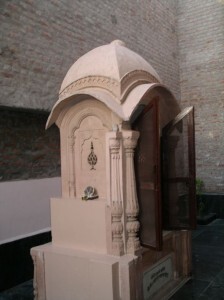
Narahari Sarkar Thakura passed away on Krishna Ekadashi of Agrahayana. Sources disagree sharply on the year. Some place it around 1540 and others as late as 1582. We state this gap honestly here instead of trying to settle it. His samadhi is traditionally placed at Radha-kunda. According to the Bhakti-ratnakara, his own disciple Lochana Dasa Thakura was present at his guru's disappearance festival, distributing sandalwood paste and garlands to the assembled guests. He left behind more than a shrine. Narahari wished that ordinary Bengali readers should be able to enter Mahaprabhu's pastimes. Lochana Dasa Thakura's Sri Chaitanya-mangala carried this wish of Narahari's out into the wider Gaudiya Vaishnava world. At Srikhanda, meanwhile, his nephew Raghunandana's line of Deity worship continued for generations. His name is still spoken today, wherever Gaudiya Vaishnavas sing Bhaktivinoda Thakura's Gaura-arati at the start of temple worship.
At a Glance
- A vaidya physician's son of Srikhanda, named directly in Sri Chaitanya-charitamrita as the fortieth great branch of Mahaprabhu's tree of mercy.
- Entered Mahaprabhu's personal service through Gadadhara Pandit, and became known for fanning the Lord with a camara, a service still sung of by name in Bhaktivinoda Thakura's Gaura-arati.
- Guru of Lochana Dasa Thakura, whom he personally ordered to compose Sri Chaitanya-mangala.
- Uncle of Raghunandana Thakura and younger brother of Mukunda Dasa, together forming one devotional household at the heart of the Srikhanda Vaishnava circle.
- Not to be confused with the much later Narahari Chakravarti Thakura (Ghanashyama Dasa), the Vrindavana-based author of Bhakti-ratnakara.
Scriptural evidence
Quoted in the text above:
- Verse 177 Gaura-ganoddesha-dipika
Further verses:
khandavasi mukunda-dasa, sri-raghunandana
narahari-dasa, ciranjiva, sulocana
ei saba mahasakha -- caitanya-krpadhama
prema-phala-phula kare yahan tahan dana
Word for word
khanda-vasi mukunda-dasa -- Mukunda dasa, a resident of Srikhanda; sri-raghunandana -- Raghunandana; narahari-dasa -- Narahari dasa; ciranjiva -- Ciranjiva; sulocana -- Sulocana; ei saba -- all of them; maha-sakha -- great branches; caitanya-krpa-dhama -- of Lord Sri Caitanya Mahaprabhu, the reservoir of mercy; prema -- love of God; phala -- fruit; phula -- flower; kare -- does; yahan -- anywhere; tahan -- everywhere; dana -- distribution.
Sri Khandavasi Mukunda and his son Raghunandana were the thirty-ninth branch of the tree, Narahari was the fortieth, Ciranjiva the forty-first and Sulocana the forty-second. They were all big branches of the all-merciful tree of Caitanya Mahaprabhu. They distributed the fruits and flowers of love of Godhead anywhere and everywhere.
From the purport: Purport excerpt: "Narahari dasa Sarakara was a very famous devotee. Locana dasa Thakura, the celebrated author of Sri Caitanya-mangala, was his disciple."
The primary textual basis for Narahari Sarkar Thakura's place among Sri Chaitanya Mahaprabhu's own associates and for his discipleship link to Lochana Dasa Thakura.
narahari-adi kori' camara dhulaya
sanjaya-mukunda-vasu-ghosa-adi gaya
Narahari Sarakara and other associates fan the Lord with camaras (yak-tail whisks) while devotees headed by Sanjaya Pandita, Mukunda Datta, and Vasu Ghosha sing in accompaniment.
A verse of Srila Bhaktivinoda Thakura's own arati song, sung daily in Gaudiya Vaishnava temple worship, that names Narahari Sarkar Thakura's personal service to Sri Chaitanya Mahaprabhu; the source for the pull-quote here.
- Sri Chaitanya-charitamrita, Adi-lila 10.78-79, with Prabhupada's purport
- Sri Chaitanya-charitamrita, Madhya-lila 13.46
- Narahari Sarakara Thakura - Biography, Gaudiya History
- Narahari Sarakara Thakura, Gaudiya History
- Narahari Sarakara Thakura, Gaudiya History (part 2)
- Narahari Chakravarti Thakura, Gaudiya History (for disambiguation)
- The Sacred Legacy of Srikhanda: Narahari Sarakara Thakura, ISKCON Bangalore
- Narahari Sarkar, Mukunda Das & Raghunandana, The Gaudiya Treasures of Bengal
- Srila Narahari Sarkar Thakura, Shyam Das Baba
- Srila Narahari Sarakara Thakura - Disappearance, ISKCON Desire Tree
- Narahari Sarakara Thakura, Stephen Knapp
- Gaura Arati lyrics (verse 4, camara service), lyricstranslate.com
- Gaura Arati, Sri Krishna Balaram Mandir
- Gaura-Nagara Bhava, Swami Tripurari (context on the apasampradaya note)
Frequently asked
When was Srila Narahari Sarkar Thakura born?
Srila Narahari Sarkar Thakura appeared c. 1479-80 AD (Shaka 1401/1402), some years before Sri Chaitanya Mahaprabhu's own appearance in Srikhanda, near Katwa, Bardhaman district, Bengal.
When and where did Srila Narahari Sarkar Thakura disappear?
Srila Narahari Sarkar Thakura disappeared Krishna Ekadashi of Agrahayana month; the exact year is disputed, with sources ranging from c. 1540 to 1582 at Srikhanda, Bengal; samadhi traditionally placed at Radha-kunda.
What are the main pastimes of Srila Narahari Sarkar Thakura?
The pastimes covered here include: Birth and Entry into Mahaprabhu's Service, The Honey Pond and the Gauranga Deities, Leader of the Srikhanda Vaishnavas, Guru to Lochana Dasa Thakura, Works, Disappearance, and a Later Controversy Honestly Noted.