Govardhana-śilā of Raghunātha dāsa Gosvāmī
रघुनाथ दास गोस्वामी की गोवर्धन-शिला Hindi name proposed
Also called Goverdhana-Śīla
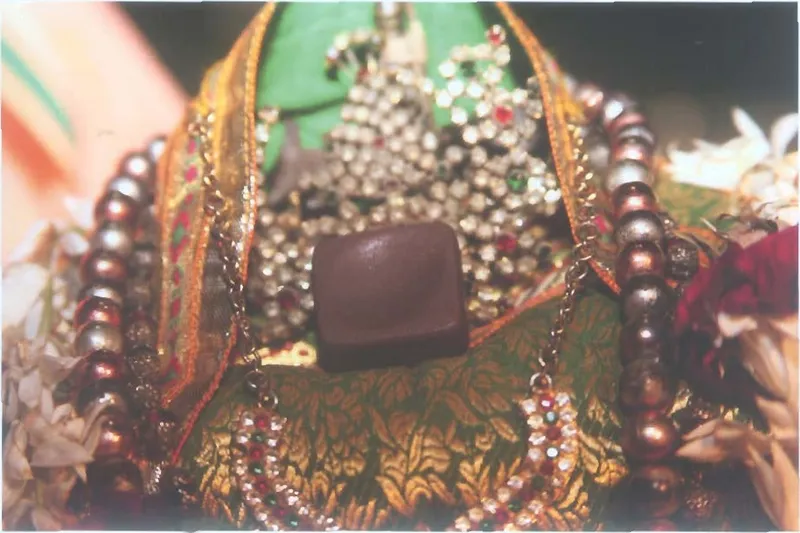
- What it is
- This small stone from Govardhana Hill is the śilā that Śrī Caitanya Mahāprabhu worshipped for three years at Purī as the very body of Kṛṣṇa and then gave to Śrīla Raghunātha dāsa Gosvāmī.
- Visiting
- Three guidebooks say that the stone bears the mark of Śrī Caitanya Mahāprabhu's thumb, and the caption of Vṛndāvana, the Playground of God (2010) says that He pressed it so hard with His thumb that a …
In short
This small stone from Govardhana Hill is the śilā that Śrī Caitanya Mahāprabhu worshipped for three years at Purī as the very body of Kṛṣṇa and then gave to Śrīla Raghunātha dāsa Gosvāmī. The Caitanya-caritāmṛta tells the whole story.[1 +10] According to the Bhakti-ratnākara, Śrīla Raghunātha dāsa Gosvāmī served it at Rādhā-kuṇḍa to the end of his life.[12 +1] Reports from 1905 to 1987 place it in the Rādhā-Gokulānanda temple in Vṛndāvana; where it is kept today is told differently by the guidebooks.[14 +5]
Key facts
Why it is glorified
Śrīmad-Bhāgavatam (10.24) tells how, at the first worship of the hill, Kṛṣṇa took another, huge form, declared "I am the hill" …
Śrīmad-Bhāgavatam (10.24) tells how, at the first worship of the hill, Kṛṣṇa took another, huge form, declared "I am the hill" and ate the offerings, and then bowed down with the people of Vraja to that form, in effect to Himself. The Bhāgavatam says nothing about stones of the hill or about this stone.[20 +2]
kṛṣṇas tv anyatamaṃ rūpaṃ gopa-viśrambhaṇaṃ gataḥ / śailo 'smīti bruvan bhūri balim ādad bṛhad-vapuḥ
Kṛṣṇa then assumed an unprecedented, huge form to instill faith in the cowherd men. Declaring “I am Govardhana Mountain!” He ate the abundant offerings.
Translation: Śrīla Prabhupāda's disciples (BBT)Explaining the verse (summarised here, not translated), Śrīla Sanātana Gosvāmī says that Kṛṣṇa Himself appeared on the summit under the guise of Govardhana, and Śrīla Viśvanātha Cakravartī Ṭhākura and Śrīla Baladeva Vidyābhūṣaṇa likewise take that form to be Kṛṣṇa Himself.[23 +1] Śrīla Prabhupāda's Kṛṣṇa book draws the lesson that the hill and Kṛṣṇa are one, so that great devotees worship rocks from Govardhana exactly as they worship the Deity in the temple.[22]
General teaching (does not name the place)“Kṛṣṇa assumed a great transcendental form and declared to the inhabitants of Vṛndāvana that He was Himself Govardhana Hill in order to convince the devotees that Govardhana Hill and Kṛṣṇa Himself are identical. … great devotees take rocks from Govardhana Hill and worship them exactly as they worship the Deity of Kṛṣṇa in the temples.”
Śrīla Prabhupāda, Kṛṣṇa, the Supreme Personality of Godhead (Kṛṣṇa book), Chapter 24, 'Worshiping Govardhana Hill' · vedabase.io
The Garga-saṁhitā has a chapter on the glory of the Govardhana stone, in which a demon struck with a stone from the hill gives up his demon body at its touch; it speaks of such stones in general.[25]
Divine pastimes
Śrī Caitanya Mahāprabhu and the stone
The Caitanya-caritāmṛta (Antya 6) tells that Śaṅkarānanda Sarasvatī, coming back from Vṛndāvana, brought a stone from Govardhana Hill and a guñjā garland, a string of small red-and-black seeds, and gave both to Śrī Caitanya Mahāprabhu.[1 +2] The Lord would hold the stone to His heart and eyes, smell it and place it on His head. It was always wet with His tears, and He called it the very body of Kṛṣṇa.[4 +3]
নেত্রজলে সেই শিলা ভিজে নিরন্তর ।
শিলারে কহেন প্রভু — ‘কৃষ্ণ-কলেবর’ ॥ ২৯২ ॥
netra-jale sei śilā bhije nirantara
śilāre kahena prabhu — ‘kṛṣṇa-kalevara’
The stone from Govardhana was always moist with tears from His eyes. Śrī Caitanya Mahāprabhu would say, “This stone is directly the body of Lord Kṛṣṇa.”
Translation: Śrīla A.C. Bhaktivedanta Swami PrabhupādaHe kept the stone and the garland for three years. Then, pleased with Śrīla Raghunātha dāsa Gosvāmī, He gave both to him with His own hand and told him to worship the stone with a jug of water and tulasī flowers.[6 +5]
প্রভু কহে, — “এই শিলা কৃষ্ণের বিগ্রহ ।
ইঁহার সেবা কর তুমি করিয়া আগ্রহ ॥ ২৯৪ ॥
prabhu kahe, — “ei śilā kṛṣṇera vigraha
iṅhāra sevā kara tumi kariyā āgraha
Śrī Caitanya Mahāprabhu instructed Raghunātha dāsa, “This stone is the transcendental form of Lord Kṛṣṇa. Worship the stone with great eagerness.”
Translation: Śrīla A.C. Bhaktivedanta Swami PrabhupādaŚrīla Svarūpa Dāmodara Gosvāmī gave Raghunātha two small cloths, a wooden seat and a water jug for the worship, and later told him to offer the stone sweets called khājā and sandeśa. As Raghunātha worshipped, he saw in the stone Kṛṣṇa Himself, the son of Nanda.[6 +6]
এইমত রঘুনাথ করেন পূজন ।
পূজা-কালে দেখে শিলায় ‘ব্রজেন্দ্রনন্দন’ ॥ ৩০০ ॥
ei-mata raghunātha karena pūjana
pūjā-kāle dekhe śilāya ‘vrajendra-nandana’
Thus Raghunātha dāsa began worshiping the stone from Govardhana, and as he worshiped he saw the Supreme Personality of Godhead, Kṛṣṇa, the son of Nanda Mahārāja, directly in the stone.
Translation: Śrīla A.C. Bhaktivedanta Swami PrabhupādaRaghunātha understood the gifts as the Lord giving him a place at Govardhana with the stone and shelter at Śrī Rādhā's feet with the garland.[27 +1]
“শিলা দিয়া গোসাঞি সমর্পিলা ‘গোবর্ধনে’ ।
গুঞ্জামালা দিয়া দিলা ‘রাধিকা-চরণে’ ।।” ৩০৭ ॥ ৩০৭ ॥
“śilā diyā gosāñi samarpilā ‘govardhane’
guñjā-mālā diyā dilā ‘rādhikā-caraṇe’ ”
“By offering me the govardhana-śilā, Śrī Caitanya Mahāprabhu has offered me a place near Govardhana Hill, and by offering me the garland of conchshells, He has offered me shelter at the lotus feet of Śrīmatī Rādhārāṇī.”
Translation: Śrīla A.C. Bhaktivedanta Swami PrabhupādaŚrīla Prabhupāda on the gift
Śrīla Prabhupāda, following Śrīla Bhaktisiddhānta Sarasvatī Ṭhākura's Anubhāṣya, writes that in Śrī Caitanya Mahāprabhu's view the stone was directly Kṛṣṇa's form. He calls hellish the idea that the Lord gave Raghunātha a stone instead of a Deity because he was not born a brāhmaṇa.[3 +1]
Names this place“However, some envious people conclude that because Raghunātha dāsa had not taken birth in the family of a brāhmaṇa, Śrī Caitanya Mahāprabhu did not give him the right to worship the Deity directly but instead gave him a stone from Govardhana. This kind of thought is nārakī, or hellish.”
Śrīla Prabhupāda, Śrī Caitanya-caritāmṛta, Antya-līlā 6.294, purport · vedabase.io
The Gosvāmīs and ācāryas
Śrīla Raghunātha dāsa Gosvāmī thanks Śrī Gaurāṅga for the garland from His chest and the Govardhana stone in a verse of his own …
Śrīla Raghunātha dāsa Gosvāmī thanks Śrī Gaurāṅga for the garland from His chest and the Govardhana stone in a verse of his own Gaurāṅga-stava-kalpavṛkṣa, which the Caitanya-caritāmṛta quotes.[6 +4] According to the Bhakti-ratnākara, his service of the kuṇḍa, the Govardhana-śilā and the guñjā garland was well known at Rādhā-kuṇḍa. When Śrīla Śrīnivāsa Ācārya came to take leave of him, very thin and weak by then, he was still serving the stone and garland given by the Lord with a joy in which he forgot himself.[12 +1] Read more: Śrīla Raghunātha dāsa Gosvāmī's life at Rādhā-kuṇḍa →
Songs
Śrīla Raghunātha dāsa Gosvāmī's own words of thanks for the garland and the stone, from the Gaurāṅga-stava-kalpavṛkṣa.
Śrīla Raghunātha dāsa Gosvāmī's own words of thanks for the garland and the stone, from the Gaurāṅga-stava-kalpavṛkṣa.[27 +1]
mahā-sampad-dāvād api patitam uddhṛtya kṛpayā
svarūpe yaḥ svīye kujanam api māṁ nyasya muditaḥ
uro-guñjā-hāraṁ priyam api ca govardhana-śilāṁ
dadau me gaurāṅgo hṛdaya udayan māṁ madayati
Visiting today
Three guidebooks say that the stone bears the mark of Śrī Caitanya Mahāprabhu's thumb, and the caption of Vṛndāvana, the Playground of God (2010) says that He pressed it so hard with His thumb that a large mark was left on top. The Caitanya-caritāmṛta does not mention such a mark, and no older source for it was found.[30 +3]
Pictures
1 pictures
History
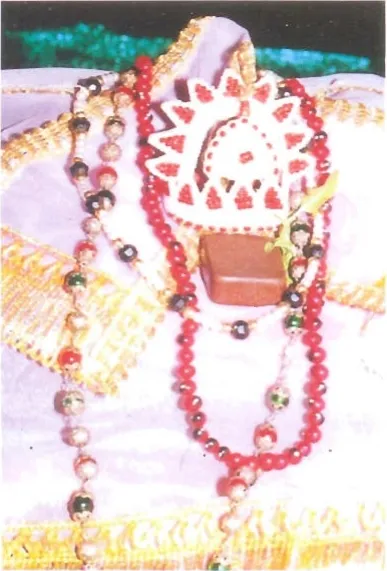
The oldest reports found of where the stone was kept put it beside the Deity Gokulānanda. The Bengali Bhaktamāla of Kṛṣṇadāsa Bābājī (1905) and an appendix printed in the Narottama-vilāsa (c. 1907) both say that it was still there in their day.[14 +5] The Bengali Vṛndāvana-kathā (1920) says that it had been brought, with Gokulānanda, to this temple beside the Rādhā-Ramaṇa temple, and describes it as nearly round and about two inches in size. The historians Prabhudayāl Mītal (1966) and A. W. Entwistle (1987) also report it in this temple.[14 +5]
Where the sources differ
Where the stone is now: most guidebooks place it on the altar of the Rādhā-Gokulānanda temple, but one says that only a copy is …
Where the stone is now: most guidebooks place it on the altar of the Rādhā-Gokulānanda temple, but one says that only a copy is there and the stone itself is worshipped at Bhāgavat-nivāsa, and another says that it used to be in the temple; which is right is not certain without a visit.[3 +7]
Accounts differ Where is the Govardhana-śilā of Śrīla Raghunātha dāsa Gosvāmī now?
- Vṛndāvana, the Playground of God (2010) pp. 80-83'Now this very śilā is present in the Rādhā-Gokulānanda temple' (lower level of the altar, viewer's right; photo).
- The Color Guide to Vṛndāvana (2000) pp. 95, 101; the undated parikramā notes Vṛndāvana'Also here is the small Govardhana Śilā'; it 'can be seen in the Rādhā Gokulānanda temple' (photo).
- Vṛndāvana-Dhāma Ki Jaya! (c. 1986) p. 51At Rādhā-Gokulānanda 'this can be seen if one offers a small donation' (photo).
- Śrī Vraja-maṇḍala Parikramā (2007) p. 640The govardhana-śilā 'used to be present here' (in the Gokulānanda temple); where it is now is not said.
How the stone passed from Śrīla Raghunātha dāsa Gosvāmī to Śrīla Viśvanātha Cakravartī Ṭhākura: the sources name different keepers, and it is not certain which is right.[3 +5]
Accounts differ How the Govardhana-śilā passed from Śrīla Raghunātha dāsa Gosvāmī to Śrīla Viśvanātha Cakravartī Ṭhākura.
- The Colour Guide to Rādhā-kuṇḍa (1999) p. 116After Śrīla Raghunātha's disappearance the śilā was given to Lakṣmīpriyā; after her, Kṛṣṇapriyā Ṭhākurāṇī worshipped it; finally it was given to Viśvanātha.
- Narottama-vilāsa, appendix (c. 1907 edition, taken from an edition of c. 1893), pp. 126, 128After Raghunātha, Śrīla Kṛṣṇadāsa Kavirāja served it, then Mukunda dāsa, who gave it to Kṛṣṇapriyā Ṭhākurāṇī of Rādhā-kuṇḍa; she had Viśvanātha serve it from time to time in her presence, and he brought it for great festivals.
- Vṛndāvana-kathā (1920) p. 101Viśvanātha worshipped the śilā after Śrīla Raghunātha's passing (no keepers in between named).
- Vṛndāvana, the Playground of God (2010) p. 82; The Color Guide to Vṛndāvana (2000) p. 100'In due course of time, the same śilā was given to' Viśvanātha (Vṛndāvana, the Playground of God (2010)); he 'worshiped for sometime' Śrīla Raghunātha's śilā (The Color Guide to Vṛndāvana (2000)); no keepers named.
More on this place
Śrīla Raghunātha dāsa Gosvāmī's life at Rādhā-kuṇḍa
References
41 references
- Śrīla Kṛṣṇadāsa Kavirāja Gosvāmī, Śrī Caitanya-caritāmṛta, Antya-līlā 6.288, online edition · vedabase.io
- Śrīla Kṛṣṇadāsa Kavirāja Gosvāmī, Śrī Caitanya-caritāmṛta, Antya-līlā 6.289, online edition · vedabase.io
- Vṛndāvana, the Playground of God (2010), Bhakti Caitanya Svāmī, PDF p. 82
- Śrīla Kṛṣṇadāsa Kavirāja Gosvāmī, Śrī Caitanya-caritāmṛta, Antya-līlā 6.291, online edition · vedabase.io
- Śrīla Kṛṣṇadāsa Kavirāja Gosvāmī, Śrī Caitanya-caritāmṛta, Antya-līlā 6.292, online edition · vedabase.io
- Śrīla Kṛṣṇadāsa Kavirāja Gosvāmī, Śrī Caitanya-caritāmṛta, Antya-līlā 6.293, online edition · vedabase.io
- Śrīla Kṛṣṇadāsa Kavirāja Gosvāmī, Śrī Caitanya-caritāmṛta, CC Antya-līlā 6.294, online edition · vedabase.io
- Śrīla Kṛṣṇadāsa Kavirāja Gosvāmī, Śrī Caitanya-caritāmṛta, Antya-līlā 6.296, online edition · vedabase.io
- Śrīla Kṛṣṇadāsa Kavirāja Gosvāmī, Śrī Caitanya-caritāmṛta, Antya-līlā 6.298, online edition · vedabase.io
- Śrīla Kṛṣṇadāsa Kavirāja Gosvāmī, Śrī Caitanya-caritāmṛta, Antya-līlā 6.299, online edition · vedabase.io
- Śrīla Kṛṣṇadāsa Kavirāja Gosvāmī, Śrī Caitanya-caritāmṛta, Antya-līlā 6.300, online edition · vedabase.io
- Śrīla Narahari Cakravartī, Bhakti-ratnākara, taraṅga 5, printed p. 198, 2nd ed., 1912
- Śrīla Narahari Cakravartī, Bhakti-ratnākara, taraṅga 6, printed p. 468, 2nd ed., 1912
- Śrī Śrī Bhaktamāla grantha, 26th mālā, survey of the temples within the village ('অথ দেবালয় কহি গ্রামের ভিতরে'), printed p. 349, right-hand column
- Vṛndāvana-kathā, chapter 7 (Rādhāvinoda and Gokulānanda), printed p. 101
- Vṛndāvana-kathā, chapter 7, section on Raghunātha dāsa Gosvāmī, printed p. 111
- Prabhudayāl Mītal, part 1 ('ब्रज-संस्कृति की भूमिका'), 'Braj-yātrā', Vṛndāvana: 'Śrī Rādhāvinoda-jī tathā Śrī Gokulānanda-jī', printed p. 137
- A. W. Entwistle, ch. 8 §66.32 'Radhavinod and Gokulanand', printed p. 413, Egbert Forsten, Groningen, 1987
- Śrīla Narahari Cakravartī, Narottama-vilāsa, appendix ('গ্রন্থকর্ত্তার পরিচয়'), printed p. 128, foot of the left column and top of the right column, 1st ed., Baṅgābda 1314
- Śrīmad-Bhāgavatam 10.24.35, GRETIL
Show all 41 references
- Śrīmad-Bhāgavatam 10.24.36, GRETIL
- Śrīla Prabhupāda, Kṛṣṇa, the Supreme Personality of Godhead (Kṛṣṇa book), Chapter 24, 'Worshiping Govardhana Hill' · vedabase.io
- Śrīla Sanātana Gosvāmī: commentary on ŚB 10.24.35, Bhagavata Vidya Pith edition, ed. Bhagavata Rishi and Krishna Shankar Shastri, 1996
- Śrīla Viśvanātha Cakravartī Ṭhākura, Baladeva Vidyābhūṣaṇa, Śrīla Jīva Gosvāmī: commentary on ŚB 10.24.36, Bhagavata Vidya Pith edition, ed. Bhagavata Rishi and Krishna Shankar Shastri, 1996
- Garga-saṁhitā, Girirāja-khaṇḍa (3), adhyāya 10, verse 8, Sanskrit Wikisource
- Śrīla Kṛṣṇadāsa Kavirāja Gosvāmī, Śrī Caitanya-caritāmṛta, Antya-līlā 6.304, online edition · vedabase.io
- Śrīla Kṛṣṇadāsa Kavirāja Gosvāmī, Śrī Caitanya-caritāmṛta, CC Antya-līlā 6.307, online edition · vedabase.io
- Śrīla Kṛṣṇadāsa Kavirāja Gosvāmī, Śrī Caitanya-caritāmṛta, Antya-līlā 6.327 (quoting Śrī Gaurāṅga-stava-kalpavṛkṣa 11), online edition · vedabase.io
- Śrīla Prabhupāda, Śrī Caitanya-caritāmṛta, Antya-līlā 6.294, purport · vedabase.io
- Vṛndāvana, the Playground of God (2010), Bhakti Caitanya Svāmī, PDF p. 83
- The Color Guide to Vṛndāvana (2000), Written and Photographed by Rājaśekhara dāsa Brahmacārī, PDF p. 109
- the undated parikramā notes Vṛndāvana, ¶205
- Vṛndāvana-Dhāma Ki Jaya! (c. 1986), by Dhruva Mahārāja dāsa, PDF p. 69
- The Color Guide to Vṛndāvana (2000), Written and Photographed by Rājaśekhara dāsa Brahmacārī, PDF p. 115
- The Colour Guide to Rādhā-kuṇḍa (1999), Rājaśekhara dāsa Brahmacārī, PDF p. 113
- Śrī Vraja-maṇḍala Parikramā (2007), PDF p. 333
- The Color Guide to Vṛndāvana (2000), Written and Photographed by Rājaśekhara dāsa Brahmacārī, PDF p. 114
- The Colour Guide to Rādhā-kuṇḍa (1999), Rājaśekhara dāsa Brahmacārī, PDF p. 120
- Śrīla Narahari Cakravartī, Narottama-vilāsa, appendix ('গ্রন্থকর্ত্তার পরিচয়'), printed p. 126, both columns, 1st ed., Baṅgābda 1314
- Vṛndāvana, the Playground of God (2010), Bhakti Caitanya Svāmī, p. 82
- The Color Guide to Vṛndāvana (2000), Written and Photographed by Rājaśekhara dāsa Brahmacārī, p. 95