Śrīla Raghunātha dāsa Gosvāmī's life at Rādhā-kuṇḍa
राधा-कुण्ड पर श्रील रघुनाथ दास गोस्वामी का जीवन
In short
Śrīla Raghunātha dāsa Gosvāmī spent most of his long life on the bank of Rādhā-kuṇḍa (Radha Kund), a sacred pond near Govardhana. The Caitanya-caritāmṛta says he bathed there three times a day and lived on a few drops of buttermilk. His own hymns call the kuṇḍa his only shelter, and Śrīla Prabhupāda made his life the standard for living there.[1–12]
On this page
At a glance
- The Caitanya-caritāmṛta (Ādi 10.101) says that he bathed in Rādhā-kuṇḍa three times a day and honoured every Vaiṣṇava, every devotee of Kṛṣṇa, living in Vraja.[1]
- Śrīla Prabhupāda writes that he lived for most of his life at Rādhā-kuṇḍa, and that the place of his devotional service still exists there.[2, 13]
- In his Sva-niyama-daśaka he says that he lives at the Queen's kuṇḍa by Govardhana and will die at that dearest lake.[6]
- Śrīla Prabhupāda names his books: the Stava-mālā (or Stavāvalī), the Dāna-carita and the Muktā-carita.[2]
- The Bhakti-ratnākara shows Śrīla Śrīnivāsa Ācārya, Śrīla Narottama dāsa Ṭhākura, Śrīla Śyāmānanda Paṇḍita, Śrīla Rāmacandra Kavirāja and Śrī Jāhnavā-devī visiting him there.[5 +6]
- According to Śrīla Prabhupāda, his counted chanting and bowing down around the kuṇḍa show the way to live there.[11, 12]
How did he come to stay at Rādhā-kuṇḍa?
The Caitanya-caritāmṛta, the life of Śrī Caitanya Mahāprabhu, tells what happened after the Lord's departure. Śrīla Raghunātha dāsa Gosvāmī meant to go to Vṛndāvana and see Śrīla Rūpa Gosvāmī and Śrīla Sanātana Gosvāmī. Then he would give up his life by jumping from Govardhana Hill (Ādi 10.94).[20]
The two brothers did not let him die. They accepted him as their third brother and kept him with them (Ādi 10.96). The verses do not say that they sent him to Rādhā-kuṇḍa.[20–23]
Years before, in Purī, Śrī Caitanya Mahāprabhu had given him two gifts: a stone from Govardhana Hill, a Govardhana-śilā, and a garland of small red seeds, a guñjā-mālā. The Caitanya-caritāmṛta gives his own understanding of the two gifts:[24, 25]
“śilā diyā gosāñi samarpilā ‘govardhane’
guñjā-mālā diyā dilā ‘rādhikā-caraṇe’ ”
“By offering me the govardhana-śilā, Śrī Caitanya Mahāprabhu has offered me a place near Govardhana Hill, and by offering me the garland of conchshells, He has offered me shelter at the lotus feet of Śrīmatī Rādhārāṇī.”
Translation: Śrīla A.C. Bhaktivedanta Swami PrabhupādaŚrīla Prabhupāda spoke of where that led him. In a talk in Calcutta in 1970 he said that after Śrī Caitanya Mahāprabhu's disappearance the Gosvāmī went to Vṛndāvana to be with the other Gosvāmīs. He stayed mostly at Rādhā-kuṇḍa and passed his days there.[3]
In his purport (explanation) to Ādi-līlā 10.91 Śrīla Prabhupāda gives the birth year as most probably A.D. 1494, and writes:[26–29]
Names this place“He lived a long time, residing for most of his life at Rādhā-kuṇḍa. The place where Raghunātha dāsa Gosvāmī performed his devotional service still exists by Rādhā-kuṇḍa.”
Śrīla Prabhupāda, Śrī Caitanya-caritāmṛta, Ādi-līlā 10.91, purport · vedabase.io
The hut and the tiger
The Bhakti-ratnākara is a Bengali book by Śrīla Narahari Cakravartī Ṭhākura about the lives and travels of the later ācāryas, the teachers of the tradition. It says that at first he lived under a tree and wanted no hut.[30, 31]
One day Śrīla Sanātana Gosvāmī came from Vṛndāvana and went to bathe at Mānasa-pāvana-ghāṭa, a bathing place on Śyāma-kuṇḍa. There he saw a tiger drink and pass close by Śrīla Raghunātha dāsa Gosvāmī, who sat deep in meditation.[30]
Śrīla Sanātana Gosvāmī told him to live in a hut from then on. It was begun that same day, and he lived in it by that order (summarised here, not translated). This is the earliest known written account of how his bhajana-kuṭī, his hut for chanting and prayer, came to be.[30, 31]
What did he write about his life at the kuṇḍa?
The Gosvāmī's own hymns say more about his life at the kuṇḍa than any later book. Śrīla Prabhupāda names his writings: the Stava-mālā (or Stavāvalī), the Dāna-carita and the Muktā-carita.[2] We quote only the translations of the Bhaktivedanta Book Trust (BBT), so these hymns are summarised here, not translated.[1 +8]
- What his guru gave him. In the opening of the Muktā-carita he bows to his guru. By his guru's mercy, he says, he received the holy name and the mantra. He also received Śrī Caitanya, Svarūpa Dāmodara, Śrīla Rūpa Gosvāmī and his elder brother. And he received Mathurā, the cowherd land, Rādhā-kuṇḍa, Govardhana and the hope of serving Rādhā and Kṛṣṇa.[10]
- His vow. In verse 9 of the Sva-niyama-daśaka, his ten vows, he says that he lives at the kuṇḍa of the Queen by Govardhana. He lives by his rules on what Vraja gives: its milk, cloth and pots. When the time comes, he says, he will die at that dearest lake.[1–6]
- Here alone. In the Vilāpa-kusumāñjali (97) he tells Śrī Rādhā that Her own kuṇḍa is always the home of Her and Her beloved. Here alone, he says, is his living and his staying.[32]
- By Śrī Rūpa's mercy. The last verse of his Stavāvalī (Abhīṣṭa-sūcana 13) is a prayer to Śrīla Rūpa Gosvāmī. By serving the dust of Śrī Rūpa's feet, he says, he lives always near Govardhana and the lake of Gāndharvā (a name of Śrī Rādhā). There, though in distress, he sings the names of Rādhā and Mukunda, a name of Kṛṣṇa.[33]
- Above every other place. In the Vraja-vilāsa-stava he takes shelter of the spot where the banks of the two kuṇḍas meet (52). He says that Vṛndāvana, Govardhana and the place of the rāsa dance (Kṛṣṇa's circle dance) do not equal even a small part of the kuṇḍa (53).[9, 34]
- His only shelter. Each verse of his Rādhā-kuṇḍāṣṭaka, a prayer of eight verses, ends by taking the kuṇḍa as his only shelter. The second says that a bath there at once plants in the heart a wish-fulfilling tree of love of God.[8–10]
His Muktā-carita also tells a pastime of Śrī Rādhā and Kṛṣṇa with pearls, which is introduced in “The Muktā-carita and Mālyahāriṇī-kuṇḍa”.[2]
The resident of Rādhā-kuṇḍa in Śrīla Rūpa Gosvāmī's play
Śrīla Rūpa Gosvāmī ends his play Dāna-keli-kaumudī with two verses that point to Rādhā-kuṇḍa. In the first, the play's character Paurṇamāsī asks Kṛṣṇa to fulfil a longing. It is the longing of the person who lives in a hut at Rādhā-kuṇḍa and wants only to serve the Divine Couple there. In the last, the poet offers the play, written at a dear friend's order, as a garland for that friend.[35, 36]
Neither verse names anyone. Śrīla Viśvanātha Cakravartī Ṭhākura's commentary says that the friend is Śrī Raghunātha dāsa, the resident of Śrī Rādhā-kuṇḍa (summarised here, not translated). He does not say in so many words that the hut-dweller of the first verse is the same person.[35, 36]
Who visited him at Rādhā-kuṇḍa?
The Bhakti-ratnākara shows a small settlement of Vaiṣṇavas on the banks around him, and pilgrims from Bengal coming to see him. Its accounts are summarised here, not translated.[14 +4]
- Śrīla Śrīnivāsa Ācārya's first visit. The book tells that the day after his initiation Śrīla Jīva Gosvāmī sent him to the Gosvāmī at Śrī-kuṇḍa. Śrīla Raghunātha dāsa Gosvāmī, Śrīla Rāghava Paṇḍita Gosvāmī and Śrīla Kṛṣṇadāsa Kavirāja Gosvāmī received him kindly, and he stayed three days at Rādhā-kuṇḍa and Govardhana (Fourth Wave).[38]
- With Śrīla Narottama dāsa Ṭhākura. Later Śrīla Rāghava Paṇḍita brought Śrīla Śrīnivāsa Ācārya and Śrīla Narottama dāsa Ṭhākura to him. His dry body was very weak, the book says, yet he rose, stretched out his arms and embraced them (Fifth Wave).[37, 39]
- Residence by mercy. Just before this, Śrīla Rāghava Paṇḍita had told Śrīla Śrīnivāsa Ācārya that living at Rādhā-kuṇḍa comes by Raghunātha's mercy. The line can also be read to mean that Raghunātha's own life there is by the Lord's mercy.[40]
- Śrīla Śyāmānanda Paṇḍita. The book says that, coming from Govardhana, he wept at the sight of the two kuṇḍas. Vrajavāsī (local) servants took him to the Gosvāmī, who blessed him and sent him on to Śrīla Jīva Gosvāmī (Sixth Wave).[41]
- Śrīla Rāmacandra Kavirāja. It tells that Rāmacandra (from the context, Śrīla Rāmacandra Kavirāja) went to Āriṭ village and bathed in the two kuṇḍas. He bowed to the Gosvāmī, who embraced him with tears (Ninth Wave).[42]
The farewell to Śrīla Śrīnivāsa Ācārya
Before Śrīla Śrīnivāsa Ācārya went back to Bengal, Śrīla Jīva Gosvāmī sent him to take leave. The book describes Śrīla Raghunātha dāsa Gosvāmī at that time. He was always burning in separation and crying for Svarūpa, Rūpa and Sanātana. His body was very thin, and he ate something only once in two or four days. He served the Govardhana-śilā and guñjā garland that the Lord had given him, and he chanted day and night.[43, 44]
He embraced Śrīnivāsa, gladly gave him leave, gave him careful advice and wept (Sixth Wave).[2 +2] Śrīla Prabhupāda records the same meeting without naming the place: Śrīla Śrīnivāsa Ācārya asked his blessings for preaching in Bengal, and the Gosvāmī gave them.[2]
The longest visit in the book is Śrī Jāhnavā-devī's (Eleventh Wave). The book calls Śrī Dāsa Gosvāmī a resident of Śrī Rādhikā-kuṇḍa. He could no longer travel, so he sent her his request, and she came to Śrī-kuṇḍa by way of Bahulā-vana.[5 +2]
Śrīla Kṛṣṇadāsa Kavirāja went ahead to tell him, where he sat chanting slowly on a quiet bank. He went to meet her in tears; he was very thin, and his face shone like the sun. She stayed three or four days.[5 +2]
One midday on the bank, according to the book, she heard the flute and saw Kṛṣṇa under a kadamba tree with Śrī Rādhā and the sakhīs, Her friends. She fainted and told no one.[45, 46] Her sitting place there is remembered at Jāhnavā-devī's baiṭhaka (baiṭhaka means sitting place).[5 +3]
What standard did Śrīla Prabhupāda draw from his life?
Śrīla Prabhupāda often spoke of the way the Gosvāmī lived at the kuṇḍa, and he made it the measure for anyone who wants to live there.[11 +6] In Calcutta in 1970 he described the Gosvāmī's day:
Names this place“At Rādhā-kuṇḍa Raghunātha Dāsa Gosvāmī did not eat every day. He would eat every alternate day, or maybe after two days, he would take a little butter, say about ten grains or twenty grains, and that was his foodstuff, and the whole day and night he would engage himself in chanting, in writing books.”
Śrīla Prabhupāda, Vaiṣṇava Calendar Description conversation, Calcutta, 2 September 1970 · vedabase.io
In 1974 he recalled that the Gosvāmī was the son of a very rich man. His father's income was twelve lakhs of rupees in those days. Yet he took up this simple life at Rādhā-kuṇḍa.[4]
Twice he described the Gosvāmī's parikramā, his walk around the kuṇḍa, bowing down to the ground all the way. In 1971 he said:[12]
Names this placeRaghunātha dāsa Gosvāmī was offering obeisances round the Rādhā-kuṇḍa, whole, that "So many times I shall fall down." He was falling down. Still there are many devotees, they do that.
Śrīla Prabhupāda, Lecture on Śrīmad-Bhāgavatam 6.3.18, Gorakhpur, 11 February 1971 · vedabase.io
In 1976 he quoted a line of the Ṣaḍ-gosvāmy-aṣṭaka, the prayer to the Six Gosvāmīs, about their counted names and bowing down:[11, 53]
Names this place“Raghunātha dāsa Gosvāmī showed how to live in Rādhā-kuṇḍa. Saṅkhyā-pūrvaka-nāma-gāna-natibhiḥ kālāvasānī-kṛtau. He was circumambulating Rādhā-kuṇḍa, falling down, making a mark. That is Rādhā-kuṇḍa vāsī.”
Śrīla Prabhupāda, Room Conversation, Bombay, 16 August 1976 · vedabase.io
He also warned that one does not become fit for the place just by moving there. In a conversation in Vṛndāvana in September 1976 he said that one cannot understand Rādhā and Kṛṣṇa's loving pastimes without first following Śrīla Rūpa Gosvāmī's instructions:[49]
Names this place“Rādhā-kuṇḍa is not so easy that by force I go to Rādhā-kuṇḍa, I become a candidate.”
Śrīla Prabhupāda, Room Conversation, Vṛndāvana, 5 September 1976 · vedabase.io
For those who cannot live there, his purport to The Nectar of Instruction gives Śrīla Rūpa Gosvāmī's advice:
Names this place“Śrīla Rūpa Gosvāmī recommends that even if one cannot live permanently on the banks of Rādhā-kuṇḍa, he should at least take a bath in the lake as many times as possible.”
Śrīla Prabhupāda, The Nectar of Instruction, Text 11, purport · vedabase.io
Where are his kuṭī and his samādhi?
Two places at the kuṇḍa carry his name today. One is his bhajana-kuṭī, his hut for chanting and prayer. The other is his samādhi, his tomb, on the bank of Rādhā-kuṇḍa.[2, 13]
Śrīla Prabhupāda's purport says that the place of his devotional service still exists. In 1970 he said that his tomb is there still in Rādhā-kuṇḍa.[2 +2]
The oldest dated mention of his dwelling there is a document of 1637 that the historian A. W. Entwistle (1987) reports. The original document has not been independently examined.[54] What the samādhi holds, and the year of his passing, are not settled by the sources; they are set out below.[2, 13]
Dates in the sources
- 1494: his birth, most probably, as Śrīla Prabhupāda's purport gives it.[26]
- 1517: his escape from home to Śrī Caitanya Mahāprabhu at Purī, as the same purport gives it.[26]
- 1637: a document naming his dwelling at Rādhā-kuṇḍa, as Entwistle reports it.[54]
- Mānasa-pāvana-ghāṭa: the bathing place where, in the Bhakti-ratnākara, Śrīla Sanātana Gosvāmī saw the tiger.[30, 31]
- Jāhnavā-devī's baiṭhaka: the place remembered as Śrī Jāhnavā-devī's seat during her visit.[5 +3]
- Śrīla Kṛṣṇadāsa Kavirāja Gosvāmī's bhajana-kuṭī: the hut of the author of the Caitanya-caritāmṛta, who calls Śrīla Raghunātha dāsa Gosvāmī his guru; see “Śrīla Kṛṣṇadāsa Kavirāja Gosvāmī at Rādhā-kuṇḍa”.[54]
Where the sources differ
Several details of his life at the kuṇḍa are told differently, and each is given with its source.[3 +3]
His food. The Caitanya-caritāmṛta (Ādi 10.98) says a few drops of buttermilk. The Bhakti-ratnākara says one leaf-cup of buttermilk, or something once in two or four days. Śrīla Prabhupāda's talks say a little butter every second or third day.[3 +3]
Accounts differ What Śrīla Raghunātha dāsa ate while living at Rādhā-kuṇḍa
- Śrī Caitanya-caritāmṛta Ādi 10.98he gave up food and drink except two or three palas of buttermilk (translation: 'a few drops of buttermilk')
- Bhakti-ratnākara, Fifth Wave (1912 printed p. 197)his rule was to drink one leaf-cup (donā) of buttermilk
- Bhakti-ratnākara, Sixth Wave (1912 printed p. 468)when Śrīnivāsa took leave of him before going to Gauḍa, he ate something once in two or four days ('করয়ে ভক্ষণ কিছু দুই চারি দিনে')
- Śrīla Prabhupāda, Calcutta 2 Sep 1970; Chicago 6 Jul 1975; Vṛndāvana 17 Sep 1975a little butter every alternate day, or after two days ('about ten grains or twenty grains')
The tiger. The modern guidebooks tell the episode differently, with two tigers.[30, 31]
Accounts differ What Śrīla Sanātana Gosvāmī saw before Raghunātha accepted a hut
- Bhakti-ratnākara, Fifth Wave (1912 printed p. 196)one tiger drinking at Mānasa-pāvana ghāṭa, passing near the meditating Raghunātha; no vision of Kṛṣṇa or Rādhā
- Śrī Vraja-maṇḍala Parikramā (2007)a tiger and a tigress walked past Raghunātha, drank from the nearby kuṇḍa and returned
- The Colour Guide to Rādhā-kuṇḍa (1999) (pp. 99-101 printed) and the undated parikramā notes Rādhā-kuṇḍatwo tigers drank while Kṛṣṇa stood guard; on another day Rādhā shaded him from the sun; only after both visions did he accept a kuṭī
Śrī Jāhnavā-devī's visit. The Narottama-vilāsa mentions no stay. The Colour Guide to Rādhā-kuṇḍa (1999) gives four days and a vision of Gopīnātha playing the flute under a tamāla tree.[45–47]
Accounts differ How long Jāhnavā stayed at Rādhā-kuṇḍa.
- Bhakti-ratnākara, Eleventh Wave p. 668'Three or four days' (দিন তিন চারি).
- The Colour Guide to Rādhā-kuṇḍa (1999)Four days.
- Narottama-vilāsa (Śrīla Narahari Cakravartī), ninth vilāsa vv. 50–54She went to Śrī-kuṇḍa by way of Bahulā-vana, saw Rādhā-kuṇḍa and Śyāma-kuṇḍa and went on to the Mānasa-gaṅgā, Govardhana, Vṛṣabhānupura and Nandīśvara; no stay at the kuṇḍa is mentioned.
Accounts differ What Jāhnavā saw on the bank of Rādhā-kuṇḍa.
- Bhakti-ratnākara, Eleventh Wave p. 669At midday, hearing the flute, she saw dark Śyāma under a kadamba tree, surrounded by Rādhikā, Lalitā and the other sakhīs, and fainted; she told no one.
- The Colour Guide to Rādhā-kuṇḍa (1999)She had a vision of Lord Gopīnātha standing under a tamāla tree playing His flute; the Gopīnātha Deity was installed next to her sitting-place to commemorate it.
His passing. The guidebooks give 1583, and The Colour Guide adds that some scholars give 1571. Neither the scholars nor the documents are named, so the year is not certain.[25 +3]
Accounts differ When Śrīla Raghunātha dāsa Gosvāmī disappeared, and on which tithi
- The Colour Guide to Rādhā-kuṇḍa (1999) p. 87 printed, the undated parikramā notes Rādhā-kuṇḍa, Govardhana Hill: India's Most Sacred Mountain (2001) p. 142in 1583
- The Colour Guide to Rādhā-kuṇḍa (1999) p. 104 printed'Some scholars have given the date of 1571, while others have suggested 1583'; transfer documents of 1576 make 1583 'quite possible'
- The Colour Guide to Rādhā-kuṇḍa (1999) p. 94 printed (Teen Gosvāmī Samādhi)on Āśvina-śukla dvādaśī in the month of Dāmodara; Śrīla Raghunātha Bhaṭṭa 1579, Śrīla Kṛṣṇadāsa Kavirāja 1582, Śrīla Raghunātha dāsa 1583
- Vṛndāvana-Dhāma Ki Jaya! (c. 1986) p. 18 printed, in a passage it attributes to the purport of CC Ādi 10.158all three left this world on the Dvādaśī of the waxing moon in the month of Kārttika, in different years; this sentence is not in Śrīla Prabhupāda's purport to CC Ādi 10.158
Accounts differ What the samādhi at Rādhā-kuṇḍa holds, and where Śrīla Raghunātha dāsa's remains are
- The Colour Guide to Rādhā-kuṇḍa (1999) p. 87 printedhis body was cremated and Śrīla Jīva Gosvāmī had the ashes placed in samādhi at this very spot
- The Colour Guide to Rādhā-kuṇḍa (1999) pp. 94-95 printed (Teen Gosvāmī Samādhi)the three Gosvāmīs were cremated at the Teen Gosvāmī site; a portion of the ashes is kept there and other portions were entombed elsewhere
- Śrī Vraja-maṇḍala Parikramā (2007)this is his puṣpa-samādhi (flower-samādhi); a samādhi of Śrīla Raghunātha dāsa is also among the three at the Teen Gosvāmī Samādhi
- Śrīla Prabhupāda, Calcutta 2 Sep 1970'His tomb is there still in Rādhā-kuṇḍa' (no detail)
How his life ended is told differently too, and the sources do not even agree whether Śrīla Kṛṣṇadāsa Kavirāja Gosvāmī outlived him. Those accounts are given in “Śrīla Kṛṣṇadāsa Kavirāja Gosvāmī at Rādhā-kuṇḍa”.[2, 13]
Places in this article
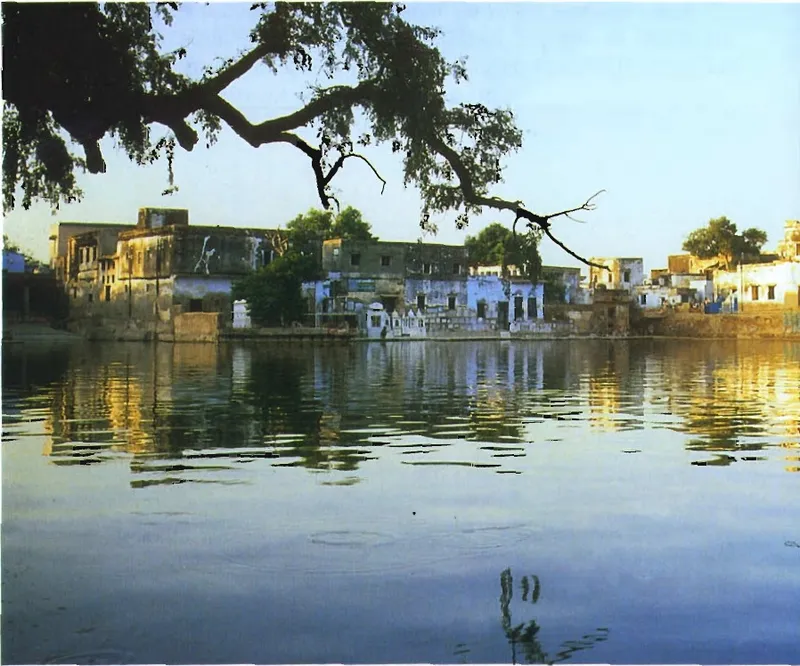
Rādhā-kuṇḍa
राधा-कुण्डRādhā-kuṇḍa is the lake of Śrī Rādhā at the foot of Govardhana Hill, in the village of Āriṭa.
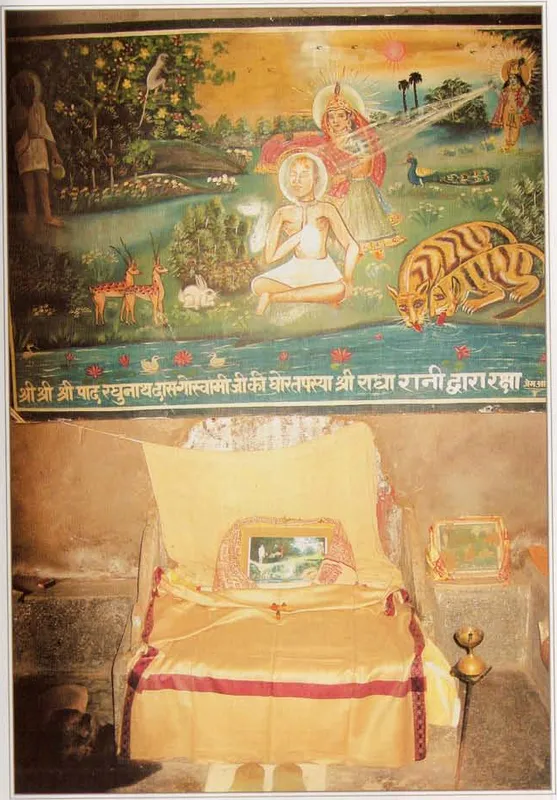
Raghunātha dāsa Gosvāmī's bhajana-kuṭī
रघुनाथ दास गोस्वामी की भजन-कुटीŚrīla Raghunātha dāsa Gosvāmī's bhajana-kuṭī, his hut for chanting and prayer, stands between Rādhā-kuṇḍa and Śyāma-kuṇḍa, next to the kuṭīs of Śrī Gopāla Bhaṭṭa Gosvāmī …
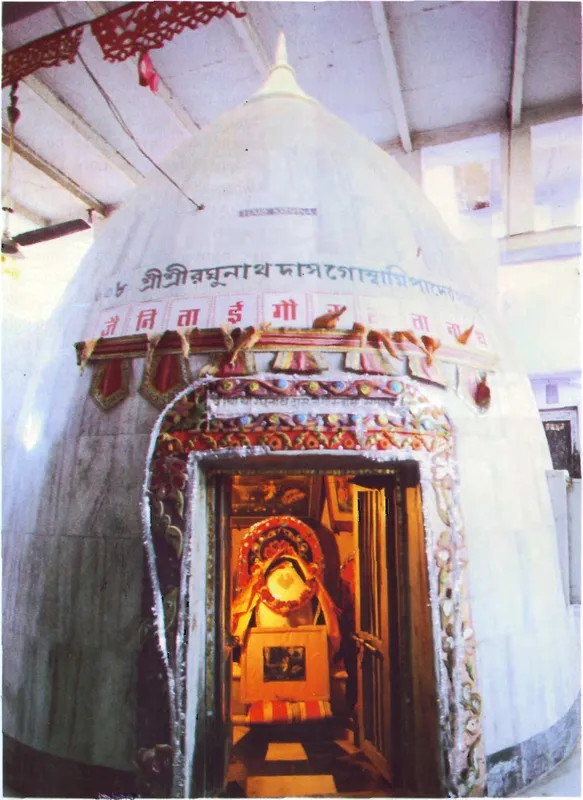
Raghunātha dāsa Gosvāmī's samādhi (Rādhā-kuṇḍa)
रघुनाथ दास गोस्वामी की समाधि (राधा-कुण्ड)This is the samādhi, the tomb or memorial shrine, of Śrīla Raghunātha dāsa Gosvāmī on the bank of Rādhā-kuṇḍa.
Rādhā-kuṇḍa (village)
राधा-कुण्ड (गाँव)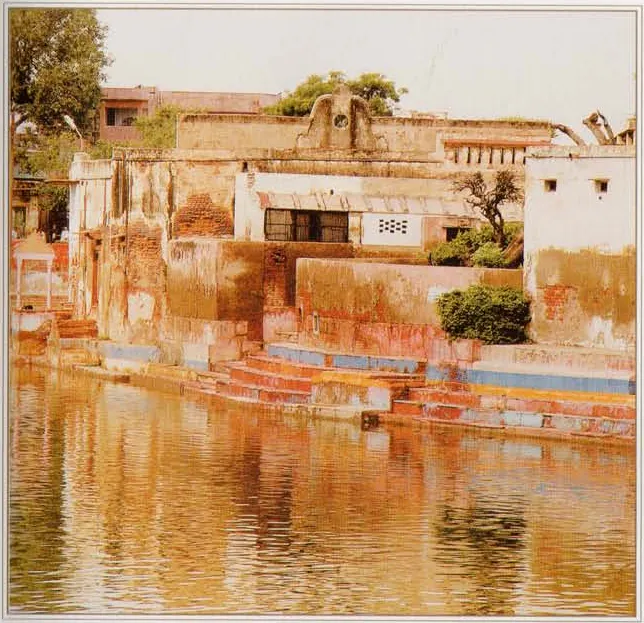
Mānasa-pāvana-ghāṭa
मानस-पावन-घाटMānasa-pāvana-ghāṭa is a bathing ghāṭa on the north side of Śyāma-kuṇḍa, Kṛṣṇa's kuṇḍa beside Rādhā-kuṇḍa.
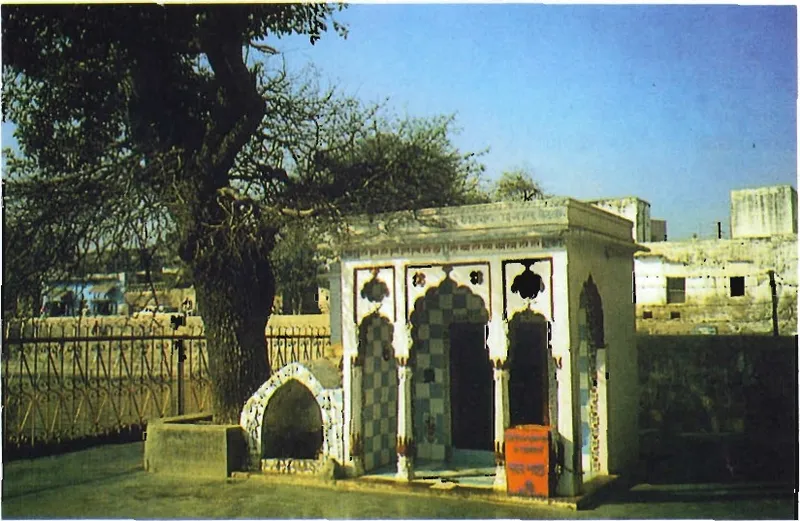
Jāhnavā-devī's baiṭhaka
जाह्नवा देवी की बैठकJāhnavā-devī's baiṭhaka, her sitting place, is on the northern bank of Rādhā-kuṇḍa, with her ghāṭa (bathing steps) beside it.
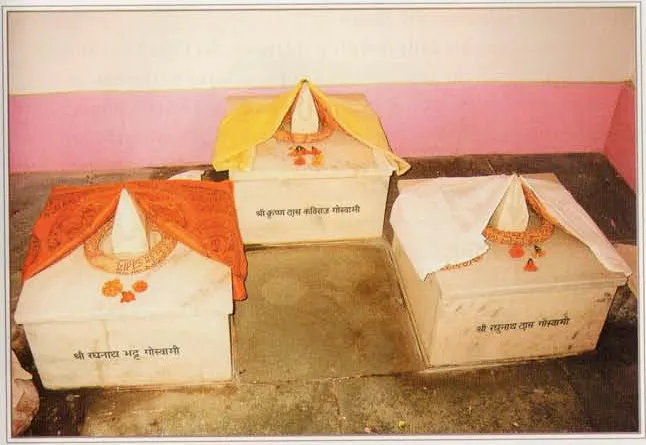
Teen Gosvāmī Samādhi
तीन गोस्वामी समाधिThe Teen Gosvāmī Samādhi, "the samādhi of the three Gosvāmīs", is a shrine at Rādhā-kuṇḍa between the bhajana-kuṭīs (huts for chanting and prayer) of Śrīla Raghunātha dās …
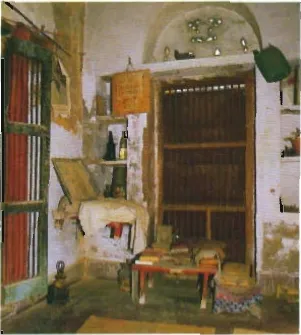
Kṛṣṇadāsa Kavirāja Gosvāmī's bhajana-kuṭī (Rādhā-kuṇḍa)
कृष्णदास कविराज गोस्वामी की भजन-कुटी (राधा-कुण्ड)Śrīla Kṛṣṇadāsa Kavirāja Gosvāmī's bhajana-kuṭī, his hut for chanting and prayer, stands near the banks of Śyāma-kuṇḍa, close to the kuṭī of Śrīla Raghunātha dāsa Gosvāmī …
Questions and answers
The Caitanya-caritāmṛta says that he bathed in the kuṇḍa three times a day and honoured every Vaiṣṇava of Vraja. The Bhakti-ratnākara describes him chanting day and night and serving the Govardhana-śilā and guñjā garland that Śrī Caitanya Mahāprabhu had given him.[1 +2]
The Caitanya-caritāmṛta says that he gave up all food and drink but a few drops of buttermilk. The Bhakti-ratnākara and Śrīla Prabhupāda's talks describe it in slightly different words, eating only once in two or four days.[3, 7]
Śrīla Prabhupāda names three: the Stava-mālā (or Stavāvalī), a collection of hymns, the Dāna-carita and the Muktā-carita.[2]
On the bank of Rādhā-kuṇḍa; Śrīla Prabhupāda said in 1970 that his tomb is there still. What it holds is told differently by the guidebooks.[3]
In his own understanding, Śrī Caitanya Mahāprabhu's gift of a Govardhana-śilā gave him a place near Govardhana, and the guñjā garland gave him shelter at Śrī Rādhā's feet. His hymns call the kuṇḍa his only shelter.[8 +4]
He said that Śrīla Raghunātha dāsa Gosvāmī showed how to live there, with counted names and bowing down around the kuṇḍa. He also said that one does not become fit for Rādhā-kuṇḍa by going there by force, without Śrīla Rūpa Gosvāmī's instructions.[11, 49]
Sources
- Śrīla Kṛṣṇadāsa Kavirāja Gosvāmī, Śrī Caitanya-caritāmṛta, Ādi-līlā 10.101, online edition · vedabase.io
- Śrīla Prabhupāda, Śrī Caitanya-caritāmṛta, Ādi-līlā 10.91, purport · vedabase.io
- Śrīla Prabhupāda, Vaiṣṇava Calendar Description conversation, Calcutta, 2 September 1970 · vedabase.io
- Śrīla Prabhupāda, Lecture on Bhagavad-gītā 4.22, Bombay, 11 April 1974 · vedabase.io
- Śrīla Narahari Cakravartī, Bhakti-ratnākara, Ekādaśa-taraṅga (11th wave), printed page 668, 2nd ed., 1912
- Śrīla Raghunātha dāsa Gosvāmī, Sva-niyama-daśaka v.9 (Grantha Mandira Stavāvalī, section (12))
- Śrīla Kṛṣṇadāsa Kavirāja Gosvāmī, Śrī Caitanya-caritāmṛta, Ādi-līlā 10.98, online edition · vedabase.io
- Śrīla Raghunātha dāsa Gosvāmī, Rādhā-kuṇḍāṣṭaka, verses 1–2 and 9
- Śrīla Raghunātha dāsa Gosvāmī, Vraja-vilāsa-stava, verses 52–54
- Śrīla Raghunātha dāsa Gosvāmī, Muktā-carita, invocation, fourth verse, GRETIL
- Śrīla Prabhupāda, Room Conversation, Bombay, 16 August 1976 · vedabase.io
- Śrīla Prabhupāda, Lecture on Śrīmad-Bhāgavatam 6.3.18, Gorakhpur, 11 February 1971 · vedabase.io
- Vṛndāvana-Dhāma Ki Jaya! (c. 1986), by Dhruva Mahārāja dāsa, PDF p. 33
- Śrīla Narahari Cakravartī, Bhakti-ratnākara, Pañcama-taraṅga (5th wave), printed page 194, 2nd ed., 1912
- Śrīla Narahari Cakravartī, Bhakti-ratnākara, Sixth Wave (ṣaṣṭha taraṅga), 1912 ed. p. 456, 2nd ed., 1912
- Śrīla Narahari Cakravartī, Bhakti-ratnākara, Ninth Wave (navama taraṅga), 1912 ed. p. 576, 2nd ed., 1912
- Śrīla Narahari Cakravartī, Bhakti-ratnākara, Fifth Wave, 1912 ed. p. 198, 2nd ed., 1912
- Śrīla Narahari Cakravartī, Bhakti-ratnākara, Ekādaśa-taraṅga (11th wave), printed page 667, 2nd ed., 1912
- Śrīla Prabhupāda, Śrī Caitanya-caritāmṛta, Ādi-līlā 10.85, purport · vedabase.io
- Śrīla Kṛṣṇadāsa Kavirāja Gosvāmī, Śrī Caitanya-caritāmṛta, CC Ādi-līlā 10.94, online edition · vedabase.io
Show all 57 references
- Śrīla Kṛṣṇadāsa Kavirāja Gosvāmī, Śrī Caitanya-caritāmṛta, Ādi-līlā 10.96, online edition · vedabase.io
- The Colour Guide to Rādhā-kuṇḍa (1999), Rājaśekhara dāsa Brahmacārī, PDF p. 90
- the undated parikramā notes Rādhā-kuṇḍa, ¶42
- Śrīla Kṛṣṇadāsa Kavirāja Gosvāmī, Śrī Caitanya-caritāmṛta, CC Antya-līlā 6.307, online edition · vedabase.io
- The Colour Guide to Rādhā-kuṇḍa (1999), Rājaśekhara dāsa Brahmacārī, PDF p. 91
- Śrīla Prabhupāda, Śrī Caitanya-caritāmṛta, Ādi-līlā 10.91, purport (quoting Bhaktisiddhānta Sarasvatī's Anubhāṣya for the birth year) · vedabase.io
- The Colour Guide to Rādhā-kuṇḍa (1999), Rājaśekhara dāsa Brahmacārī, PDF p. 88
- the undated parikramā notes Rādhā-kuṇḍa, ¶41
- Govardhana Hill: India's Most Sacred Mountain (2001), Rajasekhara dasa Brahmacari, PDF p. 155
- Śrīla Narahari Cakravartī, Bhakti-ratnākara, Fifth Wave, 1912 ed. printed p. 196, 2nd ed., 1912
- Śrīla Narahari Cakravartī, Bhakti-ratnākara, Fifth Wave, 1912 ed. printed p. 197, 2nd ed., 1912
- Śrīla Raghunātha dāsa Gosvāmī, Vilāpa-kusumāñjali, Stavāvalī hymn (8) Śrī-vilāpa-kusumāñjali, vv. 97–98
- Śrīla Raghunātha dāsa Gosvāmī, Abhīṣṭa-sūcana, Stavāvalī hymn (30) Śrī-abhīṣṭa-sūcanam, v. 13, the last verse of the Stavāvalī
- Śrīla Raghunātha dāsa Gosvāmī, Vraja-vilāsa-stava, verse 53
- Śrīla Rūpa Gosvāmī, Dāna-keli-kaumudī, vv. 99–100, after the undated edition published by Krishna Das of Kusum Sarovar
- Viśvanātha Cakravartī Ṭhākura, commentary on v. 100'), after the undated edition published by Krishna Das of Kusum Sarovar
- Śrīla Narahari Cakravartī, Bhakti-ratnākara, Fifth Wave, 1912 ed. p. 198, lines 13-16 and 21, 2nd ed., 1912
- Śrīla Narahari Cakravartī, Bhakti-ratnākara, Fourth Wave, 1912 ed. p. 145, 2nd ed., 1912
- Śrīla Narahari Cakravartī, Bhakti-ratnākara, Fifth Wave, 1912 ed. printed p. 198, 2nd ed., 1912
- Śrīla Narahari Cakravartī, Bhakti-ratnākara, Fifth Wave, 1912 ed. p. 198, lines 3-4, 2nd ed., 1912
- Śrīla Narahari Cakravartī, Bhakti-ratnākara, Ṣaṣṭha-taraṅga (6th wave), printed page 456, 2nd ed., 1912
- Śrīla Narahari Cakravartī, Bhakti-ratnākara, Ninth Wave, 1912 ed. p. 576, 2nd ed., 1912
- Śrīla Narahari Cakravartī, Bhakti-ratnākara, Sixth Wave, 1912 ed. printed p. 468, 2nd ed., 1912
- Śrīla Narahari Cakravartī, Bhakti-ratnākara, Sixth Wave, 1912 ed. printed p. 469, 2nd ed., 1912
- Śrīla Narahari Cakravartī, Bhakti-ratnākara, Eleventh Wave, 1912 ed. p. 668, 2nd ed., 1912
- Śrīla Narahari Cakravartī, Bhakti-ratnākara, Ekādaśa-taraṅga (11th wave), printed page 669, 2nd ed., 1912
- Śrīla Narahari Cakravartī, Narottama-vilāsa, Navama-vilāsa, vv. 50–52, printed page 79, right column, 1st ed., Baṅgābda 1314
- Śrīla Prabhupāda, Room Conversation, Vṛndāvana, 5 September 1976 · vedabase.io
- Śrīla Prabhupāda, Room Conversation, Vṛndāvana, 5 September 1976 · vedabase.io
- Śrīla Prabhupāda, Lecture on Śrīmad-Bhāgavatam 6.3.20-23, Gorakhpur, 14 February 1971 · vedabase.io
- Śrīla Prabhupāda, Morning Walk, Los Angeles, 7 June 1976 · vedabase.io
- Śrīla Prabhupāda, The Nectar of Instruction, Text 11, purport · vedabase.io
- The Colour Guide to Rādhā-kuṇḍa (1999), Rājaśekhara dāsa Brahmacārī, PDF p. 102
- A. W. Entwistle, ch. 8 gazetteer entry '12 Radhakund', printed p. 340, Egbert Forsten, Groningen, 1987
- The Colour Guide to Rādhā-kuṇḍa (1999), Rājaśekhara dāsa Brahmacārī, PDF p. 108
- the undated parikramā notes Rādhā-kuṇḍa, ¶43
- Govardhana Hill: India's Most Sacred Mountain (2001), Rajasekhara dasa Brahmacari, PDF p. 156
Further sources
- Śrī Caitanya-caritāmṛta, Ādi-līlā 10.91 (purport), 10.94, 10.96, 10.98, 10.101; Antya-līlā 6.307; translation and purports by Śrīla Prabhupāda (BBT). Śrīla Prabhupāda: talk on the Vaiṣṇava calendar, Calcutta, 2 September 1970; lectures and conversations of 1971, 1974 and 1976; The Nectar of Instruction, text 11, purport.
- Śrīla Raghunātha dāsa Gosvāmī, Muktā-carita and Stavāvalī; Śrīla Rūpa Gosvāmī, Dāna-keli-kaumudī, with Śrīla Viśvanātha Cakravartī Ṭhākura's commentary (GRETIL and Gaudiya Grantha Mandira digital editions): summarised here, not translated.
- Bhakti-ratnākara, Fourth, Fifth, Sixth, Ninth and Eleventh Waves (Bengali, 1912 edition); Narottama-vilāsa, ninth vilāsa (c. 1907): summarised here, not translated.
- The Colour Guide to Rādhā-kuṇḍa (1999); Śrī Vraja-maṇḍala Parikramā (2007). Historian cited by name for a dated document only: A. W. Entwistle, Braj: Centre of Krishna Pilgrimage (1987).