Indra Pūjā
इन्द्र पूजा Hindi name proposed
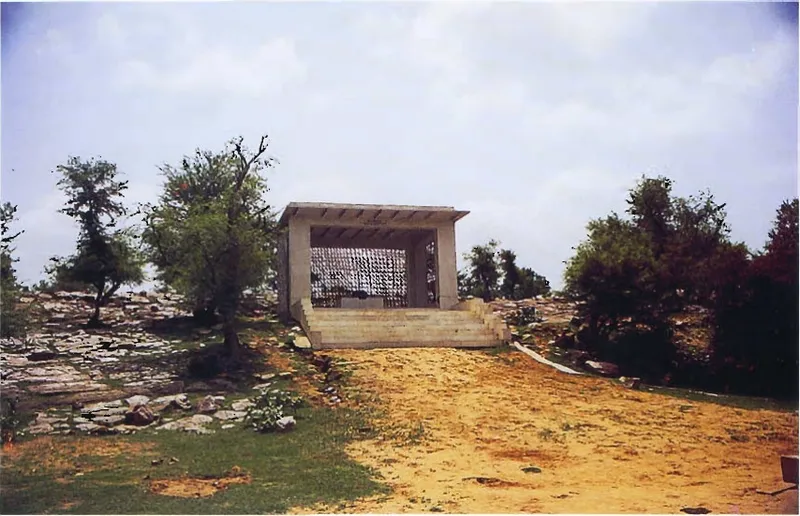
- What it is
- Indra Pūjā is a spot on Govardhana Hill near Airāvata's footprint.
- Visiting
- In 2001 Govardhana Hill described a small pavilion at the spot, from which the temple of Doka Daujī could be seen.
In short
Indra Pūjā is a spot on Govardhana Hill near Airāvata's footprint. The guidebook Govardhana Hill (2001), which describes a small pavilion there, gives it as the place where Indra, the king of heaven, bowed down to Kṛṣṇa after the lifting of the hill, while Kṛṣṇa was walking on the hill to see the damage done by Indra's rain; the spot and its name are known only from this book.[1 +2] The Bhāgavatam says that Indra came to Kṛṣṇa in a solitary place, its commentators set the meeting on Govardhana, and the Bhakti-ratnākara has Indra speak of Kṛṣṇa's wonderful mercy at Airāvata's footprint.[3 +6]
Key facts
| Kind | pastime site |
|---|---|
| Region · area | Govardhana |
Divine pastimes
Indra comes to Kṛṣṇa
After Kṛṣṇa had lifted Govardhana and held it up against Indra's rain, Indra came to Him with Surabhi, the mother of the cows. Ashamed of his offence, Indra approached Kṛṣṇa in a solitary place and fell at His feet, touching them with his crown. The Bhāgavatam names no other place.[4 +3]
śrī-śuka uvāca govardhane dhṛte śaile āsārād rakṣite vraje / go-lokād āvrajat kṛṣṇaṃ surabhiḥ śakra eva ca
vivikta upasaṅgamya vrīḍītaḥ kṛta-helanaḥ / pasparśa pādayor enaṃ kirīṭenārka-varcasā
Indra was very ashamed of having offended the Lord. Approaching Him in a solitary place, Indra fell down and lay his helmet, whose effulgence was as brilliant as the sun, upon the Lord’s lotus feet.
Translation: Śrīla Prabhupāda's disciples (BBT)In his prayer Indra admitted that when his sacrifice was stopped he had tried, out of pride and anger, to destroy the cowherds' village with rain and wind, and he took shelter of Kṛṣṇa. Kṛṣṇa answered that He had stopped the sacrifice out of mercy, so that Indra would always remember Him. Then Surabhi bathed Kṛṣṇa with her milk, and Indra, with the demigods and sages, bathed Him with water of the heavenly Gaṅgā and named Him Govinda. The chapter mentions no tears and no food offering by Indra.[4 +5] Śrīla Prabhupāda's Kṛṣṇa book tells the meeting in the same way and names no place on the hill:[7]
General teaching (does not name the place)“Indra, the king of heaven, was conscious of his offense before Kṛṣṇa; therefore he stealthily appeared before Him in a secluded place. He immediately fell down at the lotus feet of Kṛṣṇa”
Śrīla Prabhupāda, Kṛṣṇa, the Supreme Personality of Godhead (Kṛṣṇa book), Chapter 27, Prayers by Indra, the King of Heaven · vedabase.io
On the hill
The commentators on the Bhāgavatam set the meeting on Govardhana (summarised here, not translated). Śrīla Viśvanātha Cakravartī Ṭhākura says that one morning Kṛṣṇa had gone there alone to see how badly Indra's thunderbolts had battered the back of Govardhana, and that Indra came at that very time. Śrīla Jīva Gosvāmī, Śrīla Viśvanātha Cakravartī Ṭhākura and Śrīla Baladeva Vidyābhūṣaṇa take the place from the Harivaṁśa: Kṛṣṇa was seated on a rock slab of Govardhana. Śrīla Sanātana Gosvāmī and Śrīla Jīva Gosvāmī add that Indra came alone, leaving his carrier and retinue behind.[8 +1] The guidebook's picture of Kṛṣṇa inspecting the damage agrees in substance with Śrīla Viśvanātha Cakravartī Ṭhākura's words, though he speaks of damage to the hill and the guidebook of damage to Vṛndāvana.[1 +1]
The Harivaṁśa and the Viṣṇu Purāṇa tell that Indra came riding his elephant Airāvata and found Kṛṣṇa on Govardhana, seated on a rock slab (Harivaṁśa) or herding the cows among the cowherd boys (Viṣṇu Purāṇa), with Garuḍa shading Him with his wings. Indra got down from the elephant and approached Him in private.[14 +2] The Garga-saṁhitā says that Indra bowed to Kṛṣṇa in a secluded place on the hill, and that at the end Indra and the demigods walked around Him, bowed down, made offerings there and returned to heaven.[4 +3]
In Śrīla Jīva Gosvāmī's Gopāla-campū, Surabhi and Indra see Kṛṣṇa from the sky on the day of Hari (the ekādaśī) after the lifting, seated alone on a jewel-like rock of Govardhana covered with a white cloth. Indra comes secretly, falls down like a rod at His feet and weeps, and Surabhi tells Kṛṣṇa that Indra is offering Him a bath with thousands of streams from his eyes (summarised here, not translated).[17 +2]
Where it happened
The sources name several places for Indra's homage. According to the Bhakti-ratnākara, Indra told of Kṛṣṇa's wonderful mercy at Airāvata's footprint, the spot near which Govardhana Hill puts Indra Pūjā; but the book names no Indra Pūjā spot and says nothing there of bowing down, a pavilion or tears.[3] The same book sets Indra's bath of Kṛṣṇa and his many prayers at Govinda-kuṇḍa and names a Śakra-tīrtha, a tīrtha of Indra, there; Śrīla Prabhupāda, quoting it, says that there Indra offered prayers to Kṛṣṇa and bathed Him.[20 +3] Śrīla Raghunātha dāsa Gosvāmī also sets the homage at Govinda-kuṇḍa: Indra, humbled by great fear, took hold of Kṛṣṇa's feet and bathed Him through Surabhi, and the kuṇḍa arose from that water.[24 +1] Śrīla Rūpa Gosvāmī's Mathurā-māhātmya and the Nārada Purāṇa connect Indra with Govinda-kuṇḍa too, and the Varāha Purāṇa names a tīrtha made by Indra near Annakūṭa, where Kṛṣṇa and Indra spoke together.[23 +2] Read more: The lifting of Govardhana Hill, Indra's homage and the name Govinda →
Accounts differ Where Indra met Kṛṣṇa and bowed down after the lifting of Govardhana
- Śrīmad-Bhāgavatam 10.27.2in a solitary place (no location given)
- Garga-saṁhitā 3.4.1in a secluded place on the hill (girau)
- Varāha Purāṇa 164.23-26near Annakūṭa is a tīrtha made by Śakra, where Kṛṣṇa stopped Indra's sacrifice and spoke with Indra
- Govardhana Hill: India's Most Sacred Mountain (2001), p. 116'Indra Pūjā', believed to be the spot near Airāvata's foot-print, while Kṛṣṇa was walking on the hill inspecting the damage
Visiting today
In 2001 Govardhana Hill described a small pavilion at the spot, from which the temple of Doka Daujī could be seen.[1 +2]
Location
| Where it is | 'near Airāvata's foot-print'; Doka Daujī visible from here[28] |
|---|---|
| On the numbered Govardhana chart | 55 (printed as “Indra Puja”)[29] |
Nearby places
Airāvata's Foot-print · Doka Daujī Mandira
References
29 references
- Govardhana Hill: India's Most Sacred Mountain (2001), Rajasekhara dasa Brahmacari, PDF p. 130
- the key of the numbered Govardhana chart, ¶58
- Śrīla Narahari Cakravartī, Bhakti-ratnākara, Fifth Wave, 1912 ed. p. 203, 2nd ed., 1912
- Śrīmad-Bhāgavatam 10.27.1-2, GRETIL
- Garga-saṁhitā, Girirāja-khaṇḍa (3), adhyāya 4, verse 1, Sanskrit Wikisource
- Garga-saṁhitā, Girirāja-khaṇḍa (3), adhyāya 4, verse 18, Sanskrit Wikisource
- Śrīla Prabhupāda, Kṛṣṇa, the Supreme Personality of Godhead (Kṛṣṇa book), Chapter 27, Prayers by Indra, the King of Heaven · vedabase.io
- Śrīla Sanātana Gosvāmī, Śrīla Jīva Gosvāmī: commentary on ŚB 10.27.1, Bhagavata Vidya Pith edition, ed. Bhagavata Rishi and Krishna Shankar Shastri, 1996
- Śrīla Jīva Gosvāmī, Śrīla Viśvanātha Cakravartī Ṭhākura, Baladeva Vidyābhūṣaṇa: commentary on ŚB 10.27.2, Bhagavata Vidya Pith edition, ed. Bhagavata Rishi and Krishna Shankar Shastri, 1996
- Śrīmad-Bhāgavatam 10.27.12, GRETIL
- Śrīmad-Bhāgavatam 10.27.13, GRETIL
- Śrīmad-Bhāgavatam 10.27.15, GRETIL
- Śrīmad-Bhāgavatam 10.27.22-23, GRETIL
- Harivaṁśa, HV 62.2–3 (critical edition), GRETIL
- Harivaṁśa, HV 62.6–8 (critical edition), GRETIL
- Viṣṇu Purāṇa, 5.12.2–5, GRETIL
- Śrīla Jīva Gosvāmī, Gopāla-campū, Pūrva-campū 19, verses 19.7–8 and prose § 30, GRETIL
- Śrīla Jīva Gosvāmī, Gopāla-campū, Pūrva-campū 19, prose §§ 32–34 and verse 19.11, GRETIL
- Śrīla Jīva Gosvāmī, Gopāla-campū, Pūrva-campū 19, verse 19.27, GRETIL
- Śrīla Narahari Cakravartī, Bhakti-ratnākara, Fifth Wave, 1912 ed. p. 201, last couplet, 2nd ed., 1912
Show all 29 references
- Śrīla Prabhupāda, Śrī Caitanya-caritāmṛta, Madhya-līlā 18.37, purport (his translation of a Bhakti-ratnākara couplet) · vedabase.io
- Śrīla Narahari Cakravartī, Bhakti-ratnākara, Fifth Wave, 1912 ed. p. 202, at Govinda-kuṇḍa, after Vraja-vilāsa-stava 74 and the 'Mathurā-khaṇḍa' verse, 2nd ed., 1912
- Varāha Purāṇa, adhyāya 164, verses 23-26, Sanskrit Wikisource
- Śrīla Raghunātha dāsa Gosvāmī, Vraja-vilāsa-stava, (9) Vraja-vilāsa-stava v.74
- Śrīla Raghunātha dāsa Gosvāmī, Govardhanāśraya-daśaka, (5) Śrī-govardhanāśraya-daśaka v.2
- Śrīla Rūpa Gosvāmī, Mathurā-māhātmya part 1 v.416–417
- Nārada Purāṇa, Uttara-bhāga, adhyāya 80, verses 60–61a
- Govardhana Hill: India's Most Sacred Mountain (2001), Rajasekhara dasa Brahmacari, p. 116
- Numbered list of the Govardhana sites (key of the Govardhana chart)