Doka Daujī Mandira
दोक दाऊजी मन्दिर Hindi name proposed
Also called Doka Daujī, Balarāma Sthali
- What it is
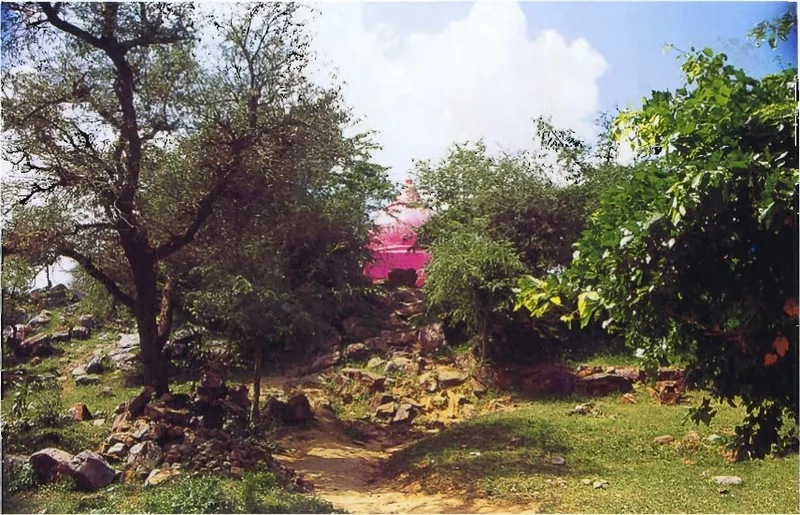
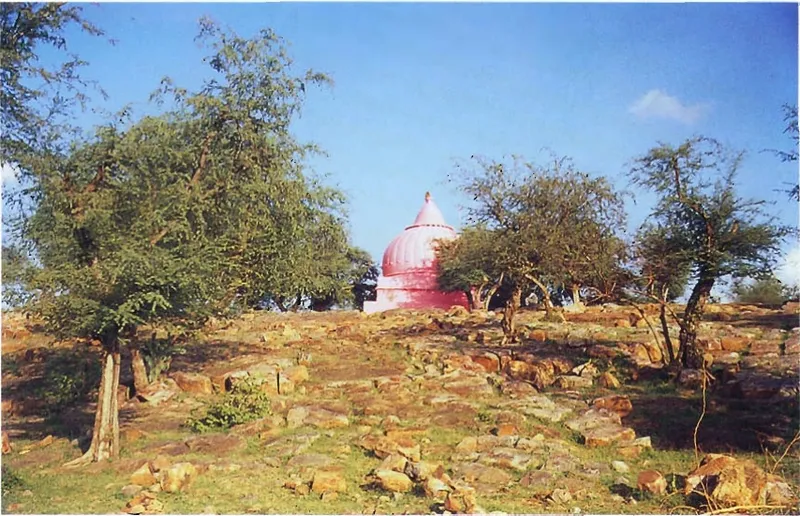
- Doka Daujī is a temple of Balarāma (Daujī, "elder brother") on top of Govardhana Hill.
- Visiting
- The temple stands on the ridge where the hill is very narrow, and the guidebook Govardhana Hill (2001) says that it can be seen from both sides of the hill and from Indra Pūjā.
- Places here
- Balarāma Mukut-śilā
In short
Doka Daujī is a temple of Balarāma (Daujī, "elder brother") on top of Govardhana Hill. The guidebook Govardhana Hill (2001) says that the hill is very narrow here, so that the temple can be seen from both sides, and that, since the hill is pictured as a peacock, the temple marks the beginning of its tail.[1 +6] According to the same book, the name comes from dekha, "looking": Balarāma crouched here and watched Kṛṣṇa's rāsa dance far away at Candra-sarovara.[1 +2] The Bhāgavatam and its commentators do not tell this; in their accounts Balarāma keeps apart from Kṛṣṇa's rāsa.[9 +8]
Key facts
| Kind | temple |
|---|---|
| Region · area | Govardhana |
Divine pastimes
Balarāma in the Bhāgavatam
Śrīmad-Bhāgavatam tells the rāsa dance, Kṛṣṇa's dance with the gopīs (the cowherd girls of Vraja), in five chapters (10.29–33). It takes place on autumn nights on the sandy bank of the river, the Yamunā in the translation, and does not name Candra-sarovara or any other place at Govardhana. Balarāma takes no part in it; He is named only in the gopīs' words.[9 +5]
The Bhāgavatam tells of Balarāma among the women of Vraja on two occasions, and in neither does He watch Kṛṣṇa's rāsa. The first is a night on which both brothers played in the forest:[17 +4]
kadācid atha govindo rāmaś cādbhuta-vikramaḥ / vijahratur vane rātryāṃ madhya-gau vraja-yoṣitām
Once Lord Govinda and Lord Rāma, the performers of wonderful feats, were playing in the forest at night with the young girls of Vraja.
Translation: Śrīla Prabhupāda's disciples (BBT)The second is His visit from Dvārakā, when He stayed in Vraja for the two spring months, Madhu and Mādhava, and spent the nights with the gopīs in a garden by the Yamunā:[17 +4]
pūrṇa-candra-kalā-mṛṣṭe kaumudī-gandha-vāyunā / yamunopavane reme sevite strī-gaṇair vṛtaḥ
In the company of numerous women, Lord Balarāma enjoyed in a garden by the Yamunā River. This garden was bathed in the rays of the full moon and caressed by breezes bearing the fragrance of night-blooming lotuses.
Translation: Śrīla Prabhupāda's disciples (BBT)Śrīla Prabhupāda's Kṛṣṇa book, his summary study of the Tenth Canto, likewise says that the rāsa dance took place in autumn, and that on His visit Balarāma "also enjoyed the rāsa dance with the gopīs" for two months of spring on the bank of the Yamunā. It names no place at Govardhana.[20 +1]
What the commentators add
The commentators on the Tenth Canto say more (summarised here, not translated). Śrīla Viśvanātha Cakravartī Ṭhākura writes that Balarāma's own rāsa took place at a spot by the Yamunā known as Śrī Rāma-ghaṭṭa, and that He kept away, even from a distance, from the place where Kṛṣṇa had danced the rāsa. The commentators also take the gopīs of Balarāma's rāsa to be other than Kṛṣṇa's beloveds.[15 +2]
The Bhāgavatam mentions no rāsa on the night when the bull-demon Ariṣṭa came (ŚB 10.36), but the commentators connect that night with one, and Śrīla Jīva Gosvāmī and the commentator Vaṁśīdhara set that rāsa at Govardhana in the middle of spring.[22 +5] When Kṛṣṇa re-entered the village with Balarāma after killing Ariṣṭa, they explain, Balarāma had come from His own play out of affection for His younger brother. None of them says where He had been, or that He watched Kṛṣṇa's rāsa.[23 +2] On the night of 10.34.20 the commentators differ on whether the two brothers were together (see below).[15 +2]
Traditional accounts
According to the guidebook Govardhana Hill (2001), Doka is a corruption of dekha, "looking": one day Balarāma, wandering on …
According to the guidebook Govardhana Hill (2001), Doka is a corruption of dekha, "looking": one day Balarāma, wandering on Govardhana, crouched here and watched Kṛṣṇa dancing the rāsa with the gopīs far away at Candra-sarovara. The undated parikramā notes Govardhana tell the same story and adds that in His absorption His white complexion turned dark like a monsoon cloud.[1 +2]
Older texts connect Candra-sarovara with the rāsa, though not with Balarāma. In the Bhakti-ratnākara, Śrīla Śrīnivāsa Ācārya's guide shows him Pārāsaulī, where Kṛṣṇa held the rāsa in spring, and Candra-sarovara, where He rested, absorbed in the rāsa.[8] Śrīla Viśvanātha Cakravartī Ṭhākura's Vraja-rīti-cintāmaṇi names the place of the supreme rāsa pastimes together with Candra-sarovara. Neither text mentions Balarāma.[1 +3] Read more: The spring rāsa at Govardhana: Pārāsaulī, Candra-sarovara and Paiṭhā →
Visiting today
The temple stands on the ridge where the hill is very narrow, and the guidebook Govardhana Hill (2001) says that it can be seen from both sides of the hill and from Indra Pūjā.[1 +3] The same book says that the Deity of Balarāma here is a Govardhana-śilā, a stone of the hill; the undated parikramā notes Govardhana describe Doka Daujī as crouching and dark.[1 +3]
The guidebook says that Gauḍīya Vaiṣṇavas, the followers of Śrī Caitanya Mahāprabhu, do not step on Govardhana Hill but offer their obeisances to Doka Daujī from a distance; the undated notes say simply that pilgrims do not go up, because Doka Daujī is on the hill.[1 +3] Śrīla Prabhupāda gives the rule for the whole hill (a general teaching; he does not name this temple):[32]
General teaching (does not name the place)“One should also avoid climbing Govardhana Hill to see the Gopāla Deity. Since Govardhana Hill itself is identical with Gopāla, one should not step on the hill or touch it with his feet. One may see Gopāla when He goes elsewhere.”
Śrīla Prabhupāda, Śrī Caitanya-caritāmṛta, Antya-līlā 13.39, purport · vedabase.io
Location
| Where it is | 'on top of Govardhana Hill'; visible from both sides of the hill, 'very narrow at this point'[34] 'Govardhana Hill is imagined to be in the form of a peacock and this temple of Doka Daujī is the beginning of the peacock's tail'[34] |
|---|---|
| On the numbered Govardhana chart | 45 (printed as “Doka Dauji Temple”)[35] |
Places at Doka Daujī Mandira
1 places
Nearby places
Candra-sarovara · Indra Pūjā
Pictures
1 pictures
History
The historian A. W. Entwistle (1987) describes a shrine on top of the hill near Aniyora which he calls Dhunka Dauji, probably this temple, and finds that only a few later sources mention it. The one source he gives for it is the Braj maṇḍal kamalākar bhāvnā, a pilgrimage text of the Puṣṭimārga, Śrī Vallabhācārya's tradition. Its date is uncertain; Entwistle reports a tradition that its author went round Braj in 1695, and he thinks it is the first Puṣṭimārga text to name the shrine. No source gives a founder or a date of building.[1 +4]
Where the sources differ
Balarāma and Kṛṣṇa's night pastimes with the women of Vraja: whether Balarāma was present, kept apart or watched
Accounts differ Balarāma and Kṛṣṇa's night pastimes with the women of Vraja: whether Balarāma was present, kept apart or watched
- Govardhana Hill: India's Most Sacred Mountain (2001); the undated parikramā notes GovardhanaBalarāma, crouching on Govardhana at Doka Daujī, watched Kṛṣṇa's rāsa at Candra-sarovara far away (the undated parikramā notes Govardhana: and turned dark)
- Śrīla Sanātana Gosvāmī on ŚB 10.34.20on a moonlit spring night Balarāma was there with Kṛṣṇa among the women of Vraja as His special friend, brought there for a special purpose which will become clear later; in one explanation the epithet of wonderful deeds is Balarāma's alone, because He protected the women while Kṛṣṇa went far away to kill Śaṅkhacūḍa
- Śrīla Jīva Gosvāmī (Laghu-toṣaṇī on ŚB 10.34.20 and 10.34.21, Krama-sandarbha on 10.34.21) and Vaṁśīdhara (on 10.34.21)on the full moon of Holī Balarāma was there as Kṛṣṇa's friend, in a secondary role, with the friends (Jīva on 10.34.20); He had His own separate group of beloveds, and all came together only because of the crowd of the Holī festival (Jīva and Vaṁśīdhara on 10.34.21)
- Bṛhat-krama-sandarbha (printed under Śrīla Jīva Gosvāmī's name) and Śrīla Śrīnātha Cakravartī on ŚB 10.34.20Govinda at one time and Rāma at another, each amid His own beloveds: the dual does not mean that They were together
The wording of these accounts is our summary of the sources, not a published translation.
More on this place
The spring rāsa at Govardhana: Pārāsaulī, Candra-sarovara and Paiṭhā
References
35 references
- Govardhana Hill: India's Most Sacred Mountain (2001), Rajasekhara dasa Brahmacari, PDF p. 119
- Govardhana Hill: India's Most Sacred Mountain (2001), Rajasekhara dasa Brahmacari, PDF p. 118
- the undated parikramā notes Govardhana, ¶118
- the key of the numbered Govardhana chart, ¶48
- Govardhana Hill: India's Most Sacred Mountain (2001), Rajasekhara dasa Brahmacari, PDF p. 26
- Govardhana Hill: India's Most Sacred Mountain (2001), Rajasekhara dasa Brahmacari, PDF p. 130
- Govardhana Hill: India's Most Sacred Mountain (2001), Rajasekhara dasa Brahmacari, PDF p. 132
- Śrīla Narahari Cakravartī, Bhakti-ratnākara, Fifth Wave, 1912 ed. p. 200, 2nd ed., 1912
- Śrīmad-Bhāgavatam 10.29.1, GRETIL
- Śrīmad-Bhāgavatam 10.29.45, GRETIL
- Śrīmad-Bhāgavatam 10.33.2, GRETIL
- Śrīmad-Bhāgavatam 10.33.25, GRETIL
- Śrīla Prabhupāda, Kṛṣṇa, the Supreme Personality of Godhead (Kṛṣṇa book), Chapter 29, 'The Rāsa Dance: Introduction' · vedabase.io
- Śrīla Prabhupāda, Kṛṣṇa, the Supreme Personality of Godhead (Kṛṣṇa book), Chapter 33, 'Description of the Rāsa Dance' · vedabase.io
- Śrīla Viśvanātha Cakravartī Ṭhākura: commentary on ŚB 10.65.18, Bhagavata Vidya Pith edition, ed. Bhagavata Rishi and Krishna Shankar Shastri, 1996
- Śrīla Viśvanātha Cakravartī Ṭhākura, Śrīla Jīva Gosvāmī: commentary on ŚB 10.65.17, Bhagavata Vidya Pith edition, ed. Bhagavata Rishi and Krishna Shankar Shastri, 1996
- Śrīmad-Bhāgavatam 10.65.17, GRETIL
- Śrīmad-Bhāgavatam 10.65.18, GRETIL
- Śrīmad-Bhāgavatam 10.34.20, GRETIL
- Śrīla Prabhupāda, Kṛṣṇa, the Supreme Personality of Godhead (Kṛṣṇa book), Chapter 65, 'Lord Balarāma Visits Vṛndāvana' · vedabase.io
Show all 35 references
- Śrīla Prabhupāda, Kṛṣṇa, the Supreme Personality of Godhead (Kṛṣṇa book), Chapter 34, 'Vidyādhara Liberated and the Demon Śaṅkhacūḍa Killed' · vedabase.io
- Śrīmad-Bhāgavatam 10.36.1, GRETIL
- Śrīmad-Bhāgavatam 10.36.15, GRETIL
- Śrīla Prabhupāda, Kṛṣṇa, the Supreme Personality of Godhead (Kṛṣṇa book), Chapter 36, 'Kaṁsa Sends Akrūra for Kṛṣṇa' · vedabase.io
- Śrīla Sanātana Gosvāmī, Śrīla Jīva Gosvāmī: commentary on ŚB 10.36.1, Bhagavata Vidya Pith edition, ed. Bhagavata Rishi and Krishna Shankar Shastri, 1996
- Vaṁśīdhara: commentary on ŚB 10.36.5-6, Bhagavata Vidya Pith edition, ed. Bhagavata Rishi and Krishna Shankar Shastri, 1996
- Vaṁśīdhara: commentary on ŚB 10.36.16, Bhagavata Vidya Pith edition, ed. Bhagavata Rishi and Krishna Shankar Shastri, 1996
- Śrīla Sanātana Gosvāmī, Śrīla Jīva Gosvāmī: commentary on ŚB 10.36.15, Bhagavata Vidya Pith edition, ed. Bhagavata Rishi and Krishna Shankar Shastri, 1996
- Śrīla Jīva Gosvāmī: commentary on ŚB 10.36.15, parts 1/2 and 2/2, Bhagavata Vidya Pith edition, ed. Bhagavata Rishi and Krishna Shankar Shastri, 1996
- Śrīla Viśvanātha Cakravartī Ṭhākura, Vraja-rīti-cintāmaṇi, third sarga, verse 17
- A. W. Entwistle, printed p. 288, Egbert Forsten, Groningen, 1987
- Śrīla Prabhupāda, Śrī Caitanya-caritāmṛta, Antya-līlā 13.39, purport · vedabase.io
- Śrīla Prabhupāda, Śrī Caitanya-caritāmṛta, Madhya-līlā 18, chapter summary (from Bhaktivinoda Ṭhākura's Amṛta-pravāha-bhāṣya) · vedabase.io
- Govardhana Hill: India's Most Sacred Mountain (2001), Rajasekhara dasa Brahmacari, p. 105
- Numbered list of the Govardhana sites (key of the Govardhana chart)