Airāvata's Foot-print
ऐरावत का चरण-चिह्न Hindi name proposed
In short
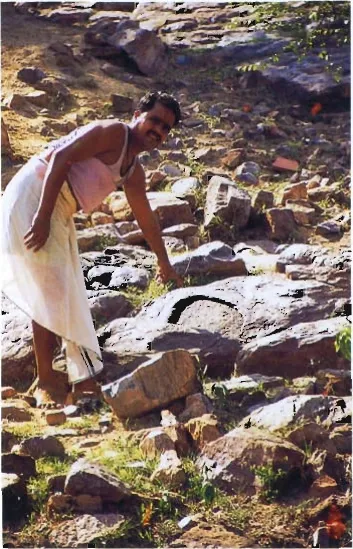
Airāvata's Foot-print is a mark in the rocks of Govardhana Hill that is shown as the footprint of Airāvata, the elephant of Indra, the king of heaven.[1 +2] The Garga-saṁhitā names the footprints of Airāvata and of Surabhi, the mother of the cows, on Govardhana, and promises Vaikuṇṭha to anyone who offers obeisances to them, even a sinful person; it does not say where on the hill they are.[4] In the Bhakti-ratnākara, Śrīla Śrīnivāsa Ācārya's guide shows him the footprint on the walk around the hill.[1] Śrīmad-Bhāgavatam tells of Airāvata's part in Kṛṣṇa's bath after the lifting of the hill but mentions no footprint, and two guidebooks give two different stories of how the mark was made.[2 +5]
Key facts
| Kind | footprint |
|---|---|
| Region · area | Govardhana |
| Ācāryas | Śrīla Śrīnivāsa Ācārya, Śrīla Rāghava Paṇḍita Gosvāmī of Govardhana |
Why it is glorified
The Garga-saṁhitā counts the footprints of Airāvata and Surabhi among the holy places of Govardhana …
The Garga-saṁhitā counts the footprints of Airāvata and Surabhi among the holy places of Govardhana:[4]
ऐरावतस्य सुरभेः पादचिह्नानि यत्र वै । तत्र नत्वा नरः पापी वैकुण्ठं याति मैथिल ॥ 38 ॥
airāvatasya surabheḥ pādacihnāni yatra vai
tatra natvā naraḥ pāpī vaikuṇṭhaṁ yāti maithila || 38 ||
Where it describes the hill as a body, the same book makes Airāvata's footprint the hill's foot, with Kṛṣṇa's handprint as its intellect (buddhi) and Surabhi's hoofprints as its wings. It does not say where on the hill the footprint is or how it was made.[4 +1]
Divine pastimes
Indra and Airāvata
In his anger Indra sent the clouds of universal destruction against Vraja. Śrīmad-Bhāgavatam tells that he meant to follow them himself, riding Airāvata, but it does not say that Indra or his elephant reached Govardhana during the storm:[10 +1]
ahaṃ cairāvataṃ nāgam āruhyānuvraje vrajam / marud-gaṇair mahā-vegair nanda-goṣṭha-jighāṃsayā
I will follow you to Vraja, riding on my elephant Airāvata and taking with me the swift and powerful wind-gods to decimate the cowherd village of Nanda Mahārāja.
Translation: Śrīla Prabhupāda's disciples (BBT)After Kṛṣṇa had held up the hill, Surabhi came to Him, and Indra with her. Ashamed of his offence, Indra approached Kṛṣṇa in a solitary place and touched His feet with his crown. Then Surabhi bathed Kṛṣṇa with her milk, Indra bathed Him with water of the heavenly Gaṅgā drawn up by Airāvata's trunk, and Indra named Him Govinda. The Bhāgavatam names no spot on the hill for these events and mentions no footprint.[5 +6]
What the commentators and other texts add
The commentators on these verses add details (summarised here, not translated). Following the Harivaṁśa, Śrīla Sanātana Gosvāmī, Śrīla Jīva Gosvāmī and Śrīla Viśvanātha Cakravartī Ṭhākura place Indra's meeting with Kṛṣṇa on a rock of Govardhana, and say that Indra first came alone, leaving his carrier and his retinue behind. Śrīla Viśvanātha Cakravartī Ṭhākura says that Kṛṣṇa had gone out alone that morning to see how Indra's thunderbolts had battered the back of the hill; Śrīla Baladeva Vidyābhūṣaṇa says that He had gone to ask after the hill's well-being and sat on a jewelled rock on its back.[15 +1]
Of the bath, Śrīla Sanātana Gosvāmī and Śrīla Jīva Gosvāmī say that Airāvata, who had come there, drew the heavenly Gaṅgā water with his trunk, and the commentators place the bath at Śakra-kuṇḍa or Govinda-kuṇḍa. None of them mentions Airāvata's footprint.[6 +2]
In the Viṣṇu Purāṇa Indra, riding Airāvata, sees Kṛṣṇa on Govardhana Hill, gets down from the elephant and bathes Kṛṣṇa with a bell taken from Airāvata; in the Garga-saṁhitā Airāvata himself bathes Kṛṣṇa on Govardhana with water from his four trunks. Neither tells of a footprint.[5 +3] Read more: The lifting of Govardhana Hill, Indra's homage and the name Govinda →
Traditional accounts
According to the Bhakti-ratnākara, Śrīla Rāghava Paṇḍita, guiding Śrīla Śrīnivāsa Ācārya around the hill, told him to see the …
According to the Bhakti-ratnākara, Śrīla Rāghava Paṇḍita, guiding Śrīla Śrīnivāsa Ācārya around the hill, told him to see the footprint of Airāvata, where Indra spoke of Kṛṣṇa's wonderful mercy. The book shows it after the guide's own cave and gives neither its exact place nor how it was made.[1]
How the mark was made is told only by the guidebooks, and they tell it differently: Govardhana Hill (2001) says that Airāvata left it when he bowed down to Kṛṣṇa, and the undated parikramā notes Govardhana say that Airāvata stood here when Indra came to offer his respects to Kṛṣṇa.[2 +1]
Śrīla Prabhupāda
Śrīla Prabhupāda's Kṛṣṇa book tells how Indra came to Kṛṣṇa after the lifting of the hill, without naming the place or mentioning …
Śrīla Prabhupāda's Kṛṣṇa book tells how Indra came to Kṛṣṇa after the lifting of the hill, without naming the place or mentioning a footprint (a general reference):[12 +2]
General teaching (does not name the place)“Indra, the king of heaven, was conscious of his offense before Kṛṣṇa; therefore he stealthily appeared before Him in a secluded place.”
Śrīla Prabhupāda, Kṛṣṇa, the Supreme Personality of Godhead (Kṛṣṇa book), Chapter 27, 'Prayers by Indra, the King of Heaven' · vedabase.io
Location
| Where it is | 'on the side of Govardhana Hill'[19] 'Near the kuṇḍa on top of the hill'[20] |
|---|---|
| On the numbered Govardhana chart | 54 (printed as “Airavata’s Footprint”)[21] |
Nearby places
Indra Pūjā · Airāvata-kuṇḍa
Where the sources differ
Where the footprint is and how it was made: the Garga-saṁhitā and the Bhakti-ratnākara give no place; one guidebook puts it on the side of the hill near Indra Pūjā, another near Airāvata-kuṇḍa on top of the hill.
Accounts differ Where Airāvata's footprint is, and how it was made
- Garga-saṁhitā 3.7.38, 3.8.10the footprints of Airāvata and Surabhi are on Govardhana; no place on the hill and no cause given
- Bhakti-ratnākara (Fifth Wave), 1912 ed. p. 203Śrīnivāsa's guide points out 'Airāvata's footprint' where Indra spoke of Kṛṣṇa's wonderful mercy; no exact place on the hill and no cause given; the next couplets name a kuṇḍa printed সুরতিকুণ্ড and Rudra-kuṇḍa
- Govardhana Hill: India's Most Sacred Mountain (2001)on a rock 'on the side of Govardhana Hill', near Indra Pūjā; made when Airāvata 'bowed down to offer obeisances to Lord Kṛṣṇa'
- Śrī Vraja-maṇḍala Parikramā (2007)'Near the kuṇḍa on top of the hill are the impressions of Airāvata's feet' (Airāvata-kuṇḍa, where Airāvata bathed Kṛṣṇa)
Accounts differ How Indra came to Kṛṣṇa after the lifting, and Airāvata's part
- Śrīmad-Bhāgavatam 10.25.7Indra meant to follow the clouds to Vraja riding Airāvata
- Śrīmad-Bhāgavatam 10.27.1-2, 22-23after the lifting Indra came with Surabhi and approached Kṛṣṇa in a solitary place; Airāvata's trunk supplied the water for the bath; no place, no footprint
- Canto 10 commentators (on ŚB 10.27.1-2, 22-24)Indra first came alone, leaving his vehicle; he met Kṛṣṇa on a rock of Govardhana (Harivaṁśa); Airāvata, who had come, drew the water; the bath was at Śakra- or Govinda-kuṇḍa; no footprint
- Śrīla Prabhupāda, Kṛṣṇa book ch. 27Indra came stealthily to a secluded place; the water came through the trunk of his carrier elephant
The wording of these accounts is our summary of the sources, not a published translation.
More on this place
The lifting of Govardhana Hill, Indra's homage and the name Govinda
References
21 references
- Śrīla Narahari Cakravartī, Bhakti-ratnākara, Fifth Wave, 1912 ed. p. 203, 2nd ed., 1912
- Govardhana Hill: India's Most Sacred Mountain (2001), Rajasekhara dasa Brahmacari, PDF p. 130
- the undated parikramā notes Govardhana, ¶139
- Garga-saṁhitā, Girirāja-khaṇḍa (3), adhyāya 7, verse 38, Sanskrit Wikisource
- Garga-saṁhitā, Girirāja-khaṇḍa (3), adhyāya 4, verse 9, Sanskrit Wikisource
- Śrīmad-Bhāgavatam 10.27.22-23, GRETIL
- Viṣṇu Purāṇa, 5.12.2, GRETIL
- Śrīla Prabhupāda, Kṛṣṇa, the Supreme Personality of Godhead (Kṛṣṇa book), Chapter 27, Prayers by Indra, the King of Heaven · vedabase.io
- Garga-saṁhitā, Girirāja-khaṇḍa (3), adhyāya 8, verse 10, Sanskrit Wikisource
- Śrīmad-Bhāgavatam 10.25.2, GRETIL
- Śrīmad-Bhāgavatam 10.25.7, GRETIL
- Śrīmad-Bhāgavatam 10.27.1, GRETIL
- Śrīmad-Bhāgavatam 10.27.2, GRETIL
- Śrīla Prabhupāda, Kṛṣṇa, the Supreme Personality of Godhead (Kṛṣṇa book), Chapter 27, 'Prayers by Indra, the King of Heaven' · vedabase.io
- Śrīla Sanātana Gosvāmī, Śrīla Jīva Gosvāmī: commentary on ŚB 10.27.1, Bhagavata Vidya Pith edition, ed. Bhagavata Rishi and Krishna Shankar Shastri, 1996
- Śrīla Jīva Gosvāmī, Śrīla Viśvanātha Cakravartī Ṭhākura, Baladeva Vidyābhūṣaṇa: commentary on ŚB 10.27.2, Bhagavata Vidya Pith edition, ed. Bhagavata Rishi and Krishna Shankar Shastri, 1996
- Śrīla Sanātana Gosvāmī, Śrīla Jīva Gosvāmī: commentary on ŚB 10.27.22-23, Bhagavata Vidya Pith edition, ed. Bhagavata Rishi and Krishna Shankar Shastri, 1996
- Vaṁśīdhara, Śrīla Sanātana Gosvāmī, Śrīla Jīva Gosvāmī: commentary on ŚB 10.27.24, Bhagavata Vidya Pith edition, ed. Bhagavata Rishi and Krishna Shankar Shastri, 1996
- Govardhana Hill: India's Most Sacred Mountain (2001), Rajasekhara dasa Brahmacari, p. 116
- Śrī Vraja-maṇḍala Parikramā (2007), p. 240-241
- Numbered list of the Govardhana sites (key of the Govardhana chart)