Madana-mohana Mandira (Vṛndāvana, new)
मदनमोहन मन्दिर (वृन्दावन, नया) Hindi name proposed
Also called new Madana-mohana temple, New Madan-mohan
- What it is
- The new Madana-mohana Mandira stands immediately beside the old Madana-mohana temple of Śrīla Sanātana Gosvāmī in Vṛndāvana.
- Visiting
- The new temple stands immediately beside the old one; Vṛndāvana, the Playground of God (2010) shows its carved stone entrance gateway, and The Color Guide to Vṛndāvana (2000) draws the "present …
- Places here
- Govardhana-śilā worshipped by Sanātana Gosvāmī (new Madana-mohana Mandira)
In short
The new Madana-mohana Mandira stands immediately beside the old Madana-mohana temple of Śrīla Sanātana Gosvāmī in Vṛndāvana.[1 +3] According to the guidebooks, a replacement (pratibhū) Deity of Madana-mohana is worshipped here, with Rādhikā on His left and Lalitā on His right.[1 +5] Śrīla Prabhupāda said in 1967 that after the old temple was desecrated a new temple was built where Madana-mohana now resides, and in 1973 he wrote that the two stand side by side.[7 +1] Two historians name its builder as the Bengali devotee Nandakumāra Vasu, early in the nineteenth century; the guidebooks tell it differently.[10 +3] A guidebook of 2010 records a local tradition that a small Govardhana-śilā kept here was worshipped by Śrīla Sanātana Gosvāmī; this is not certain.[1 +1]
Key facts
| Kind | temple |
|---|---|
| Region · area | Vṛndāvana |
| Ācāryas | Śrīla Sanātana Gosvāmī |
Why it is glorified
Madana-mohana is the Deity before whom Śrīla Kṛṣṇadāsa Kavirāja Gosvāmī bows at the start of the Caitanya-caritāmṛta.
Madana-mohana is the Deity before whom Śrīla Kṛṣṇadāsa Kavirāja Gosvāmī bows at the start of the Caitanya-caritāmṛta.[15] Śrīla Prabhupāda explains that Madana-mohana is worshipped for re-establishing one's forgotten relationship with the Lord (sambandha), and that beginners worship Him so that He may attract them and end their attachment to sense gratification; the 2010 guidebook prints this teaching on the new temple's page.[1 +2]
General teaching (does not name the place)“Worship of Madana-mohana is on the platform of reestablishing our forgotten relationship with the Personality of Godhead. … In the beginning of our spiritual life we must therefore worship Madana-mohana so that He may attract us and nullify our attachment for material sense gratification. This relationship with Madana-mohana is necessary for neophyte devotees.”
Śrīla Prabhupāda, Śrī Caitanya-caritāmṛta, Ādi-līlā 1.19, purport · vedabase.io
The same guidebook quotes Śrīla Prabhupāda's purport that Śrīla Sanātana Gosvāmī is the ideal spiritual master, because he gives the shelter of Madana-mohana's lotus feet.[1 +2]
The Gosvāmīs and ācāryas
Śrīla Sanātana Gosvāmī's small Govardhana-śilā
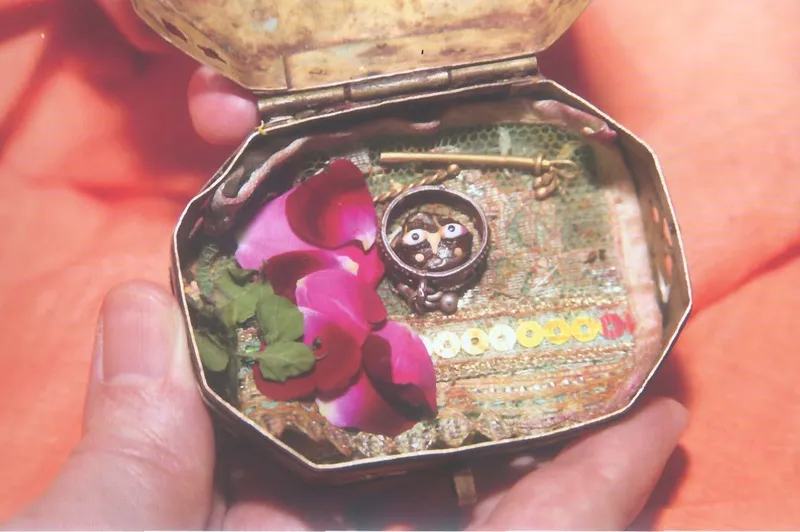
Vṛndāvana, the Playground of God (2010) says that a small Govardhana-śilā, a stone from Govardhana Hill worshipped as Kṛṣṇa, is kept at the new temple, and records a local tradition that Śrīla Sanātana Gosvāmī worshipped it personally. Its photograph shows a small stone in a round metal ring, marked with a pair of large painted eyes, in an eight-sided metal box lined with brocade. No other source mentions this śilā, so the tradition is not certain, and how it came here is not recorded.[1 +1]
The same book keeps it apart from the large Govardhana-śilā with the marks of Kṛṣṇa's foot, which, the book says, Kṛṣṇa gave to Śrīla Sanātana Gosvāmī, and which it places at the Rādhā-Dāmodara temple.[1 +2] Śrī Vraja-maṇḍala Parikramā (2007) mentions a śālagrāma-śilā on the new temple's altar but no Govardhana-śilā; it may simply not mention it.[8]
Songs
The verse with which the Caitanya-caritāmṛta glorifies Rādhā and Madana-mohana, sung as a praṇāma to the Deity of sambandha.
The verse with which the Caitanya-caritāmṛta glorifies Rādhā and Madana-mohana, sung as a praṇāma to the Deity of sambandha.[21]
jayatāṁ suratau paṅgor mama manda-mater gatī
mat-sarvasva-padāmbhojau rādhā-madana-mohanau
Śrīla Viśvanātha Cakravartī Ṭhākura's Madana-gopāladevāṣṭaka sings of Madana-gopāla with Lalitā and Rādhā; the Bhakti-ratnākara quotes its eighth verse after telling how Rādhikā and Lalitā came to Madana-mohana's altar.[8 +2]
Visiting today
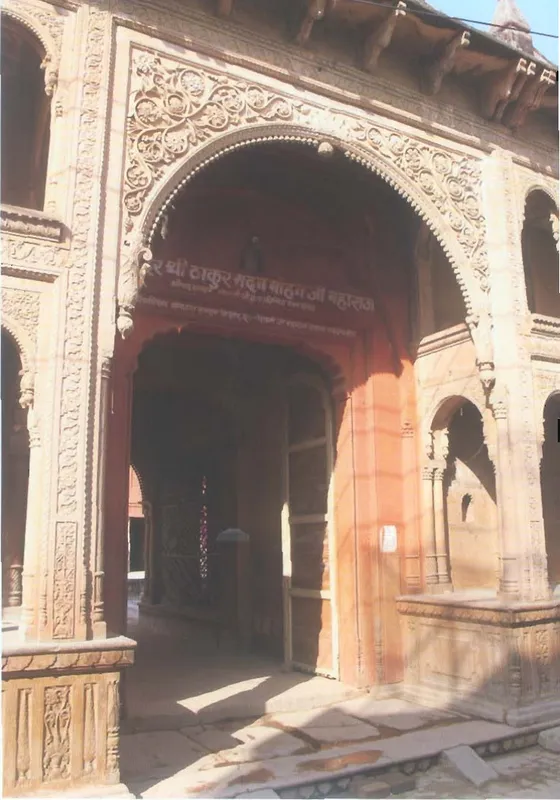
The new temple stands immediately beside the old one; Vṛndāvana, the Playground of God (2010) shows its carved stone entrance gateway, and The Color Guide to Vṛndāvana (2000) draws the "present temple" joined to the old temple on its plan of the compound.[1 +3] The 2007 guidebook describes Madana-mohana with Rādhikā and Lalitā on the altar, a śālagrāma-śilā, and Jagannātha in a separate room.[8 +1]
Location
| Where it is | 'immediately adjacent' to the old temple[25] |
|---|
Places at Madana-mohana Mandira (Vṛndāvana, new)
1 places
Nearby places
Rādhā-Madana-mohana Mandira (Vṛndāvana, old)
Pictures
1 pictures
History
The old temple and the new
Śrīla Prabhupāda said in a lecture of 1967 that the old temple was first built by Śrīla Sanātana Gosvāmī and was desecrated by Emperor Aurangzeb, and that Madana-mohana now resides in a new temple. In a letter of 1973 he wrote that the original temple stood on high ground and still stands beside the new one. He names no builder or date for the new temple.[7 +1]
Names this place“The temple of Madan Mohan was formerly on high level, that is, the original old temple. It is still existent and can be seen side by side with the new Madan Mohan temple. … The old temples are rejected and these temples are both now newly situated as you will see in the photos.”
Śrīla Prabhupāda, Letter to Jadurani, letter 73-06-28, 28 June 1973 · vedabase.io
The historian Prabhudayāl Mītal (1966) says that the Gauḍīya devotees of Vṛndāvana installed the pratibhū Deity in Saṁvat 1805 (about 1748–49), and that a Bengali devotee named Nandakumāra Vasu built the new temple near the old one in Saṁvat 1877 (about 1820–21), the same year as his new temples of Govindadeva and Gopīnātha. A. W. Entwistle (1987) also names Nand Kumar Bose, a Bengali Kāyastha, early in the nineteenth century.[10 +3] The guidebooks and a Bengali history of 1920 give other years and builders (see below).[10 +3]
Rādhikā and Lalitā
Śrīla Prabhupāda wrote that in Śrīla Kṛṣṇadāsa Kavirāja Gosvāmī's time Madana-mohana stood alone, and that the Deity of Rādhārāṇī was added later.[8 +1] According to the Bhakti-ratnākara, two goddess Deities were sent from Purī, and Madana-mohana told His servant in a dream that they were Rādhikā and Lalitā: he should place the smaller, Rādhikā, on His left and the taller, Lalitā, on His right, and the servant did so (summarised here, not translated). The guidebook Śrī Vraja-maṇḍala Parikramā (2007) describes this arrangement on the new temple's altar.[8 +1]
Where the sources differ
Who built the new temple and when: the guidebooks, Śrīla Prabhupāda, the historians and the 1920 Vṛndāvana-kathā give different …
Who built the new temple and when: the guidebooks, Śrīla Prabhupāda, the historians and the 1920 Vṛndāvana-kathā give different builders and years, and some of them may rest on no record.[1 +5]
Accounts differ Who built the newer Madana-mohana temple beside the old one, and when.
- Śrī Vraja-maṇḍala Parikramā (2007)A pratibhū-vigraha was established in 1748; Śrī Nandalāla Vasu built the present temple in 1819.
- Vṛndāvana, the Playground of God (2010)After the old temple was damaged, the devotees running it, descendants of Śrīla Sanātana Gosvāmī's disciples, built a new temple immediately adjacent to it.
- Śrīla Prabhupāda, lecture 18 March 1967'Then another new temple is now constructed where Madana-mohana is residing' (no builder or date).
- Mītal (1966), part 1 p. 136 and part 2 p. 277The pratibhū-vigraha was installed in Saṁvat 1805 (about 1748-49); a Bengali devotee named Nandakumāra (Vasu) built a new temple near the old one in Saṁvat 1877 (about 1820-21) and the pratibhū-vigraha was seated in it.
References
25 references
- Vṛndāvana, the Playground of God (2010), Bhakti Caitanya Svāmī, PDF p. 17
- Vṛndāvana, the Playground of God (2010), Bhakti Caitanya Svāmī, PDF p. 21
- The Color Guide to Vṛndāvana (2000), Written and Photographed by Rājaśekhara dāsa Brahmacārī, PDF p. 165
- The Color Guide to Vṛndāvana (2000), Written and Photographed by Rājaśekhara dāsa Brahmacārī, PDF p. 11
- Vṛndāvana, the Playground of God (2010), Bhakti Caitanya Svāmī, PDF p. 22
- Śrī Vraja-maṇḍala Parikramā (2007), PDF p. 327
- Śrīla Prabhupāda, Lecture on Śrī Caitanya-caritāmṛta, Ādi-līlā 7.149-171, San Francisco, 18 March 1967 · vedabase.io
- Śrī Vraja-maṇḍala Parikramā (2007), PDF p. 328
- Śrīla Prabhupāda, Letter to Jadurani, letter 73-06-28, 28 June 1973 · vedabase.io
- A. W. Entwistle, ch. 8 §66.3 'Madanmohan', printed p. 402, Egbert Forsten, Groningen, 1987
- A. W. Entwistle, ch. 5 §36 'The Gaudiya Sampraday in modern times', printed p. 219, Egbert Forsten, Groningen, 1987
- Prabhudayāl Mītal, part 1 ('ब्रज-संस्कृति की भूमिका'), 'Braj-yātrā', Vṛndāvana: end of the Madanamohana entry, printed p. 136
- Prabhudayāl Mītal, part 2 ('ब्रज का इतिहास'), modern period, entry 'Nandakumāra Vasu', printed p. 277
- Vṛndāvana, the Playground of God (2010), Bhakti Caitanya Svāmī, PDF p. 19
- Śrīla Kṛṣṇadāsa Kavirāja Gosvāmī, Śrī Caitanya-caritāmṛta, Ādi-līlā 1.15, online edition · vedabase.io
- Śrīla Prabhupāda, Śrī Caitanya-caritāmṛta, Ādi-līlā 1.19, purport · vedabase.io
- Śrīla Prabhupāda, Śrī Caitanya-caritāmṛta, Ādi-līlā 1.47, purport · vedabase.io
- Śrīla Narahari Cakravartī, Bhakti-ratnākara, Sixth Wave (ṣaṣṭha taraṅga), 1912 ed. pp. 458-459, 2nd ed., 1912
- Vṛndāvana, the Playground of God (2010), Bhakti Caitanya Svāmī, PDF p. 52
- Vṛndāvana, the Playground of God (2010), Bhakti Caitanya Svāmī, PDF p. 53
Show all 25 references
- Sambandhādhideva Praṇāma (jayatāṁ suratau paṅgor) (Kṛṣṇadāsa Kavirāja Gosvāmī (as the song book credits it)) · song book
- Śrī Madana-gopāladevāṣṭaka (Viśvanātha Cakravartī Ṭhākura (as the song book credits it)) · song book
- the undated parikramā notes Vṛndāvana, ¶56
- Vṛndāvana-kathā, ch. 3, printed p. 65
- Vṛndāvana, the Playground of God (2010), Bhakti Caitanya Svāmī, p. 17