Sanātana Gosvāmī's govardhana-śilā (Rādhā-Dāmodara)
सनातन गोस्वामी की गोवर्धन-शिला (राधा-दामोदर) Hindi name proposed
Also called Sanātana Gosvāmī's Govardhana śilā, Govardhana-śilā of Sanātana Gosvāmī (Rādhā-Dāmodara)
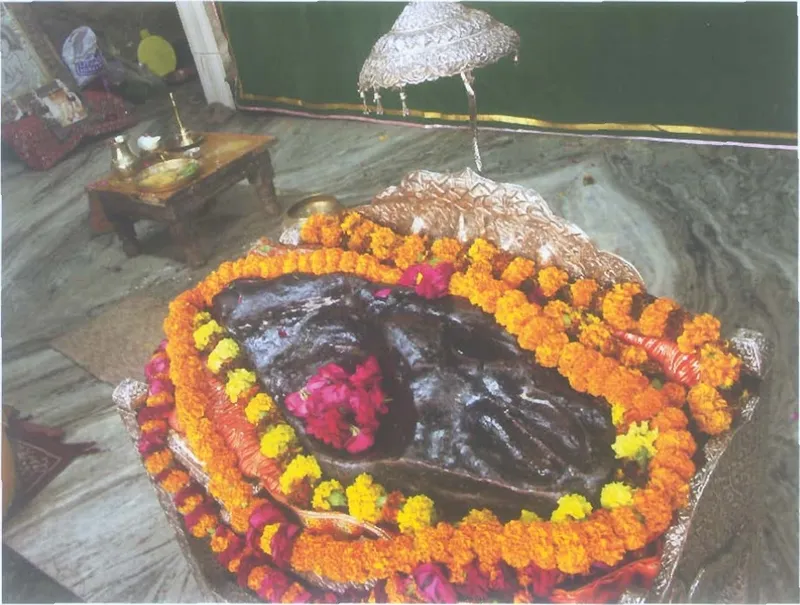
- What it is
- A large dark stone from Govardhana Hill is kept in the Rādhā-Dāmodara temple in Vṛndāvana and shown to pilgrims on request.
- Visiting
- Vṛndāvana, the Playground of God (2010) shows the śilā as a large dark stone on a metal tray under a small parasol, garlanded with flowers, with its marks pointed out in the caption.
In short
A large dark stone from Govardhana Hill is kept in the Rādhā-Dāmodara temple in Vṛndāvana and shown to pilgrims on request. The guidebooks identify it as the śilā (stone) that Kṛṣṇa gave Śrīla Sanātana Gosvāmī.[1 +7] According to the Bhakti-ratnākara, Kṛṣṇa came as a cowherd boy to the aged Śrīla Sanātana Gosvāmī at Cakra-tīrtha, gave him a Govardhana-śilā bearing His own footprint, and told him that going around it would fulfil his daily walk around the hill.[7 +1] The guidebooks say that after Śrīla Sanātana Gosvāmī's passing, Śrīla Jīva Gosvāmī installed it in this temple.[1 +2] The sources differ on its marks, on the number of rounds, and on whether the original is here or in Jaipur.
Key facts
| Kind | śilā |
|---|---|
| Region · area | Vṛndāvana · Rādhā-Dāmodara Mandira (Vṛndāvana) |
| Ācāryas | Śrīla Sanātana Gosvāmī, Śrīla Jīva Gosvāmī |
Why it is glorified
The Śrīmad-Bhāgavatam does not tell of this stone; its gift is set in Śrīla Sanātana Gosvāmī's lifetime.
The Śrīmad-Bhāgavatam does not tell of this stone; its gift is set in Śrīla Sanātana Gosvāmī's lifetime. In the gopīs' song about Kṛṣṇa's flute they praise Govardhana as the best of the Lord's servants, jubilant at the touch of the feet of Kṛṣṇa and Balarāma:[10 +2]
Of all the devotees, this Govardhana Hill is the best! O my friends, this hill supplies Kṛṣṇa and Balarāma, as well as Their calves, cows and cowherd friends, with all kinds of necessities — water for drinking, very soft grass, caves, fruits, flowers and vegetables. In this way the hill offers respect to the Lord. Being touched by the lotus feet of Kṛṣṇa and Balarāma, Govardhana Hill appears very jubilant.
Translation: Śrīla A.C. Bhaktivedanta Swami PrabhupādaThe commentators explain that joy through the hill's stones (summarised here, not translated). Śrīla Viśvanātha Cakravartī Ṭhākura writes that when Their feet touch them, Govardhana's stones become like soft mud and take Their footprints, marked with the flag, thunderbolt and goad. Śrīla Sanātana Gosvāmī writes that wherever Kṛṣṇa steps, the stones at once turn as soft as butter. Neither names any particular stone.[14] Śrīla Jīva Gosvāmī and Śrīla Sanātana Gosvāmī also say that stones melt when Kṛṣṇa plays His flute.[15 +1]
Later the gopīs tell Uddhava that they can never forget Kṛṣṇa, because they see His footprints marked with divine symbols (ŚB 10.47.50, translated by Śrīla Prabhupāda's disciples). Śrīla Viśvanātha Cakravartī Ṭhākura adds that these footprints are present "even now" on stones and in other places.[17 +3]
Traditional accounts
The Bhakti-ratnākara (Fifth Wave) tells the story on the Govardhana parikramā. Śrīla Sanātana Gosvāmī lived in a hut at Cakra-tīrtha and walked around Govardhana every day. Seeing his labour in old age, Kṛṣṇa as Gopīnātha met him in the guise of a cowherd boy, climbed the hill and brought down a śilā with His own footprint. He told Śrīla Sanātana Gosvāmī to go around it from that day, gave it to him at the hut and disappeared (summarised here, not translated).[1 +5]
নিজ পদ চিহ্ন গোবর্দ্ধন শিলা আনি । সনাতনে কহে পুন সুমধুর বাণী ॥ অহে স্বামি লহ এই কৃষ্ণপদচিন । আজি হৈতে করিবে ইহার প্রদক্ষিণ ॥ সব পরিক্রমা সিদ্ধ হইব ইহাতে । এত কহি শিলা আনি দিলেন কুটীতে । শিলা সমর্পিয়া কৃষ্ণ হৈল অদর্শন । বালকে না দেখি ব্যগ্র হৈল সনাতন ॥
nija pada cihna gobarddhana śilā āni
sanātane kahe puna sumadhura bāṇī
ahe sbāmi laha ei kṛṣṇapadacina
āji haite karibe ihāra pradakṣiṇa
saba parikramā siddha haiba ihāte
eta kahi śilā āni dilena kuṭīte
śilā samarpiẏā kṛṣṇa haila adarśana
bālake nā dekhi byagra haila sanātana ||
The Bhakti-ratnākara says nothing of where the stone went later. Śrīla Sanātana Gosvāmī's bhajana-kuṭī at Cakra-tīrtha tells the story in full.[7 +1] Read more: Govardhana parikramā →
Śrīla Prabhupāda
In a conversation of 1975 Śrīla Prabhupāda reminded his disciples of a footprint of Kṛṣṇa that they had seen at the …
In a conversation of 1975 Śrīla Prabhupāda reminded his disciples of a footprint of Kṛṣṇa that they had seen at the Rādhā-Dāmodara temple. He does not name the śilā or Śrīla Sanātana Gosvāmī, and the transcript does not say which footprint he meant, though the guidebooks describe no other footprint of Kṛṣṇa at the temple.[22]
Names this place“Yaśodānandana: They were much bigger. Prabhupāda: You have seen that Rādhā-Dāmodara temple, Kṛṣṇa footprint impression.”
Śrīla Prabhupāda, Conversation with Devotees, Hyderabad, 14 April 1975 · vedabase.io
Visiting today
Vṛndāvana, the Playground of God (2010) shows the śilā as a large dark stone on a metal tray under a small parasol, garlanded with flowers, with its marks pointed out in the caption. Śrī Vraja-maṇḍala Parikramā (2007) gives its length as one and a half cubits.[1 +2] To see it, ask the pūjārī; the guidebooks of 2000 to 2010 add that a small donation is usual.[1 +5]
History
No early source tells how or when the stone came to Vṛndāvana. Śrī Vraja-maṇḍala Parikramā (2007) says that Śrīla Sanātana Gosvāmī brought it to Vṛndāvana and went around it daily, and that after his passing Śrīla Jīva Gosvāmī installed it in the Rādhā-Dāmodara temple and began to worship it; Govardhana Hill (2001) says only that it was kept at the temple after his passing.[1 +2] The earliest account found is the Bengali Vṛndāvana-kathā (1920). It describes a black stone shaped like a banyan leaf, about one and a half cubits long, given by a boy of Vraja, and says that Śrīla Jīva Gosvāmī kept it in this temple and worshipped it. In 1920 it was shown for a separate fee of one rupee four annas.[1 +3]
Where the sources differ
The marks on the śilā and how they came to be
Accounts differ The marks on the śilā and how they came to be
- Bhakti-ratnākara, Fifth Wavethe cowherd boy climbed the hill and brought a Govardhana-śilā bearing His own footprint ('nija pada cihna', 'kṛṣṇapadacina'); no other marks
- the undated parikramā notes Vṛndāvana and The Color Guide to Vṛndāvana (2000)Kṛṣṇa stood on a big stone of the hill and played His flute until the stone melted, leaving His footprint, a calf's hoofprint, His flute and His stick
- Vṛndāvana, the Playground of God (2010)as the Lord spoke, standing on a large rock with a calf beside Him, the rock melted, leaving His footprint, the calf's, and the marks of His flute and stick
- Govardhana Hill: India's Most Sacred Mountain (2001)Kṛṣṇa brought a rock from the hill on which His footprint, a calf's hoofprint, His flute and stick were impressed
Accounts differ How many circumambulations of the śilā equal a Govardhana parikramā
- Vṛndāvana, the Playground of God (2010)seven times every day
- Govardhana Hill: India's Most Sacred Mountain (2001)seven times
- The Color Guide to Vṛndāvana (2000)four times
- the undated parikramā notes Vṛndāvanathree times
Whether the original śilā is in Vṛndāvana or in Jaipur.
Accounts differ Where the original śilā is now
- the undated parikramā notes Vṛndāvana, Vṛndāvana, the Playground of God (2010), The Color Guide to Vṛndāvana (2000), Vṛndāvana-Dhāma Ki Jaya! (c. 1986)kept in the Rādhā-Dāmodara temple, Vṛndāvana (shown on request)
- Śrī Vraja-maṇḍala Parikramā (2007), Vṛndāvana chapterŚrīla Jīva Gosvāmī installed it in the Rādhā-Dāmodara temple; darśana on special request (Jaipur not mentioned)
- Śrī Vraja-maṇḍala Parikramā (2007), Govardhana chapterit 'used to reside in the temple of Śrī Rādhā-Dāmodara in Vṛndāvana, but nowadays it is in the temple of Śrī Rādhā-Dāmodara in Jaipura'; its pratibhū-vigraha is in Vṛndāvana
- Govardhana Hill: India's Most Sacred Mountain (2001)a similar śilā is kept at the Rādhā-Dāmodara temple in Jaipur, 'but the śilā kept in Vṛndāvana is believed to be the original'
More on this place
Govardhana parikramā
References
24 references
- Śrī Vraja-maṇḍala Parikramā (2007), PDF p. 331
- Vṛndāvana, the Playground of God (2010), Bhakti Caitanya Svāmī, PDF p. 53
- Vṛndāvana-kathā, chapter 5 (pañcama pariccheda, 'Rādhā-Dāmodarajī'), printed p. 82
- the undated parikramā notes Vṛndāvana, ¶142
- The Color Guide to Vṛndāvana (2000), Written and Photographed by Rājaśekhara dāsa Brahmacārī, PDF p. 80
- Vṛndāvana-Dhāma Ki Jaya! (c. 1986), by Dhruva Mahārāja dāsa, PDF p. 67
- Śrīla Narahari Cakravartī, Bhakti-ratnākara, Fifth Wave, 1912 ed. p. 208, 2nd ed., 1912
- Śrīla Narahari Cakravartī, Bhakti-ratnākara, Fifth Wave, 1912 ed. p. 209, 2nd ed., 1912
- Govardhana Hill: India's Most Sacred Mountain (2001), Rajasekhara dasa Brahmacari, PDF p. 83
- Śrīmad-Bhāgavatam 10.21.18, Bhagavata Vidya Pith edition, ed. Bhagavata Rishi and Krishna Shankar Shastri, 1996
- Śrīmad-Bhāgavatam 10.21.19, Bhagavata Vidya Pith edition, ed. Bhagavata Rishi and Krishna Shankar Shastri, 1996
- Śrīla Prabhupāda, Kṛṣṇa, the Supreme Personality of Godhead (Kṛṣṇa book), Chapter 21, The Gopīs Attracted by the Flute · vedabase.io
- Śrīmad-Bhāgavatam 10.21.18, Bhagavata Vidya Pith edition, ed. Bhagavata Rishi and Krishna Shankar Shastri, 1996
- Śrīla Viśvanātha Cakravartī Ṭhākura: commentary on ŚB 10.21.18, Bhagavata Vidya Pith edition, ed. Bhagavata Rishi and Krishna Shankar Shastri, 1996
- Śrīla Jīva Gosvāmī: commentary on ŚB 10.21.15, Bhagavata Vidya Pith edition, ed. Bhagavata Rishi and Krishna Shankar Shastri, 1996
- Śrīla Sanātana Gosvāmī: commentary on ŚB 10.87.24, part 2 of the comment, Bhagavata Vidya Pith edition, ed. Bhagavata Rishi and Krishna Shankar Shastri, 1996
- Śrīmad-Bhāgavatam 10.47.50, Bhagavata Vidya Pith edition, ed. Bhagavata Rishi and Krishna Shankar Shastri, 1996
- Śrīla Prabhupāda, Kṛṣṇa, the Supreme Personality of Godhead (Kṛṣṇa book), Chapter 47, Delivery of the Message of Kṛṣṇa to the Gopīs · vedabase.io
- ŚB 10.47.49, translation by Śrīla Prabhupāda's disciples · vedabase.io
- Śrīla Viśvanātha Cakravartī Ṭhākura: commentary on ŚB 10.47.50, Bhagavata Vidya Pith edition, ed. Bhagavata Rishi and Krishna Shankar Shastri, 1996
- Śrīla Narahari Cakravartī, Bhakti-ratnākara, Fifth Wave, 1912 ed. p. 209, 2nd ed., 1912
- Śrīla Prabhupāda, Conversation with Devotees, Hyderabad, 14 April 1975 · vedabase.io
- Śrī Vraja-maṇḍala Parikramā (2007), p. 636-637
- Vṛndāvana, the Playground of God (2010), Bhakti Caitanya Svāmī, p. 52