Māna-sarovara Mandira (Māṭavana)
मान-सरोवर मन्दिर (माटवन) Hindi name proposed
Also called Maan Sarovara temple
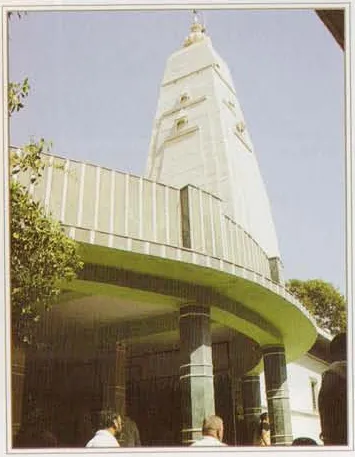
- What it is
- The Māna-sarovara Mandira is the old temple on the bank of Māna-sarovara, the lake of Māṭavana across the Yamunā from Vṛndāvana.
- Visiting
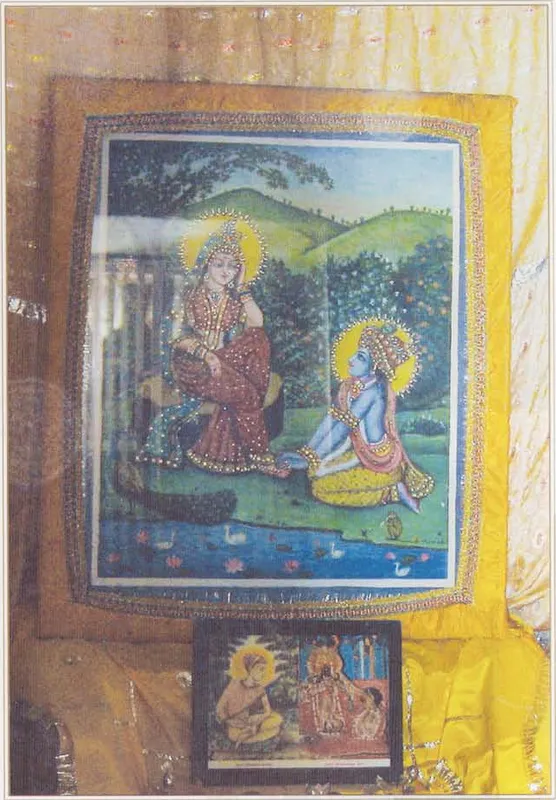
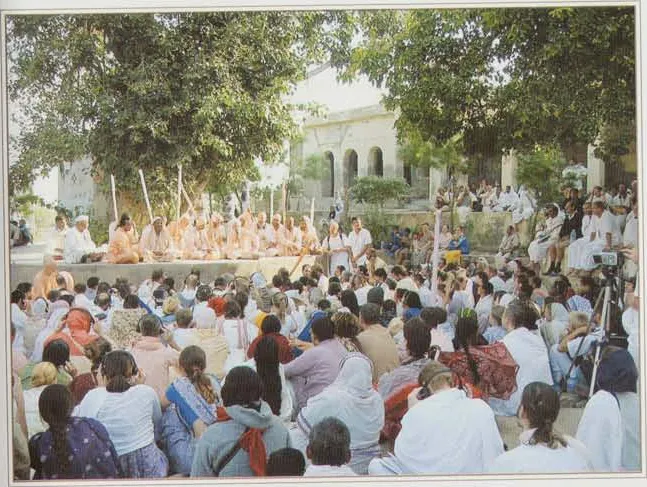
- Śrī Vraja-maṇḍala Parikramā (2007) prints photographs of the temple and of the painting, and one of a gathering for hari-kathā, talks about Kṛṣṇa, outside the temple.
In short
The Māna-sarovara Mandira is the old temple on the bank of Māna-sarovara, the lake of Māṭavana across the Yamunā from Vṛndāvana. According to the guidebook Śrī Vraja-maṇḍala Parikramā (2007) and the undated parikramā notes Māna-sarovara, a painting is worshipped in it that shows Kṛṣṇa at the feet of Śrīmatī Rādhikā, asking Her to give up Her māna, Her loving anger.[1 +2] Śrīmad-Bhāgavatam tells of the gopī who became proud on the night of the rāsa dance, but it has no such scene and names no lake or temple.[4 +1] No date or builder of the temple was found.
Key facts
| Kind | temple |
|---|---|
| Region · area | Bhāṇḍīravana · Māna-sarovara (Māṭavana) |
| Ācāryas | Śrīla Jayadeva Gosvāmī |
Divine pastimes
The painting and the Bhāgavatam
Śrī Vraja-maṇḍala Parikramā (2007) sets the scene of the painting at this lake, at the time of the autumn rāsa dance, and connects it with Śrīla Jayadeva Gosvāmī's Gīta-govinda, which itself names no lake or temple.[1 +3] This page does not tell the scene: the page of Māna-sarovara gives Śrīla Prabhupāda's words on that poem, which explain why, and sets the accounts of the lake side by side.[6] Read more: Śrī Rādhā's māna at the autumn rāsa and how it was broken →
Śrīmad-Bhāgavatam (10.30.35-40) tells it differently. On the night of the rāsa dance Kṛṣṇa led one gopī away alone. When She grew proud and asked to be carried, He told Her to climb on His shoulder and then disappeared, and She was left lamenting. The Bhāgavatam names no place.[4 +1]
evam uktaḥ priyām āha skandha āruhyatām iti / tataś cāntardadhe kṛṣṇaḥ sā vadhūr anvatapyata
Thus addressed, Lord Kṛṣṇa replied, “Just climb on My shoulder.” But as soon as He said this, He disappeared. His beloved consort then immediately felt great remorse.
Translation: Śrīla Prabhupāda's disciples (BBT)In his Kṛṣṇa book Śrīla Prabhupāda names that gopī: Rādhārāṇī. He too names no lake or temple.[4 +1]
General teaching (does not name the place)“When Kṛṣṇa was spoken to in this way, He might have told Rādhārāṇī, ‘All right, better get on My shoulder.’ But immediately Kṛṣṇa must have disappeared, and now Rādhārāṇī must be lamenting for Him”
Śrīla Prabhupāda, Kṛṣṇa, the Supreme Personality of Godhead, ch. 30, 'Kṛṣṇa's Hiding from the Gopīs' · vedabase.io
Visiting today
Śrī Vraja-maṇḍala Parikramā (2007) prints photographs of the temple and of the painting, and one of a gathering for hari-kathā, talks about Kṛṣṇa, outside the temple. They show the temple as it was in 2007; its present state has not been checked.[1 +2]
Location
| Where it is | bank of Māna-sarovara[8] |
|---|
Pictures
2 pictures
History
No date, builder or document for the old temple was found. F. S. Growse, writing in 1883, describes two small, plain shrines at the lake, then recent, and the hermitage of Lakhmī Dās, a gosāīṁ of the Rādhāvallabha sampradāya. He does not mention a painting, and it is not certain whether the old temple is one of those shrines.[7] The records differ on who built the shrines and on whether the temple of Rājā Sūraj Mal's queen stands at the lake or in the village of Pānī-gaon, south of it; those accounts are set side by side on the page of Pānī-gaon.[7]
More on this place
Śrī Rādhā's māna at the autumn rāsa and how it was broken
References
8 references
- Śrī Vraja-maṇḍala Parikramā (2007), PDF p. 259
- Śrī Vraja-maṇḍala Parikramā (2007), PDF p. 260
- the undated parikramā notes Māna-sarovara, ¶11
- Śrīmad-Bhāgavatam ŚB 10.30.38, GRETIL
- Śrīla Prabhupāda, Kṛṣṇa, the Supreme Personality of Godhead, ch. 30, 'Kṛṣṇa's Hiding from the Gopīs' · vedabase.io
- Śrīla Jayadeva Gosvāmī, Gīta-govinda, sarga 10, verse 8 (seventh stanza of Song 19; GRETIL GG_10.8), GRETIL
- Mathurá (1883), F. S. Growse, B.C.S., M.A. Oxon., C.I.E. (as the title page gives him, p. 87
- Śrī Vraja-maṇḍala Parikramā (2007), p. 492-493