Pāśa-khela-ghāṭa
पाश-खेल-घाट Hindi name proposed
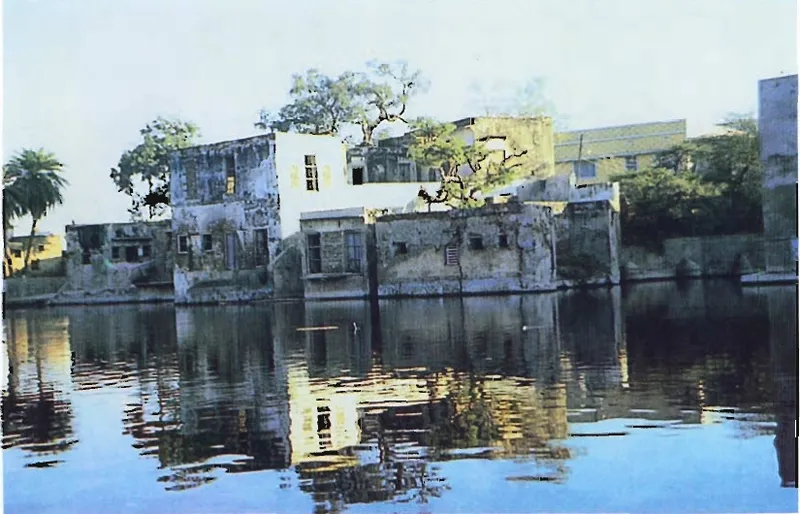
- What it is
- Pāśa-khela-ghāṭa, "the ghāṭa of the dice game", is a bathing ghāṭa on the bank of Śyāma-kuṇḍa at Rādhā-kuṇḍa.
- Visiting
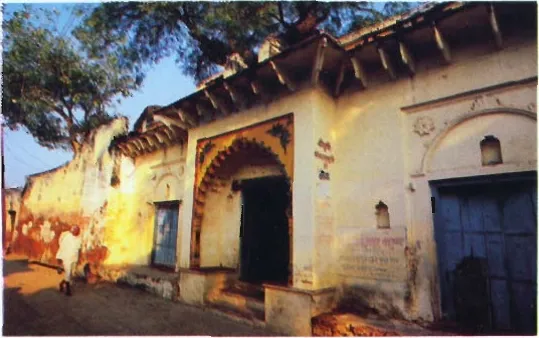
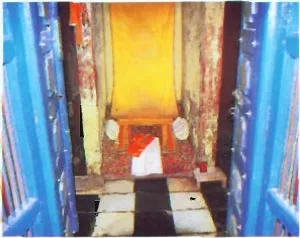
- The Colour Guide (1999) prints photographs of the gateway of Pāśa-khela-ghāṭa and of the baiṭhaka, a narrow shrine with a raised seat, and mentions a small temple of the Vallabha-sampradāya there.
- Places here
- Vallabhācārya's baiṭhaka (Rādhā-kuṇḍa)
In short
Pāśa-khela-ghāṭa, "the ghāṭa of the dice game", is a bathing ghāṭa on the bank of Śyāma-kuṇḍa at Rādhā-kuṇḍa. Only The Colour Guide to Rādhā-kuṇḍa (1999) uses the name: it records a local tradition, which is not certain, that Rādhā and Kṛṣṇa play dice here, and it retells a game from Śrīla Viśvanātha Cakravartī Ṭhākura.[1 +3] That game is in his Kṛṣṇa-bhāvanāmṛta, which names no ghāṭa, and Śrīla Kṛṣṇadāsa Kavirāja Gosvāmī sets the dice game in a kuñja by Rādhā's own lake.[3 +3] The same guidebook places here a sitting place, a baiṭhaka, of Śrī Vallabhācārya, with a small temple of his sampradāya.[1 +7]
Key facts
| Kind | ghāṭa |
|---|---|
| Region · area | Rādhā-kuṇḍa · Śyāma-kuṇḍa (Rādhā-kuṇḍa) |
| Ācāryas | Śrīla Viśvanātha Cakravartī Ṭhākura, Vallabhācārya (Vallabha Bhaṭṭa) |
Divine pastimes
The dice game in the scriptures
Śrīmad-Bhāgavatam tells no dice game of Kṛṣṇa in Vraja. Commenting on 10.47.53, Śrīla Viśvanātha Cakravartī Ṭhākura says that when the gopīs closed their eyes before Uddhava at Kṛṣṇa's message, Kṛṣṇa by His yoga-māyā gave them in that moment a hundred crore years of pastimes with Him, among them the rāsa dance, the dice game and water sports. He names no place (summarised here, not translated).[13]
Śrīla Rūpa Gosvāmī's Ujjvala-nīlamaṇi counts the dice game among the pastimes of the divine lovers and gives an example of it. It names no place.[14]
Śrīla Viśvanātha Cakravartī Ṭhākura's dice game
In the fifteenth canto of Śrīla Viśvanātha Cakravartī Ṭhākura's Kṛṣṇa-bhāvanāmṛta, among the midday pastimes, Rādhā and Kṛṣṇa play a game of dice with Their friends around Them: Sudevī brings the pieces, Nāndīmukhī and Vṛndā are witnesses, Kundalatā keeps the game, and Madhumaṅgala and Lalitā call the throws. The canto names no ghāṭa and does not mention Śyāma-kuṇḍa (summarised here, not translated).[3 +1]
The Colour Guide (1999) retells this game for Pāśa-khela-ghāṭa without naming the work. According to that book, Rādhā and Kṛṣṇa may still play dice at this ghāṭa.[1 +1]
Sudevī's kuñja
Śrīla Kṛṣṇadāsa Kavirāja Gosvāmī's Govinda-līlāmṛta calls Sudevī-sukhada-kuñja, the green kuñja in the north-west of Rādhā's lake, the ground of Rādhā and Kṛṣṇa's dice game. At midday, it says, they go there to play, with Lalitā and Kṛṣṇa's friend advising the throws, Sudevī and Subala moving the pieces, and Kundalatā keeping the game (summarised here, not translated).[5 +1] Read more: The dice game of Rādhā and Kṛṣṇa: the books and the places →
The Gosvāmīs and ācāryas
The Caitanya-caritāmṛta (Madhya 19.61) tells that Śrī Vallabha Bhaṭṭa, then living at Āḍāila near Prayāga, came to see Śrī …
Śrī Vallabhācārya
The Caitanya-caritāmṛta (Madhya 19.61) tells that Śrī Vallabha Bhaṭṭa, then living at Āḍāila near Prayāga, came to see Śrī Caitanya Mahāprabhu. Śrīla Prabhupāda writes in his purport that Vallabha Bhaṭṭa later became the ācārya of the sampradāya known as the Vallabhācārya-sampradāya, wrote a commentary on Śrīmad-Bhāgavatam and established a Deity near Govardhana Hill.[2 +3]
General teaching (does not name the place)“Vallabha Bhaṭṭa wrote many books, including a commentary on Śrīmad-Bhāgavatam called Subodhinī-ṭīkā and notes on the Vedānta-sūtra in the form of an Anubhāṣya. … Near Govardhana Hill he established a Deity in the valley.”
Śrīla Prabhupāda, Śrī Caitanya-caritāmṛta, Madhya-līlā 19.61, purport · vedabase.io
The two guidebooks both record a sitting place of Śrī Vallabhācārya on the bank of Śyāma-kuṇḍa, but at different ghāṭas: The Colour Guide (1999) at Pāśa-khela-ghāṭa, Śrī Vraja-maṇḍala Parikramā (2007) at Vallabha-ghāṭa. The two names may belong to one ghāṭa. No Gauḍīya text found mentions him at Rādhā-kuṇḍa.[1 +7]
Visiting today
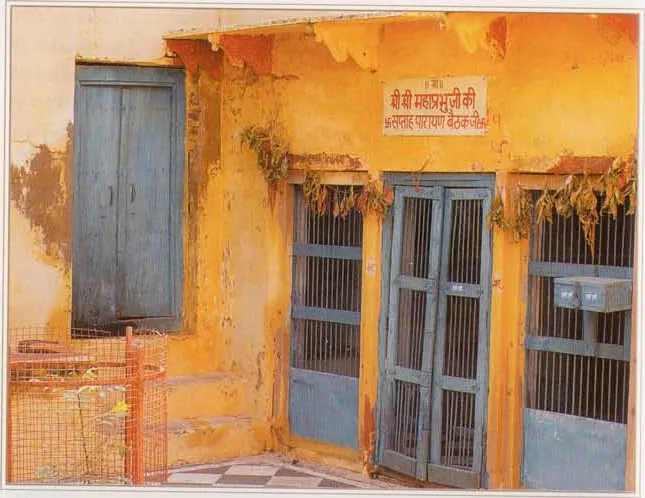
The Colour Guide (1999) prints photographs of the gateway of Pāśa-khela-ghāṭa and of the baiṭhaka, a narrow shrine with a raised seat, and mentions a small temple of the Vallabha-sampradāya there. Śrī Vraja-maṇḍala Parikramā (2007) photographs a building it calls Śrī Vallabhācārya's sitting place. Whether the two photographs show the same building is not stated.[1 +3]
Location
| Where it is | On the banks of Śyāma-kuṇḍa.[20] |
|---|
Places at Pāśa-khela-ghāṭa
1 places
Pictures
3 pictures
History
Three dated works record a memorial of Śrī Vallabhācārya at Rādhā-kuṇḍa before the guidebooks. The Bengali Vṛndāvana-kathā (1920) counts him among those whose seat, hut or other mark remains there. The historian Prabhudayāl Mītal (1966) places his baiṭhaka at Vallabha-ghāṭa, and A. W. Entwistle (1987) describes a temple of his line with his baiṭhaka on the side of Śyāma-kuṇḍa opposite Pañca Pāṇḍava-ghāṭa. None of them gives a date or a builder.[10 +2]
Where the sources differ
Where Rādhā and Kṛṣṇa play dice at the two kuṇḍas.
Accounts differ Where Rādhā and Kṛṣṇa play dice at the two kuṇḍas.
- The Colour Guide to Rādhā-kuṇḍa (1999)At Pāśa-khela-ghāṭa: 'At this celebrated ghāṭa on the banks of Śyāma-kuṇḍa, Rādhā and Kṛṣṇa enjoy the pastimes of pāśa-khela'.
- Śrī Vraja-maṇḍala Parikramā (2007)In Vidagdhānandada-kuñja, Vidagdha Sakhā's 'green emerald' kuñja in the south of Śyāma-kuṇḍa, given to Campakalatā: 'Here the Youthful Couple play the game of chaupaḍa'.
- Govinda-līlāmṛta 7.98–7.99 and 18.25–18.28 (Śrīla Kṛṣṇadāsa Kavirāja Gosvāmī)In Sudevī-sukhada, the all-green kuñja in the north-west of Rādhā's lake, 'the ground of Rādhā and Kṛṣṇa's dice game'; the midday game is played there.
- Kṛṣṇa-bhāvanāmṛta 14.9–14.12 and 15.1–34 (Śrīla Viśvanātha Cakravartī Ṭhākura)Jokes over dice are among the pastimes at Rādhā's lake (14.12); the midday game of sarga 15, which The Colour Guide to Rādhā-kuṇḍa (1999) retells, follows the water sports at the two kuṇḍas and is played in a kuñja that is not named; no ghāṭa.
At which ghāṭa of Śyāma-kuṇḍa Śrī Vallabhācārya's sitting place is: The Colour Guide (1999) says Pāśa-khela-ghāṭa, Śrī Vraja-maṇḍala Parikramā (2007) Vallabha-ghāṭa, under a choharā tree.[1 +5]
Accounts differ At which ghāṭa of Śyāma-kuṇḍa is Vallabhācārya's sitting place?
- The Colour Guide to Rādhā-kuṇḍa (1999)At Pāśa-khela-ghāṭa ('Pāśa-Khela Ghāṭa (Vallabhācārya Baiṭhāka)'), with a small temple run by the Vallabha-sampradāya; no tree is mentioned.
- Śrī Vraja-maṇḍala Parikramā (2007)At Vallabha-ghāṭa, west of Tamāla-talā on the southern bank, under a choharā tree; Pāśa-khela-ghāṭa is not in its list of ghāṭas.
- Prabhudayāl Mītal (1966), p. 104The baiṭhaka of Śrī Vallabhācārya is at Vallabha-ghāṭa (bank not given); Rādhāvallabha-ghāṭa, with Hita Harivaṁśa's baiṭhaka, is named separately.
- A. W. Entwistle (1987), p. 340A Puṣṭimārga temple with the baiṭhakas of Vallabha, Viṭṭhalanātha and Gokulanātha stands on the side of Kṛṣṇa-kuṇḍa opposite Pañca-Pāṇḍava-ghāṭa; no ghāṭa is named.
More on this place
The dice game of Rādhā and Kṛṣṇa: the books and the places
References
20 references
- The Colour Guide to Rādhā-kuṇḍa (1999), Rājaśekhara dāsa Brahmacārī, PDF p. 152
- The Colour Guide to Rādhā-kuṇḍa (1999), Rājaśekhara dāsa Brahmacārī, PDF p. 153
- Śrīla Viśvanātha Cakravartī Ṭhākura, Kṛṣṇa-bhāvanāmṛta, sarga 15 ('mādhyāhnika-līlāsvādana'), v.6–7 with the ṭīkā on v.7 (index locator '(15) caturdaśaḥ sargaḥ'), after the edition of Radhikanath Goswami, Vrindavan, 1906
- Śrīla Viśvanātha Cakravartī Ṭhākura, Kṛṣṇa-bhāvanāmṛta, sarga 15 ('mādhyāhnika-līlāsvādana'), v.33–34 with the ṭīkā on v.33 (index locator '(15) caturdaśaḥ sargaḥ'), after the edition of Radhikanath Goswami, Vrindavan, 1906
- Śrīla Kṛṣṇadāsa Kavirāja Gosvāmī, Govinda-līlāmṛta, 7.98–7.99 (saptamaḥ sargaḥ, the forenoon pastimes; a pair of verses, 'yugmakam'), after the editions of Haridas Das and Haridas Shastri
- Śrīla Kṛṣṇadāsa Kavirāja Gosvāmī, Govinda-līlāmṛta, 18.25–18.28 (aṣṭadaśaḥ sargaḥ, the midday pastimes), after the editions of Haridas Das and Haridas Shastri
- Śrī Vraja-maṇḍala Parikramā (2007), PDF p. 99
- Śrī Vraja-maṇḍala Parikramā (2007), PDF p. 100
- Śrīla Prabhupāda, Śrī Caitanya-caritāmṛta, Madhya-līlā 19.61, purport · vedabase.io
- Vṛndāvana-kathā, chapter 8 (aṣṭama pariccheda), entry 'Rādhākuṇḍa', printed pp. 121-122
- Prabhudayāl Mītal, 'Braj-yātrā', fourth halt (Rādhā-kuṇḍa and Kusuma-sarovara): 'Rādhā-kuṇḍa', printed p. 104
- A. W. Entwistle, ch. 8, gazetteer entry '12 Radhakund' (Govardhana area), printed p. 340, Egbert Forsten, Groningen, 1987
- Śrīla Viśvanātha Cakravartī Ṭhākura: commentary on ŚB 10.47.53, Bhagavata Vidya Pith edition, ed. Bhagavata Rishi and Krishna Shankar Shastri, 1996
- Śrīla Rūpa Gosvāmī, Ujjvala-nīlamaṇi, 15.246, GRETIL
- Govardhana Hill: India's Most Sacred Mountain (2001), Rajasekhara dasa Brahmacari, PDF p. 143
- Śrīla Kṛṣṇadāsa Kavirāja Gosvāmī, Śrī Caitanya-caritāmṛta, CC Madhya-līlā 19.61, online edition · vedabase.io
- Śrī Vraja-maṇḍala Parikramā (2007), PDF p. 102
- The Colour Guide to Rādhā-kuṇḍa (1999), Rājaśekhara dāsa Brahmacārī, PDF p. 9
- Śrī Vraja-maṇḍala Parikramā (2007), PDF p. 101
- The Colour Guide to Rādhā-kuṇḍa (1999), Rājaśekhara dāsa Brahmacārī, p. 148