Raṅgajī Mandira
रंगजी मन्दिर Hindi name proposed
Also called Śrī Raṅgajī Temple, Raṅganatha Temple, Seth temple
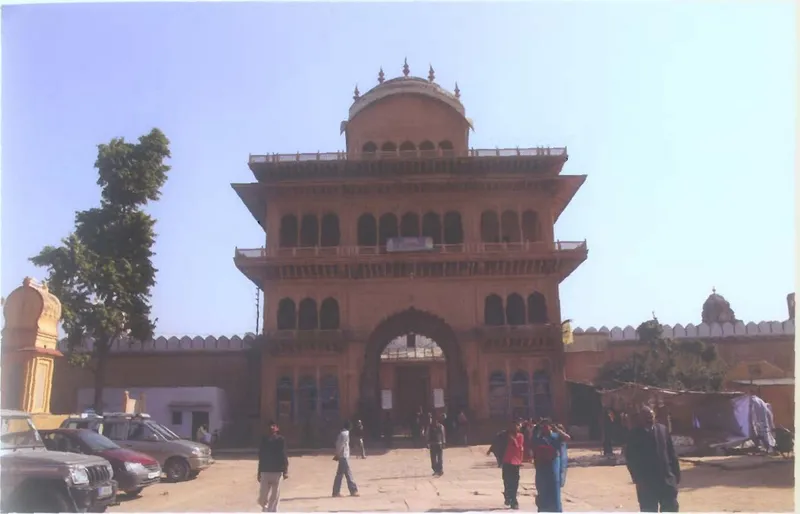
- What it is
- The Raṅgajī Mandira is the large South Indian-style temple of Śrī Raṅganātha (Raṅgajī), a form of Viṣṇu, in Vṛndāvana.
- Visiting
- Vṛndāvana, the Playground of God (2010) calls the Raṅganātha temple the biggest in Vṛndāvana; it has gopuram gateways in the South Indian style as well as gateways in the North Indian style.
- Places here
- Gajarāja-kuṇḍa, Garuḍa-stambha (Raṅgajī Mandira)
In short
The Raṅgajī Mandira is the large South Indian-style temple of Śrī Raṅganātha (Raṅgajī), a form of Viṣṇu, in Vṛndāvana. It belongs to the Śrī Vaiṣṇavas, the followers of Śrī Rāmānujācārya, and is one of the largest temples in the town, enclosed by high walls with gopurams, the tall gateways of South India.[1 +5] The Seṭh family of Mathurā built it, and three guidebooks give 1851 for its completion, after about six years of work.[1 +5] Śrīla Prabhupāda counted it among the big temples that came after the seven old temples of the Gosvāmīs.[9] A pond in the temple, the Gajarāja-kuṇḍa, and its gilded pillar, the Garuḍa-stambha, are described below.
Key facts
| Kind | temple |
|---|---|
| Region · area | Vṛndāvana |
Divine pastimes
Gajendra's deliverance
No scripture mentions this temple, which dates from the nineteenth century; its link with scripture is a pastime that is shown here every year.[10] According to Śrī Vraja-maṇḍala Parikramā (2007), on Baladeva-pūrṇimā the fight between the elephant Gajendra and the crocodile, with Śrī Hari protecting the elephant who surrendered to Him, is displayed in a pond near the temple's main entrance on the north. The Bengali Vṛndāvana-kathā (1920) reports that on the full-moon day of Śrāvaṇa the Deity was taken round the stone-lined tank in a boat while the deliverance of Gajendra was shown.[4 +3]
The same 2007 book names a Gajarāja-kuṇḍa in the temple of Śrī Raṅgajī as the third of the six kuṇḍas of Vṛndāvana in its list (gaja-rāja, like gajendra, means the king of the elephants). It does not say that this is the pond of the yearly display, though the name suggests it.[4 +1]
The Bhāgavatam (Canto 8, chapters 2–3) sets the pastime far from Vraja. Gajendra lived in the forests of Trikūṭa, a mountain in the Ocean of Milk, and a crocodile seized him in the lake there. The Lord came on Garuḍa, pulled the elephant and the crocodile out of the water, and cut off the crocodile's mouth with His disc. The pond is therefore a place where the pastime is shown, not where it happened.[10 +3]
taṃ vīkṣya pīḍitamajaḥ sahasāvatīrya sagrāhamāśu sarasaḥ kṛpayojjahāra / grāhādvipāṭitamukhādariṇā gajendraṃ saṃpaśyatāṃ hariramūmucaducchriyāṇām
Thereafter, seeing Gajendra in such an aggrieved position, the unborn Supreme Personality of Godhead, Hari, immediately got down from the back of Garuḍa by His causeless mercy and pulled the King of the elephants, along with the crocodile, out of the water. Then, in the presence of all the demigods, who were looking on, the Lord severed the crocodile’s mouth from its body with His disc. In this way He saved Gajendra, the King of the elephants.
Translation: Śrīla A.C. Bhaktivedanta Swami PrabhupādaŚrīla Prabhupāda
Śrīla Prabhupāda spoke of this temple several times in passing.
Śrīla Prabhupāda spoke of this temple several times in passing. In Paris in 1974 he named it among the big temples of Vṛndāvana that came after the seven old temples:[9]
Names this place“These are old seven temples. Later on, other big, big temples, Raṅganātha temple and Gaekwar temple, like that, Jaipur temple, they came into existence.”
Śrīla Prabhupāda, Room Conversation with Professor Olivier Lacombe, Paris, 14 June 1974 · vedabase.io
In 1975 he gave it as an example of the very big temples built in the southern manner, and in 1976 he said that the original Raṅganātha temple is in the South and that Vṛndāvana has one too.[3 +4]
In a letter of 1970 to an Indian official he wrote that one of his Western disciples had been refused entry here:[25]
Names this place“Similarly one disciple was refused entry in the Ranganatha Temple in Vrndavana.”
Śrīla Prabhupāda, Letter to P. Gangulee (Minister of Education & Culture, Embassy of India, Washington), letter 70-08-16, 16 August 1970 · vedabase.io
Visiting today
The temple
Vṛndāvana, the Playground of God (2010) calls the Raṅganātha temple the biggest in Vṛndāvana; it has gopuram gateways in the South Indian style as well as gateways in the North Indian style.[1 +4] The Vṛndāvana-kathā (1920) describes the Govindajī temple on one side of the road from Mathurā and the Seṭhs' temple on the other.[26]
The Color Guide to Vṛndāvana (2000) describes a ten-day Brahmotsava with a car festival in the month of Caitra (March–April), when the car is pulled to the Raṅgajī Bāg garden nearby; Śrī Vraja-maṇḍala Parikramā (2007) says that the great chariot stands near the western door.[3 +1] The 2007 book also places Brahma-kuṇḍa to the north of the temple.[3 +2]
The darśana times printed in 2000 (in summer maṅgala-ārati at 4 a.m., darśana 8 a.m. to noon and 3 to 6 p.m.) may well have changed; ask at the temple.[3]
Location
| Where it is | map key 25[31] surrounded by high walls; the car goes to the Raṅgajī Bāg nearby[32] |
|---|
Places at Raṅgajī Mandira
2 places
Nearby places
Raṅgajī Bāg · Rādhā-Govinda Mandira (Vṛndāvana, old)
Pictures
4 pictures
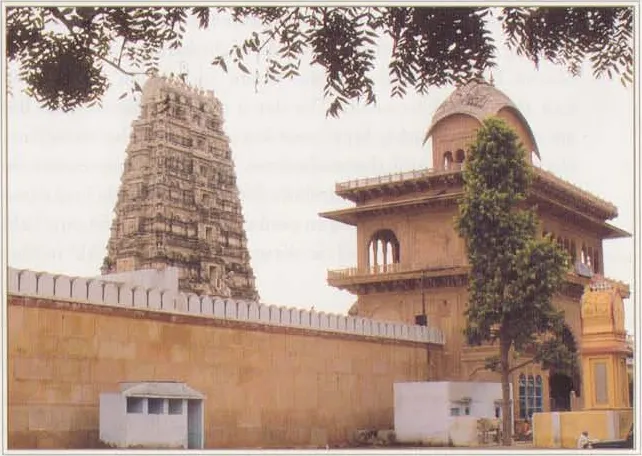
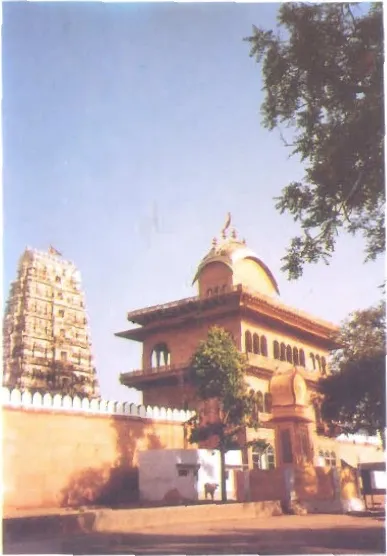
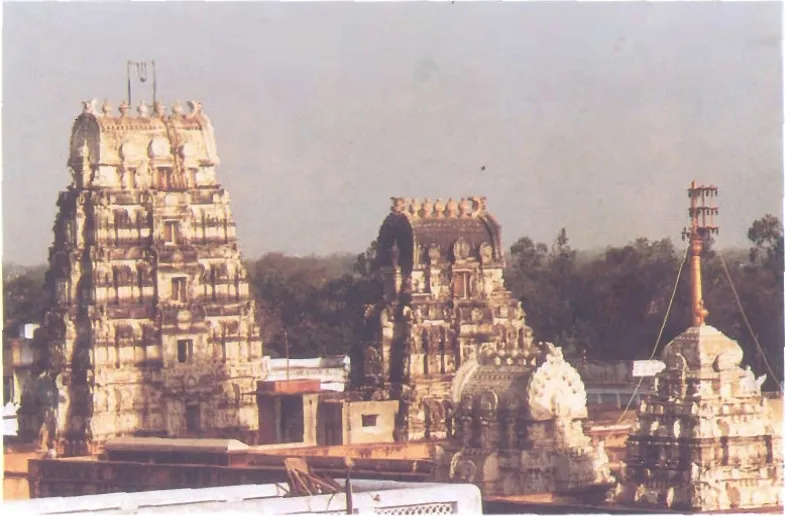
History
The builders
The guidebooks give 1851 for the temple and the Seṭh family of Mathurā as its builders. Śrī Vraja-maṇḍala Parikramā (2007) names Śrī Lakṣmīcanda Seṭh and a cost of 4.5 million (45 lakh) rupees, and Vṛndāvana, the Playground of God (2010) says that it is still sometimes called the Seṭh temple.[1 +5] The historian Prabhudayāl Mītal (1966) gives Saṁvat 1902 (about 1845) for the start and Saṁvat 1908 (about 1851) for the end, at 45 lakh rupees.[16 +1] A. W. Entwistle (1987) says that it was modelled on the temple of Śrīraṅgam in South India, was finished in 1851 after six years, and was endowed with thirty-three villages.[7]
The sources differ on which members of the family built it. Mītal and Entwistle name Lakṣmīcanda's younger brothers, Rādhākṛṣṇa and Govindadāsa, who had come under the influence of Śrī Svāmī Raṅgācārya of the Rāmānuja line; Mītal adds that the work stopped for lack of money and that Lakṣmīcanda then completed it.[6 +2] The Vṛndāvana-kathā (1920) says that the two younger brothers took initiation secretly from Śrī Raṅgācārya, a Śrī-sampradāya teacher from Madras who lived at Govardhana, that the eldest brother then left the Jain faith and took initiation from him too, and that the three built the temple together from 1845 to 1851.[12 +1]
Accounts differ Who built the Raṅgajī temple: Seṭh Lakṣmīcanda, or his younger brothers Rādhākṛṣṇa and Govindadāsa.
- Śrī Vraja-maṇḍala Parikramā (2007)'In 1851 AD, Śrī Lakṣmīcanda Seṭh built this temple at the expense of 4.5 million rupees.'
- Vṛndāvana, the Playground of God (2010), The Color Guide to Vṛndāvana (2000)Built by the (wealthy) Seth family of Mathurā in 1851.
- Entwistle (1987), pp. 217-218Financed by Lakshmi Chand's two brothers, Radhakrishan and Gobind Das; completed in 1851 after six years of work, at a cost of four and a half million rupees.
- Mītal (1966), part 1 p. 139Built by Seṭh Rādhākṛṣṇa and Govindadāsa, younger brothers of Seṭh Lakṣmīcanda, in Saṁvat 1908, at a cost of 45 lakh rupees.
The Garuḍa-stambha
At the eastern gate, according to Śrī Vraja-maṇḍala Parikramā (2007), stands a tall Garuḍa-stambha covered with gold leaf, which people call Sone kā Tāla-vṛkṣa, the Golden Palm Tree.[4 +2] The Vṛndāvana-kathā (1920) already gives that popular name; it calls the pillar the Viṣṇudhvaja, Viṣṇu's flag-pillar, and places it right in front of the nāṭa-mandira, the hall before the shrine.[4 +1]
F. S. Growse's Mathurá: A District Memoir (1883) describes it as a flag-pillar of gilt copper in front of the Deity, sixty feet high, sunk about twenty-four feet more into the ground, which cost 10,000 rupees by itself; the Vṛndāvana-kathā also gives sixty feet and says that it is all copper, gilded with gold. No source gives the year in which it was set up or who made it.[20 +1]
A Garuḍa-stambha, Śrīla Prabhupāda explains in a general purport, is a column bearing a statue of Garuḍa in front of the Deity, as at the Jagannātha temple in Purī; he does not speak of this pillar, and the sources do not say whether it carries a figure of Garuḍa.[22 +1]
General teaching (does not name the place)“In front of the temple of Jagannātha is a column on which the statue of Garuḍa is situated. It is called the Garuḍa-stambha.”
Śrīla Prabhupāda, Śrī Caitanya-caritāmṛta, Madhya-līlā 2.54, purport · vedabase.io
Where the sources differ
The guidebooks and the Vṛndāvana-kathā (1920) describe the Deity of the main shrine differently.
The guidebooks and the Vṛndāvana-kathā (1920) describe the Deity of the main shrine differently.[28 +1]
Accounts differ The form of the Deity in the main sanctum of the Raṅgajī temple.
- Śrī Vraja-maṇḍala Parikramā (2007)Śrī Raṅgajī presides in the main temple within many walls, with Lakṣmī-devī massaging His feet
- The Color Guide to Vṛndāvana (2000)dedicated to Lord Śrī Raṅganātha or Raṅgajī, a form of Lord Vishnu lying down on the Śeṣa Nāga
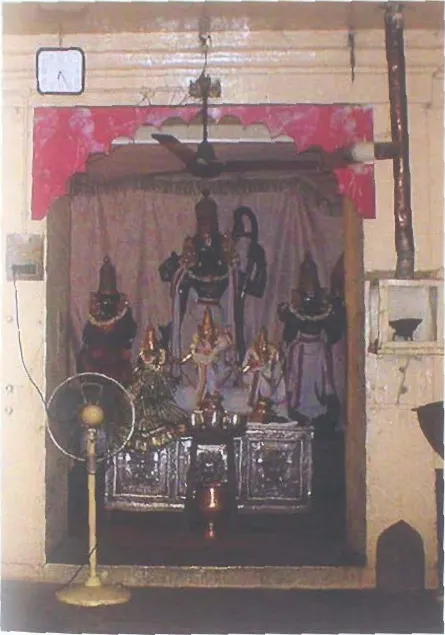
- Vṛndāvana, the Playground of God (2010)the Lord worshipped as Raṅganātha, Lord Viṣṇu in the company of His internal energies Śrī and Bhū; its photograph captioned 'The Deities in the Raṅganātha Temple' shows three standing Deity figures, the central one larger
- Vṛndāvana-kathā (1920), pp. 256 and 258in the main shrine, a standing form of Śrī Kṛṣṇa as a cowherd (go-cāraṇa-mūrti), the right hand raised in abhaya-mudrā and the left hanging, with no image of Rādhā; Viṣṇu lying on Ananta, with Lakṣmī serving His feet, is in a shrine on the north side of the inner court
Whether visitors from abroad may enter the temple: Śrīla Prabhupāda's letter of 1970 and two guidebooks of 2000 and 2010 tell it differently, and the rule today needs to be asked on the spot.[25]
Accounts differ Entry into the Raṅgajī temple for visitors who are not Hindus by birth (foreigners).
- Śrīla Prabhupāda, letter to P. Gangulee, 16 August 1970one disciple was refused entry in the Ranganatha Temple in Vrndavana
- The Color Guide to Vṛndāvana (2000)the only temple in Vṛndāvana that does not allow foreigners to enter; footnote: they may enter the courtyard, walk around the outside of the temple and visit the museum
- Vṛndāvana, the Playground of God (2010)up until a few years ago it had policies prohibiting non-Hindus from entering, but the rules have been relaxed, so now everyone can visit
Where the Veṇu-kūpa, the well that Kṛṣṇa made with His flute, is. The Vṛndāvana-kathā (1920) places it inside this temple; the guidebooks of 2000 and 2010 place it elsewhere; all the accounts are set side by side on the page of the Veṇu-kūpa.[26 +1]
References
32 references
- Vṛndāvana, the Playground of God (2010), Bhakti Caitanya Svāmī, PDF p. 194
- Vṛndāvana, the Playground of God (2010), Bhakti Caitanya Svāmī, PDF p. 195
- The Color Guide to Vṛndāvana (2000), Written and Photographed by Rājaśekhara dāsa Brahmacārī, PDF p. 136
- Śrī Vraja-maṇḍala Parikramā (2007), PDF p. 336
- Śrīla Prabhupāda, Morning Walk, Chicago, 5 July 1975 · vedabase.io
- A. W. Entwistle, ch. 5 §35 (nineteenth-century patrons), printed p. 217, Egbert Forsten, Groningen, 1987
- A. W. Entwistle, ch. 5 §35 (nineteenth-century patrons), printed p. 218, Egbert Forsten, Groningen, 1987
- Prabhudayāl Mītal, part 1 ('ब्रज-संस्कृति की भूमिका'), 'Braj-yātrā', Vṛndāvana: 'Raṅgajī kā mandir', printed p. 139
- Śrīla Prabhupāda, Room Conversation with Professor Olivier Lacombe, Paris, 14 June 1974 · vedabase.io
- Śrīmad-Bhāgavatam 8.3.33, GRETIL
- Śrī Vraja-maṇḍala Parikramā (2007), PDF p. 345
- Vṛndāvana-kathā, ch. 21, 'শেঠেদের মন্দির', printed p. 263
- Śrīmad-Bhāgavatam 8.2.1, GRETIL
- Śrīmad-Bhāgavatam 8.2.20, GRETIL
- Śrīmad-Bhāgavatam 8.2.27, GRETIL
- Prabhudayāl Mītal, part 2 ('ब्रज का इतिहास'), modern period, entry 'Seṭh Lakṣmīcanda': 'Śrī Raṅgajī kā mandir', printed p. 271
- Prabhudayāl Mītal, part 2 ('ब्रज का इतिहास'), modern period, entry 'Seṭh Lakṣmīcanda', printed p. 271
- Vṛndāvana-kathā, ch. 21, 'শেঠেদের মন্দির', printed p. 262
- The Color Guide to Vṛndāvana (2000), Written and Photographed by Rājaśekhara dāsa Brahmacārī, PDF p. 137
- Pulinbihārī Datta, ch. 21 (ekaviṁśa pariccheda) 'শেঠেদের মন্দির', printed p. 260
Show all 32 references
- Mathurá (1883), F. S. Growse, B.C.S., M.A. Oxon., C.I.E. (as the title page gives him, p. 260
- Śrīla Prabhupāda, Śrī Caitanya-caritāmṛta, Madhya-līlā 2.54, purport · vedabase.io
- Śrīla Prabhupāda, Letter to Bharadraja, letter 75-11-18, 18 November 1975 · vedabase.io
- Śrīla Prabhupāda, Morning Walk, Bombay, 13 April 1976 · vedabase.io
- Śrīla Prabhupāda, Letter to P. Gangulee (Minister of Education & Culture, Embassy of India, Washington), letter 70-08-16, 16 August 1970 · vedabase.io
- Vṛndāvana-kathā, chapter 21 (ekaviṁśa pariccheda), section 'শেঠেদের মন্দির' (the Seṭhs' temple), printed p. 260
- Śrī Vraja-maṇḍala Parikramā (2007), PDF p. 321
- Vṛndāvana-kathā, ch. 21 (একবিংশ পরিচ্ছেদ) 'শেঠেদের মন্দির', printed p. 256
- Vṛndāvana-kathā, ch. 21, 'শেঠেদের মন্দির', printed p. 258
- Vṛndāvana-kathā, end of the chapter before chapter 18, section 'কূপ' (wells), printed p. 199
- Śrī Vraja-maṇḍala Parikramā (2007), p. 646-647
- The Color Guide to Vṛndāvana (2000), Written and Photographed by Rājaśekhara dāsa Brahmacārī, p. 122