Temple of Rādhā stealing Kṛṣṇa's flute (Nidhuvana)
कृष्ण की वंशी चुराती राधा का मन्दिर (निधुवन) Hindi name proposed
Also called Shrine of Rādhārāṇī stealing Kṛṣṇa's flute (Nidhuvana)
- What it is
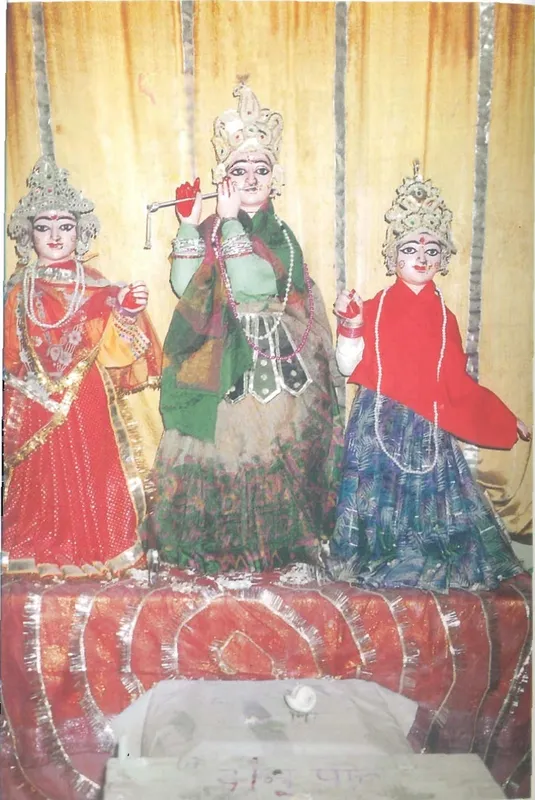
- This small shrine in the grove of Nidhuvana, near Śrī Svāmī Haridāsa's samādhi, shows Śrīmatī Rādhārāṇī with Kṛṣṇa's flute, with Her friends Lalitā and Viśākhā on either side.
- Visiting
- Three guidebooks describe the small shrine in Nidhuvana: Śrīmatī Rādhārāṇī with Kṛṣṇa's flute, Lalitā and Viśākhā on either side.
In short
This small shrine in the grove of Nidhuvana, near Śrī Svāmī Haridāsa's samādhi, shows Śrīmatī Rādhārāṇī with Kṛṣṇa's flute, with Her friends Lalitā and Viśākhā on either side.[1 +4] The guidebooks say that it marks the day Rādhā stole Kṛṣṇa's flute.[3] The Bhāgavatam tells no such theft, and the Gosvāmīs, who tell it in several works, set it elsewhere: in a cave of Govardhana, at Rādhā-kuṇḍa at midday, or in an unnamed kuñja (grove). No older text ties the pastime to Nidhuvana.[6 +8]
Key facts
| Kind | temple |
|---|---|
| Region · area | Vṛndāvana · Nidhuvana |
Divine pastimes
The gopīs and the flute
Śrīmad-Bhāgavatam (10.21) tells how the gopīs, the cowherd girls, heard Kṛṣṇa's flute in the autumn forest and spoke of it among themselves. In this verse they ask what good deeds the flute did, that it enjoys on its own the nectar of Kṛṣṇa's lips, which is meant for them. The Bhāgavatam tells no theft of the flute and names no place.[6 +1]
My dear gopīs, what auspicious activities must the flute have performed to enjoy the nectar of Kṛṣṇa’s lips independently and leave only a taste for us gopīs, for whom that nectar is actually meant! The forefathers of the flute, the bamboo trees, shed tears of pleasure. His mother, the river on whose bank the bamboo was born, feels jubilation, and therefore her blooming lotus flowers are standing like hair on her body.
Translation: Śrīla Prabhupāda's disciples (BBT)Explaining this verse, the commentators, Śrīla Sanātana Gosvāmī and Śrīla Viśvanātha Cakravartī Ṭhākura among them, see in the gopīs' words a wish to take the flute and hide it away; Śrīla Sanātana Gosvāmī says that Śrī Rādhā Herself spoke the verse to Her sakhīs (summarised here, not translated). None of them names a place or says that the flute was actually taken.[6 +2]
The theft in the Gosvāmīs' works
Śrīla Rūpa Gosvāmī's Ujjvala-nīlamaṇi names the theft of the flute as one kind of playful theft. His example, a verse that he also collected in his Padyāvalī, describes a girl quietly taking the flute from the sleeping Mādhava. The verse names no place and does not name the girl.[17 +1]
In Śrīla Rūpa Gosvāmī's drama Vidagdha-mādhava, the fourth act is called "Veṇu-haraṇa", the stealing of the flute. At a cave-temple of Govardhana, Rādhā comes to have Kṛṣṇa's flute without His noticing, and Kṛṣṇa concludes that Rādhikā has taken it. In the next act She sounds the flute before Viśākhā and Lalitā.[8 +1]
In other works Rādhā takes the flute while Kṛṣṇa only pretends to sleep: in a cave of Govardhana in Śrīla Raghunātha dāsa Gosvāmī's Navāṣṭaka, and in a new little kuñja, at Her friend's word, in the Vṛndāvana-mahimāmṛta. In Śrīla Jīva Gosvāmī's Gopāla-campū She sends a friend to steal the flute of the sleeping Kṛṣṇa in a kuñja. None of these names Nidhuvana.[10 +2]
In Śrīla Kṛṣṇadāsa Kavirāja Gosvāmī's Govinda-līlāmṛta, the theft is one of the midday pastimes at Rādhā-kuṇḍa, where Rādhā takes the flute and hides it.[13 +1] According to a song in the Bhakti-ratnākara on the eight periods of Rādhā and Kṛṣṇa's day, the stealing of the flute is one of the pastimes at midday, when Rādhā meets Kṛṣṇa near Her own kuṇḍa.[14] Read more: Nidhuvana: Śrī Rādhā's dream of the golden youth and the stolen flute →
In Śrī Caitanya Mahāprabhu's pastimes
The Caitanya-caritāmṛta tells that once in Navadvīpa Śrī Caitanya Mahāprabhu, in ecstasy, asked Śrī Śrīvāsa Ṭhākura for His flute, and was told that the gopīs had stolen it:[19]
General teaching (does not name the place)In ecstasy the Lord asked Śrīvāsa Ṭhākura to deliver His flute, but Śrīvāsa Ṭhākura replied, “Your flute has been stolen away by the gopīs.”
Śrīla Prabhupāda, Śrī Caitanya-caritāmṛta, Ādi-līlā 17.233, translation · vedabase.io
Traditional accounts
According to Vṛndāvana, the Playground of God (2010), a gopī friend saw Kṛṣṇa sleeping nearby; Rādhārāṇī crept up behind Him and …
According to Vṛndāvana, the Playground of God (2010), a gopī friend saw Kṛṣṇa sleeping nearby; Rādhārāṇī crept up behind Him and took the flute resting on His chest. Kṛṣṇa lamented loudly over the theft, and She then gave the flute back. The book cites no source for the story, and The Color Guide to Vṛndāvana (2000) says only that the temple is dedicated to Rādhā when She stole Kṛṣṇa's flute.[3]
Visiting today
Three guidebooks describe the small shrine in Nidhuvana: Śrīmatī Rādhārāṇī with Kṛṣṇa's flute, Lalitā and Viśākhā on either side. The Color Guide to Vṛndāvana (2000) and the undated parikramā notes Vṛndāvana say that She is seen playing the flute; Vṛndāvana, the Playground of God (2010) says that She holds it, near Śrī Svāmī Haridāsa's samādhi.[1 +4] No source gives the shrine's date or founder.[1 +4]
Nearby places
Svāmī Haridāsa's samādhi
Where the sources differ
Where the theft of Kṛṣṇa's flute is set: the guidebooks say Nidhuvana, the Gosvāmīs' works a cave of Govardhana, Rādhā-kuṇḍa at midday or an unnamed kuñja.[3 +2]
Accounts differ Where the theft of Kṛṣṇa's flute is set.
- Vṛndāvana, the Playground of God (2010); The Color Guide to Vṛndāvana (2000); the undated parikramā notes VṛndāvanaA small shrine in Nidhuvana is dedicated to Rādhā's theft of Kṛṣṇa's flute; Vṛndāvana, the Playground of God (2010): Kṛṣṇa was sleeping nearby and Rādhā took the flute resting on His chest.
- Bhakti-ratnākara, Fifth Wave, 1912 ed. p. 418, song after Govinda-līlāmṛta 1.4The stealing of the flute (vaṃśī-haraṇa) is one of the midday pastimes, when Rādhā meets Kṛṣṇa near Her own kuṇḍa.
- Govinda-līlāmṛta (Śrīla Kṛṣṇadāsa Kavirāja Gosvāmī) 7.1, 7.121, 8.1, 10.30–31At midday, after Kṛṣṇa has come to Rādhā-kuṇḍa and been led to a kuñja at its north-east, Rādhā takes His flute and hides it in Her cloth; 'the stealing of the flute' is one of the midday pastimes.
- Vidagdha-mādhava (Śrīla Rūpa Gosvāmī), Act 4 'Veṇu-haraṇa'At a cave-temple of Govardhana Hill, Rādhā gets the flute into Her cloth without Kṛṣṇa noticing; He concludes that Rādhikā has taken it.
The wording of these accounts is our summary of the sources, not a published translation.
More on this place
Nidhuvana: Śrī Rādhā's dream of the golden youth and the stolen flute
References
21 references
- The Color Guide to Vṛndāvana (2000), Written and Photographed by Rājaśekhara dāsa Brahmacārī, PDF p. 102
- The Color Guide to Vṛndāvana (2000), Written and Photographed by Rājaśekhara dāsa Brahmacārī, PDF p. 104
- Vṛndāvana, the Playground of God (2010), Bhakti Caitanya Svāmī, PDF p. 185
- Vṛndāvana, the Playground of God (2010), Bhakti Caitanya Svāmī, PDF p. 184
- the undated parikramā notes Vṛndāvana, ¶185
- Śrīmad-Bhāgavatam 10.21.9, Bhagavata Vidya Pith edition, ed. Bhagavata Rishi and Krishna Shankar Shastri, 1996
- Śrīla Prabhupāda, Kṛṣṇa, the Supreme Personality of Godhead (Kṛṣṇa book), Chapter 21, 'The Gopīs Attracted by the Flute' · vedabase.io
- Śrīla Rūpa Gosvāmī, Vidagdha-mādhava, Act 4, named 'Veṇu-haraṇa' (the stealing of the flute), v.34 with the Prakrit line before it (index label '(4) veṇu-nāda-vilāsaḥ v.34')
- Śrīla Rūpa Gosvāmī, Vidagdha-mādhava, Act 5, v.17 and the dialogue after it (index labels '(5) veṇu-nāda-vilāsaḥ v.17' and 'after v.17')
- Śrīla Raghunātha dāsa Gosvāmī, Stavāvalī, Śrī Navāṣṭaka v.6 (hymn (20) of the Stavāvalī text, headed 'śrī-navāṣṭakam' at Stavāvalī)
- Vṛndāvana-mahimāmṛta, śataka 16, v.28 (index label '(16) ṣoḍaśaṁ śatakam v.16.28'), after Shyamlal Hakim's edition, Vrindavan, 1978
- Gopāla-campū, Pūrva-campū 29 (ekonatriṁśaṁ pūraṇam), ¶[42], v.57
- Śrīla Kṛṣṇadāsa Kavirāja Gosvāmī, Govinda-līlāmṛta, sarga 10, vv.30–31 (index labels '(10) daśamaḥ sargaḥ v.30', 'v.31'), after the editions of Haridas Das and Haridas Shastri
- Śrīla Narahari Cakravartī, Bhakti-ratnākara, Fifth Wave (pañcama taraṅga), 1912 ed. p. 418, song after Govinda-līlāmṛta 1.4, 2nd ed., 1912
- Śrīla Sanātana Gosvāmī: commentary under ŚB 10.21.9 (part 1/2)'), Bhagavata Vidya Pith edition, ed. Bhagavata Rishi and Krishna Shankar Shastri, 1996
- Bṛhat-krama-sandarbha: commentary on ŚB 10.21.9, Bhagavata Vidya Pith edition, ed. Bhagavata Rishi and Krishna Shankar Shastri, 1996
- Śrīla Rūpa Gosvāmī, Ujjvala-nīlamaṇi 15.237–238, GRETIL
- Śrīla Rūpa Gosvāmī, Padyāvalī 253 (under the heading 'atha vaṃśī-cauryam'), attributed to Daityāri Paṇḍita, GRETIL
- Śrīla Prabhupāda, Śrī Caitanya-caritāmṛta, Ādi-līlā 17.233, translation · vedabase.io
- The Color Guide to Vṛndāvana (2000), Written and Photographed by Rājaśekhara dāsa Brahmacārī, p. 88
- Vṛndāvana, the Playground of God (2010), Bhakti Caitanya Svāmī, p. 184