Nidhuvana: Śrī Rādhā's dream of the golden youth and the stolen flute
निधिवन (निधुवन): श्री राधा का स्वप्न और चुराई हुई वंशी
In short
Nidhuvana, known today as Nidhivan, is a walled grove of Vṛndāvana north of the Vaṁśīvaṭa. The guidebooks set two pastimes at its shrines: Śrī Rādhā's dream of a golden youth, whom She understood to be Kṛṣṇa Himself, and Her playful taking of Kṛṣṇa's flute. The poems that tell both pastimes name no place.[1–9]
On this page
At a glance
- The place: Nidhuvana lies north of the Vaṁśīvaṭa, according to Śrīla Viśvanātha Cakravartī Ṭhākura's Vraja-rīti-cintāmaṇi.[1, 2]
- The dream: told in Śrīla Viśvanātha Cakravartī Ṭhākura's Svapna-vilāsāmṛtāṣṭaka, eight verses that name no place.[4 +2]
- Its meaning: the golden youth points to Śrī Caitanya Mahāprabhu, Kṛṣṇa with the mood and complexion of Śrīmatī Rādhārāṇī.[12]
- The flute: Śrīmad-Bhāgavatam 10.21.9 tells of the gopīs, the cowherd girls of Vraja, speaking about Kṛṣṇa's flute, but tells no theft.[13, 14]
- The theft: Śrīla Rūpa Gosvāmī names the taking of the flute as one kind of playful theft.[15, 16]
- The shrines: the guidebooks list in Nidhuvana the Raṅga Mahal and a shrine of Śrī Rādhā stealing Kṛṣṇa's flute.[5 +3]
What is Nidhivan?
Nidhuvana is a grove inside the town of Vṛndāvana. Śrī Vraja-maṇḍala Parikramā (2007) counts it among the forests of the Vṛndāvana parikramā, the walk around the town. It places it north of Sevā-kuñja and lists a city quarter of the same name.[17–21] Śrīla Viśvanātha Cakravartī Ṭhākura's Vraja-rīti-cintāmaṇi places it north of the Vaṁśīvaṭa. It names it as the forest where Kṛṣṇa went after He disappeared from the gopīs on the night of the rāsa dance.[1, 2] The Bhakti-ratnākara names Nidhuvana on Śrīla Śrīnivāsa Ācārya's tour of Vṛndāvana, right after Cīra-ghāṭa, as a place of Rādhā and Kṛṣṇa's pastimes with the sakhīs, Śrī Rādhā's girl friends.[22]
The guidebooks explain the name from a Sanskrit word for the pastimes of the Divine Couple.[2 +3] The Prema-vilāsa says that Śrī Caitanya Mahāprabhu sent Śrīla Lokanātha Gosvāmī from Navadvīpa to Vṛndāvana. Among the places where he should live, the Lord named Nidhuvana, with the Rāsa-sthalī, the Vaṁśīvaṭa and Dhīra-samīra.[24] How Śrīla Lokanātha Gosvāmī came to Vraja is told in its own article.[24] Read more: How Śrīla Lokanātha Gosvāmī came to Vraja and stayed there →
Inside the walled grove the guidebooks list:[5 +3]
- the Raṅga Mahal, a small temple;[5 +3]
- the shrine of Śrī Rādhā holding Kṛṣṇa's flute, with Lalitā and Viśākhā;[5 +3]
- Viśākhā-kuṇḍa, a sacred pond, and a rāsa-sthalī, a place of the rāsa dance;[5 +3]
- the place where the Deity of Bāṅke-bihārī was found, and the samādhi (tomb) of Svāmī Haridāsa.[5 +3] Six guidebooks say that Svāmī Haridāsa found the Deity of Bāṅke-bihārī in Nidhuvana, and so do the Bengali Vṛndāvana-kathā (1920) and Kṛṣṇadāsa Bābājī's Bengali Bhaktamāla (1905).[5 +5] The historian Mītal (1966) writes that Svāmī Haridāsa lived in Nidhuvana for the rest of his life after coming to Vṛndāvana. The ācāryas of his line lived there after him.[28–31]
Śrīla Prabhupāda on Nidhuvana
Śrīla Prabhupāda spoke of Nidhuvana on a morning walk in Los Angeles in 1973, and told the story of a saint who saw what happened there while he chanted:[32]
Names this placeIn Vṛndāvana, there is a place called Nidhuvana. … Nidhuvana. So that was a place... Still, people go to visit. So one Bhagavān dāsa Bābājī, he was chanting, and in the middle of his chanting he made [makes sound with hands like clapping] like this. … So "There was a goat entered Nidhuvana. So I drove it away.
Śrīla Prabhupāda, Morning Walk, Los Angeles, 21 April 1973 · vedabase.io
In conversations with Western visitors who had seen it, in 1969 and 1976, he called the little garden and its small temple Nidhuvana.[33, 34] In his purport, his explanation, to Caitanya-caritāmṛta Ādi 10.108 he writes, from the Gaura-gaṇoddeśa-dīpikā, that an associate of Śrī Caitanya was formerly a Durvāsā of Nidhuvana in Kṛṣṇa's pastimes.[35, 36]
What did Śrī Rādhā dream of the golden youth?
The dream is told in a short Sanskrit poem of eight verses by Śrīla Viśvanātha Cakravartī Ṭhākura. It is called the Svapna-vilāsāmṛtāṣṭaka, "the nectar of the dream pastime" (summarised here, not translated, since only the Bhaktivedanta Book Trust's translations are quoted). Śrī Rādhā tells Kṛṣṇa that She saw in a dream a river like the Yamunā and a forest like Vṛndāvana. There a jewel among brāhmaṇas, golden like lightning, danced among many dancers and drums.[4 +2] Sometimes He wept, calling Kṛṣṇa; sometimes He called for Rādhā. He made the whole world, from a blade of grass to Brahmā, weep with Him in love.[4]
Hearing this, Kṛṣṇa smiled and stirred the Kaustubha jewel on His chest. At once the jewel showed the same scene, as if to all beings.[10] In the last verse Śrī Rādhā remembers the words of Garga Muni at Kṛṣṇa's name-giving: His colour would sometimes be yellow. So Her dream is true, She concludes, and the golden person She saw is Kṛṣṇa Himself.[4 +2] The poem does not say where Rādhā and Kṛṣṇa were when She told the dream.[4]
How does the dream point to Śrī Caitanya?
The words of Garga Muni that Śrī Rādhā remembers are in Śrīmad-Bhāgavatam, in Śrīla Prabhupāda's translation:[11 +2]
āsan varṇās trayo hy asya gṛhṇato 'nuyugaṃ tanūḥ / śuklo raktas tathā pīta idānīṃ kṛṣṇatāṃ gataḥ
Your son Kṛṣṇa appears as an incarnation in every millennium. In the past, He assumed three different colors — white, red and yellow — and now He has appeared in a blackish color.
Translation: Śrīla A.C. Bhaktivedanta Swami PrabhupādaŚrīla Prabhupāda explains in his purport that the yellow colour belongs to the Lord's appearance in this age:[11 +2]
General teaching (does not name the place)“We actually see that in Kali-yuga, Bhagavān has appeared in pīta-varṇa, or a yellow color, as Gaurasundara, although the Bhāgavatam speaks of kṛṣṇa-varṇam. … Thus the Gauḍīya Vaiṣṇavas accept the conclusion that although Caitanya Mahāprabhu appeared in pīta color, He is Kṛṣṇa.”
Śrīla Prabhupāda, Śrīmad-Bhāgavatam, 10.8.13, purport · vedabase.io
Śrīla Viśvanātha Cakravartī Ṭhākura, in his commentary on the same verse, says that in the Dvāpara and Kali ages of this cycle the source of all avatāras appears twice. He appears as Kṛṣṇa, and as the yellow one, Kṛṣṇa within and fair without (summarised here, not translated).[38] The teaching behind the dream is the one that opens the Caitanya-caritāmṛta, in Śrīla Prabhupāda's translation:[12]
General teaching (does not name the place)“The loving affairs of Śrī Rādhā and Kṛṣṇa are transcendental manifestations of the Lord’s internal pleasure-giving potency. Although Rādhā and Kṛṣṇa are one in Their identity, previously They separated Themselves. Now these two transcendental identities have again united, in the form of Śrī Kṛṣṇa Caitanya. I bow down to Him, who has manifested Himself with the sentiment and complexion of Śrīmatī Rādhārāṇī although He is Kṛṣṇa Himself.”
Śrīla Prabhupāda, Śrī Caitanya-caritāmṛta, Ādi-līlā 1.5, translation · vedabase.io
Śrī Vraja-maṇḍala Parikramā (2007) says that the scene ended with a promise. Kṛṣṇa would take Śrī Rādhā's golden complexion and the feelings of Her heart, and appear as Gaurāṅga. These words are the guidebook's; the poem does not have them.[10, 25]
Did Śrī Rādhā steal Kṛṣṇa's flute?
The Bhāgavatam tells no theft of the flute. In the song of the flute (ŚB 10.21), the gopīs hear Kṛṣṇa play in the autumn forest. They wonder among themselves what good deeds the flute performed, that it can enjoy the nectar of His lips on its own. Śrīla Prabhupāda translates the verse in the Caitanya-caritāmṛta:[13, 14]
My dear gopīs, what auspicious activities must the flute have performed to enjoy the nectar of Kṛṣṇa’s lips independently and leave only a taste for us gopīs, for whom that nectar is actually meant! The forefathers of the flute, the bamboo trees, shed tears of pleasure. His mother, the river on whose bank the bamboo was born, feels jubilation, and therefore her blooming lotus flowers are standing like hair on her body.
Translation: Śrīla Prabhupāda's disciples (BBT)The commentators find in these words a wish to hide the flute away, and some a wish to steal it (summarised here, not translated). Śrīla Viśvanātha Cakravartī Ṭhākura has the gopīs complain that the flute openly enjoys what belongs to them, and conclude that it must be hidden away somewhere.[13 +2] Śrīla Sanātana Gosvāmī says that Śrī Rādhā Herself spoke the verse among Her sakhīs.[39]
The flute in the Gosvāmīs' works
Śrīla Rūpa Gosvāmī's Ujjvala-nīlamaṇi names the taking of Kṛṣṇa's flute, His clothes or His flowers as a playful theft, a pastime of love. Its example is a verse from his collection Padyāvalī, where a young woman quietly takes the flute. Neither text names a place or the girl.[15, 16] The Gosvāmīs then tell the pastime in their own works, each in a different setting (all summarised here, not translated):[41–47]
- Śrīla Rūpa Gosvāmī's drama Vidagdha-mādhava calls its fourth act "Veṇu-haraṇa", the stealing of the flute, and sets it at a cave-temple of Govardhana Hill.[41, 42]
- Śrīla Raghunātha dāsa Gosvāmī's Navāṣṭaka sets it in a cave of Govardhana, and Śrīla Jīva Gosvāmī's Gopāla-campū in an unnamed kuñja.[43–45]
- Śrīla Kṛṣṇadāsa Kavirāja Gosvāmī's Govinda-līlāmṛta counts the stealing of the flute among the midday pastimes at Rādhā-kuṇḍa, and so does a song in the Bhakti-ratnākara.[46, 47]
None of these works names Nidhuvana.[43–45] The other midday pastimes at Rādhā-kuṇḍa are told in their own article.[46, 47] Read more: The dice game of Rādhā and Kṛṣṇa: the books and the places →
The Caitanya-caritāmṛta remembers the flute in Śrī Caitanya Mahāprabhu's own life. In Navadvīpa, absorbed in ecstasy, He asked for His flute, and Śrīvāsa Ṭhākura answered:[48]
General teaching (does not name the place)In ecstasy the Lord asked Śrīvāsa Ṭhākura to deliver His flute, but Śrīvāsa Ṭhākura replied, “Your flute has been stolen away by the gopīs.”
Śrīla Prabhupāda, Śrī Caitanya-caritāmṛta, Ādi-līlā 17.233, translation · vedabase.io
Which shrine in Nidhuvana remembers the flute?
Three guidebooks describe a small shrine in Nidhuvana. Its altar shows Śrīmatī Rādhārāṇī with Kṛṣṇa's flute, and Her friends Lalitā and Viśākhā on either side. Two books say that She is seen playing it, one that She holds it.[5–9] According to Vṛndāvana, the Playground of God (2010), the shrine marks a pastime in which a friend saw Kṛṣṇa sleeping nearby. Śrī Rādhā quietly took the flute from Him; Kṛṣṇa lamented its loss; and She then gave it back.[7]
The same guidebooks describe the Raṅga Mahal at the far end of the grove, where, they say, the devotees keep a bed for the Divine Couple.[2 +4] The guidebooks also say that Rādhā and Kṛṣṇa sometimes rest in Nidhuvana after the rāsa.[2 +4] The Bhāgavatam itself says only that, after the dance, Kṛṣṇa played with the gopīs in the Yamunā and walked with them through a garden on its bank. Śrīla Prabhupāda tells how the night ended at the brāhma-muhūrta, the hour before dawn:[52–55]
General teaching (does not name the place)“When that auspicious moment arrived, Kṛṣṇa asked the gopīs to leave. Although His beloveds were not willing to quit His company, they were very obedient to Him. As soon as Kṛṣṇa asked them to go home, they immediately left and returned home.”
Śrīla Prabhupāda, Kṛṣṇa, the Supreme Personality of Godhead (Kṛṣṇa book), Chapter 33, 'Description of the Rāsa Dance' · vedabase.io
Where the rāsa itself took place is told in its own article.[52–55] Read more: Where the autumn rāsa took place →
Is Nidhuvana the place named in the poems?
Neither pastime is set in Nidhuvana by the poems that tell it. The Svapna-vilāsāmṛtāṣṭaka names no place. Śrī Vraja-maṇḍala Parikramā (2007) sets the dream in a kuñja, a forest bower, of Nidhuvana at the end of the night. Vṛndāvana, the Playground of God (2010) sets it in the Raṅga Mahal.[2–4, 10] The accounts differ:
Accounts differ Setting of Rādhā's dream of the golden youth (Svapna-vilāsa).
- Śrīla Viśvanātha Cakravartī, Svapna-vilāsāmṛtāṣṭakaNames no place where Rādhā and Kṛṣṇa were; the dream itself shows a river-bank like the Yamunā in a forest like Vṛndāvana; the last verse calls Kṛṣṇa 'kuñja-nṛpati'.
- Śrī Vraja-maṇḍala Parikramā (2007)At the end of the night, while the Divine Couple were sleeping in a keli-kuñja of Nidhuvana.
- Vṛndāvana, the Playground of God (2010)Rādhārāṇī and Kṛṣṇa 'were taking rest in Raṅga Mahal' — a building which, the same page says, the devotees have made.
The Gosvāmīs' works set the taking of the flute at Govardhana, in a kuñja or at Rādhā-kuṇḍa, and the guidebooks at the Nidhuvana shrine.[5 +9]
Accounts differ Where the theft of Kṛṣṇa's flute is set.
- Vṛndāvana, the Playground of God (2010); The Color Guide to Vṛndāvana (2000); the undated parikramā notes VṛndāvanaA small shrine in Nidhuvana is dedicated to Rādhā's theft of Kṛṣṇa's flute; Vṛndāvana, the Playground of God (2010): Kṛṣṇa was sleeping nearby and Rādhā took the flute resting on His chest.
- Bhakti-ratnākara, Fifth Wave, 1912 ed. p. 418, song after Govinda-līlāmṛta 1.4The stealing of the flute (vaṃśī-haraṇa) is one of the midday pastimes, when Rādhā meets Kṛṣṇa near Her own kuṇḍa.
- Govinda-līlāmṛta (Śrīla Kṛṣṇadāsa Kavirāja Gosvāmī) 7.1, 7.121, 8.1, 10.30–31At midday, after Kṛṣṇa has come to Rādhā-kuṇḍa and been led to a kuñja at its north-east, Rādhā takes His flute and hides it in Her cloth; 'the stealing of the flute' is one of the midday pastimes.
- Vidagdha-mādhava (Śrīla Rūpa Gosvāmī), Act 4 'Veṇu-haraṇa'At a cave-temple of Govardhana Hill, Rādhā gets the flute into Her cloth without Kṛṣṇa noticing; He concludes that Rādhikā has taken it.
The wording of these accounts is our summary of the sources, not a published translation.
Places in this article
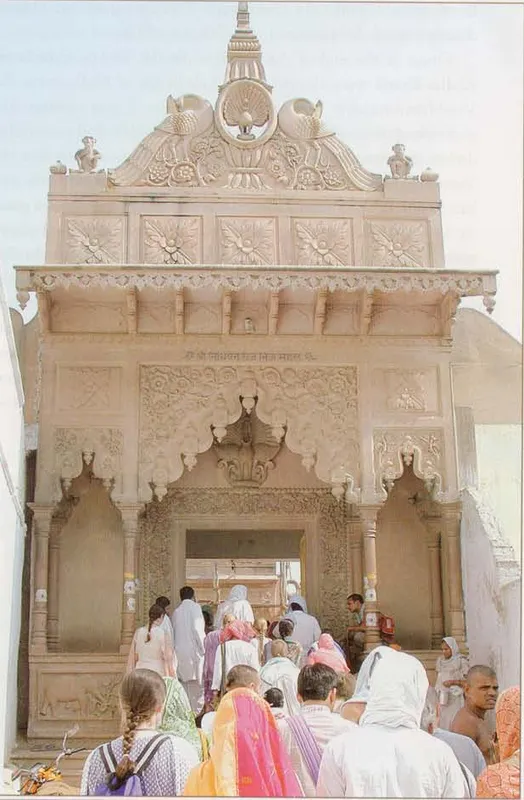
Nidhuvana
निधुवनNidhuvana is a walled grove in Vṛndāvana town, north of Sevā-kuñja.
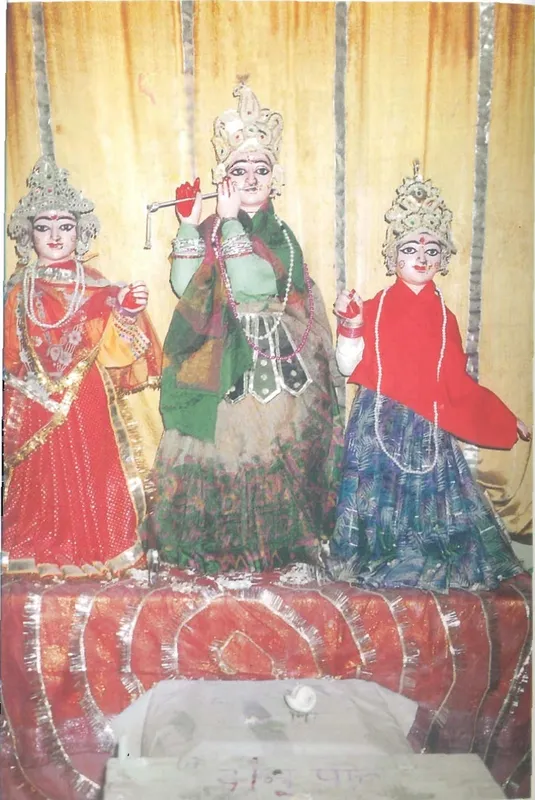
Temple of Rādhā stealing Kṛṣṇa's flute (Nidhuvana)
कृष्ण की वंशी चुराती राधा का मन्दिर (निधुवन)This small shrine in the grove of Nidhuvana, near Śrī Svāmī Haridāsa's samādhi, shows Śrīmatī Rādhārāṇī with Kṛṣṇa's flute, with Her friends Lalitā and Viśākhā on either …
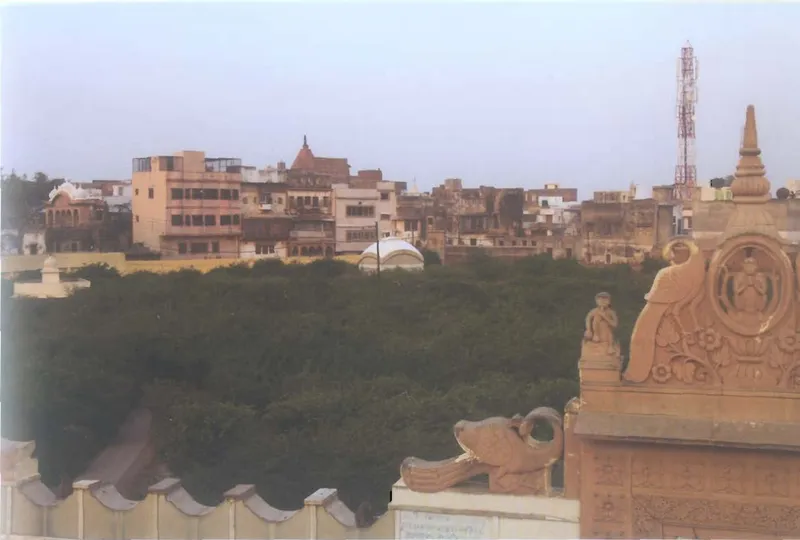
Raṅga Mahal (Nidhuvana)
रंग महल (निधुवन)The Raṅga Mahal is a small shrine at the far end of Nidhuvana, a walled garden in Vṛndāvana.
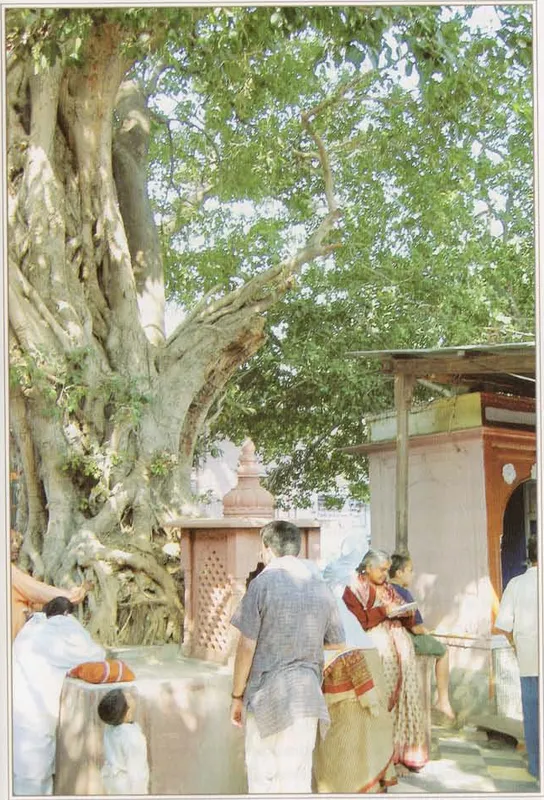
Vaṁśīvaṭa (Vṛndāvana)
वंशीवट (वृन्दावन)Vaṁśīvaṭa, "the banyan of the flute", stands on the bank of the Yamunā in Vṛndāvana, near the Gopīśvara Mahādeva temple.
Place where Bāṅke-bihārī was found (Nidhuvana)
बाँके बिहारी का प्राकट्य-स्थल (निधुवन)Questions and answers
Nidhivan, or Nidhuvana, is a walled grove in Vṛndāvana, north of the Vaṁśīvaṭa. According to the guidebooks, it holds the Raṅga Mahal, a shrine of Śrī Rādhā with Kṛṣṇa's flute, Viśākhā-kuṇḍa and the samādhi of Svāmī Haridāsa.[1 +5]
In Śrīla Viśvanātha Cakravartī Ṭhākura's Svapna-vilāsāmṛtāṣṭaka, She dreamt of a golden brāhmaṇa dancing by a river like the Yamunā, weeping and calling Kṛṣṇa's name and Hers. From Garga Muni's words She understood that He was Kṛṣṇa Himself.[4 +2]
Garga Muni said that Kṛṣṇa had appeared in a yellow colour in the past. Śrīla Prabhupāda explains that in Kali-yuga the Lord appeared in a yellow colour as Gaurasundara, Śrī Caitanya Mahāprabhu.[11 +2]
The Bhāgavatam tells no theft. Śrīla Rūpa Gosvāmī names the taking of the flute as a playful theft, and the Gosvāmīs' works tell it at Govardhana, in a kuñja or at Rādhā-kuṇḍa.[13 +6]
A small shrine whose altar shows Śrīmatī Rādhārāṇī with Kṛṣṇa's flute between Lalitā and Viśākhā, according to three guidebooks.[5–9]
No. The Svapna-vilāsāmṛtāṣṭaka and the Gosvāmīs' works on the flute name no Nidhuvana; it is the guidebooks that set both pastimes there.[2 +5]
Sources
- Śrīla Viśvanātha Cakravartī Ṭhākura, Vraja-rīti-cintāmaṇi, dvitīya sarga (chapter 2) vv. 75–76
- Vṛndāvana, the Playground of God (2010), Bhakti Caitanya Svāmī, PDF p. 182
- Śrī Vraja-maṇḍala Parikramā (2007), PDF p. 314
- Śrīla Viśvanātha Cakravartī Ṭhākura, Svapna-vilāsāmṛtāṣṭakam, verses 1-2
- The Color Guide to Vṛndāvana (2000), Written and Photographed by Rājaśekhara dāsa Brahmacārī, PDF p. 102
- The Color Guide to Vṛndāvana (2000), Written and Photographed by Rājaśekhara dāsa Brahmacārī, PDF p. 104
- Vṛndāvana, the Playground of God (2010), Bhakti Caitanya Svāmī, PDF p. 185
- Vṛndāvana, the Playground of God (2010), Bhakti Caitanya Svāmī, PDF p. 184
- the undated parikramā notes Vṛndāvana, ¶185
- Śrīla Viśvanātha Cakravartī Ṭhākura, Svapna-vilāsāmṛtāṣṭakam, verses 5 and 8
- Śrīmad-Bhāgavatam 10.8.13, GRETIL
- Śrīla Prabhupāda, Śrī Caitanya-caritāmṛta, Ādi-līlā 1.5, translation · vedabase.io
- Śrīmad-Bhāgavatam 10.21.9, Bhagavata Vidya Pith edition, ed. Bhagavata Rishi and Krishna Shankar Shastri, 1996
- Śrīla Prabhupāda, Kṛṣṇa, the Supreme Personality of Godhead (Kṛṣṇa book), Chapter 21, 'The Gopīs Attracted by the Flute' · vedabase.io
- Śrīla Rūpa Gosvāmī, Ujjvala-nīlamaṇi 15.237–238, GRETIL
- Śrīla Rūpa Gosvāmī, Padyāvalī 253 (under the heading 'atha vaṃśī-cauryam'), attributed to Daityāri Paṇḍita, GRETIL
- The Color Guide to Vṛndāvana (2000), Written and Photographed by Rājaśekhara dāsa Brahmacārī, PDF p. 165
- Śrī Vraja-maṇḍala Parikramā (2007), PDF p. 341
- Śrī Vraja-maṇḍala Parikramā (2007), PDF p. 344
- Vṛndāvana, the Playground of God (2010), Bhakti Caitanya Svāmī, PDF p. 141
Show all 55 references
- The Color Guide to Vṛndāvana (2000), Written and Photographed by Rājaśekhara dāsa Brahmacārī, PDF p. 105
- Śrīla Narahari Cakravartī, Bhakti-ratnākara, Fifth Wave, 1912 ed. printed p. 325, 2nd ed., 1912
- Śrīla Rūpa Gosvāmī, Ujjvala-nīlamaṇi, 15.252, last quarter-verse, GRETIL
- Prema-vilāsa, seventh vilāsa, printed p. 45, left-hand column, Kolkata, 1913
- Śrī Vraja-maṇḍala Parikramā (2007), PDF p. 315
- Śrī Vraja-maṇḍala Parikramā (2007), PDF p. 334
- The Color Guide to Vṛndāvana (2000), Written and Photographed by Rājaśekhara dāsa Brahmacārī, PDF p. 68
- Prabhudayāl Mītal, 'Braj kā prākṛtik aur bhaugolik varṇan', 'Katipay ramaṇīk sthal': 'निधिबन', printed p. 43
- A. W. Entwistle, ch. 5 §10 'Swami Haridas', printed p. 156, Egbert Forsten, Groningen, 1987
- Pulinbihārī Datta, ch. 17 (saptadaśa pariccheda), list of Vṛndāvana's groves and gardens, no. 11 'নিধুবন', printed p. 196
- Śrī Śrī Bhaktamāla grantha, chapter 'চরিত্র শ্রীহরিদাস স্বামী', printed p. 243, left-hand column
- Śrīla Prabhupāda, Morning Walk, Los Angeles, 21 April 1973 · vedabase.io
- Śrīla Prabhupāda, Room Conversation with Allen Ginsberg, Columbus, 13 May 1969 · vedabase.io
- Śrīla Prabhupāda, Conversation with George Harrison, London, 26 July 1976 · vedabase.io
- Śrīla Prabhupāda, Śrī Caitanya-caritāmṛta, Ādi-līlā 10.108, purport · vedabase.io
- Gaura-gaṇoddeśa-dīpikā, v.111
- Śrīla Prabhupāda, Śrīmad-Bhāgavatam, 10.8.13, purport · vedabase.io
- Śrīla Viśvanātha Cakravartī Ṭhākura: commentary on ŚB 10.8.13, Bhagavata Vidya Pith edition, ed. Bhagavata Rishi and Krishna Shankar Shastri, 1996
- Śrīla Sanātana Gosvāmī: commentary under ŚB 10.21.9 (part 1/2)'), Bhagavata Vidya Pith edition, ed. Bhagavata Rishi and Krishna Shankar Shastri, 1996
- Bṛhat-krama-sandarbha: commentary on ŚB 10.21.9, Bhagavata Vidya Pith edition, ed. Bhagavata Rishi and Krishna Shankar Shastri, 1996
- Śrīla Rūpa Gosvāmī, Vidagdha-mādhava, Act 4, named 'Veṇu-haraṇa' (the stealing of the flute), v.34 with the Prakrit line before it (index label '(4) veṇu-nāda-vilāsaḥ v.34')
- Śrīla Rūpa Gosvāmī, Vidagdha-mādhava, Act 5, v.17 and the dialogue after it (index labels '(5) veṇu-nāda-vilāsaḥ v.17' and 'after v.17')
- Śrīla Raghunātha dāsa Gosvāmī, Stavāvalī, Śrī Navāṣṭaka v.6 (hymn (20) of the Stavāvalī text, headed 'śrī-navāṣṭakam' at Stavāvalī)
- Vṛndāvana-mahimāmṛta, śataka 16, v.28 (index label '(16) ṣoḍaśaṁ śatakam v.16.28'), after Shyamlal Hakim's edition, Vrindavan, 1978
- Gopāla-campū, Pūrva-campū 29 (ekonatriṁśaṁ pūraṇam), ¶[42], v.57
- Śrīla Kṛṣṇadāsa Kavirāja Gosvāmī, Govinda-līlāmṛta, sarga 10, vv.30–31 (index labels '(10) daśamaḥ sargaḥ v.30', 'v.31'), after the editions of Haridas Das and Haridas Shastri
- Śrīla Narahari Cakravartī, Bhakti-ratnākara, Fifth Wave (pañcama taraṅga), 1912 ed. p. 418, song after Govinda-līlāmṛta 1.4, 2nd ed., 1912
- Śrīla Prabhupāda, Śrī Caitanya-caritāmṛta, Ādi-līlā 17.233, translation · vedabase.io
- The Color Guide to Vṛndāvana (2000), Written and Photographed by Rājaśekhara dāsa Brahmacārī, PDF p. 103
- Vṛndāvana-Dhāma Ki Jaya! (c. 1986), by Dhruva Mahārāja dāsa, PDF p. 69
- Vṛndāvana, the Playground of God (2010), Bhakti Caitanya Svāmī, PDF p. 9
- Śrīmad-Bhāgavatam 10.33.20, GRETIL
- Śrīmad-Bhāgavatam 10.33.24
- Śrīmad-Bhāgavatam 10.33.38, GRETIL
- Śrīla Prabhupāda, Kṛṣṇa, the Supreme Personality of Godhead (Kṛṣṇa book), Chapter 33, 'Description of the Rāsa Dance' · vedabase.io
Further sources
- Śrīmad-Bhāgavatam 10.8.13 and 10.21.9, translation by Śrīla Prabhupāda (BBT); his Kṛṣṇa book and Śrī Caitanya-caritāmṛta (Ādi-līlā 1.5, 10.108, 17.233) with his translation and purports.
- Śrīla Viśvanātha Cakravartī Ṭhākura, Svapna-vilāsāmṛtāṣṭaka (in the Stavāmṛta-laharī) and Vraja-rīti-cintāmaṇi; the Canto 10 commentaries (Sanskrit), summarised, not translated.
- Śrīla Rūpa Gosvāmī, Ujjvala-nīlamaṇi, Padyāvalī, Vidagdha-mādhava; Śrīla Raghunātha dāsa Gosvāmī, Stavāvalī; Śrīla Jīva Gosvāmī, Gopāla-campū; Śrīla Kṛṣṇadāsa Kavirāja Gosvāmī, Govinda-līlāmṛta: summarised from the Sanskrit.