Vajranābha-kuṇḍa
वज्रनाभ-कुण्ड Hindi name proposed
Also called Vajra-kuṇḍa
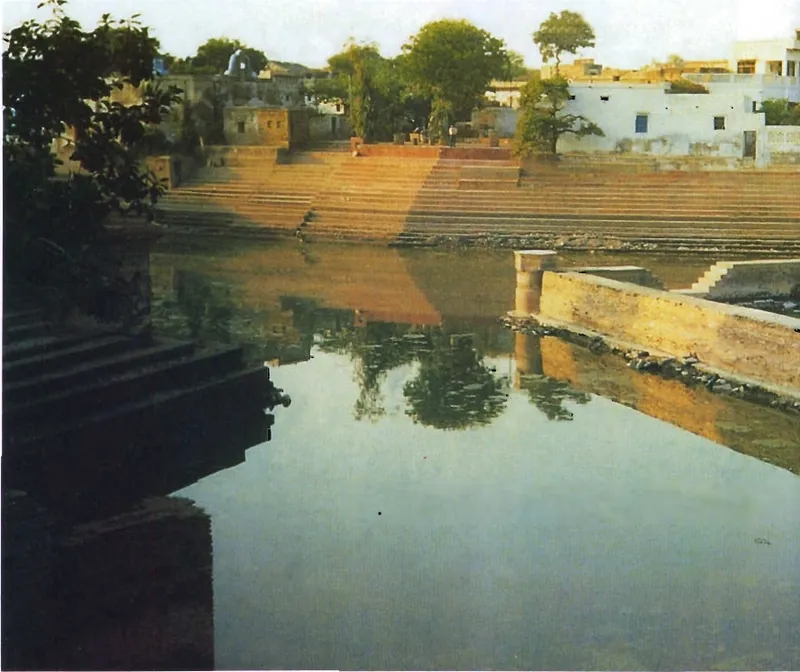
- What it is
- Vajranābha-kuṇḍa, also called Vajra-kuṇḍa, is a small kuṇḍa that two guidebooks place inside Śyāma-kuṇḍa, Kṛṣṇa's kuṇḍa at Rādhā-kuṇḍa.
- Visiting
- Śrī Vraja-maṇḍala Parikramā (2007) lists Vajranābha-kuṇḍa among the ghāṭas and kuṇḍas of Rādhā-kuṇḍa, in the middle of Kṛṣṇa's kuṇḍa, but does not mark it on its map.
In short
Vajranābha-kuṇḍa, also called Vajra-kuṇḍa, is a small kuṇḍa that two guidebooks place inside Śyāma-kuṇḍa, Kṛṣṇa's kuṇḍa at Rādhā-kuṇḍa. The Colour Guide to Rādhā-kuṇḍa (1999) says that it is the original kuṇḍa made by Kṛṣṇa's heel, and that King Vajranābha, Kṛṣṇa's great-grandson, may have walled it round.[1 +1] Śrī Vraja-maṇḍala Parikramā (2007) places a Vajranābha-kuṇḍa in the middle of Kṛṣṇa's kuṇḍa.[3 +1] No source older than these guidebooks names this kuṇḍa. The Canto 10 commentators tell that Kṛṣṇa made His kuṇḍa with a blow of His heel, but they mean Kṛṣṇa's kuṇḍa as a whole.[5 +1]
Key facts
| Kind | kuṇḍa |
|---|---|
| Region · area | Rādhā-kuṇḍa · Śyāma-kuṇḍa (Rādhā-kuṇḍa) |
| Ācāryas | Śrīla Raghunātha dāsa Gosvāmī |
Divine pastimes
The killing of Ariṣṭa
Śrīmad-Bhāgavatam (10.36) tells how the bull-demon Ariṣṭa came to the cowherd village and charged Kṛṣṇa "like a thunderbolt hurled by Indra", and how Kṛṣṇa seized him by the horns and killed him, then entered the village with Balarāma. It names no kuṇḍa, and the thunderbolt there is only a comparison for the bull's charge.[7 +2] Śrīla Prabhupāda writes that Śrī Caitanya Mahāprabhu understood that Ariṣṭāsura had been killed in Āriṭ-grāma, the village where He then found Rādhā-kuṇḍa and Śyāma-kuṇḍa in two paddy fields.[10]
The kuṇḍa made by Kṛṣṇa's heel
The Canto 10 commentators tell what followed (summarised here, not translated). Śrīla Sanātana Gosvāmī says that water rose from a blow of Kṛṣṇa's heel and a kuṇḍa named Ariṣṭa-kuṇḍa came into being, and Śrīla Jīva Gosvāmī quotes the Ādi-varāha: Kṛṣṇa made a holy place on the earth with an angry blow of His heel and bathed there.[5 +1] In the twenty verses in Śrīla Viśvanātha Cakravartī Ṭhākura's comment, Kṛṣṇa strikes the ground with His heel and calls all the holy places to come:[5 +1]
kiṁ paryaṭāmi bhuvanāny adhunaiva sarvā ānīya tīrtha-vitatīḥ karavāṇi tāsu
snānaṁ vilokayata tāvad idaṁ mukundaḥ procyaiva tatra kṛtavānbata pārṣṇi-ghātam ||ii|| pātālato jalam idaṁ kila bhogavatyā āyātam atra nikhilā api tīrtha-saṅghāḥ
āgacchateti bhagavad-vacasā ta etya tatraiva rejur atha kṛṣṇa uvāca gopīḥ ||iii||
[Kṛṣṇa replied,] ‘Why should I have to wander throughout the entire universe? I will at once bring all the countless pilgrimage places here and take My bath in them. Just watch!’ With this, Lord Mukunda struck His heel on the ground. … [Then He said,] ‘This is the water of the Bhogavatī River, coming from the Pātāla region. And now, O holy places, all of you please come here!’ When the Supreme Lord had spoken these words, all the holy places went there and appeared before Him.
Translation: Śrīla Prabhupāda's disciples (BBT)None of these commentators says anything of a smaller kuṇḍa inside Kṛṣṇa's kuṇḍa, of Vajranābha or of a thunderbolt of Indra.[5 +1] Read more: How Rādhā-kuṇḍa appeared: the accounts side by side →
Traditional accounts
According to the local tradition recorded in The Colour Guide (1999), King Vajranābha, excavating at the kuṇḍas, found the …
According to the local tradition recorded in The Colour Guide (1999), King Vajranābha, excavating at the kuṇḍas, found the original kuṇḍa made by Kṛṣṇa's right heel and built round it a sandstone wall eight feet high and sixty feet square, wide enough to walk on; this account is not certain. The book says that the wall can be seen when Śyāma-kuṇḍa is emptied for cleaning or its water is low in summer.[1 +2] In another place the same book says that the inner kuṇḍa was found during Śrīla Raghunātha dāsa Gosvāmī's digging of Śyāma-kuṇḍa, ringed by stone steps that, according to the book, Vajranābha built almost five thousand years before.[12]
Śrīla Prabhupāda
In his translation of Śrīmad-Bhāgavatam (1.15.39) Śrīla Prabhupāda tells how Mahārāja Yudhiṣṭhira made Vajra king of Mathurā …
In his translation of Śrīmad-Bhāgavatam (1.15.39) Śrīla Prabhupāda tells how Mahārāja Yudhiṣṭhira made Vajra king of Mathurā; this is about Vajra himself, not about the kuṇḍa.[15 +2]
General teaching (does not name the place)“Then he posted Vajra, the son of Aniruddha [grandson of Lord Kṛṣṇa], at Mathurā as the King of Śūrasena. Afterwards Mahārāja Yudhiṣṭhira performed a Prājāpatya sacrifice and placed in himself the fire for quitting household life.”
Śrīla Prabhupāda, Śrīmad-Bhāgavatam, Canto 1, 15.39, translation · vedabase.io
Visiting today
Śrī Vraja-maṇḍala Parikramā (2007) lists Vajranābha-kuṇḍa among the ghāṭas and kuṇḍas of Rādhā-kuṇḍa, in the middle of Kṛṣṇa's kuṇḍa, but does not mark it on its map.[3 +1] The Colour Guide (1999) prints a photograph of a structure jutting into Śyāma-kuṇḍa, which it says is believed to be Vajranābha's wall.[1 +1]
History
King Vajra
Śrīmad-Bhāgavatam names Vajra as the son of Kṛṣṇa's grandson Aniruddha, one of the few who survived the end of the Yadu dynasty.[13 +1] When Mahārāja Yudhiṣṭhira retired, he made Vajra king of Mathurā; the Bhāgavata-māhātmya of the Skanda Purāṇa calls him Vajranābha and has Mahārāja Parīkṣit visit him there.[15 +2] The same work tells that Vajra, with Parīkṣit's help and the grace of the sage Śāṇḍilya, found and named the places of Kṛṣṇa's pastimes in Vraja and made kuṇḍas, wells and other works. It names no kuṇḍa at Rādhā-kuṇḍa.[18]
Where the sources differ
How Kṛṣṇa's kuṇḍa was made and where the heel-made kuṇḍa is: the Bhāgavatam and its Canto 10 commentators beside the guidebooks.
Accounts differ How Kṛṣṇa's kuṇḍa was made and where the heel-made kuṇḍa is: the Bhāgavatam and its Canto 10 commentators beside the guidebooks.
- Śrīmad-Bhāgavatam 10.36.1–15; Kṛṣṇa book ch. 36Ariṣṭa is killed; no kuṇḍa is named or made. The only thunderbolt of Indra is a simile: Ariṣṭa charged 'like a thunderbolt hurled by Indra' (10.36.10).
- Śrīla Sanātana Gosvāmī on ŚB 10.36.15 and 10.36.9From the blow of Kṛṣṇa's heel water rose and a kuṇḍa named Ariṣṭa-kuṇḍa came into being: Kṛṣṇa's kuṇḍa itself; no inner kuṇḍa, no Vajranābha, no Indra.
- Ādi-varāha as quoted by Śrīla Jīva Gosvāmī (and Vaṁśīdhara) on ŚB 10.36.15Having killed Ariṣṭa, He made a tīrtha on the earth with an angry blow of His heel and bathed there.
- The twenty verses in Śrīla Viśvanātha Cakravartī's comment on ŚB 10.36.15 (ii–iii, xiv, xvii)Mukunda struck His heel on the ground; the water of the Bhogavatī came up from Pātāla and the holy places came; they live in 'this most excellent pond, which He created by one stroke of His heel', and later pass from Śrī Kṛṣṇa-kuṇḍa into Rādhā's. No 'right' heel, no inner kuṇḍa, no Indra.
Accounts differ What Vajranābha built at the kuṇḍas.
- The Colour Guide to Rādhā-kuṇḍa (1999)'It is said' he built an eight-foot-high, sixty-foot-square sandstone boundary wall round the original kuṇḍa (Vajra-kuṇḍa), wide enough to walk on.
- The Colour Guide to Rādhā-kuṇḍa (1999)Stone steps built by him encircled the original kuṇḍa, found during Śrīla Raghunātha dāsa's excavation.
- the undated parikramā notes Rādhā-kuṇḍaHe excavated the sacred kuṇḍas and built stone ghāṭas around both Rādhā-kuṇḍa and Śyāma-kuṇḍa.
- Śrī Vraja-maṇḍala Parikramā (2007)He restored (established) the two kuṇḍas under the guidance of Śāṇḍilya and other sages; no wall, steps or inner kuṇḍa mentioned.
How the kuṇḍa got its name: The Colour Guide (1999) reports that some local sādhus take it from King Vajranābha, while others say that Indra may have thrown down his thunderbolt, the vajra, there to help Kṛṣṇa make Śyāma-kuṇḍa. No text has been found for the Indra story.[1]
Accounts differ Origin of the name Vajra-kuṇḍa / Vajranābha-kuṇḍa.
- The Colour Guide to Rādhā-kuṇḍa (1999), some local sādhusNamed after King Vajranābha.
- The Colour Guide to Rādhā-kuṇḍa (1999), others ('while others say')Named after Indra's thunderbolt (vajra), which Indra threw down to help Kṛṣṇa make Śyāma-kuṇḍa.
- Śrī Vraja-maṇḍala Parikramā (2007)Calls it 'Vajranābha-kuṇḍa' (gives no explanation).
Accounts differ Where the Vajra(nābha)-kuṇḍa lies within Śyāma-kuṇḍa.
- Śrī Vraja-maṇḍala Parikramā (2007)In the middle of Śrī Kṛṣṇa-kuṇḍa.
- The Colour Guide to Rādhā-kuṇḍa (1999), photograph captionA structure 'jutting into Syāma-kuṇḍa' from the bank is believed to be Vajranābha's wall round Vajra-kuṇḍa.
Accounts differ When the original heel-made kuṇḍa inside Śyāma-kuṇḍa was found.
- The Colour Guide to Rādhā-kuṇḍa (1999)King Vajranābha discovered it during his excavation ('it is said').
- The Colour Guide to Rādhā-kuṇḍa (1999)It was discovered during Śrīla Raghunātha dāsa Gosvāmī's excavation of Śyāma-kuṇḍa, encircled by Vajranābha's old steps.
More on this place
How Rādhā-kuṇḍa appeared: the accounts side by side
References
20 references
- The Colour Guide to Rādhā-kuṇḍa (1999), Rājaśekhara dāsa Brahmacārī, PDF p. 35
- The Colour Guide to Rādhā-kuṇḍa (1999), Rājaśekhara dāsa Brahmacārī, PDF p. 40
- Śrī Vraja-maṇḍala Parikramā (2007), PDF p. 100
- Śrī Vraja-maṇḍala Parikramā (2007), PDF p. 101
- Śrīla Viśvanātha Cakravartī Ṭhākura: commentary on ŚB 10.36.15, verses ii–iii of the twenty verses, Bhagavata Vidya Pith edition, ed. Bhagavata Rishi and Krishna Shankar Shastri, 1996
- Śrīla Sanātana Gosvāmī: commentary on ŚB 10.36.15: Sanātana Śrīmad-Bhāgavatam canto 10, part 5, with ten commentaries, Jīva 306143, Bhagavata Vidya Pith edition, ed. Bhagavata Rishi and Krishna Shankar Shastri, 1996
- Śrīmad-Bhāgavatam 10.36.10, GRETIL
- Śrīmad-Bhāgavatam 10.36.13-15, GRETIL
- Śrīla Prabhupāda, Kṛṣṇa, the Supreme Personality of Godhead (Kṛṣṇa book), Chapter 36, 'Kaṁsa Sends Akrūra for Kṛṣṇa' · vedabase.io
- Śrīla Prabhupāda, Śrī Caitanya-caritāmṛta, Madhya-līlā 18.3, purport · vedabase.io
- Śrīla Viśvanātha Cakravartī Ṭhākura: commentary on ŚB 10.36.15, verses ii–iii of the twenty verses, Bhagavata Vidya Pith edition, ed. Bhagavata Rishi and Krishna Shankar Shastri, 1996
- The Colour Guide to Rādhā-kuṇḍa (1999), Rājaśekhara dāsa Brahmacārī, PDF p. 44
- Śrīmad-Bhāgavatam 10.90.37, GRETIL
- Śrīla Prabhupāda, Kṛṣṇa, the Supreme Personality of Godhead (Kṛṣṇa book), Chapter 90, 'Summary Description of Lord Kṛṣṇa’s Pastimes' · vedabase.io
- Śrīla Prabhupāda, Śrīmad-Bhāgavatam, Canto 1, 15.39, translation · vedabase.io
- Śrīmad-Bhāgavata-māhātmya, Skanda version, adhyāya 1, verse 5, Sanskrit Wikisource
- Śrī Vraja-maṇḍala Parikramā (2007), PDF p. 103
- Śrīmad-Bhāgavata-māhātmya, Skanda version, adhyāya 2, verses 4-6, Sanskrit Wikisource
- The Colour Guide to Rādhā-kuṇḍa (1999), Rājaśekhara dāsa Brahmacārī, p. 31
- Śrī Vraja-maṇḍala Parikramā (2007), p. 174-175